Mullein symbolism is closely connected to protection, healing, resilience, light, and spiritual guidance. Known for its tall flowering stalk and soft, woolly leaves, mullein is a distinctive wild plant with a long history in European folklore, traditional herbal practices, and American botanical culture.
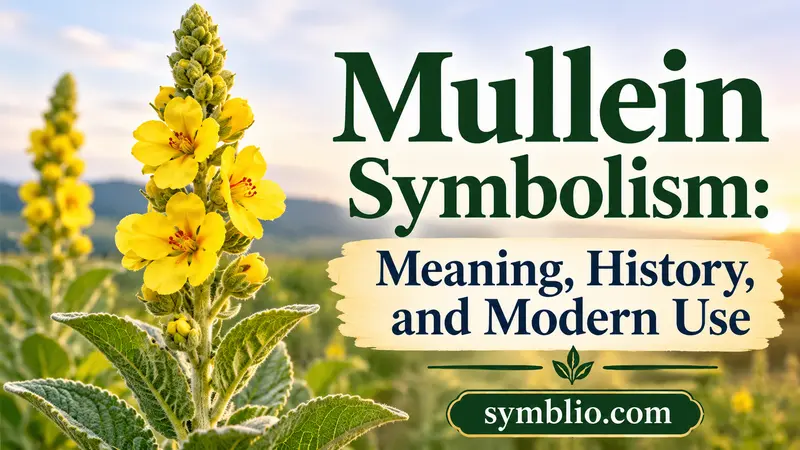
Common mullein (Verbascum thapsus) is recognizable by its large, gray-green leaves and upright stalk covered with small yellow flowers. It often grows in sunny fields, along roadsides, and in disturbed soil. Its unusual appearance has inspired names such as blanket leaf, velvet plant, candlewick, and Aaron’s rod.
People interested in plant symbolism may associate mullein with finding comfort during difficult periods, protecting personal boundaries, or maintaining hope when circumstances are uncertain. These interpretations are connected to the plant’s physical qualities and historical uses rather than to one universally accepted symbolic tradition.
In the United States, mullein occupies an interesting place between wildflower appreciation, herbal history, gardening, and spiritual plant traditions. Understanding its symbolism requires looking at both its practical history and the cultural stories that developed around it.
Quick Answer
Mullein symbolism commonly represents protection, healing, resilience, and guidance in modern American plant and spiritual traditions. Historically, its use as a torch, candle wick, and traditional medicinal plant also connected it with light, comfort, purification, and the hope of recovery.
TL;DR
- Mullein commonly symbolizes protection, healing, and personal resilience.
- Its torch-like stalk connects it with light and guidance.
- Traditional herbal practices contributed to its association with comfort and recovery.
- European folklore linked dried mullein with household protection.
- American interpretations combine botanical history, spirituality, and wildflower appreciation.
- Its ability to grow in disturbed soil suggests adaptability and perseverance.
What Does Mullein Look Like?
Mullein is a flowering plant belonging to the Verbascum genus. Common mullein is generally a biennial, meaning it completes its life cycle over two growing seasons.
During its first year, it develops a low-growing arrangement of broad, soft leaves close to the ground. These leaves have a grayish-green appearance and a thick covering of fine hairs that gives them a velvety texture.
In its second year, the plant produces a tall, upright flowering stalk. Small yellow flowers appear along the upper portion, creating a shape that resembles a natural candle or torch.
This appearance explains several traditional names, including candlewick plant, torchwort, and Aaron’s rod.
The contrast between its soft leaves and tall, sturdy stalk also contributes to its modern symbolic interpretation. The leaves suggest comfort and gentleness, while the flowering stalk suggests strength, visibility, and determination.
Mullein is particularly noticeable in open landscapes, where its height makes it stand out among shorter plants.
The Core Symbolism of Mullein
Mullein does not have one official symbolic meaning. Its associations developed through practical uses, folklore, religious artwork, and observations of its growth.
Several themes appear repeatedly in interpretations of the plant.
Protection comes from its historical reputation as a plant associated with safeguarding homes and creating light in darkness.
Healing reflects its long-standing role in traditional herbal practices, particularly those involving respiratory complaints and skin discomfort.
Resilience relates to its ability to establish itself in challenging environments and return with a tall flowering stalk after its first growing season.
Guidance comes from its resemblance to a candle or torch, objects historically used to illuminate dark surroundings.
Comfort is associated with its soft leaves and traditional reputation as a helpful household plant.
Together, these meanings make mullein an appealing symbol for people who value perseverance, reassurance, and the ability to find direction during uncertain periods.
Ancient Roots and the History of Mullein
Mullein has a long history in European and Mediterranean plant traditions. Its recognizable shape, useful leaves, and tall flowering stalk made it familiar to communities long before modern ornamental gardening became popular.
Ancient Greek and Roman traditions associated the plant with practical household and agricultural uses. Historical accounts describe the use of its yellow flowers for coloring and its dried stalks for illumination.
The Roman practice of dipping dried stalks in animal fat produced a simple torch. This practical function helped establish the connection between mullein and light.
Its historical botanical associations also extended into religious and artistic imagery. European and Mediterranean artwork has included mullein representations in ancient funerary settings and Renaissance religious paintings.
These representations have been connected with Athena and Minerva in ancient contexts, as well as Christ and John the Baptist in certain Christian artworks. Such interpretations associated the plant with wisdom, illumination, spiritual elevation, and renewal.
It is important to distinguish these documented artistic associations from modern personal interpretations. Not every historical community understood mullein in the same way, and its symbolic meanings changed according to the setting.
Mullein as a Symbol of Light and Guidance
One of the most recognizable symbolic associations of mullein is light.
The plant’s tall flowering stalk naturally resembles a candle, especially when its yellow flowers cover the upper portion. This resemblance became more meaningful because dried mullein stalks were historically used as torches.
Light has long served as a recognizable metaphor for knowledge, understanding, direction, and hope. A torch helps someone see a path that would otherwise remain difficult to navigate.
Mullein inherited some of these associations through its practical relationship with illumination.
In modern American interpretations, the plant can represent:
- Finding direction during a confusing period.
- Recognizing opportunities after uncertainty.
- Seeking knowledge and understanding.
- Maintaining hope during personal challenges.
- Becoming a source of encouragement for others.
Someone who connects with mullein’s symbolism might choose it as a reminder to remain thoughtful and steady when making important decisions.
The meaning does not depend on supernatural beliefs. It can simply reflect the familiar human association between light and the ability to see clearly.
Mullein Symbolism in Protection and Spiritual Traditions
Protection is another important association connected to mullein. European folklore sometimes described the plant as a protective presence around homes and doorways.
Its dried stalks were associated with household illumination, while certain traditional beliefs treated the plant as a way to discourage unwanted spiritual influences.
The common names hag’s taper and witch’s candle reflect its connections with older European beliefs about herbalists, folk practitioners, and supernatural protection.
These names do not establish that every historical community considered mullein magical. Rather, they demonstrate how practical plants could become part of local folklore.
In contemporary American spiritual practices, mullein may be interpreted as a symbol of:
- Personal safety and emotional security.
- Maintaining healthy boundaries.
- Creating a peaceful home environment.
- Feeling grounded during uncertain experiences.
- Seeking reassurance and inner confidence.
Some modern practitioners incorporate mullein imagery into nature-inspired spiritual artwork or personal botanical collections. These practices reflect individual beliefs rather than a universal religious teaching.
Healing, Comfort, and Traditional Herbal Associations
Mullein’s association with healing comes primarily from its history as a traditional herbal plant.
European herbal traditions used different parts of mullein for various complaints, particularly respiratory discomfort. Its leaves and flowers appeared in historical preparations intended to soothe coughs and throat irritation.
Traditional communities also used the plant externally in preparations for certain skin complaints.
These practices contributed to its reputation as a plant associated with comfort and recovery.
In American history, mullein became familiar through household herbal traditions. Early settlers cultivated it for medicinal purposes, and it eventually spread into surrounding landscapes.
Historical records also document its use among several Indigenous communities after European contact. Different nations developed or adopted distinct uses, so these traditions should not be treated as one shared Indigenous belief.
Today, the plant’s historical medicinal reputation contributes to its symbolic association with caring for oneself and recovering from difficult experiences.
However, symbolic healing should not be confused with proven medical treatment. Traditional uses do not establish that mullein can cure illnesses, and wild plants should not automatically be considered safe for consumption or medicinal preparation.
What Mullein Represents in American Culture
In the United States, mullein has a more complicated cultural identity than many familiar garden flowers.
It is not traditionally associated with major national celebrations, wedding customs, or widely recognized American holidays. Instead, its cultural importance comes from herbal history, rural landscapes, botanical interest, and contemporary nature-based spirituality.
Early European settlers brought common mullein to North America. Historical records indicate that it was established in parts of the eastern United States by the seventeenth century.
Over time, it became familiar in fields, roadsides, pastures, and other disturbed environments.
Several associations are particularly relevant to American interpretations.
Self-reliance: Its history as a practical household plant connects it with resourcefulness and making use of available natural materials.
Rural heritage: Its presence in older agricultural landscapes can evoke memories of traditional countryside life.
Adaptability: Its ability to grow in disturbed areas makes it an appealing metaphor for adjusting to changing circumstances.
Natural simplicity: Its unpretentious appearance appeals to people who appreciate ordinary plants rather than highly cultivated flowers.
In contemporary American culture, mullein is more likely to appear in discussions of wild plants, herbal history, and botanical spirituality than in formal floral symbolism.
Mullein and Its Connection to Resilience
Resilience is one of the most accessible modern interpretations of mullein.
The plant’s growth pattern provides a natural explanation for this association. During its first growing season, common mullein develops a broad rosette of leaves close to the ground. It then produces a tall flowering stalk during its second year.
This gradual development offers a useful metaphor for personal growth.
Not every period of progress is immediately visible. Some stages involve preparation, adjustment, and building a foundation before recognizable changes appear.
Mullein can therefore represent:
- Patience during personal development.
- Strength developed through experience.
- Adapting to unfamiliar circumstances.
- Continuing forward after setbacks.
- Recognizing the value of gradual progress.
Its ability to establish itself in disturbed soil adds another layer to this interpretation.
For someone experiencing a major life transition, mullein can serve as a reminder that an unfamiliar environment does not necessarily prevent growth.
This interpretation is especially relevant to modern nature-inspired writing, artwork, and personal reflection.
Religious and Cross-Cultural Interpretations
Mullein’s symbolic associations are not identical across religious and cultural traditions.
In ancient Mediterranean contexts, its representation has been connected with Athena and Minerva, goddesses associated with wisdom and strategic understanding.
Some ancient depictions also placed the plant in funerary settings. In these contexts, researchers have suggested connections with renewal and continued existence after death.
During the Renaissance, mullein appeared in Christian-themed artwork. Certain representations connected it with Christ and John the Baptist, particularly through visual associations involving light and spiritual elevation.
These historical examples show that mullein could communicate different ideas depending on the artwork and religious setting.
In North America, its cultural history also includes Indigenous plant knowledge. Some Native American communities adopted mullein after European contact and developed their own practical uses for it.
For example, historical ethnobotanical records document uses among Potawatomi, Catawba, Mohegan, and other communities. These records primarily concern practical plant knowledge, not one universal spiritual meaning.
It is important to respect the differences between these traditions rather than combining them into a single symbolic interpretation.
The Emotional and Psychological Meaning of Mullein
Plants often become meaningful because people connect their physical characteristics with personal experiences.
Mullein offers several qualities that can encourage emotional reflection.
Its soft leaves may suggest gentleness, reassurance, and comfort. Its upright flowering stalk can suggest confidence, determination, and visibility.
Its gradual development can also remind people that personal growth takes time.
These qualities create several possible emotional associations.
| Emotional Context | Symbolic Meaning | Common Association |
|---|---|---|
| Difficult transitions | Resilience | Continuing through change |
| Personal uncertainty | Guidance | Finding direction |
| Emotional recovery | Comfort | Allowing time to heal |
| Personal boundaries | Protection | Maintaining security |
| New beginnings | Growth | Developing gradually |
Mullein may appeal to people who prefer understated symbols rather than dramatic imagery.
Its symbolism does not promise that difficult circumstances will disappear. Instead, it offers a natural image of patience, steadiness, and the possibility of moving forward.
Mullein Symbolism in Dreams and Personal Reflection
Some contemporary spiritual interpretations associate seeing plants in dreams with personal development, emotional experiences, or changes in one’s environment.
Within this approach, mullein may be interpreted through its familiar characteristics.
Seeing a tall flowering mullein plant might represent confidence, direction, or a desire to become more independent.
A young plant with broad leaves could suggest preparation, patience, or a period of gradual development.
A dried flowering stalk might encourage reflection on completed experiences, changing circumstances, or the natural passage of time.
However, there is no scientifically established dream interpretation specifically associated with mullein.
Dream meanings are subjective. A person’s memories, surroundings, and feelings generally provide more useful context than assigning one fixed meaning to a particular plant.
For someone who frequently encounters mullein in nature, the plant may simply reflect a familiar part of their environment.
Mullein in Tattoos, Jewelry, and Personal Style
Mullein is not among the most recognizable mainstream tattoo flowers, but its distinctive appearance makes it suitable for botanical artwork.
Its long flowering stalk creates an attractive vertical design, while the rounded leaves provide opportunities for more detailed illustrations.
People interested in mullein-inspired designs may connect the plant with:
- Protection and personal boundaries.
- Healing and emotional recovery.
- Resilience through difficult experiences.
- Guidance and personal direction.
- Appreciation for nature and herbal history.
A botanical tattoo featuring mullein can communicate these ideas without relying on elaborate imagery.
In jewelry and accessories, its yellow flowers and elongated shape can inspire nature-themed pendants, illustrations, and decorative patterns.
Unlike roses or lilies, mullein does not have a widely established commercial flower-language meaning in American culture. Its interpretation is generally personal and connected to the wearer’s interest in its botanical or historical background.
Mullein in Gardens, Home Decor, and Contemporary Design
Mullein’s unusual shape makes it visually interesting in botanical illustrations, naturalistic gardens, and countryside-inspired decor.
Its gray-green leaves create a soft contrast with its yellow flowers. This combination works particularly well in artwork that emphasizes natural textures and muted colors.
In garden design, some gardeners appreciate its architectural flowering stalk and its value to wildlife.
Its flowers provide pollen and nectar for visiting insects, while its seeds can serve as food for certain birds. The plant also supports specialist insect species.
However, common mullein can spread into disturbed environments and is considered invasive or undesirable in some regions. Gardeners should consider local ecological guidance before planting it.
In interior design, mullein imagery can suggest:
- Simplicity and natural living.
- Appreciation for wild landscapes.
- Historical botanical traditions.
- Quiet strength and adaptability.
- Connection with rural heritage.
Unlike traditional decorative flowers, mullein often appeals to people who appreciate the appearance of uncultivated nature.
The Symbolic Meaning of Mullein’s Yellow Flowers
The yellow flowers of mullein add another dimension to its interpretation.
Yellow is commonly associated with sunlight, warmth, optimism, awareness, and intellectual clarity in modern Western color symbolism.
These associations complement mullein’s historical relationship with torches and illumination.
Its small yellow flowers grow along a tall central stalk, creating a bright vertical display against the surrounding landscape.
In symbolic artwork, this combination can suggest:
- Hope during uncertain circumstances.
- Optimism after a difficult period.
- Awareness and clearer thinking.
- Warmth, encouragement, and reassurance.
- The ability to recognize opportunities.
The flowers also attract pollinators, giving them a practical connection with ecological activity and renewal.
Although yellow does not have one universal cultural meaning, its familiar association with sunlight makes it a natural companion to mullein’s symbolism of guidance.
Common Misunderstandings About Mullein Symbolism
Several popular interpretations of mullein require historical context.
One common misunderstanding is that mullein has always been a sacred Native American plant. Although some Indigenous communities developed traditional uses for it, common mullein is not native to North America. It arrived from Europe and surrounding regions after European contact.
Another misconception is that every traditional association with protection comes from one ancient religious belief. In reality, its protective reputation developed through different forms of European folklore and practical household use.
It is also inaccurate to assume that mullein has an officially recognized flower-language meaning. Unlike certain flowers with established Victorian associations, mullein’s symbolic interpretations vary between historical research, modern spiritual practices, and personal preference.
Finally, its traditional reputation as a medicinal plant should not be confused with proof that it can treat every condition associated with its historical use.
Understanding these distinctions makes mullein symbolism more meaningful because it separates documented cultural history from modern interpretation.
How Mullein’s Meaning Has Changed Over Time
Mullein’s symbolic identity developed through several overlapping stages.
In ancient Mediterranean societies, its practical uses and appearance contributed to associations with illumination and religious imagery.
During medieval European traditions, its dried stalks and historical relationship with household lighting became connected with folklore involving protection, witches, and herbal practitioners.
The Renaissance introduced another dimension through religious paintings, where mullein sometimes appeared in Christian imagery associated with spiritual light and renewal.
When European settlers introduced the plant to North America, it became part of American rural landscapes and traditional botanical practices. Its use among different communities expanded its cultural history.
In the modern United States, its meaning is less connected to one established religious or cultural tradition. Instead, people often interpret it through nature appreciation, herbal history, personal spirituality, and environmental awareness.
Its central associations with light, protection, healing, and resilience have remained recognizable, even as the contexts surrounding them have changed.
FAQs
Mullein is commonly associated with protection, guidance, healing, and resilience in contemporary spiritual interpretations. Its historical use as a torch also connects it with illumination and the search for direction.
Yes, protection is one of its recurring folkloric associations. Some European traditions connected dried mullein stalks with safeguarding homes and discouraging unwanted spiritual influences.
A mullein tattoo can represent personal resilience, emotional recovery, protection, or guidance. Its meaning is usually individual rather than based on an established mainstream tattoo tradition.
Mullein does not have a clearly established biblical meaning or a specific biblical teaching devoted to the plant. Its occasional association with Christian artwork comes from historical artistic interpretations rather than a direct biblical command or passage.
Aaron’s rod is one of several traditional names associated with mullein. The name reflects the plant’s tall, upright flowering stalk, which resembles a staff or rod.
Mullein can represent new beginnings because of its gradual two-season growth pattern. Its development from a low rosette into a tall flowering plant offers a natural metaphor for preparation, patience, and eventual progress.
Mullein is generally interpreted positively through associations with light, protection, comfort, and resilience. However, its ecological status as an introduced plant that can become invasive gives it a different meaning in environmental discussions.
Conclusion
Mullein symbolism brings together several meaningful ideas, including protection, healing, light, guidance, and resilience. Its unusual appearance, historical use as a source of illumination, and place in traditional herbal practices explain why people continue to associate it with comfort and personal strength.
In modern American culture, mullein is appreciated through botanical interest, nature-inspired spirituality, and its connections with rural history. Its gradual growth also provides a fitting reminder that meaningful development often happens through patience rather than immediate change.
Ultimately, mullein represents the possibility of finding strength, direction, and renewal while remaining grounded in the natural world.