
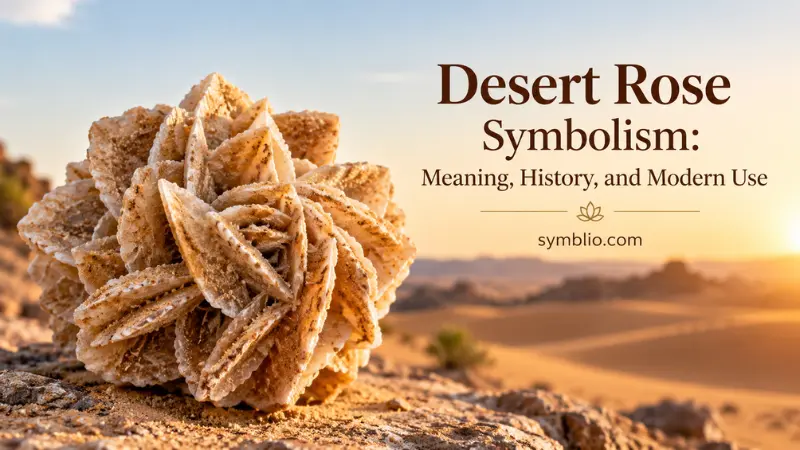
Desert rose symbolism comes from a natural formation that looks surprisingly like a flower. Despite its name, a desert rose is not a plant or an actual rose. It is a mineral formation made when crystals develop in sandy environments, creating layered shapes that resemble petals.
People are drawn to desert roses because their appearance suggests a connection between harsh landscapes and delicate beauty. The contrast makes them useful as symbols of endurance, transformation, natural beauty, and growth under difficult conditions.
In the United States, desert roses appear in mineral collections, home decor, jewelry, craft displays, and spiritual or nature-focused settings. Their symbolism is usually personal rather than tied to one official religious tradition, so meaning can vary according to context.
Quick Answer
Desert rose commonly symbolizes resilience, transformation, and beauty developing under difficult conditions in modern American culture. Its mineral formation also supports associations with nature, endurance, change, and the ability to find beauty in an otherwise harsh environment.
TL;DR
- Desert roses symbolize resilience and beauty shaped by difficult conditions.
- Their flower-like form comes from natural crystal growth in sand.
- American interpretations often emphasize endurance, transformation, and personal growth.
- They are popular in mineral collections, decor, jewelry, and spiritual spaces.
- Their symbolism is personal rather than universally religious or traditional.
- Their unusual appearance has inspired modern ideas about nature and adaptation.
What Is a Desert Rose?
A desert rose is a mineral formation that typically consists of gypsum or barite crystals growing together with embedded sand grains. As the crystals develop, they can form flattened, curved, or layered structures that resemble the petals of a rose.
The formation occurs in arid environments where groundwater, minerals, and evaporation interact under suitable geological conditions. Individual specimens can range from small pieces that fit in a person’s hand to much larger formations.
The name itself explains much of the symbol’s appeal. A “rose” suggests flowers, delicacy, beauty, and life, while the “desert” suggests dryness, exposure, and demanding conditions. Putting those two ideas together creates a natural metaphor for beauty surviving where conditions are not easy.
What It Commonly Means in the United States
American interpretations of the desert rose generally center on resilience and transformation. The formation is often viewed as an example of something visually delicate emerging from an environment associated with dryness and survival.
For some people, it represents the ability to adapt without losing one’s identity. For others, it suggests patience because the formation develops through geological processes rather than appearing instantly.
The symbol can also represent understated beauty. Unlike a cultivated flower, the desert rose does not depend on a garden or carefully controlled conditions to acquire its distinctive shape. That makes it a useful metaphor for people who value natural development over perfection.
Why the Desert Rose Represents Resilience
Resilience is one of the easiest meanings to connect with the formation. Deserts are commonly associated with limited water, intense sunlight, temperature changes, and sparse vegetation. A mineral formation developing in such an environment naturally invites comparisons with persistence.
This does not mean the mineral itself is “surviving” in a biological sense. The symbolism is metaphorical. People transfer the qualities they associate with the desert onto the object.
In personal symbolism, a desert rose may therefore stand for getting through a difficult period, adapting to changing circumstances, or continuing to develop despite limitations.
The Geological Origins Behind Its Symbolism
The symbolic meaning becomes more interesting when the geological process is considered. Desert roses form when mineral crystals grow under particular environmental conditions and incorporate surrounding sediment.
Their shapes are not deliberately designed to resemble flowers. The flower-like appearance is an accidental result of crystal growth and geological conditions.
That distinction matters. The symbolism comes from human interpretation of a natural form rather than from an ancient message encoded into the stone. People see a rose-shaped formation and connect it with familiar ideas such as growth, beauty, endurance, and transformation.
This is similar to how humans interpret shells, feathers, trees, mountains, and other natural objects symbolically.
Ancient and Cross-Cultural Connections
Desert roses occur in several parts of the world, including desert regions of Africa, Asia, Australia, and the Americas. Different communities have developed their own relationships with minerals, deserts, and naturally unusual formations.
However, there is no single ancient tradition that assigns one universal symbolic meaning to every desert rose. Modern claims sometimes present particular meanings as if they were shared across all historical cultures, but that is too broad.
Minerals have long been used as ornaments, trade goods, decorative objects, and materials for personal items. Yet the specific modern idea of the desert rose as a symbol of resilience and personal transformation should not automatically be presented as an ancient universal belief.
Desert Rose Symbolism in American Culture
In the United States, desert roses are particularly suited to nature-oriented and Southwestern visual culture. Their sandy appearance and connection with arid landscapes can complement interiors influenced by desert scenery, natural materials, and regional geology.
They may appear on shelves beside other mineral specimens, in educational collections, or as decorative objects. Collectors may appreciate them primarily for their geological structure rather than for symbolism.
At the same time, someone who keeps a desert rose at home may attach a personal meaning to it. One person might associate it with overcoming a difficult period, while another might simply see it as a reminder of the beauty found in nature.
That flexibility is an important part of its modern American meaning.
Emotional and Psychological Associations
The desert rose can represent several emotional ideas without requiring a supernatural interpretation.
Endurance may appeal to someone who has faced challenging circumstances.
Transformation fits the formation’s unusual development from minerals and sand into a recognizable flower-like structure.
Patience follows from the slow geological processes involved in mineral formation.
Self-acceptance can also emerge from the contrast between the desert environment and the rose-like appearance. The object does not resemble a conventional garden rose, yet its unusual form is precisely what makes it attractive.
These meanings are symbolic associations rather than psychological diagnoses or scientifically established effects.
Desert Rose and Personal Growth
Personal-growth symbolism is especially common in modern discussions of natural objects. The desert rose fits this theme because its form creates an easy visual metaphor: difficult surroundings do not necessarily prevent something distinctive from developing.
For someone marking a transition, the stone may represent moving from one stage of life to another. It can serve as a physical reminder that development does not always happen in comfortable circumstances.
This interpretation works best when treated as a personal metaphor. The desert rose does not guarantee growth or change. Its value lies in the meaning an individual chooses to associate with it.
Why People Use Desert Roses in Home Decor
Desert roses work well as decorative objects because they combine an organic appearance with geological origins. Their layered structures can resemble petals, leaves, or abstract sculptures depending on the specimen.
In American homes, they can fit naturally into spaces featuring rocks, dried plants, wood, pottery, desert landscapes, or Southwestern-inspired design.
The decorative meaning can also be subtle. Someone does not have to treat a desert rose as a spiritual object to appreciate its symbolism. It can simply represent an interest in natural history, desert environments, or unusual forms created by geological processes.
| Context | Meaning in the USA | Common Associations | Notes |
|---|---|---|---|
| Home decor | Natural beauty | Desert landscapes, earth, simplicity | Often valued for appearance |
| Personal keepsake | Resilience | Endurance, change, recovery | Meaning varies by owner |
| Mineral collection | Natural formation | Geology, curiosity, discovery | Scientific interest may be primary |
| Jewelry | Individual identity | Nature, uniqueness, transformation | Less common than conventional gemstones |
| Spiritual decor | Personal growth | Grounding, reflection, transition | Usually based on modern personal practice |
Desert Roses in Jewelry and Personal Style
Desert rose formations can inspire jewelry and artistic designs, although they are less conventional than gemstones such as quartz, amethyst, or turquoise.
When used in personal style, their unusual appearance can communicate individuality. A person may choose the symbol because it feels less conventional than a standard floral design.
A desert rose motif can also suggest a connection with landscapes and natural materials. In this setting, the flower shape does not necessarily represent romance. Instead, it can point toward resilience, independence, natural beauty, or a personal connection with the desert.
Desert Rose Tattoos and Their Meaning
A desert rose tattoo can combine several symbolic ideas into one image. The most common interpretations are likely to involve resilience, transformation, individuality, and beauty formed under challenging circumstances.
The surrounding design can change the emphasis. A desert landscape may strengthen the connection with endurance and nature. A conventional rose alongside a desert rose can create a contrast between cultivated beauty and naturally formed beauty.
Because tattoo symbolism is highly personal, there is no fixed meaning that applies to every desert rose tattoo. The owner’s experience and the other elements in the design often provide more information than the flower-like shape alone.
Religious and Spiritual Interpretations
The desert has an important role in several religious traditions, but that does not mean the mineral formation itself has a universal religious meaning.
Some modern spiritual communities associate desert roses with grounding, reflection, protection, or personal transformation. These interpretations are contemporary and vary considerably between practitioners.
It is useful to distinguish these beliefs from documented geological facts. The desert rose’s physical formation can be explained through mineral growth and environmental conditions, while spiritual meanings are matters of personal or cultural interpretation.
That distinction allows the object to be appreciated both scientifically and symbolically.
Positive and Negative Meanings
The desert rose is generally associated with positive ideas, but symbolism can change depending on the viewer.
Positive interpretations include:
- resilience
- patience
- transformation
- individuality
- natural beauty
- adaptability
- personal growth
A less positive interpretation might focus on isolation, dryness, hardship, or emotional distance because of the desert setting.
Neither interpretation is inherently correct. Symbolism often depends on which aspect of an object a person emphasizes. Someone inspired by the desert’s survival qualities may see strength, while someone focused on its barrenness may see loneliness.
Common Misunderstandings About the Desert Rose
One common misunderstanding is that a desert rose is literally a dried desert flower. It is a mineral formation, not a botanical rose.
Another mistake is assuming that every desert rose has the same mineral composition. Many are formed from gypsum, while others are associated with barite. Their exact characteristics depend on their geological setting.
It is also misleading to claim that desert roses have one universally recognized spiritual meaning. Modern crystal and spiritual communities may assign particular qualities to them, but those interpretations should be distinguished from established geology and documented historical traditions.
Finally, the name itself should not be treated as proof of ancient rose symbolism. The resemblance between the mineral formation and a flower is what makes the modern metaphor appealing.
How the Meaning Has Evolved
The desert rose’s modern symbolism reflects a broader shift in how people engage with natural objects. In earlier contexts, an unusual mineral might have been valued primarily for its rarity, appearance, usefulness, or geological interest.
Today, people frequently give natural objects personal meanings. A stone can become a reminder of a place visited, a period of change, a family connection, or a personal goal.
The desert rose fits this trend particularly well because its appearance already suggests a story: a flower-like form associated with a dry landscape. Modern symbolism builds on that visual contrast rather than depending on one ancient definition.
What the Desert Rose Can Represent Today
In contemporary American culture, the desert rose can represent several connected ideas without needing a single fixed definition.
The desert rose can symbolize resilience when the emphasis is on developing under difficult conditions. Its unusual formation also makes it a fitting symbol of transformation, especially when the focus is on how crystals create its flower-like shape.
For some people, the stone suggests individuality, since each natural specimen has its own irregular form. Others see natural beauty in its connection with desert landscapes, geology, and organic-looking shapes.
For many people, its strongest appeal is the combination of these ideas. The desert rose looks floral without being a flower, and that difference gives it a distinct identity.
FAQs
In modern spiritual practices, desert roses are sometimes associated with grounding, reflection, resilience, and transformation. These are contemporary interpretations rather than universally established religious meanings.
No. A desert rose is a mineral formation created by crystal growth in sandy environments. Its layered structure resembles rose petals, which explains its name.
A desert rose tattoo can represent resilience, personal transformation, individuality, or beauty developed through difficult circumstances. The surrounding imagery and the tattoo owner’s personal story can change its meaning.
It is not a universal religious symbol. Some people incorporate it into personal spiritual practices, but those interpretations should be distinguished from formal religious traditions.
It is usually interpreted positively, with associations such as endurance, growth, patience, and natural beauty. The desert setting can also support less positive interpretations involving isolation or hardship.
Its flower-like appearance emerging from a desert environment creates a natural metaphor for developing under demanding conditions. The association is symbolic rather than a statement about the mineral itself being biologically resilient.
In the United States, it can represent natural beauty, resilience, transformation, individuality, and appreciation for desert landscapes. Its meaning is generally personal and flexible rather than governed by a single cultural tradition.
Conclusion
Desert rose symbolism is rooted in the striking contrast between its flower-like appearance and its geological origins in sandy, arid environments. That contrast makes it a natural metaphor for resilience, transformation, patience, individuality, and beauty that does not depend on ideal conditions.
In modern American culture, the desert rose can function as a mineral specimen, decorative object, personal keepsake, tattoo inspiration, or spiritual reminder. Its meaning is strongest when connected to the person’s own experience rather than treated as a universal rule.
Ultimately, the desert rose offers a simple image with several possible interpretations: something unusual can take shape in an environment that seems unlikely to produce it.