
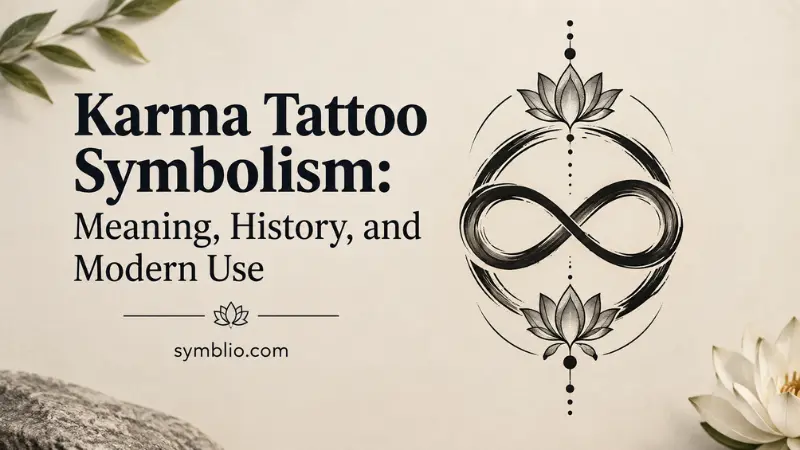
A karma tattoo can represent personal responsibility, balance, consequences, and the belief that actions shape future experiences. For many people, karma tattoo symbolism offers a way to mark a personal philosophy rather than simply decorate the body.
The idea of karma comes from ancient South Asian religious and philosophical traditions, especially Hinduism, Buddhism, and Jainism. Although the concept has developed differently within each tradition, karma generally concerns intentional actions and their consequences rather than a simple system of instant reward and punishment.
In the United States, karma has also developed a broader everyday meaning. People may use the word to describe fairness, personal accountability, or the hope that harmful behavior eventually has consequences. A tattoo based on karma can therefore carry a traditional religious reference, a personal reminder, or a modern interpretation of cause and effect.
Quick Answer
Karma tattoo symbolism commonly represents personal responsibility, cause and effect, balance, and the belief that actions have consequences in modern American culture. Historically, karma is a more complex religious and philosophical concept associated with intentional action and its consequences in Hinduism, Buddhism, and Jainism.
TL;DR
- Karma tattoos often symbolize accountability and consequences.
- Karma originated in ancient South Asian religious traditions.
- American interpretations often emphasize fairness and personal responsibility.
- Sanskrit and dharma imagery can add traditional context.
- Modern tattoos may express growth, reflection, or life philosophy.
- Karma does not simply mean instant cosmic punishment or reward.
What a Karma Tattoo Looks Like
There is no single traditional design that universally represents karma. Instead, tattoo artists and wearers combine different images, words, scripts, and religious symbols to communicate an interpretation of the concept.
Common designs include the word karma, Sanskrit-inspired lettering, circular motifs, lotus flowers, balance imagery, mandalas, or symbols associated with Hindu or Buddhist traditions. Some designs are deliberately minimal, using only lettering or a small circular emblem.
A tattoo can also communicate karma indirectly. A person might choose imagery involving cycles, paths, seeds, scales, or interconnected forms to suggest cause and consequence without using the word itself.
Because karma has specific meanings within religious traditions, the surrounding imagery matters. A generic tattoo inspired by the modern Western idea of “what goes around comes around” is different from a design intended to represent a particular Hindu, Buddhist, or Jain understanding of karma.
What Karma Commonly Means in the United States
In contemporary American conversation, karma is often understood as a principle of consequences. Someone might say that a person “got their karma” after experiencing consequences for selfish or harmful behavior.
This everyday use tends to simplify the original concept. American popular culture frequently treats karma almost like an invisible form of justice: good behavior eventually produces good results, while harmful behavior eventually comes back to the person who caused it.
That interpretation explains why karma tattoos can appeal to people who value accountability. The tattoo may serve as a reminder to consider the effects of one’s choices before acting.
For others, karma represents something less judgmental. It can express the idea that choices have consequences, experiences are interconnected, and personal growth comes from learning rather than blaming others.
Ancient Roots of the Karma Concept
The history of karma reaches back thousands of years in South Asian thought. Early uses of the concept appear in ancient Indian religious literature, where karma was connected with action and its consequences.
Over time, different traditions developed their own explanations. Hindu philosophical traditions often connect karma with dharma, duty, ethical action, rebirth, and liberation. Buddhist teachings place particular emphasis on intentional action and its effects rather than treating karma as a supernatural reward system.
Jain philosophy also gives karma an important role, developing a distinctive understanding in which karma is connected to bondage and the soul’s movement toward liberation.
Because these traditions are not identical, it is misleading to describe karma as having one universal definition. The common thread is the relationship between action and consequence, but the details vary significantly.
Karma in Hindu Thought
In Hindu traditions, karma is closely related to ethical action, duty, rebirth, and spiritual liberation. The concept appears in several major philosophical and religious texts and has been interpreted in different ways across Hindu schools.
Karma may be discussed alongside dharma, a broad concept involving duty, ethical order, conduct, and the appropriate way of living. Actions can contribute to future circumstances, while liberation involves moving beyond the cycle of rebirth.
A karma tattoo inspired by Hindu philosophy can therefore carry a much broader meaning than “what goes around comes around.” It may represent living according to one’s responsibilities, acting ethically, or remembering that choices have consequences.
Anyone choosing explicitly Hindu religious imagery should understand the tradition behind the symbol rather than treating it as merely decorative.
Karma in Buddhism and Jainism
Buddhist interpretations of karma focus strongly on intention. In many Buddhist teachings, intentional actions influence future experiences and contribute to patterns of suffering and liberation. Karma is therefore connected to ethical conduct and the cultivation of the mind.
Jainism has a different philosophical framework. Karma is associated with the soul’s bondage and the consequences of actions, while spiritual practice aims toward liberation.
These distinctions are important for tattoo symbolism. A lotus, Buddha-related imagery, Jain symbols, or Sanskrit lettering may carry meanings that extend beyond the general American interpretation of karma.
A person choosing such imagery should avoid assuming that all South Asian religious traditions use karma in exactly the same way.
Why Karma Tattoos Represent Personal Accountability
One of the strongest modern interpretations of a karma tattoo is accountability.
The tattoo can remind its wearer that choices matter. Words, relationships, habits, and decisions can influence other people as well as the person making them.
This interpretation does not require belief in supernatural punishment. Someone may choose a karma tattoo simply as a personal rule: act carefully, treat people fairly, and accept responsibility for the results of your decisions.
For people who have experienced major changes in their lives, the tattoo can also mark a shift in behavior. It might represent leaving behind destructive habits, becoming more thoughtful, or choosing to respond differently to difficult situations.
Karma and the Idea of Balance
Balance is another common visual interpretation of karma tattoos, especially in contemporary tattoo culture.
Circular designs work particularly well because a circle can suggest cycles, continuity, and movement. Balance imagery can also communicate the idea that actions and consequences are connected rather than isolated events.
However, balance should not automatically be treated as the original definition of karma. The familiar Western image of cosmic scales is a modern association rather than a complete explanation of the traditional concept.
For tattoo wearers, that distinction can still be useful. A balance-inspired design may express a personal interpretation while remaining visually connected to the broader idea of consequences.
Emotional and Psychological Meaning
A karma tattoo can carry different emotional meanings depending on the person’s experience.
For one person, it may represent self-discipline. For another, it may symbolize forgiveness, patience, or learning from mistakes. Someone recovering from a difficult period might use the concept as a reminder to focus on their own actions rather than trying to control other people’s behavior.
Karma can also represent acceptance. Instead of expecting immediate justice, the tattoo may remind someone that not every outcome can be controlled and that their responsibility lies primarily in how they choose to act.
This makes karma especially adaptable as a personal symbol. The same word can represent accountability, hope, reflection, restraint, or personal growth.
Karma Tattoos and Personal Growth
Many contemporary tattoos function as permanent reminders of life lessons. Karma fits naturally into this role because the concept connects behavior with consequences.
Someone might choose the tattoo after overcoming a difficult period, changing their priorities, or recognizing how earlier decisions affected their life.
The design can represent a commitment to make better choices going forward. In this context, the tattoo is less about predicting what will happen and more about remembering how the wearer wants to behave.
That distinction makes the symbolism practical. Instead of promising that life will always be fair, it can serve as a reminder that one’s own actions remain within one’s control.
Karma Tattoo Meanings by Context
| Context | Meaning in the USA | Common Associations | Notes |
|---|---|---|---|
| Personal philosophy | Actions have consequences | Accountability, responsibility | Usually secular |
| Spiritual tattoo | Ethical action and spiritual development | Hinduism, Buddhism, Jainism | Meaning depends on tradition |
| Relationship tattoo | Treating others fairly | Respect, reciprocity | Often highly personal |
| Minimalist design | Reminder of cause and effect | Simplicity, reflection | May have little religious content |
| Circular or mandala design | Cycles and interconnectedness | Balance, continuity | Design meaning varies |
Karma in Modern American Tattoo Culture
Tattoos in the United States often combine personal identity with visual storytelling. A karma tattoo can fit that tradition because the concept is easy to connect with a person’s own experiences.
Some people choose small lettering, while others combine the word with flowers, geometric patterns, or spiritual imagery. Placement can also affect the personal meaning. A discreet design may function primarily as a private reminder, while a larger design can become a more visible statement of philosophy.
Social media has also encouraged combinations of cultural symbols that would have been less common in earlier tattoo culture. This creates creative possibilities, but it also increases the importance of understanding where religious symbols come from.
A tattoo can be aesthetically attractive while still carrying cultural meaning that deserves consideration.
Common Misunderstandings About Karma Tattoos
The most common misunderstanding is that karma simply means instant punishment for bad behavior.
Traditional karma is more complicated. It generally concerns actions and consequences within a broader religious or philosophical framework. It is not necessarily a promise that someone who behaves badly will immediately experience a matching misfortune.
Another misconception is that karma means everything happens for a reason. That is a separate philosophical claim and does not fully represent Hindu, Buddhist, or Jain teachings.
Finally, karma should not be used as a simplistic explanation for another person’s suffering. Saying that someone “deserved” hardship because of karma can turn a complex religious idea into victim-blaming.
Understanding these distinctions makes a karma-inspired tattoo more respectful and meaningful.
Cultural Respect and Religious Imagery
A tattoo based on a South Asian religious concept deserves some cultural awareness. The word “karma” has become common in American English, but its roots are much older and more specific than its casual modern use suggests.
The issue becomes especially important when a design incorporates sacred figures, religious scripts, or traditional symbols. Wearing such imagery does not automatically mean disrespect, but understanding what the imagery represents can prevent accidental misuse.
A simple tattoo based on the modern philosophical idea of consequences is different from reproducing a sacred religious image without knowing its context.
For anyone choosing a design with explicit Hindu, Buddhist, or Jain elements, learning the traditional meaning beforehand is a sensible part of the process.
How Karma Symbolism Has Evolved
The meaning of karma has changed as the concept moved between religious traditions, philosophical discussions, languages, and modern popular culture.
In its South Asian origins, karma developed within sophisticated religious systems concerned with ethical action, rebirth, liberation, and spiritual development. Modern American usage often strips away much of that surrounding philosophy and uses karma as shorthand for consequences or fairness.
Tattoo culture adds another layer. A person can take the modern English meaning and turn it into a private statement about responsibility, growth, or relationships.
This evolution does not make the modern interpretation invalid. It simply means that there are several layers of meaning, and they should not be confused with one another.
Where Karma Tattoos Fit in Modern Life
Today, karma-inspired designs can appear in many settings beyond traditional tattoo culture. The concept is common in jewelry, clothing, wall art, social media captions, wellness culture, and popular entertainment.
The word is particularly adaptable because it works in both spiritual and secular conversations. Someone may use it as part of a religious worldview, while another person may use it simply to describe consequences.
That flexibility explains much of its continuing popularity. A small tattoo can communicate a philosophy without requiring a long explanation, although the exact meaning ultimately belongs to the person wearing it.
FAQs
A karma tattoo commonly represents cause and effect, accountability, ethical behavior, or personal responsibility. Its exact meaning depends on whether the wearer intends a traditional religious interpretation or a modern personal one.
Karma is a major concept in Hinduism, Buddhism, and Jainism, although each tradition understands it differently. In modern American culture, the word is also frequently used in secular discussions about consequences.
It can be either, depending on the design and personal interpretation. Many people use it positively as a reminder to act responsibly, learn from mistakes, or treat others fairly.
That phrase captures part of the modern American interpretation, but it simplifies the traditional concept. Classical ideas of karma involve intentional action and consequences within larger religious and philosophical systems.
Circular patterns, lotus imagery, mandalas, paths, and balance-related designs are common choices. If religious symbols are included, their specific Hindu, Buddhist, or Jain meanings should be understood before combining them.
Yes. A wearer may use karma as a reminder that choices shape future experiences and that personal behavior can change. In this sense, the tattoo can mark a commitment to learn from the past and act differently in the future.
It can be, particularly when the wearer understands the concept and avoids treating sacred religious imagery as mere decoration. Designs using specific religious figures, scripts, or symbols deserve extra cultural and historical consideration.
Conclusion
Karma has a long history that extends far beyond the simplified idea of instant cosmic justice. Its traditional meanings involve action, intention, consequence, ethical conduct, and spiritual development, with important differences among Hindu, Buddhist, and Jain traditions.
In modern American tattoo culture, karma tattoo symbolism often becomes a personal statement about accountability, growth, fairness, or the consequences of one’s choices. The strongest designs are not necessarily the most elaborate; they are the ones whose imagery matches the meaning the wearer actually intends.
A karma tattoo can ultimately serve as a simple reminder: choices matter, and how we act remains one of the parts of life we can influence.


