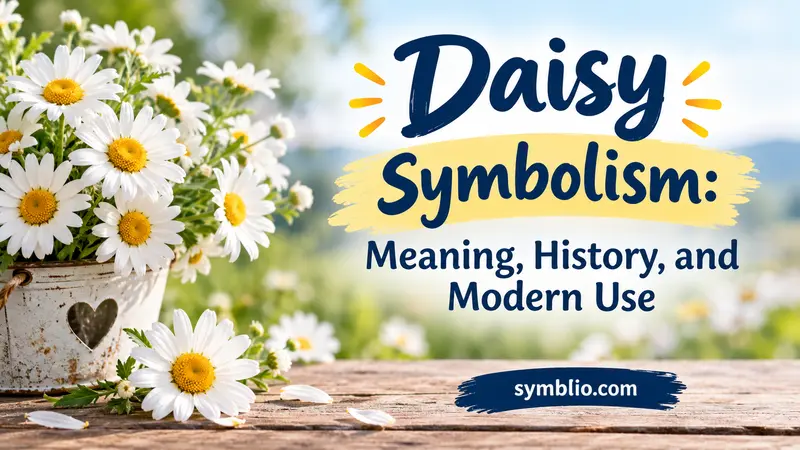
Daisies are among the most recognizable flowers in American gardens, wildflower fields, bouquets, and floral designs. Their bright centers and delicate white petals give them a simple, cheerful appearance, which helps explain why daisy symbolism is commonly associated with innocence, purity, happiness, and new beginnings. Although white daisies are especially familiar, varieties also appear in yellow, pink, red, and other colors.
The daisy’s appeal comes partly from its connection to ordinary life. It can grow along a roadside, brighten a backyard, or appear in a carefully arranged wedding bouquet. Unlike flowers that people often reserve for formal ceremonies, daisies feel approachable and unpretentious. They can communicate affection without extravagance and optimism without ignoring life’s difficulties.
In the United States, daisies frequently appear in spring decorations, children’s illustrations, casual gifts, jewelry, tattoos, and cottage-style interiors. Their meanings also extend beyond modern design. European folklore, flower-giving customs, and older associations with purity and renewal have helped shape how people interpret them today.
Understanding the daisy means looking at both its botanical characteristics and the cultural ideas people have attached to it. Its symbolism is not fixed, and the meaning of a particular daisy can change according to its color, setting, and the person giving or receiving it.
Quick Answer
Daisy symbolism most commonly represents innocence, purity, happiness, and new beginnings in modern American culture, especially in springtime gifts, weddings, gardens, and personal designs. Historically, daisies have also been associated with childhood, faithful affection, and renewal, with some European traditions connecting them to folklore and ideas of protection.
TL;DR
- Daisies commonly represent innocence, happiness, purity, and fresh starts.
- Their springtime blooms connect them with renewal and the return of warmer days.
- White petals often suggest sincerity, while yellow varieties convey cheerfulness.
- European folklore links daisies with love, childhood, and seasonal traditions.
- Modern Americans use daisies in bouquets, tattoos, jewelry, and home decor.
- A daisy’s meaning depends on its color, cultural context, and personal associations.
What Daisies Look Like and Why Their Shape Matters
A typical daisy has a central disk surrounded by narrow, petal-like structures that create the familiar flower shape. Many people think of white petals and a yellow center first, although the daisy family includes numerous species with different sizes, colors, and growing habits.
Botanically, what appears to be one flower is actually a flower head made up of many small individual flowers. The central disk contains tiny florets, while the outer ray florets resemble petals. This structure gives daisies their distinctive sunburst appearance.
The familiar shape helps explain some of the flower’s symbolic associations. A bright center surrounded by white petals can suggest clarity, openness, and simplicity. Its resemblance to a small sun also makes it a natural emblem of daylight and cheerfulness.
Daisies are not all the same species. The English daisy, oxeye daisy, Shasta daisy, and gerbera daisy differ in appearance and botanical classification. Their shared common name creates a broad visual category, but specific traditions may refer to one variety rather than every flower called a daisy.
The Main Meanings Behind Daisy Symbolism
Daisies are most often associated with innocence, purity, happiness, simplicity, and renewal. These interpretations developed through a combination of appearance, seasonal growth, literature, folklore, and flower-giving customs.
Innocence reflects the flower’s uncomplicated appearance and its frequent association with childhood. Daisy chains, children’s illustrations, and playful spring decorations reinforce this connection.
Purity is especially associated with white daisies. White flowers have often represented sincerity, cleanliness, or unspoiled intentions in Western floral traditions. However, this meaning is cultural rather than an inherent property of the flower.
Happiness comes partly from the daisy’s bright center, open shape, and association with sunny weather. A bunch of daisies often feels friendly and informal, making it suitable for everyday gifts.
Simplicity may be the daisy’s most distinctive quality. It does not require elaborate petals or an extravagant arrangement to be recognizable. For many people, that straightforward appearance suggests an appreciation of ordinary pleasures.
Renewal follows from its association with spring and returning daylight. Daisies appearing in lawns and meadows can mark a seasonal change, offering a visual reminder that dormant landscapes can become lively again.
These meanings overlap, but they are not identical. A daisy given to a child may communicate innocence, while the same flower in a spring arrangement may emphasize renewal. The setting helps determine which interpretation feels most appropriate.
How the Daisy Acquired Its Historical Meaning
The English word daisy developed from an Old English expression meaning “day’s eye.” The name refers to the flower’s tendency to open in daylight and close as darkness approaches or conditions become unfavorable.
This daily movement gave the plant a natural connection to the sun, morning, and the return of light. The association does not mean every daisy behaves in precisely the same way, but it helps explain why the flower’s name carries such a vivid image.
Daisies also appear in medieval European literature. English poet Geoffrey Chaucer wrote appreciatively about the flower, connecting it with springtime, beauty, and idealized love. Such literary references helped establish the daisy as more than an ordinary plant in the imagination of later readers.
In medieval European culture, the flower’s appearance in meadows and its seasonal return also connected it with the changing year. Its small size and abundance made it accessible to people who encountered flowers in everyday landscapes rather than only in cultivated gardens.
It is difficult to identify one original symbolic meaning for all daisies. Different communities developed different interpretations, and modern meanings often combine several historical strands. The safest conclusion is that the daisy’s symbolism grew gradually from its appearance, behavior, seasonal associations, and place in literature and custom.
Daisy Symbolism in Medieval Europe and Folklore
European folklore connected daisies with childhood, affection, and small rituals intended to answer questions about love. One familiar custom involved removing the flower’s outer florets one at a time while repeating a phrase about whether someone loved the person performing the ritual.
In English-speaking traditions, this practice became widely associated with the rhyme “he loves me, he loves me not.” The final floret supposedly supplied an answer. The ritual was a form of playful divination, not a reliable way to discover another person’s feelings.
Daisy chains were another longstanding custom. Children threaded flower stems together to make necklaces, bracelets, or crowns. The activity helped link daisies with playfulness, friendship, and childhood memories.
Some regional traditions also assigned protective qualities to daisy chains or used flowers in customs concerning future partners. These beliefs varied, and they should not be treated as a single universal European tradition.
Folklore matters because it shows how an ordinary flower can acquire meaning through repeated human activities. The daisy became associated with affection not simply because of its appearance, but because people used it in games, stories, and rituals involving relationships.
What Daisies Mean in Modern American Culture
In the United States, daisies generally communicate warmth, friendliness, optimism, and uncomplicated affection. They are common in garden plantings, casual bouquets, spring displays, and decorative patterns.
Unlike red roses, which many Americans associate with romantic love, daisies can express appreciation without necessarily suggesting a romantic relationship. They may suit a friend, family member, teacher, or someone who simply enjoys flowers.
Their informal appearance also makes daisies useful in designs that aim to feel welcoming rather than formal. A daisy print on a notebook or shirt can suggest a playful personality, while a vase of fresh daisies can brighten a kitchen or living room without making the space feel ceremonial.
Daisies also fit comfortably into American spring and summer imagery. They appear on greeting cards, garden signs, children’s clothing, and illustrations celebrating outdoor life. Their association with open fields and sunshine makes them an easy visual shorthand for a relaxed, cheerful mood.
There is no official American code that assigns a single meaning to every daisy. Personal experience often matters more than a formal symbolic rule. Someone may associate daisies with a grandparent’s garden, a childhood home, or a memorable bouquet, giving the flower a meaning that extends beyond common cultural associations.
Daisy Meanings by Color
Color can influence how people interpret daisies, particularly in floral gifts, artwork, and tattoos. These meanings are flexible conventions rather than universal rules.
White daisies — innocence and sincerity
White daisies most clearly express the traditional associations with purity, simplicity, and honest intentions. They can suit a gentle, understated gift or a design focused on childhood and fresh beginnings.
Yellow daisies — cheerfulness and friendship
Yellow flowers often suggest warmth, optimism, and friendliness. Yellow daisies work particularly well in informal arrangements intended to brighten someone’s day.
Pink daisies — affection and tenderness
Pink daisies can convey gentle affection, appreciation, or sweetness. They are often suitable for thoughtful gifts when a softer expression of care feels appropriate.
Red daisies — energy and bold affection
Red varieties can communicate enthusiasm, confidence, or stronger affection. These interpretations draw partly on broader Western associations with the color red, rather than on a universal daisy tradition.
Purple daisies — individuality and creativity
Purple varieties may suggest imagination, originality, or a distinctive personal style. These meanings are especially relevant in contemporary floral design and decorative art.
When choosing daisies as a gift, consider the recipient’s preferences as well as the flower’s conventional associations. A favorite color or a meaningful memory can communicate more than a symbolic dictionary ever could.
Daisy Symbolism in Christianity and Religious Contexts
Daisies are not among the central symbols of Christianity in the way the cross, fish, or lamb are. Nevertheless, Christian interpretations of flowers sometimes connect the daisy’s white petals with purity and its yellow center with light.
Some historical writers and later religious garden traditions have interpreted flowers as reminders of spiritual virtues. In this broader framework, a daisy may suggest innocence, humility, or the beauty of creation. Such readings are interpretive rather than universal Christian teachings.
The flower’s association with daylight can also invite comparisons with hope, goodness, and spiritual illumination. These connections arise from the broader use of light as a religious metaphor, not from a single established doctrine about daisies.
In modern American religious settings, daisies may appear in seasonal floral arrangements, church decorations, or personal artwork. Their meaning usually depends on the occasion and the individual or community using them.
It is important not to assume that every daisy carries a religious message. A flower used in a church arrangement might simply be chosen for its color, availability, or seasonal appearance.
What Daisies Represent in Love and Relationships
Daisies have a distinctive place in romantic symbolism because they can express affection without the intensity commonly associated with roses. Their traditional links with innocence and sincerity make them suitable for conveying uncomplicated feelings.
A bouquet of daisies might communicate, “I appreciate you,” “You make me happy,” or “I enjoy being around you.” These are possible interpretations, not fixed translations. The meaning becomes clearer when the giver explains the occasion or the reason for choosing the flowers.
The flower’s association with love also appears in the tradition of plucking petals to ask whether someone returns a person’s affection. The custom reflects curiosity and hope, especially in childhood and adolescence, but it does not reveal another person’s actual feelings.
Daisies can also represent loyalty and enduring affection when their meaning comes from a shared memory. A couple might choose them because they appeared at a meaningful place or featured in an important moment. In such cases, the personal story gives the flower its strongest significance.
For weddings, daisies may suit couples who prefer a relaxed, garden-inspired style. Their appearance can suggest a celebration centered on warmth, natural beauty, and personal connection rather than elaborate formality.
The Emotional and Psychological Meaning of Daisies
Daisies often evoke pleasant feelings because their appearance combines visual simplicity with bright contrast. The central disk draws the eye, while the surrounding petals create a balanced shape that is easy to recognize.
Their associations with spring and outdoor spaces may also bring up memories of childhood, gardens, vacations, or time spent with family. These responses are personal, not guaranteed psychological effects. Someone who grew up surrounded by daisies may experience the flower differently from someone who rarely encounters it.
The idea of simplicity is particularly relevant. In a culture filled with elaborate products and carefully staged images, an ordinary wildflower can represent a preference for natural beauty and modest pleasures. A daisy motif may suggest that a person values approachability over extravagance.
Daisies can also represent resilience in an everyday, nontechnical sense. Their familiar presence in lawns and meadows makes them easy to associate with persistence and the ability to flourish in ordinary surroundings. This is a symbolic interpretation, not a claim that every daisy species can thrive under all conditions.
Ultimately, the flower’s emotional meaning depends on both shared cultural associations and individual experience. Its appearance may suggest happiness to one person and remind another of a meaningful relationship.
Why Daisies Appear in Tattoos, Jewelry, and Fashion
Daisy designs are popular in personal style because the flower remains recognizable even when simplified. A few curved lines can communicate the basic shape, making it suitable for small accessories, delicate illustrations, and minimalist artwork.
In tattoos, daisies may represent a new chapter, a connection to childhood, optimism, or a desire to approach life with openness. Some people choose them to remember a loved one or celebrate a meaningful experience. Others simply appreciate the flower’s appearance.
The design can change the interpretation. A single daisy may suggest simplicity and individuality, while a cluster of flowers can evoke friendship, family, or a shared history. A daisy combined with a date or name may serve as a personal memorial.
In jewelry, daisy motifs often have a youthful, cheerful, or nature-inspired quality. Earrings, pendants, rings, and bracelets may use the flower to express an appreciation for gardens or understated floral designs.
Fashion uses the daisy in prints, embroidery, hair accessories, and seasonal collections. Its familiarity allows designers to evoke spring and informality without relying on elaborate imagery.
None of these choices has a universally agreed meaning. The most useful interpretation is the one that fits the wearer’s reason for choosing the design.
Daisies in Weddings, Gifts, and Home Decor
Daisies work well in settings where people want flowers to feel welcoming and natural. Their relatively simple shape complements wildflower bouquets, garden weddings, informal celebrations, and seasonal table arrangements.
At weddings, daisies can help create an atmosphere of freshness and sincerity. They may also reflect a couple’s preference for familiar flowers over more formal arrangements. Their symbolic associations with innocence and new beginnings can add another layer of meaning, although not every couple selects flowers for symbolism.
As gifts, daisies are versatile because they can communicate appreciation without creating the expectations that sometimes accompany a more explicitly romantic bouquet. They may be suitable for birthdays, congratulations, thank-you gestures, or a simple expression of care.
In home decor, daisy motifs often appear in kitchen textiles, wall art, ceramic pieces, bedding, and garden accessories. They can make a room feel lighter and more playful, especially when paired with green, yellow, or other soft colors.
Daisies also fit seasonal decorating. Their spring associations make them a natural choice for fresh arrangements after winter, while their bright appearance works equally well in summer displays.
The occasion determines whether the flowers feel playful, romantic, celebratory, or comforting. Their versatility is one reason the daisy remains recognizable across different styles of American life.
Daisy Symbolism Across Cultures
Daisies are familiar in several parts of the world, but their symbolic meanings vary according to local traditions and the particular species involved.
In European folklore, daisies have been linked with spring, childhood games, love divination, and affection. Medieval literature also helped associate the flower with beauty and idealized love.
In Victorian-era Britain and America, the language of flowers assigned meanings to different plants, allowing bouquets to communicate sentiments through their selection and arrangement. Daisy meanings often included simplicity or innocence, although flower dictionaries did not always agree with one another.
Elsewhere, daisies may be valued primarily for their ornamental qualities, seasonal appearance, or role in gardens. A symbolic interpretation that feels familiar in the United States may not carry the same importance in another community.
It is also important to distinguish the daisy from other flowers that share a similar shape. A gerbera, an English daisy, and an oxeye daisy are botanically different plants, even though people may use the same common name for them. Cultural references may concern one species in particular.
A respectful cross-cultural interpretation avoids treating flower symbolism as universal. Local history, religious traditions, literature, and personal experience all influence what a flower represents.
When Daisy Symbolism Is Misunderstood
Daisies are usually associated with positive ideas, but several misconceptions can complicate their interpretation.
One common mistake is assuming that a flower has one official meaning. In reality, innocence, simplicity, happiness, affection, and renewal can all be reasonable interpretations, depending on the context.
Another misconception is that Victorian flower meanings formed a consistent code understood by everyone. Nineteenth-century flower dictionaries became popular, but authors sometimes assigned different meanings to the same plant. Their lists reflected literature, folklore, imagination, and social fashions as well as established custom.
The daisy’s association with death also deserves context. The English expression “pushing up daisies” is a colloquial reference to being dead and buried. This phrase does not cancel the flower’s more familiar associations with spring and happiness. It simply shows that a flower’s meaning can change when it appears in an idiom.
Likewise, a white daisy does not automatically communicate a religious message, and a tattoo does not reveal a person’s character. Symbols invite interpretation, but they cannot reliably tell an observer everything about the person using them.
The clearest approach is to distinguish traditional associations from personal meanings and to avoid presenting folklore as fact.
Daisy Symbolism at a Glance
The following table summarizes common interpretations in contemporary American settings. These are flexible associations, not strict rules.
| Context | Common meaning | Typical use |
|---|---|---|
| White daisies | Innocence and sincerity | Bouquets, weddings, illustrations |
| Yellow daisies | Cheerfulness and friendship | Gifts, gardens, seasonal decor |
| Daisy chains | Childhood and connection | Crafts, folklore, nostalgic designs |
| Daisy tattoos | Renewal and personal growth | Body art, memorial designs |
| Spring arrangements | Fresh starts and optimism | Home decor, celebrations |
How Daisy Symbolism Has Changed Over Time
The daisy’s meaning has developed through everyday observation, folklore, literature, and changing decorative tastes. Its earliest associations in English are tied to daylight, while medieval European writing helped connect it with spring and love.
Later folklore gave the flower a place in children’s games and romantic customs. The Victorian interest in floriography added another layer by assigning symbolic meanings to flowers and using them in decorative and literary settings.
In modern American culture, daisies have become flexible visual symbols rather than parts of a strict code. They can suggest innocence in children’s artwork, friendship in a casual bouquet, renewal in a spring display, or individuality in a tattoo.
The flower’s role in contemporary life also reflects changing ideas about beauty. Daisies are often appreciated for their accessibility and informal appearance, making them suitable for designs that value simplicity over luxury.
Social media and digital design have further spread the daisy as a familiar motif in illustrations, profile graphics, stickers, and fashion imagery. These uses can borrow traditional associations without requiring users to know their historical origins.
The central ideas have remained recognizable, but their importance depends on context. Modern interpretations combine inherited folklore with personal experience, current design preferences, and the meaning people choose to give the flower.
FAQs
Daisies may symbolize purity, humility, hope, and the beauty of the natural world in spiritual interpretations. These associations are not universal religious teachings, so the meaning depends on the tradition and individual perspective.
A daisy tattoo can represent innocence, happiness, renewal, personal growth, or a meaningful memory. Its meaning may also come from the wearer’s connection to a particular person, place, or stage of life.
Yes, daisies have been associated with affection and romantic curiosity in European folklore. Today, they can express warmth and appreciation, although they are often less explicitly romantic than red roses.
A white daisy commonly represents innocence, sincerity, purity, and simplicity. In a bouquet or decorative design, it may also suggest a fresh beginning or an understated sense of beauty.
Daisies can symbolize new beginnings because of their association with spring and returning daylight. They are often used in seasonal arrangements and personal designs to represent a fresh chapter or renewed optimism.
Daisy chains, flower-picking games, and the flower’s appearance in children’s illustrations have helped create this association. For many people, daisies also recall gardens, outdoor play, and familiar memories from early life.
Their common modern associations are positive, but meanings can vary. The phrase “pushing up daisies” connects them with death in informal English, while historical flower dictionaries sometimes assigned differing interpretations to the same flower.
Conclusion
Daisy symbolism centers on innocence, purity, happiness, simplicity, affection, and renewal. Its associations developed from the flower’s daylight-responsive appearance, its role in European folklore and literature, and its continued presence in gardens, gifts, and everyday design.
In the United States, daisies remain appealing because they can communicate warmth without formality. They appear in wedding bouquets, friendship gifts, tattoos, jewelry, and home decor, with each setting emphasizing a different aspect of their meaning.
Ultimately, daisy symbolism combines familiar cultural associations with personal experience. Whether a daisy represents a fresh start, a cherished memory, or the simple pleasure of a flower in bloom, its meaning is clearest when considered in the context where people encounter it.