Rue symbolism connects one small, bitter-smelling herb with several contrasting ideas: regret, repentance, protection, healing, and remembrance. Known for its blue-green foliage and yellow flowers, rue has occupied a place in European folklore, traditional medicine, religious customs, and household gardens for centuries.
In the United States, rue is less familiar than herbs such as rosemary, lavender, or sage, but its historical associations still appear in discussions of folklore, spiritual traditions, herbal gardens, and symbolic plants. Its reputation is especially distinctive because the plant can represent both sorrow over past actions and the desire to protect what matters.
Understanding rue requires looking beyond a single definition. Its name has a long association with regret, while its use in traditional practices gave it additional connections to purification, resilience, and protection. These meanings developed in different settings, so they should not be treated as one universal belief.
Quick Answer
Rue symbolism most commonly represents regret, repentance, protection, and remembrance in modern American interpretations of traditional plant symbolism. Historically, the herb was associated with repentance in European literature and with protective or medicinal practices in various folk traditions.
TL;DR
- Rue represents regret and repentance, partly because of its association with the word rue.
- Ancient Mediterranean societies used the herb in culinary, medicinal, and ritual contexts.
- European folklore connected rue with protection against harmful influences.
- Christian traditions sometimes associated rue with repentance and spiritual reflection.
- Modern gardeners and symbolic plant enthusiasts value rue for its historical associations.
- Rue can also represent resilience, caution, and learning from past mistakes.
What Rue Looks Like and Why It Matters
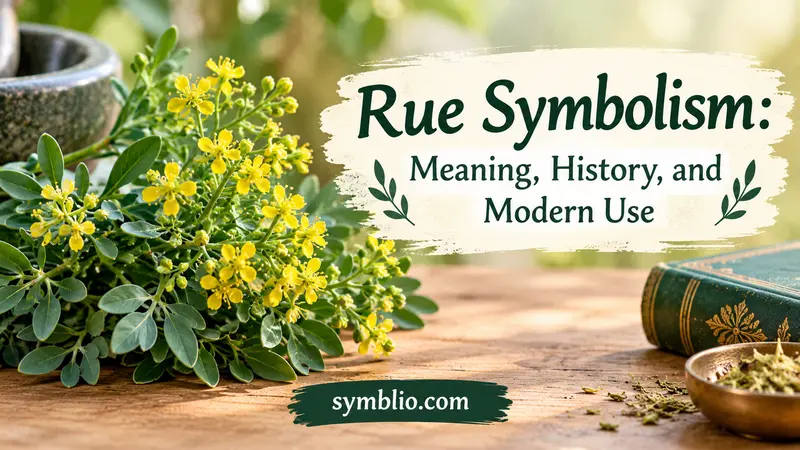
Rue (Ruta graveolens) is an aromatic, evergreen or semi-evergreen shrub native to parts of southern Europe and the Mediterranean region. It has finely divided, blue-green leaves, a strong scent, and clusters of small yellow flowers that appear during the growing season.
The plant’s appearance helps explain some of its symbolic appeal. Its foliage looks delicate from a distance, yet rue has a sharp smell and a notably bitter taste. That contrast has made it a useful emblem for ideas that are not entirely pleasant but may encourage reflection, caution, or change.
Rue also differs from many flowers used in modern bouquets. Roses often communicate affection, and lilies frequently appear in ceremonies of mourning. Rue carries a more complicated message: it can suggest sorrow for the past, a desire to make amends, or a wish to guard against future trouble.
Its historical role in gardens, household remedies, and religious customs gives these interpretations a concrete foundation rather than making them arbitrary associations.
The Core Symbolic Meanings of Rue
Rue has several established symbolic associations, with regret and repentance among the best documented in European literary tradition.
Regret is its most recognizable meaning. The English verb to rue means to regret something, as in the expression “to rue the day.” This connection made the herb an effective literary image for the consequences of a decision.
Repentance adds a moral dimension. Regret describes sorrow about something that happened, while repentance suggests recognizing a wrong and wanting to change one’s behavior. Rue became associated with this distinction through its historical nickname, the herb of grace.
Protection developed through traditional beliefs about the plant’s medicinal and household uses. People once believed rue could ward off illness, harmful influences, and other dangers. These were historical beliefs, not evidence that the plant possesses supernatural protective powers.
Remembrance and sorrow appear in European literature, where rue can accompany scenes of grief, reflection, and lost innocence.
In modern symbolic interpretation, these meanings can work together. A person might associate rue with learning from a difficult experience, acknowledging a mistake, or protecting personal boundaries after a painful event.
However, no single meaning applies in every culture or situation. The context in which rue appears determines whether it suggests remorse, spiritual reflection, protection, or simply an interest in traditional herbs.
Ancient Mediterranean Roots and Early Uses
Rue’s history extends into the ancient Mediterranean world, where people cultivated aromatic plants for food, household purposes, ritual practices, and medicine.
Writers in the Greco-Roman tradition discussed rue as a useful herb. Historical accounts describe its use in remedies and associate it with protection against poisons and other dangers. Ancient people often interpreted a plant’s strong smell, bitter taste, or unusual physical properties as signs of its medicinal or protective value.
These beliefs formed part of a world in which medicine, religion, and everyday customs frequently overlapped. A plant might be used in a remedy, included in a household ritual, and valued as a garden ornament without those roles seeming contradictory.
Rue’s reputation as a protective herb developed within this setting. People attributed various benefits to it, although many historical claims were exaggerated or unsupported by modern medical evidence.
It is important not to assume that every later European meaning originated in ancient Greece or Rome. Rue accumulated associations across different periods and communities. Some developed from practical uses, while others emerged through language, Christian customs, literature, and folklore.
The plant’s long history therefore explains its symbolic versatility better than any claim that it had one fixed meaning from antiquity onward.
Why Rue Became Known as the Herb of Grace
One of rue’s most significant historical names is herb of grace. The phrase connects the plant with repentance, forgiveness, and religious reflection.
In European Christian traditions, rue was sometimes used to sprinkle holy water during church ceremonies. This practice helped associate the plant with religious observance and spiritual cleansing. Its nickname also reflected the idea that acknowledging wrongdoing could become the beginning of moral renewal.
The plant’s bitterness reinforced the association. Just as rue tastes unpleasant, repentance can involve facing uncomfortable truths about one’s behavior. The comparison offered a memorable way to connect a physical sensation with an inward experience.
Still, rue was not a universal Christian symbol, and its use varied by time and place. Its historical role should not be confused with an official religious requirement or a belief shared by every Christian community.
Today, the phrase herb of grace may appeal to people interested in traditional gardens, medieval customs, or the symbolism of repentance. It offers a way to understand grace not merely as receiving forgiveness but also as recognizing the need for change.
Rue Symbolism in Shakespeare and English Literature
English literature helped preserve rue’s association with sorrow and repentance long after many people stopped using the herb regularly.
William Shakespeare makes particularly memorable use of rue in Hamlet. During Ophelia’s flower-distribution scene, rue appears alongside other plants that carry meanings associated with grief, memory, and human relationships.
The moment is important because the flowers do more than decorate the scene. They communicate emotions that the characters cannot express through ordinary conversation. Rue’s association with repentance and sorrow makes it appropriate to a dramatic setting shaped by betrayal, loss, and moral uncertainty.
Shakespeare also uses rue in Richard II, where the plant appears in a passage about tears and remembrance. These literary appearances reinforced the connection between the herb and regret.
The symbolism works partly because the English word rue already means to feel sorrow or regret. The plant’s name allows writers to suggest both the herb itself and the emotion associated with it.
This is a useful example of how symbolism develops through language. A plant does not acquire every meaning from its physical characteristics; wordplay, poetry, and repeated cultural references can be just as influential.
For contemporary American readers, Shakespeare’s use of rue remains one of the clearest explanations for why the herb appears in discussions of literary flowers and traditional plant meanings.
What Rue Symbolizes in the United States
Rue does not have the same broad public recognition in the United States as familiar symbolic plants such as the rose, sunflower, or white lily. Most Americans are more likely to encounter its meanings through literature, historical gardening, herbal traditions, or discussions of folklore than through everyday floral customs.
Within those settings, rue commonly communicates several ideas.
- Personal accountability: Rue can represent admitting that a choice caused harm and accepting responsibility for it.
- Reflection: Its connection with repentance makes it appropriate to discussions of lessons learned from past experiences.
- Protection: Its place in historical folk practices gives it an association with guarding a home or maintaining personal boundaries.
- Historical knowledge: Growing rue can reflect an interest in traditional gardens, medicinal plant history, or older European customs.
- Sorrow and remembrance: In literary contexts, rue can suggest grief or the recognition that something valuable has been lost.
These interpretations are possibilities, not a standard American code. A gardener may grow rue simply because of its distinctive foliage, while a reader may recognize it from Shakespeare without assigning it any spiritual meaning.
American culture also includes many traditions brought by immigrant communities, so rue’s interpretation can vary according to family history and cultural practice. Its meaning is best understood within the specific context in which it appears.
Rue in Folklore and Traditional Protection
Protection is one of rue’s most persistent associations in European and other folk traditions.
People historically believed that certain plants could guard households, discourage harmful influences, or protect against illness. Rue became part of this broader tradition because it was already familiar as an aromatic herb with a long history of practical use.
Some European folklore connected rue with protection against witchcraft, nightmares, or other perceived dangers. In these accounts, the plant served as a boundary between ordinary domestic life and forces that people feared or could not explain.
The underlying symbolic idea remains understandable even when the supernatural claim is not accepted. A protective plant can represent the desire to feel secure, establish boundaries, and preserve a sense of order.
In the United States, such meanings may appear in discussions of folk magic, traditional herbal customs, or historical gardens. However, practices differ substantially between communities, and a belief documented in one tradition should not be presented as universal folklore.
Rue’s protective symbolism is therefore best described as a historical and cultural association rather than proof that the herb can prevent misfortune.
Rue in Mexican and Latin American Traditions
Rue also appears in some Latin American folk traditions, including practices associated with spiritual cleansing.
In certain Mexican folk-healing contexts, rue is used in limpias, rituals intended to cleanse a person of perceived negative influences or restore spiritual balance. Related practices vary across regions and may combine plants, prayers, gestures, and other culturally specific elements.
For people who participate in these traditions, rue may represent purification, protection, or the removal of unwanted influences. These meanings differ from the European literary emphasis on regret and repentance, although both involve a desire to move from an undesirable condition toward a better one.
Rue also has a place in some Caribbean and South American folk practices, but there is no single Latin American interpretation shared by every country or community.
In the United States, these associations may be encountered through Mexican American cultural traditions, family practices, or studies of folk medicine. They should be discussed respectfully, without reducing living traditions to exotic curiosities or assuming that everyone from a particular background follows them.
It is equally important to distinguish cultural symbolism from medical effectiveness. A plant’s ritual role can be meaningful to participants without establishing that it treats illness or removes supernatural influences.
Rue and Religious Symbolism in the Bible
Rue appears in the New Testament in Luke 11:42, where Jesus refers to rue alongside mint and other herbs while criticizing religious leaders for emphasizing tithing while neglecting justice and love for God.
The passage concerns religious priorities rather than presenting rue as a symbol with one definitive spiritual meaning. The herb appears as something people cultivated and tithed, making it part of the everyday agricultural world familiar to the audience.
Later European interpretations of rue as the herb of grace developed through additional religious and literary traditions. These associations should not be treated as though the biblical passage explicitly assigns the plant the meaning of repentance or protection.
For modern readers interested in Christian symbolism, rue can nevertheless prompt reflection on the difference between outward observance and inward moral responsibility. That interpretation arises from reading the biblical passage alongside the herb’s later cultural associations, rather than from the plant alone.
This distinction matters because symbols often gather meanings from several sources. A plant mentioned in scripture may acquire additional associations through sermons, literature, ritual practices, and popular customs over many generations.
The Emotional and Psychological Meaning of Rue
Rue’s symbolic meanings can be understood through familiar emotional experiences.
Regret involves looking back at a decision and wishing something had happened differently. Repentance goes a step further by recognizing responsibility and considering how to act differently in the future. Rue can represent the transition between those two states.
This makes the plant a possible emblem of personal accountability. It can stand for accepting an uncomfortable truth rather than avoiding it, or for recognizing that a mistake does not have to define every future decision.
Rue’s protective associations introduce a different emotional theme: the need for security. After disappointment or conflict, people often reconsider their boundaries and become more careful about whom they trust. In this context, rue can represent caution and the intention to protect one’s well-being.
Its bitter taste also provides a natural metaphor for difficult lessons. Some experiences are unpleasant but clarify what a person values, what needs to change, or which decisions deserve greater care.
These interpretations should not be mistaken for psychological diagnoses or universal responses. A person may find rue meaningful because of a personal memory, a literary reference, or a family tradition. The symbolism offers a language for reflection; it does not determine how someone must feel.
Rue Symbolism in Tattoos, Jewelry, and Personal Style
Rue is less common in mainstream American tattoo designs than roses, lavender, or olive branches, but its distinctive foliage can appeal to people who prefer plants with historical or literary associations.
A rue tattoo may represent regret transformed into wisdom, repentance, protection, or the willingness to acknowledge past mistakes. A person might choose it to mark a turning point, a period of reflection, or an ongoing commitment to personal responsibility.
The design can communicate different ideas depending on its surrounding elements.
- Rue with a closed book may suggest literary interests or reflection on the past.
- Rue with a candle may evoke remembrance or spiritual contemplation.
- Rue arranged with other traditional herbs may express an interest in historical gardening or folk practices.
- A simple botanical illustration may emphasize the plant itself rather than any specific belief.
These are possible interpretations, not established meanings for every design.
Rue may also appear in botanical jewelry, illustrations, embroidered motifs, or decorative objects. In these forms, it can appeal to people interested in natural history, traditional plant lore, or understated symbolism.
Because rue is not widely recognized as a symbol by the general American public, a design may require explanation. Someone who sees a rue tattoo might notice only a botanical image unless the person wearing it shares its intended meaning.
Rue Compared With Other Symbolic Herbs
Rue becomes easier to understand when compared with plants that have more familiar roles in American symbolism.
| Plant | Common symbolic associations | Typical context |
|---|---|---|
| Rue | Regret, repentance, protection | Folklore, literature, traditional gardens |
| Rosemary | Remembrance and fidelity | Memorials, ceremonies, literary symbolism |
| Lavender | Calm, care, and relaxation | Gardens, gifts, personal-care products |
| Sage | Wisdom and purification in various traditions | Gardens, culinary use, some ceremonial practices |
| Basil | Hospitality, love, or spiritual associations in particular cultures | Cooking, gardens, cultural customs |
These meanings are broad summaries, not universal definitions. Each plant carries different associations across cultures, and some traditions assign several meanings to the same herb.
The main distinction is rue’s strong connection to regret and repentance. Rosemary is more commonly associated with remembering someone or something, while lavender often communicates calmness in contemporary American settings.
Comparing these plants also shows why botanical symbolism cannot be reduced to a simple dictionary. A plant’s meaning may emerge from its scent, appearance, practical use, name, literary history, or role in a particular community.
Rue in Gardens, Home Decor, and Modern Botanical Design
In modern American gardens, rue is often valued for its unusual foliage and its place in traditional herb collections. Its blue-green leaves contrast with brighter flowers, and the plant can add an old-fashioned character to a garden.
For people interested in symbolism, growing rue may represent a connection to historical plant knowledge or an appreciation of the relationship between nature and cultural memory. It can also serve as a reminder that plants have played roles beyond decoration, including food preparation, household practices, medicine, and ritual.
In home decor, rue may appear in botanical prints, vintage-style illustrations, herbarium displays, or artwork inspired by Shakespearean gardens. These uses allow the plant to communicate historical interest without requiring the owner to follow a particular spiritual tradition.
Unlike seasonal American decorations associated with Christmas, Thanksgiving, or Valentine’s Day, rue does not have a widely established national holiday role. Its use remains relatively specialized and is usually driven by individual interests.
Gardeners should also remember that rue is not simply an ornamental version of a harmless kitchen herb. Its compounds can cause skin reactions when the plant contacts skin exposed to sunlight, and ingesting it can be dangerous. It should not be used as a home remedy without qualified medical guidance.
Positive and Negative Interpretations of Rue
Rue is unusual because its symbolism includes both uncomfortable emotions and constructive intentions.
Its negative associations include regret, sorrow, remorse, and the consequences of poor decisions. In literature, rue may appear when a character recognizes a loss or confronts the results of earlier actions.
Its more constructive associations include repentance, protection, and reflection. These meanings suggest that acknowledging a mistake can become a starting point for change, while recognizing vulnerability can encourage someone to establish healthier boundaries.
The distinction lies in what happens after the initial feeling. Regret alone looks backward; repentance can involve a decision to behave differently. Protection may arise from fear, but it can also express thoughtful care for oneself or others.
Rue does not automatically represent punishment, bad luck, or an unhappy future. Those interpretations may occur in individual stories or personal beliefs, but they are not universal meanings attached to the plant.
A balanced interpretation recognizes that sorrow and growth are not mutually exclusive. Rue can symbolize the discomfort of facing the past while leaving room for wiser choices in the future.
Common Misunderstandings About Rue Symbolism
Several misunderstandings can make rue’s symbolism seem more fixed or dramatic than it actually is.
Rue always means bad luck. Its strongest documented literary associations involve regret and repentance, while folklore also connects it with protection. It does not have one universal meaning of misfortune.
Rue is exclusively a religious symbol. Christian customs helped shape its reputation as the herb of grace, but its history also includes ancient medicine, domestic use, gardening, and literature.
Every culture interprets rue in the same way. European literary symbolism differs from the meanings found in some Latin American cleansing traditions. Local customs and personal experiences matter.
Historical medicinal use proves that rue is safe or effective. Traditional remedies reflect the knowledge and beliefs of their time. Some historical claims have not been validated, and the plant can cause harmful effects.
A rue tattoo has one official definition. Tattoo symbolism is personal. One person may choose rue for repentance, while another may value its botanical appearance or literary history.
These distinctions help separate established cultural associations from modern interpretations. They also prevent a complex plant from being reduced to a single label.
How Rue’s Meaning Has Changed Over Time
Rue’s symbolic history reflects changing relationships between people, plants, language, and belief.
In the ancient Mediterranean world, rue was valued for practical purposes and associated with remedies and protection. As the herb entered European gardens and religious customs, its role expanded beyond the household and into ceremonial life.
During the medieval and early modern periods, rue remained part of traditional herbal knowledge. Its association with repentance gained particular visibility in English through literary language and the expression herb of grace.
Shakespeare helped preserve that association for later readers. His use of rue connected the plant with grief, sorrow, and moral reflection, giving the herb a recognizable place in English literary tradition.
Over time, advances in medicine and changes in household practices reduced the role of rue as a commonly used remedy. Its historical meanings, however, survived in books, botanical gardens, folklore collections, and cultural traditions.
In the United States today, rue is more likely to be encountered as a historical or symbolic plant than as an everyday household herb. Its meaning continues to develop through botanical art, personal interpretation, gardening, and interest in traditional customs.
The central associations remain recognizable, but modern use tends to emphasize reflection, historical interest, and personal meaning rather than the practical protective claims of earlier periods.
FAQs
Rue can symbolize repentance, spiritual reflection, protection, and cleansing, depending on the tradition. Its association with the herb of grace links it particularly to acknowledging wrongdoing and seeking moral renewal.
It can represent both. Regret and repentance are prominent in European literary traditions, while protective meanings developed through historical folklore and household practices.
A rue tattoo may express accountability, learning from past mistakes, protection, or an interest in traditional plant symbolism. Its meaning depends on the wearer’s intentions and the imagery surrounding the plant.
Rue appears in Luke 11:42 as an herb that people tithed. The passage criticizes religious leaders for prioritizing such practices over justice and love, rather than explicitly defining rue as a symbol of repentance.
The nickname developed through European associations between rue, repentance, and Christian religious customs. The plant was also used to sprinkle holy water in some church ceremonies.
Neither meaning is universal. Historical traditions often associated rue with protection, while its literary reputation emphasized regret and repentance rather than a fixed prediction of good or bad fortune.
Rue is especially associated with regret, repentance, and protection, whereas rosemary is widely recognized in European literary traditions as a symbol of remembrance. Both plants have varied meanings depending on the cultural setting.
Conclusion
Rue is a symbol shaped by the relationship between regret, repentance, protection, and remembrance. Its bitter taste, historical household uses, religious associations, and appearances in English literature all contributed to the meanings people attach to it today.
In modern American culture, rue is not as widely recognized as many familiar flowers and herbs, but its symbolism remains relevant to people interested in folklore, botanical history, literature, and personal reflection. It can represent the willingness to acknowledge the past without allowing past mistakes to determine every future choice.
Ultimately, rue symbolism offers a grounded reminder that reflection can lead to change. Whether encountered in a traditional garden, a Shakespearean passage, or a personal botanical design, rue carries a meaning that extends beyond sorrow: the possibility of learning, taking responsibility, and moving forward with greater care.