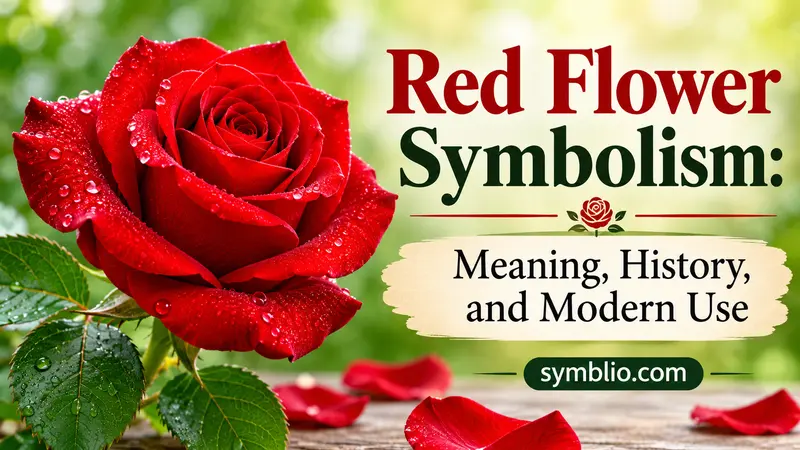
Red flowers are among the most recognizable expressions of human emotion. A bouquet of red roses can communicate romantic love, a red poppy can honor someone who served, and a red carnation can express affection or admiration. Although these flowers share the same striking color, their meanings depend on their species, cultural background, and the occasion on which people give or display them.
Red flower symbolism connects the natural beauty of flowers with feelings such as love, passion, courage, devotion, respect, and remembrance. In the United States, red flowers frequently appear at Valentine’s Day celebrations, weddings, anniversaries, memorial services, and public commemorations.
Understanding their symbolism requires looking beyond color alone. The rose, poppy, tulip, carnation, and other red blooms each have distinct histories that help explain why people continue to choose them for meaningful occasions.
Quick Answer
Red flowers commonly symbolize romantic love, passion, strong affection, and devotion in modern American culture, especially when given as gifts or displayed during celebrations. Historically, they have also represented courage, religious devotion, sacrifice, vitality, and remembrance across different cultures and traditions.
TL;DR
- Red roses traditionally represent romantic love and devotion.
- Ancient Greek and Roman traditions connected roses with goddesses of love.
- Red poppies commemorate military service and sacrifice.
- Red flowers often communicate courage, admiration, and strong emotions.
- Different cultures associate red blooms with celebration, prosperity, and happiness.
- Modern uses include weddings, tattoos, memorials, fashion, and home decoration.
What Red Flowers Represent in Modern Culture
The most familiar meaning of a red flower in the United States is love. Red roses, in particular, have become a widely recognized way to express romantic affection. Their color makes them noticeable, while their association with love gives them a message that many people understand without explanation.
However, romantic love is only one part of their symbolism.
Red flowers can also communicate:
- Passion: Strong feelings, enthusiasm, and emotional intensity.
- Devotion: Lasting affection and commitment to another person.
- Courage: Bravery, determination, and the willingness to face difficulties.
- Respect: Appreciation for someone whose actions or character deserve recognition.
- Remembrance: Respectful recognition of people who have died or made sacrifices.
- Vitality: Energy, confidence, and the continuation of life.
The meaning changes according to the flower and its setting. A red rose presented on an anniversary communicates something different from a red poppy worn during a remembrance event.
This distinction matters because red is not an independent symbolic language. The flower’s identity, the giver’s intention, and the surrounding cultural tradition all contribute to its message.
Ancient Roots of Red Flower Symbolism
Red flowers have appeared in artistic, religious, and ceremonial traditions for thousands of years. Their associations developed through mythology, gardening, religious practices, and the human tendency to connect natural objects with emotional experiences.
In ancient Greece, the rose became closely associated with Aphrodite, the goddess of love and beauty. The Romans connected the flower with Venus, her equivalent in Roman mythology. These associations helped establish the rose as an emblem of affection, attraction, and beauty.
Ancient Roman traditions also connected roses with death and remembrance. During Rosalia, a spring observance honoring the dead, families used roses in commemorative practices. This demonstrates that the flower’s historical meaning was not limited to romance.
Red roses also became connected with blood and sacrifice through classical stories involving the goddess Venus and the thorns of a rose.
Over time, these associations developed into a broader symbolic vocabulary. Red flowers could represent love and beauty while also suggesting mortality, sacrifice, and the temporary nature of life.
The ancient traditions surrounding roses helped shape later European interpretations, particularly during the medieval and Victorian periods.
Why Red Represents Love and Passion
Red is visually associated with warmth, intensity, and strong emotion. Its connections with the heart, blood, and physical vitality have helped establish it as a familiar color of passion and affection.
When people give red flowers, they often choose them because the color communicates feelings that might otherwise be difficult to express.
A red rose can suggest romantic attraction, while a red tulip may communicate affection and admiration. A red carnation can express love or appreciation in a different setting.
These meanings are cultural associations rather than universal rules. Not every person interprets red flowers in the same way, and the meaning of a particular arrangement depends on the relationship between the people involved.
Red flowers can also represent love beyond romantic relationships. They may appear in arrangements celebrating family connections, honoring someone important, or expressing gratitude.
The central idea is emotional intensity: red flowers often communicate that a feeling matters deeply to the person expressing it.
Red Flower Symbolism in the United States
American culture gives red flowers several recognizable roles. They appear in private celebrations, public ceremonies, religious settings, and everyday decorative arrangements.
One important example is the rose. In 1986, President Ronald Reagan officially proclaimed the rose the national floral emblem of the United States. The designation recognized its associations with love, devotion, beauty, and national life. The rose is therefore more than a popular romantic gift; it also has an official place in American national symbolism.
Red flowers are particularly visible during Valentine’s Day, when florists, retailers, restaurants, and families use them to celebrate affection.
They also appear at:
- Weddings and anniversary celebrations.
- Graduation and achievement ceremonies.
- Memorial services and cemetery visits.
- Military remembrance events.
- Religious celebrations and seasonal decorations.
- Public gatherings honoring important individuals.
Their meaning depends on the setting. A red bouquet at a wedding may represent affection and commitment, while flowers placed at a memorial may communicate respect and remembrance.
American culture does not assign one fixed meaning to every red flower. Instead, it combines older European floral traditions with contemporary personal and public customs.
The Symbolism of Different Red Flowers
Not all red flowers communicate the same message. Their individual histories, shapes, cultural associations, and common uses create distinct interpretations.
Red rose
The red rose is the clearest symbol of romantic love and devotion. It commonly appears in Valentine’s Day arrangements, proposals, anniversaries, and other occasions celebrating romantic relationships.
Its connection with Aphrodite and Venus gives it an ancient mythological background, while its popularity in modern American gift-giving keeps that association familiar.
Red poppy
The red poppy is associated with remembrance, military sacrifice, and respect for those who died in war. Its modern commemorative meaning developed after World War I through the influence of the poem In Flanders Fields and the efforts of American humanitarian Moina Michael.
In the United States, the American Legion family promotes the red poppy as a symbol honoring fallen service members and supporting living veterans.
Red tulip
Red tulips commonly communicate affection, romantic interest, and admiration. Their clean shape and bright appearance make them popular in spring arrangements and contemporary floral designs.
They can express affection without carrying exactly the same traditional associations as red roses.
Red carnation
Red carnations are associated with love, admiration, and affection. Their symbolic meaning can vary according to cultural tradition and shade.
They are frequently used in bouquets, celebrations, and arrangements honoring family members or other important people.
Red chrysanthemum
Red chrysanthemums can express affection and love in some floral traditions. In other cultures, chrysanthemums have strong associations with seasonal celebrations and funerary customs.
Their interpretation depends particularly on the country and occasion.
Red hibiscus
Red hibiscus flowers are often associated with beauty, vitality, hospitality, and tropical environments. Their large, open petals make them recognizable in gardens, decorative arrangements, and cultural artwork.
Their meaning can also reflect local traditions rather than a single internationally accepted interpretation.
What Different Red Flowers Mean in Everyday Life
The following comparison explains how several popular red flowers are commonly understood in American culture.
| Red Flower | Common Symbolic Meaning | Typical Context |
|---|---|---|
| Red rose | Romantic love and devotion | Valentine’s Day and anniversaries |
| Red poppy | Remembrance and sacrifice | Military commemorations |
| Red tulip | Affection and admiration | Spring bouquets and gifts |
| Red carnation | Love and appreciation | Family celebrations |
| Red chrysanthemum | Affection and strong feelings | Floral arrangements |
| Red hibiscus | Beauty and vitality | Gardens and decorative artwork |
These interpretations are useful starting points, not strict rules. A person may choose a flower simply because they enjoy its appearance, fragrance, or seasonal availability.
Red Flowers in Christianity and Religious Traditions
Red flowers have several associations within Christian art and religious symbolism. Their meanings often connect with love, sacrifice, devotion, and the blood of Christ.
The rose became associated with the Virgin Mary in Christian tradition. Medieval religious artwork frequently used roses to represent spiritual love, beauty, and devotion. The flower also appeared in representations of paradise and sacred gardens.
Red roses can carry additional associations with martyrdom and sacrifice because of the relationship between red coloring and blood.
Other red flowers may appear in church decorations, particularly during celebrations and observances where red represents love, devotion, or the Holy Spirit.
However, religious interpretation depends on the particular flower and denomination. A red rose does not automatically communicate one specific Christian teaching, and decorative flowers are not necessarily intended as formal religious symbols.
Outside Christianity, red flowers also appear in Hindu religious celebrations and offerings. Their use may express reverence, devotion, celebration, or respect for particular deities, depending on the flower and regional practice.
Red Flowers in Asian Cultures
Red flowers carry important meanings in several Asian cultures, although interpretations differ between countries and communities.
In Chinese cultural traditions, red is strongly associated with happiness, prosperity, celebration, and good fortune. It frequently appears during weddings, festivals, and important family occasions.
Red flowers can contribute to these celebratory associations. Their appearance in decorative arrangements may communicate wishes for happiness, success, and positive beginnings.
In Japanese culture, red flowers appear in artistic, seasonal, and ceremonial settings. Their meanings depend on the particular plant, occasion, and artistic context. Red chrysanthemums, for example, have associations that cannot be reduced to the same romantic message commonly attached to American red roses.
In Indian traditions, red flowers frequently appear in religious offerings, festivals, weddings, and ceremonial decorations. Red is often associated with auspicious occasions, celebration, and devotion.
These cultural examples demonstrate why people should avoid assuming that a red flower has the same meaning everywhere. The surrounding tradition matters just as much as the color.
Red Flowers as Symbols of Courage and Remembrance
Red flowers can communicate respect for people who have faced difficult circumstances or made significant sacrifices.
The red poppy is the most recognizable American example. Its commemorative meaning developed during and after World War I.
American professor Moina Michael was inspired by John McCrae’s wartime poem In Flanders Fields. In 1918, she began wearing a red poppy to remember those who served. Her efforts helped establish the flower as a memorial symbol within the American Legion Auxiliary in 1921.
Today, the American Legion family promotes National Poppy Day on the Friday before Memorial Day. People wear red poppies to honor fallen service members and support living veterans.
This tradition illustrates a different side of red flower symbolism. Rather than communicating personal romance, the flower represents collective memory, gratitude, and respect.
Other red flowers may also appear at memorial services, but their meaning usually comes from the arrangement and the occasion rather than an established national tradition.
Emotional and Psychological Meaning of Red Flowers
Red flowers often attract attention because of their strong visual contrast and recognizable color. Their emotional associations can influence how people interpret a bouquet, garden, or floral arrangement.
Several common emotional connections include:
Affection and closeness: Red flowers can communicate that someone is valued and appreciated. They are frequently chosen when words alone do not seem sufficient.
Confidence and courage: Their bold appearance can suggest determination, strength, and self-assurance.
Excitement and enthusiasm: Bright red blooms can make a setting feel energetic and celebratory.
Respect and remembrance: In commemorative settings, red flowers can communicate recognition and gratitude.
Romantic attraction: Red roses are especially associated with intimate affection and romantic commitment.
These responses are not universal psychological reactions. Personal memories, cultural backgrounds, and individual preferences influence how someone experiences a particular flower.
For one person, red carnations may recall a family celebration. For another, a red poppy may represent a meaningful remembrance ceremony.
The emotional meaning of a flower often comes from the experience attached to it.
Red Flower Symbolism in Weddings and Relationships
Red flowers have a recognizable place in American wedding traditions. Couples may include them in bouquets, centerpieces, ceremony decorations, and floral arrangements at receptions.
Red roses are particularly popular because they communicate love and commitment. Their historical connection with romance makes them a natural choice for couples who want traditional floral decorations.
Red tulips and carnations offer alternatives for people who prefer different flower shapes or arrangements.
Red flowers can also appear during anniversaries and relationship celebrations. A bouquet may mark an important date, celebrate a shared experience, or express appreciation.
However, not every wedding uses red flowers, and their presence does not automatically communicate a particular religious or cultural tradition.
The meaning comes from the couple’s intentions and the context in which the flowers appear.
Red Flowers in Tattoos, Jewelry, and Personal Style
Red flowers are popular visual subjects in tattoos and personal artwork because they combine recognizable natural forms with strong emotional associations.
A red rose tattoo is often chosen to represent love, devotion, or an important personal relationship. Some people associate it with family, while others use it to remember someone who has influenced their lives.
Red poppies can represent remembrance and respect. Their association with military history gives them a meaning that differs from the romantic symbolism of roses.
Red tulips and other blossoms may represent personal growth, affection, beauty, or a meaningful experience.
In jewelry, red floral designs can appear in pendants, earrings, brooches, and decorative accessories. Their meaning may be personal rather than traditional.
Fashion also uses red floral patterns to create visual contrast and express confidence. A red flower printed on a dress, scarf, or accessory can function as a decorative feature without carrying a specific symbolic message.
The most meaningful designs are often those connected to a personal memory or cultural background.
Red Flowers in Home Decoration and Gardens
Red flowers are frequently used in American homes and gardens because they create visible contrast and bring warmth to a space.
In interior decoration, red floral arrangements can introduce a focal point in living rooms, dining areas, and entryways. Red roses may create a romantic atmosphere, while red tulips can provide a cleaner, seasonal appearance.
Gardeners often use red blooms to add visual interest among green foliage and lighter-colored flowers.
Different plants also suit different environments. Roses, tulips, carnations, hibiscus, and poppies have different growing requirements, so the choice of flower depends on climate, available sunlight, and seasonal conditions.
Decorative meaning is not always intentional. Some people grow red flowers because they appreciate their appearance or want to attract pollinators.
Nevertheless, their established associations with warmth, affection, and celebration can influence how people use them in shared spaces.
When Red Flower Symbolism Can Be Misunderstood
One common misunderstanding is the belief that every red flower represents romantic love.
Although red roses are strongly associated with romance, red poppies have a different commemorative history. Red carnations may express family affection or admiration, while red hibiscus flowers often appear in tropical decorative traditions.
Another misunderstanding comes from treating Victorian flower dictionaries as universal authorities.
During the nineteenth century, floriography, or the language of flowers, became popular in Europe and the United States. People used floral arrangements to communicate feelings through carefully selected plants and colors.
Some dictionaries assigned highly specific meanings to individual flowers. However, different publications sometimes gave contradictory interpretations, and the meaning could change according to the flower’s condition or arrangement.
Modern interpretations are much less rigid.
A red flower does not automatically reveal someone’s romantic intentions, religious beliefs, political position, or personal identity. Its meaning should be understood through the situation rather than assumed from color alone.
It is also important to distinguish historical symbolism from modern commercial associations. Florists and greeting-card companies often emphasize romantic meanings because they are familiar and easy to communicate, but this represents only one part of the flower’s cultural history.
How the Meaning of Red Flowers Has Changed Over Time
The symbolism of red flowers has developed through several overlapping traditions.
In ancient Mediterranean cultures, roses were associated with love, beauty, religious observances, and remembrance of the dead.
During the medieval period, Christian artwork expanded the rose’s associations with spiritual devotion and sacred love.
In the nineteenth century, Victorian floriography made flower meanings fashionable. Red flowers became part of a wider system for expressing affection, admiration, and other emotions through gifts.
The twentieth century introduced additional public associations, particularly through the red poppy and its connection with remembrance after World War I.
In modern American life, these traditions coexist. Red roses remain a familiar expression of romantic affection, red poppies represent remembrance, and other red blooms communicate a range of personal and cultural messages.
Social media, fashion, photography, and contemporary floral design have also expanded how people use red flowers.
Their meanings have not replaced one another. Instead, older associations continue alongside newer personal interpretations.
FAQs
A red flower commonly symbolizes love, passion, affection, and devotion. Depending on the species and cultural setting, it may also represent courage, remembrance, prosperity, or religious dedication.
A red flower can communicate romantic interest, affection, or commitment. Red roses are particularly associated with romantic love, while other red flowers may express admiration or appreciation.
In some religious traditions, red flowers represent devotion, sacrifice, sacred love, and spiritual dedication. Christian artwork frequently associates red roses with religious love and martyrdom, while Hindu traditions use red flowers in various devotional ceremonies.
A red flower tattoo can represent love, personal devotion, courage, remembrance, or an important relationship. Its meaning depends on the flower chosen and the personal experience behind the design.
Yes. Red poppies are an established symbol of remembrance for people who died in military service, particularly following World War I. Red roses have also appeared in historical mourning and commemorative traditions.
No. Red roses are strongly connected with romantic love, but other red flowers have different associations. Red poppies, for example, are widely recognized as symbols of remembrance and sacrifice.
Red roses have a long association with Aphrodite and Venus, the ancient goddesses of love. Their established romantic meaning made them a natural choice for Valentine’s Day celebrations and modern expressions of affection.
Conclusion
Red flowers communicate some of the most recognizable emotions in human culture. They can express romantic love, affection, courage, devotion, admiration, and remembrance. Their meanings developed through ancient mythology, religious traditions, historical ceremonies, and modern customs.
In the United States, red roses remain a familiar expression of romantic love, while red poppies represent remembrance and respect for fallen service members. Other red flowers carry their own associations, shaped by cultural traditions and personal experiences.
Ultimately, red flower symbolism is not limited to one emotion or occasion. The flower itself, the cultural setting, and the intention behind giving or displaying it determine the message. A red bloom can celebrate love, honor a memory, or simply bring beauty and warmth into everyday life.