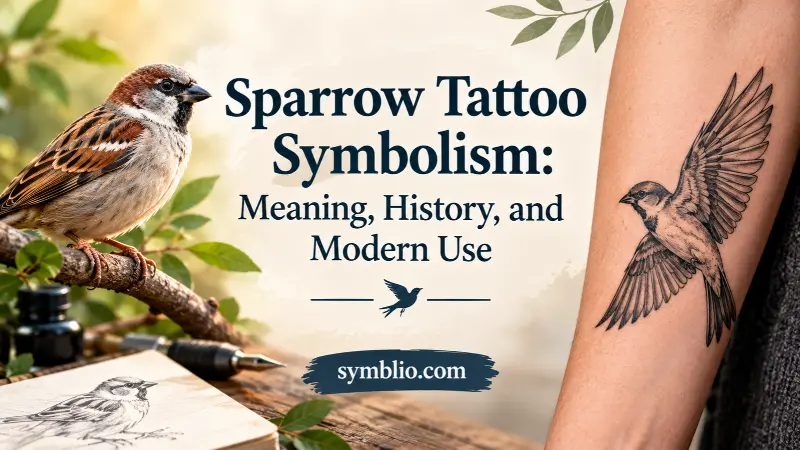
A sparrow tattoo often represents freedom, loyalty, resilience, and the ability to find meaning in ordinary life. Although sparrows are small, their presence in cities, gardens, and neighborhoods makes them familiar birds across the United States. For many people, a sparrow tattoo turns that everyday image into a personal reminder of independence, belonging, or perseverance.
The meaning depends on the design and the person wearing it. Two sparrows might represent a lasting relationship, while a single bird in flight can suggest independence or a new beginning. Some people also choose sparrows to express religious faith, remember someone they have lost, or honor a connection to maritime tattoo traditions.
Understanding sparrow tattoo symbolism requires looking beyond the bird’s appearance. Its cultural associations developed through religious teachings, traditional tattooing, folklore, and everyday observations of the natural world. Those influences give the sparrow several possible meanings without making any single interpretation universal.
Quick Answer
Sparrow tattoo symbolism most commonly represents freedom, loyalty, resilience, and hope in modern American tattoo culture. Historically, sparrows have also been associated with Christian ideas of divine care, sailors’ traditions, companionship, and the ability to find a place to belong.
TL;DR
- Freedom: A flying sparrow can represent independence and personal growth.
- Loyalty: Two sparrows may honor a partner, family member, or close friend.
- Resilience: The bird’s adaptability reflects endurance through difficult circumstances.
- Maritime history: Traditional sparrow tattoos connect with sailors and seafaring culture.
- Faith: Christian interpretations associate sparrows with divine attention and human worth.
- Remembrance: A sparrow can serve as a personal memorial or tribute.
What a Sparrow Looks Like and Why Its Appearance Matters
The house sparrow is a small, sturdy bird with a short, thick beak adapted for eating seeds. Males commonly have a gray crown, chestnut coloring around the head, and a dark bib, while females and younger birds usually show more muted brown and tan markings. Artists often simplify these features when creating tattoo designs.
In tattoo art, the sparrow may appear perched on a branch, flying with its wings spread, holding a flower, or facing another bird. Each pose can influence the impression the design creates.
A bird sitting quietly on a twig may suggest contentment, patience, or an appreciation for simple pleasures. A sparrow flying upward can communicate freedom, ambition, or a willingness to move beyond familiar surroundings. Two birds facing each other may suggest affection, partnership, or mutual support.
The sparrow’s ordinary appearance is part of its appeal. Unlike a phoenix or eagle, it does not depend on dramatic size or legendary abilities to make a statement. Its symbolism often comes from the idea that an unassuming creature can still possess value, character, and the ability to survive.
The Main Meanings Behind Sparrow Tattoos
Sparrow tattoos can carry several related meanings, but the most relevant one depends on the wearer’s experiences and intentions.
Freedom and independence are common interpretations, particularly when the bird appears in flight. The image can mark a transition into a new stage of life, the decision to follow an independent path, or the desire to make choices according to personal values.
Loyalty and belonging offer another interpretation. Sparrows live in close proximity to people and often gather in groups. A tattoo can therefore represent family connections, enduring friendships, or the comfort of having a place where one belongs.
Resilience comes from the bird’s ability to adapt to changing environments. House sparrows thrive in many human-inhabited areas, finding food and shelter in places where conditions change. As a tattoo, this quality can represent adaptability and the determination to keep moving forward.
Hope and renewal often appear in designs showing a sparrow in flight or perched near a flower. The bird can mark a fresh start after a major change, a reminder to remain open to new opportunities, or an appreciation for life’s everyday possibilities.
For some wearers, the central message is simply humility. A sparrow does not need to be the largest or most impressive bird to have a place in the world. That interpretation can express self-respect without boasting or the belief that ordinary lives deserve recognition.
Ancient Literary and Religious Roots
Sparrows have appeared in religious writing and classical literature long before contemporary tattoo culture developed.
In the Christian Bible, sparrows appear in passages that emphasize God’s awareness of seemingly insignificant creatures. Matthew 10:29–31 uses the sale of sparrows to illustrate a larger point about divine knowledge and human worth. Luke 12:6–7 presents a similar teaching.
These passages helped establish the sparrow as a reminder that smallness does not equal insignificance. For Christians, a sparrow tattoo may represent faith, reassurance during uncertainty, or the belief that every person deserves care and attention.
Classical Roman poetry offers another historical association. The Roman poet Catullus wrote poems about a sparrow belonging to a woman he called Lesbia. The bird appears in verses concerned with affection, playfulness, intimacy, and grief over its loss. This literary tradition connects sparrows with personal attachment and the emotional importance of small, familiar things.
These sources do not establish one universal meaning for every sparrow image. Instead, they provide different cultural foundations from which modern interpretations have developed. A tattoo inspired by Christian scripture communicates something different from one chosen for its literary associations with affection or loss.
How Sparrow Tattoos Fit Into American Tattoo History
American tattoo culture developed through several overlapping traditions, including maritime life, military service, traveling tattoo artists, and working-class communities. By the nineteenth and twentieth centuries, sailors had helped popularize recognizable designs featuring anchors, ships, hearts, and birds.
The sparrow belongs to this broader family of traditional bird imagery, but an important distinction matters: the swallow has a more firmly established place in classic sailor-tattoo lore than the sparrow does. The two birds are sometimes confused in modern discussions, especially when simplified illustrations make their shapes difficult to distinguish.
Traditional swallow tattoos became associated with seafaring experience, long journeys, and the hope of returning home. Some maritime traditions linked a swallow with a milestone of nautical travel, commonly described as 5,000 nautical miles. Details vary across historical accounts, and these conventions should not automatically be attributed to every sparrow tattoo.
The sparrow nevertheless fits naturally within traditional American tattoo art. Its compact shape works well with bold outlines, limited color palettes, banners, flowers, and other familiar motifs. Over time, tattoo artists and wearers have also developed personal interpretations that extend beyond the older maritime vocabulary.
Today, someone choosing a sparrow tattoo does not need a connection to the Navy, merchant shipping, or traditional tattooing. The design can honor those roots while expressing a contemporary personal story.
Sparrow Versus Swallow: An Important Difference
The sparrow and swallow are different birds, even though their symbolic meanings sometimes overlap in tattoo culture.
A house sparrow generally has a compact body, a relatively short tail, and a thick, conical beak. A barn swallow has longer, pointed wings and a distinctive forked tail. Swallows are also known for their agile flight and long migrations.
In traditional maritime tattooing, the swallow is especially associated with voyages, distance traveled, and homecoming. The sparrow is more often interpreted in modern designs through ideas such as humble worth, companionship, adaptability, and everyday resilience.
| Feature | Sparrow tattoo | Swallow tattoo |
|---|---|---|
| Common modern meaning | Humility, resilience, belonging | Freedom, travel, homecoming |
| Traditional tattoo connection | American traditional bird imagery | Established maritime tattoo tradition |
| Typical appearance | Compact body and short tail | Pointed wings and forked tail |
| Personal interpretation | Family, faith, perseverance | Journeys, experience, loyalty |
These distinctions are useful rather than absolute. Tattoo art often simplifies bird anatomy, and individual artists may use the two images in overlapping ways. When historical accuracy matters, identifying the bird correctly helps preserve the meaning of the design.
What Sparrow Tattoos Mean in Modern American Culture
In the United States, tattoos increasingly function as personal expressions rather than fixed symbols with one accepted definition. A sparrow may represent an important relationship, a family history, an experience of change, or a value the wearer wants to keep in mind.
Its small size makes it suitable for discreet designs on the wrist, ankle, shoulder, or upper chest. Larger compositions can incorporate several birds, branches, flowers, or lettering to tell a more detailed story.
Sparrows also suit people who prefer symbols drawn from familiar surroundings rather than grand mythological figures. Their connection to ordinary neighborhoods and everyday nature gives them an accessible quality. The wearer does not need to believe in a supernatural meaning to appreciate the bird’s associations with persistence or freedom.
Modern American interpretations are also shaped by individual identity. Someone who grew up watching sparrows outside a childhood home might associate them with security and family. Another person may connect the bird with moving to a new city, finding independence, or learning to appreciate a quieter life.
There is no single national interpretation that applies to all Americans. Personal memories, family beliefs, artistic preferences, and cultural backgrounds can all shape the message.
The Emotional and Psychological Meaning of a Sparrow Tattoo
A tattoo can serve as a visual reminder of a personal value, especially when the image carries associations the wearer already understands. The sparrow lends itself to this kind of meaning because it combines vulnerability with adaptability.
For someone who has experienced a major life transition, the bird might represent the ability to adjust without losing a sense of self. For another person, it may stand for the importance of staying connected to family and friends while developing greater independence.
The sparrow can also express a quieter form of confidence. Its symbolism does not depend on dominance, size, or conquest. Instead, it can reflect the idea that strength sometimes means being resourceful, accepting support, and continuing with ordinary responsibilities when circumstances become difficult.
These interpretations are personal rather than psychological diagnoses. A tattoo cannot reveal someone’s personality or experiences on its own. Its meaning comes primarily from the associations the wearer gives it.
Single Sparrow and Two Sparrow Tattoo Meanings
The number of birds can change the visual story of a tattoo.
A single sparrow often emphasizes individuality, independence, or a personal journey. It may commemorate a new chapter, celebrate self-discovery, or represent the ability to build a life in unfamiliar surroundings.
Two sparrows commonly suggest partnership, affection, and companionship. Someone might choose the design to honor a spouse, sibling, parent, or close friend. The birds can also represent two people who maintain a meaningful connection despite distance or changing circumstances.
A small flock may symbolize family, community, or a group of people who have supported one another. For someone who values belonging, several birds flying together can communicate connection without relying on names or written messages.
The arrangement matters, too. Birds facing each other can create a sense of mutual attention, while birds flying in the same direction may suggest shared goals. Birds moving apart can represent independence or separate paths, although this interpretation depends on the wearer’s intention.
None of these arrangements has a universally fixed definition. The best design is one that reflects the relationship or experience the wearer wants to commemorate.
Christian Faith and the Sparrow Tattoo
For Christians, the sparrow can be a meaningful image of faith, care, and human dignity. The biblical passages in Matthew and Luke use the bird to illustrate that even creatures considered inexpensive or ordinary remain within God’s awareness.
This association gives the sparrow a reassuring role. A person might choose the tattoo as a reminder of faith during uncertainty, a connection to a church community, or a belief that their life has value even when they feel overlooked.
The hymn His Eye Is on the Sparrow, first published in the early twentieth century, helped carry this biblical imagery into American religious culture. Its message links the bird with trust, comfort, and confidence in divine care.
Some designs pair a sparrow with a cross, a short personal inscription, or a small branch. Others rely on the bird alone, allowing the religious association to remain private.
A sparrow tattoo is not automatically a Christian symbol, however. Someone who does not follow Christianity may choose the same image for entirely different reasons. The biblical meaning is one established interpretation, not a requirement for wearing the design.
Sparrows in Other Cultures and Traditions
Sparrows appear in folklore, literature, and everyday symbolism across different societies. Their meanings vary because cultures interpret familiar animals through different stories, beliefs, and experiences.
In classical European literature, the sparrow can represent intimacy and affection, as seen in Catullus’s poems about a beloved pet bird. Christian traditions associate this small bird with divine care and the value of seemingly insignificant life. In Japan, sparrows appear in folk stories, poetry, visual art, and seasonal imagery, where they often reflect everyday life and the natural world.
Their social behavior and presence in the human environment can support associations with community, liveliness, and everyday nature, although meanings vary by artwork and tradition.
In other settings, sparrows may appear as signs of good fortune, domestic life, or ordinary companionship. Such interpretations should be understood in context rather than treated as beliefs shared by everyone in a country or religious community.
For American wearers, these cultural references can offer inspiration, but a design drawn from a particular tradition deserves thoughtful treatment. Learning the story behind a motif is more respectful than assuming every sparrow carries the same meaning worldwide.
Popular Sparrow Tattoo Designs and Their Interpretations
Traditional American sparrow
Bold outlines, strong colors, and compact shapes connect this style with the history of Western tattooing. It can express appreciation for tattoo heritage, loyalty, or personal resilience.
Minimalist sparrow
Fine lines and restrained detail keep the focus on the bird itself. This style often suits ideas of freedom, simplicity, independence, or a private personal reminder.
Two sparrows
Paired birds can honor a relationship, shared memories, or family bonds. Their placement and direction can help communicate the connection.
Sparrow with a flower
A flower introduces additional associations, such as affection, growth, remembrance, or the beauty of ordinary life. The specific flower influences the overall message.
Sparrow on a branch
A resting bird can convey calm, patience, and appreciation for home or familiar surroundings. This design tends to feel more contemplative than a bird in flight.
Tattoo styles influence how a symbol feels, even when the central subject stays the same. A traditional design may emphasize heritage and bold self-expression, while a fine-line image can feel understated and intimate.
The accompanying elements also matter. A banner can preserve a name or date, a branch can suggest a connection to nature, and a cross can introduce a religious interpretation. Each addition should contribute to the story rather than simply fill space.
How Placement Changes the Personal Message
Tattoo placement affects visibility, composition, and how closely the design relates to the wearer’s daily life. It does not impose a universal symbolic meaning, but it can influence the way a tattoo is experienced.
- Wrist or forearm: A visible placement can make the bird a regular reminder of freedom, resilience, or a personal commitment.
- Shoulder or upper arm: This area offers room for traditional artwork, flowers, paired birds, or a larger composition.
- Chest: A sparrow placed near the chest can feel personally meaningful, particularly when it commemorates family, a partner, or a significant memory. It may also reference older maritime tattoo arrangements.
- Ankle or foot: A smaller bird here can create a discreet design associated with movement, independence, or a personal journey.
- Back or shoulder blade: More space allows the bird to appear in flight or within a scene that includes several symbolic elements.
Practical considerations are just as important as symbolism. Visibility, clothing, workplace expectations, personal comfort, and the long-term care required for a tattoo all affect whether a placement is appropriate.
A design should be chosen for the meaning it holds and the wearer’s circumstances, not because a particular body location supposedly guarantees a specific symbolic effect.
Sparrow Tattoos, Color, and Visual Meaning
Color can influence the mood of a sparrow tattoo, although no color has one universal interpretation across all tattoo traditions.
Black and gray designs emphasize shape, shading, and detail. They can give the bird a restrained, classic appearance that works well for memorials, personal reminders, or realistic artwork.
Brown and muted earth tones echo the natural coloring of many sparrows. These shades can reinforce associations with everyday life, nature, familiarity, and a connection to home.
Red accents may draw attention to the bird’s head or chest and can introduce associations with affection, vitality, or emotional intensity. The interpretation depends on the rest of the composition rather than the color alone.
Blue accents can create a cooler, lighter appearance and may complement a design centered on the open sky or freedom. A blue bird should not automatically be interpreted as a sparrow, however, because color can also change how viewers identify the species.
A colorful traditional tattoo and a monochrome sparrow can communicate different moods without having different essential meanings. Choosing a palette that suits the artwork and the wearer’s intentions is more useful than following rigid color-symbolism rules.
Misunderstandings and Misuse of Sparrow Symbolism
Sparrow tattoos are generally associated with positive or personal meanings, but several misunderstandings can arise when people treat tattoo folklore as established fact.
The first is the assumption that every small bird tattoo represents a sailor’s achievements. The familiar maritime tradition of marking nautical travel is primarily associated with swallows. Sparrows sometimes appear in similar artwork, but the distinction matters when a wearer wants to represent a specific historical practice.
Another misconception is that sparrows have one official meaning in every culture. A Christian interpretation of divine care, a literary association with affection, and a modern personal symbol of independence come from different sources. They can coexist without becoming interchangeable.
Some tattoo descriptions also present birds as guaranteed signs of luck, protection, or future success. These claims belong to personal belief or folklore rather than verifiable outcomes. A tattoo may provide comfort or serve as a reminder, but it cannot ensure a particular event will happen.
Finally, a sparrow should not be assumed to reveal someone’s religion, relationship status, profession, or personal history. Even a traditional design may have been chosen simply because the wearer appreciates its appearance.
Respecting these distinctions makes it easier to appreciate the bird’s cultural history without imposing assumptions on the people who wear it.
How Sparrow Tattoo Symbolism Has Evolved
The sparrow’s meaning has developed through several layers of interpretation rather than one continuous, universally shared tradition.
Religious writing gave the bird an association with divine attention and the worth of ordinary life. Classical poetry connected it with intimacy, affection, and loss. Maritime tattoo culture introduced a broader visual language of birds, journeys, homecoming, and personal experience, with the swallow serving as its more clearly established small-bird emblem.
During the twentieth century, traditional tattoo designs became more widely recognizable beyond seafaring communities. As tattoos entered mainstream American fashion and personal expression, wearers gained greater freedom to choose symbols for individual reasons rather than inherited conventions.
By 2026, a sparrow tattoo might represent a family connection, a religious conviction, an important life transition, or simply a love of birds. Digital images and tattoo portfolios also make it easier for people to combine historical styles with contemporary illustration.
The result is a flexible symbol with several credible points of reference. Its older associations remain available, but modern wearers do not have to follow a single inherited interpretation.
How to Choose a Sparrow Tattoo That Feels Personal
The most meaningful design usually begins with the idea the wearer wants to preserve. Instead of starting with a particular style or placement, consider what the sparrow represents in the context of a personal experience.
Someone who values independence might prefer a single bird in flight. A person honoring a family relationship may choose two sparrows or a bird paired with a meaningful date. Someone drawing on Christian faith may prefer a simple sparrow that recalls a biblical passage without additional decoration.
It can also help to consider whether the design should communicate its meaning openly or remain personal. A traditional bird with a banner makes room for a name or phrase, while a small, unadorned sparrow leaves more room for private interpretation.
Historical accuracy may matter to people interested in maritime tattoo culture. In that case, distinguishing a sparrow from a swallow and learning about the relevant tattoo tradition can help the design reflect the intended story.
Ultimately, there is no test a sparrow tattoo must pass to be meaningful. Its value comes from the connection between the image, the wearer’s intention, and the memories or principles it represents.
FAQs
A sparrow tattoo can represent divine care, faith, humility, and the belief that every life has value. These associations are particularly relevant to Christians familiar with the sparrow passages in Matthew and Luke, although spiritual interpretations vary among individuals.
Some people treat small birds as signs of hope, favorable change, or protection, drawing on folklore and personal beliefs. However, a sparrow tattoo has no universally established meaning as a good-luck charm, and its symbolism does not guarantee future outcomes.
Sparrows can appear in maritime-inspired tattoo designs, but the swallow is the bird most firmly associated with traditional sailor symbolism. Swallow tattoos have been linked to nautical experience, journeys, and returning home, so distinguishing the two birds is important when historical accuracy matters.
Two sparrows commonly represent companionship, love, family, or a meaningful relationship between two people. Their arrangement may reflect a shared journey or enduring connection, but the exact meaning depends on the wearer’s personal story.
A sparrow can serve as a memorial to someone who has died, particularly when the bird recalls a shared memory, a loved one’s faith, or the importance of an ordinary moment. Adding a date, flower, or small inscription can make the tribute more specific without requiring an elaborate design.
A sparrow typically has a compact body, short tail, and thick beak, while a swallow usually has pointed wings and a forked tail. In tattoo traditions, swallows have a more established association with sailors, nautical travel, and homecoming, whereas sparrows are often interpreted through humility, belonging, and everyday resilience.
Conclusion
Sparrow tattoo symbolism brings together freedom, loyalty, resilience, faith, and the value of ordinary life. Its history draws on religious writing, classical literature, and the wider traditions of American tattoo art, while contemporary interpretations allow the bird to represent individual experiences and relationships.
For one person, a sparrow may be a reminder of divine care; for another, it may honor family, mark a new beginning, or celebrate the ability to adapt to change. The swallow’s stronger connection to traditional maritime milestones is worth recognizing, but it does not limit the ways people can interpret sparrow imagery today.
Ultimately, the most meaningful sparrow tattoo is one that reflects something the wearer genuinely values. A small bird can carry a personal story without needing an elaborate explanation.