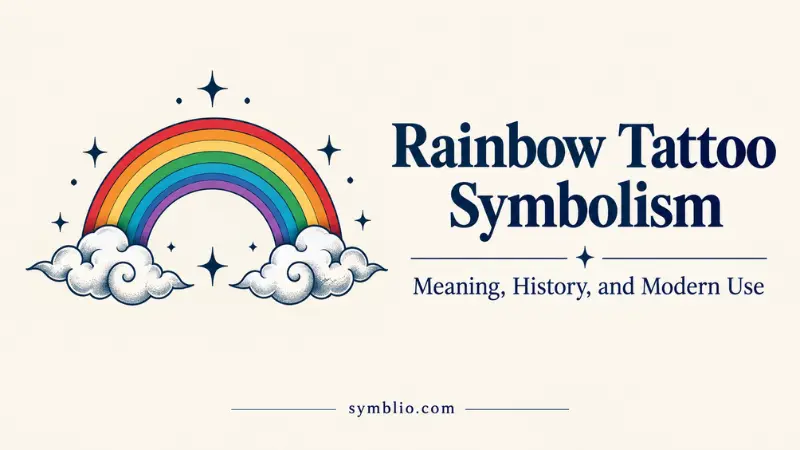
A rainbow tattoo can represent hope, individuality, acceptance, diversity, or the promise of better days after a difficult period. In the United States, rainbow tattoo symbolism also has a strong connection to LGBTQ+ pride, equal rights, and the freedom to express one’s identity. The meaning often depends on the design, the colors chosen, and the personal story behind it.
Unlike symbols with one established interpretation, the rainbow can communicate several ideas at once. A small, simple arc might remind someone of a fresh start, while a rainbow incorporating the colors of the Pride flag can express solidarity with the LGBTQ+ community. A rainbow paired with clouds, flowers, stars, or a meaningful date may carry a more personal message.
Rainbows also have a long history in religion, mythology, literature, and folklore. Their appearance after rain has made them natural symbols of hope and renewal in many settings. Modern tattoos bring these older associations together with contemporary ideas about identity, inclusion, and self-expression.
Quick Answer
Rainbow tattoo symbolism most commonly represents hope, new beginnings, individuality, and LGBTQ+ pride in modern American culture. Historically, rainbows have also symbolized divine promises, connections between worlds, and the possibility of renewal after hardship.
TL;DR
- Hope: A rainbow can mark a fresh start after a difficult experience.
- Pride: Rainbow colors can express LGBTQ+ identity, acceptance, and solidarity.
- Renewal: The appearance of a rainbow after rain suggests change and possibility.
- Individuality: Different colors can represent a person’s many interests or experiences.
- Faith: Religious traditions associate rainbows with promises, protection, and divine connection.
- Personal memories: A rainbow can commemorate a relationship, milestone, or meaningful life change.
What a Rainbow Tattoo Represents
A rainbow tattoo takes its basic meaning from a natural phenomenon: sunlight passing through water droplets and separating into visible colors. Its curved bands of color create a recognizable image that is both simple and visually distinctive.
For many people, the central idea is hope after uncertainty. Rainbows appear under particular weather conditions, often when rain clouds begin to clear. This makes them an appealing image for someone who wants to remember a period of change or acknowledge progress through a challenging chapter.
Other people choose rainbow tattoos to celebrate the variety of experiences that make up their lives. Each color can suggest a different quality, memory, or aspect of identity. The complete arc then represents a life that cannot be reduced to one characteristic.
The meaning does not have to be dramatic. Someone may simply enjoy the colors, associate them with childhood, or want a cheerful design that reflects a love of nature.
The most important consideration is personal context. Two people can wear nearly identical rainbow tattoos while attaching entirely different stories to them.
Hope, Optimism, and New Beginnings
Hope is one of the most familiar meanings associated with rainbows. A rainbow often appears when the weather changes, making it an easy visual metaphor for the possibility of better circumstances.
A person might choose this tattoo after finishing school, moving to a new place, rebuilding a friendship, or reaching a personal milestone. The design can serve as a reminder that circumstances change and that difficult periods do not necessarily define the future.
Some people prefer a fine-line rainbow with delicate colors because it feels quiet and understated. Others choose bold, saturated bands that make the image more noticeable. Neither style has an inherently stronger meaning; the choice depends on the message the wearer wants to express.
A rainbow tattoo can also represent optimism without referring to a specific hardship. For these wearers, the image expresses an outlook rather than a record of something that happened.
Its appeal lies in this flexibility. The rainbow suggests possibility without requiring the wearer to explain exactly what that possibility means.
LGBTQ+ Pride and Identity in American Culture
In the United States, the rainbow has an especially recognizable association with LGBTQ+ pride. A rainbow tattoo can communicate acceptance, belonging, visibility, and support for equal rights.
The modern Pride rainbow flag emerged in San Francisco in 1978. Artist and activist Gilbert Baker worked with other community members to create the original eight-color design, which was introduced at a local Pride celebration. Later changes produced the familiar six-color version with red, orange, yellow, green, blue, and violet stripes.
The flag became a widely recognized emblem of LGBTQ+ communities and their efforts to gain visibility, dignity, and equal treatment. As its use spread, the rainbow also became a way for people to identify welcoming spaces and express solidarity.
A tattoo inspired by the Pride flag may communicate several things:
- Personal LGBTQ+ identity.
- Support for LGBTQ+ friends, relatives, or communities.
- A commitment to acceptance and equal treatment.
- Pride in living openly and authentically.
- Remembrance of a meaningful moment in someone’s journey.
Not every rainbow tattoo is a Pride statement, however. A natural-looking rainbow, a pastel arc, or a colorful abstract design may have no connection to sexuality or gender identity. Context, accompanying imagery, and the wearer’s own explanation help clarify its intended meaning.
The History of Rainbow Symbolism
Rainbows have carried symbolic meanings long before modern tattoo culture developed. Their unusual appearance, broad range of colors, and connection to changing weather encouraged people in different societies to incorporate them into stories about gods, nature, promises, and the relationship between different realms.
In ancient Greek mythology, Iris was a divine messenger associated with the rainbow. The image could therefore suggest communication between the divine and human worlds.
In the Hebrew Bible, the rainbow appears in the story of Noah after the flood. It serves as a sign of God’s covenant that a flood would not again destroy all life in the same way. Within this tradition, the rainbow is associated with a promise, mercy, and the continuation of life.
Rainbows also became familiar images in literature and popular culture. Their connection with dreams, distant possibilities, and imagined destinations helped reinforce their association with aspiration and hope.
The modern LGBTQ+ Pride rainbow has a more specific historical origin in late twentieth-century activism. Its meaning grew through community use rather than simply inheriting one ancient interpretation.
These histories are related through the same natural image, but they should not be treated as identical. A religious rainbow tattoo, a Pride-inspired tattoo, and a design celebrating a new beginning can share the same colors while expressing different beliefs and experiences.
What the Colors of a Rainbow Tattoo Mean
Color can change the impression of a rainbow tattoo, although no universal system assigns one fixed meaning to every shade. Personal associations, cultural traditions, and the design’s relationship to the Pride flag all influence interpretation.
Traditional rainbow colors: Red, orange, yellow, green, blue, and violet create the familiar spectrum. Together, they can suggest variety, unity, joy, and the idea that different elements can form a harmonious whole.
Pastel rainbow: Soft pink, lavender, pale blue, and muted yellow often create a gentle, playful appearance. Wearers may associate these shades with childhood memories, tenderness, creativity, or a calm personal aesthetic.
Pride rainbow: The recognizable six-color arrangement commonly signals LGBTQ+ pride, inclusion, and community. Its meaning is more culturally specific than that of an ordinary rainbow.
Black-line rainbow: A monochrome design emphasizes shape rather than color. It can represent hope, simplicity, or a personal memory, but it does not automatically carry the same associations as a multicolored Pride design.
When interpreting a rainbow tattoo, avoid assuming that every color represents a separate personality trait. The original Pride flag did assign meanings to its eight colors, but those historical assignments should not be confused with a universal interpretation of all rainbow artwork.
Rainbow Tattoos and Religious Beliefs
For people whose beliefs are important to them, a rainbow tattoo may express faith, gratitude, or trust in a promise.
In the biblical story of Noah, the rainbow represents God’s covenant following the flood. Someone inspired by this account might view a rainbow tattoo as a reminder of faithfulness, mercy, or reassurance during uncertain times.
Other religious and spiritual interpretations depend on the tradition involved. In Greek mythology, the rainbow’s association with Iris connects it with messages between divine and human realms. Some contemporary spiritual interpretations use the rainbow to express harmony, interconnectedness, or a relationship between earthly life and something greater.
These meanings should not be combined indiscriminately. A person who chooses a rainbow because of the biblical covenant may have a different intention from someone who sees it as a general spiritual symbol.
Rainbow tattoos can also raise personal questions for religious wearers who belong to communities with different views about tattoos or LGBTQ+ symbolism. The image alone cannot establish someone’s beliefs. Its significance depends on the wearer’s understanding and the context in which the tattoo appears.
Rainbow Tattoos as Symbols of Personal Growth
A rainbow tattoo can mark a change in how someone understands themselves or approaches life. Unlike a date or written phrase, the image leaves room for a private meaning that may become clearer over time.
For example, a person might associate a rainbow with learning to accept a personal difference, becoming more confident, or discovering a new direction. Another might use it to commemorate a transition from one stage of life to another.
The range of colors can also represent the different parts of a person’s identity. Someone may see themselves as a student, artist, friend, family member, and community volunteer. A rainbow offers a visual metaphor for holding those roles together without reducing the person to a single label.
This interpretation is particularly personal because growth does not follow the same path for everyone. The tattoo need not indicate that a difficult experience has been completely resolved. It may simply mark a moment when the wearer recognized progress or decided to move forward.
Emotional and Psychological Associations
Colors and familiar images can evoke memories, feelings, and cultural associations. Rainbow tattoos draw on both the visual appeal of bright colors and the stories people have learned to connect with them.
Several emotional associations are common:
- Joy: Bright colors can create a cheerful, energetic impression.
- Comfort: A rainbow may remind someone of childhood, family, or a familiar place.
- Belonging: In a Pride context, the design can represent recognition and connection with a community.
- Resilience: The image may serve as a personal reminder of persistence during change.
- Creativity: The spectrum offers opportunities for unusual combinations of colors, patterns, and artistic styles.
These associations are not psychological rules. Color preferences vary between individuals and cultures, and a tattoo cannot reliably reveal a person’s emotional state or life history.
For some wearers, the rainbow’s value comes from its visibility. For others, the tattoo is meaningful precisely because only they know the story behind it.
Popular Rainbow Tattoo Designs and Their Meanings
The surrounding imagery often provides clues to a rainbow tattoo’s intended message.
Minimalist rainbow: A small arc or simple outline emphasizes clarity and simplicity. It can stand for optimism, a personal milestone, or an everyday reminder to remain open to possibility.
Rainbow with clouds: Clouds introduce the contrast between difficult conditions and a brighter outlook. This pairing often suggests patience, hope, and change.
Rainbow with flowers: Flowers can add associations with growth, affection, remembrance, or renewal. The particular flower may introduce another layer of meaning.
Rainbow with stars or a moon: Celestial details can suggest dreams, imagination, wonder, or a connection with the natural world. This combination is often chosen for its imaginative appearance as well as its symbolism.
Watercolor rainbow: Blended shades create a loose, expressive effect. The style may communicate artistic freedom, individuality, or a preference for less rigid designs.
A tattoo can also include initials, a date, or a short phrase. These details can connect the image to a specific relationship or event, making the design more individual than a rainbow alone.
Where Rainbow Tattoos Appear and What Placement Can Suggest
Tattoo placement affects visibility, composition, and how a design fits the body. It does not have a fixed symbolic meaning, but it can influence how the wearer relates to the image.
| Placement | Common design choice | Possible personal significance |
|---|---|---|
| Wrist | Small, simple rainbow | An everyday visual reminder |
| Forearm | Medium or detailed rainbow | A design the wearer wants to display |
| Upper arm | Rainbow with flowers or clouds | Space for a larger personal composition |
| Ankle | Fine-line or minimalist arc | A subtle, understated design |
| Shoulder or back | Larger, detailed artwork | Room for a broader visual story |
These are design tendencies rather than universal rules. A wrist tattoo does not necessarily mean openness, and a covered tattoo does not automatically indicate privacy or secrecy.
Placement also involves practical considerations, including clothing, workplace expectations, skin movement, and how much detail the design requires. If someone is considering a tattoo, it is worth discussing these factors with a qualified professional and a trusted adult.
Rainbow Tattoos in Fashion and Contemporary Culture
Rainbow imagery appears in clothing, jewelry, graphic design, public art, and digital media. Its meaning changes according to the setting.
During Pride events in the United States, rainbow imagery commonly communicates LGBTQ+ visibility and support. Rainbow designs also appear on accessories, stickers, and artwork created to celebrate inclusion.
Outside Pride contexts, the same image may be used for children’s products, nature-inspired decoration, playful fashion, or colorful personal art. A rainbow on a notebook may simply reflect someone’s taste in illustration, while one on a community center’s entrance may be intended to signal welcome and acceptance.
Social media has helped people share tattoo designs and explain the stories behind them. A photograph of a rainbow tattoo may accompany a personal milestone, a celebration of identity, or an artistic portfolio. However, an image posted online does not necessarily disclose the wearer’s full motivation.
Commercial use can complicate interpretation, too. Businesses may use rainbow designs to express support for LGBTQ+ communities, but the image alone does not establish how consistently they support those communities in practice.
Rainbow Symbolism in Other Cultures
Although contemporary American audiences often recognize the rainbow as a sign of hope or LGBTQ+ pride, its associations extend beyond the United States.
In ancient Greek mythology, Iris personified the rainbow and served as a messenger among the gods. This connection gave the rainbow an association with communication between realms.
In the biblical tradition, the rainbow represents the covenant following Noah’s flood. Its meaning centers on a divine promise rather than modern identity politics.
Other cultural traditions include rainbow imagery in stories about creation, spiritual connection, and the structure of the world. The details differ, and not every tradition assigns the rainbow the same role.
For tattoo interpretation, cultural context matters. A design inspired by a particular religious story should be understood on its own terms rather than treated as interchangeable with every other rainbow symbol. A simple rainbow also does not automatically claim a connection to a specific culture.
Common Misunderstandings About Rainbow Tattoos
Rainbow tattoos are visually recognizable, but their meanings are not always obvious. Several common assumptions can lead to inaccurate interpretations.
Every rainbow tattoo represents LGBTQ+ identity. This is not true. The rainbow has many associations, including hope, nature, childhood memories, faith, and creativity. A Pride-inspired design has a more specific context, but the image alone cannot establish a person’s identity.
Every rainbow means the same thing. A natural rainbow, a biblical rainbow, and a Pride flag draw on different histories. Their meanings may overlap, but they are not identical.
A rainbow tattoo always represents overcoming hardship. Some people choose the image for this reason, while others simply enjoy its appearance or connect it with positive memories.
The meaning of every color is fixed. Color associations depend on the design and tradition. The historical meaning assigned to a stripe on a particular flag should not be treated as a universal definition of that color.
The tattoo reveals someone’s beliefs. A rainbow tattoo cannot tell you whether its wearer is religious, LGBTQ+, an ally, or simply interested in colorful artwork. It is better to let people explain their own symbols than to make assumptions about them.
Understanding these distinctions makes rainbow symbolism easier to interpret respectfully.
How Rainbow Tattoo Symbolism Has Evolved
The rainbow’s symbolic history shows how one natural image can acquire new meanings without completely losing its older associations.
Religious stories connected rainbows with promises and divine relationships. Mythology used the image to explain communication between different realms. Literature and popular culture associated rainbows with dreams, possibility, and imagined destinations.
In the late twentieth century, LGBTQ+ activists in the United States developed the rainbow flag as a recognizable emblem of pride and community. Its growing visibility gave rainbow imagery a specific social and political meaning that remains important today.
Tattoo culture allows these interpretations to coexist. One person may choose a rainbow to express faith, another to celebrate an important personal change, and another to identify with LGBTQ+ communities. A single design may even combine several meanings.
The evolution is not a replacement of one interpretation with another. Instead, it reflects the way symbols gain meaning through the people who use them, the settings in which they appear, and the histories they carry.
Rainbow Tattoo Symbolism at a Glance
The following table summarizes several common interpretations and the contexts in which they are most likely to appear.
| Context | Common meaning | Typical design clues |
|---|---|---|
| Personal milestones | Hope and new beginnings | Simple arc, date, or short phrase |
| LGBTQ+ pride | Identity, inclusion, and solidarity | Pride flag colors or related symbols |
| Religious faith | Covenant, promise, or divine connection | Biblical references or faith-related imagery |
| Nature-inspired art | Beauty and appreciation of the natural world | Clouds, rain, landscapes, or sunlight |
| Personal expression | Creativity and individuality | Watercolor effects or unconventional colors |
These categories are guides, not definitive interpretations. The same tattoo may fit several categories, and the wearer’s intention remains the most reliable explanation of its meaning.
FAQs
A rainbow tattoo commonly symbolizes hope, renewal, diversity, and individuality. In modern American culture, it may also represent LGBTQ+ pride and support for equal rights, depending on the design and context.
No. Rainbow tattoos can celebrate nature, faith, personal growth, childhood memories, or artistic expression. The traditional Pride color arrangement often signals LGBTQ+ inclusion, but the rainbow itself has a much broader history.
Spiritual interpretations vary by belief system. In the biblical account of Noah, the rainbow represents God’s covenant, while other traditions connect it with divine messages or relationships between different realms.
A rainbow emerging from clouds often represents hope after uncertainty or the possibility of change. Some people use the combination to mark a personal milestone, while others choose it simply because they like the imagery.
A small rainbow can represent a personal reminder of hope, optimism, identity, or a meaningful memory. Its size does not determine its significance; the wearer’s intention matters more than the dimensions.
They can, particularly when a design is based on a flag with an established color system. In other rainbow tattoos, individual colors may reflect personal preferences or associations rather than universally recognized meanings.
Rainbow tattoos are often associated with positive ideas such as hope, acceptance, and renewal. However, their interpretation depends on cultural context and personal experience, so there is no single meaning that applies to every wearer.
Conclusion
Rainbow tattoo symbolism brings together several ideas: hope after uncertainty, the possibility of renewal, individuality, faith, and LGBTQ+ pride. Its long history includes religious stories and mythology, while its modern American meaning also reflects changing attitudes toward identity, visibility, and inclusion.
The design itself can be simple or elaborate, colorful or monochrome, and paired with imagery that adds another layer of meaning. What matters most is the relationship between the symbol and the person who chooses it.
A rainbow tattoo does not need to communicate one universal message. It can serve as a reminder of a personal milestone, an expression of belonging, or an appreciation of color and nature. Its meaning becomes most clear when the design is understood in the context of the wearer’s own story.