
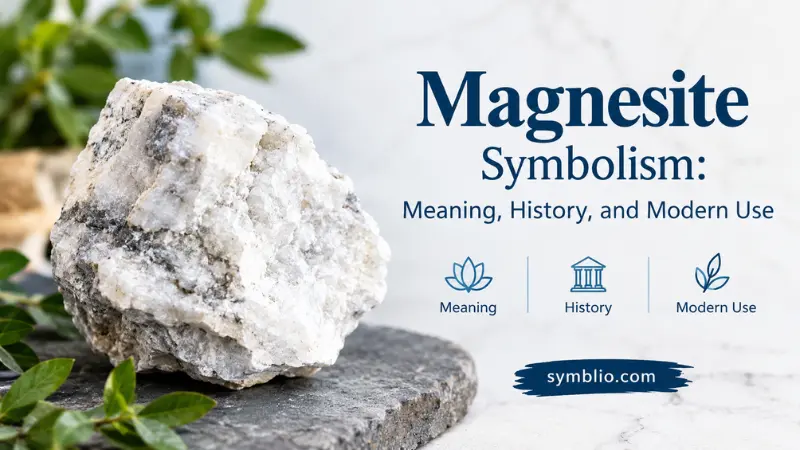
Magnesite symbolism is commonly associated with calm, patience, self-reflection, and emotional balance in modern crystal culture. This naturally occurring mineral is recognized by its white or cream-colored appearance, sometimes marked with gray or brown veins. Its understated look has made it a popular choice for jewelry, decorative objects, and crystal collections.
Unlike symbols rooted in a specific religion, myth, or national tradition, magnesite’s symbolic meanings largely come from contemporary mineral collecting, alternative wellness communities, and personal interpretations of natural stones. Its appearance encourages associations with simplicity and quietness, while its use in crystal practices connects it with relaxation and thoughtful decision-making.
Understanding magnesite means separating its geological identity from the meanings people assign to it. The mineral has identifiable physical properties and a documented place in mineralogy, but ideas about its emotional or spiritual significance belong to cultural belief and personal experience rather than established scientific evidence.
Quick Answer
Magnesite symbolism most commonly represents calm, patience, emotional balance, and self-awareness in modern American crystal culture. Its white appearance also encourages associations with simplicity and clarity, while contemporary spiritual practices often connect it with meditation, reflection, and a more deliberate approach to everyday challenges.
TL;DR
- Calm: Magnesite is associated with quietness and relaxation.
- Patience: Its symbolism encourages thoughtful responses instead of impulsive reactions.
- Clarity: White and cream tones suggest simplicity and a fresh perspective.
- Self-reflection: Crystal enthusiasts connect it with personal awareness and mindfulness.
- Modern American use: It appears in jewelry, meditation spaces, and decorative collections.
- Science versus belief: Emotional and spiritual associations are symbolic, not scientifically proven effects.
What Magnesite Looks Like and Where It Is Found
Magnesite is a naturally occurring carbonate mineral composed primarily of magnesium carbonate, with the chemical formula MgCO₃. It typically appears white, grayish white, cream, or pale brown, although impurities can create other shades. Some specimens have a porcelain-like surface, while others look chalky, granular, or slightly translucent.
The mineral forms through geological processes involving magnesium-rich rocks, carbonate rocks, and mineral-bearing fluids. It can occur in veins, altered rock formations, and sedimentary deposits. Although well-formed crystals exist, many specimens appear as compact masses rather than distinct, sharply defined crystals.
For symbolic purposes, magnesite’s appearance is particularly important. White surfaces can suggest simplicity and openness, while gray or brown markings introduce a sense of natural variation. These impressions help explain why people often associate the mineral with calmness, reflection, and an uncomplicated approach to life.
Magnesite also has practical uses beyond personal collections. Industries process it to produce magnesium oxide, which is valuable in heat-resistant materials and other manufacturing applications. Its geological identity remains the same whether it is displayed as a specimen, cut into beads, or used in industrial production.
The Core Symbolic Meaning of Magnesite
In contemporary crystal culture, magnesite is most often associated with several related ideas. These meanings are interpretive rather than universal traditions, but they provide a useful framework for understanding the mineral’s modern appeal.
Calm and composure are central associations. The stone’s pale color and relatively understated appearance can remind people of a quiet environment, encouraging them to approach difficult moments with greater patience.
Self-awareness is another common interpretation. Magnesite is sometimes used as a personal reminder to pause, examine one’s thoughts, and recognize emotional reactions before responding to a situation.
Clarity and simplicity emerge from its white or cream coloring. People who prefer minimal designs may see the stone as an expression of straightforward values, thoughtful choices, and less complicated surroundings.
Patience and balance connect these themes. Rather than representing dramatic change, magnesite can symbolize a measured response to everyday pressures.
These associations work best as personal interpretations. A person might keep a magnesite stone on a desk to remind themselves to take a breath before an important conversation. Another might wear a bracelet because its neutral appearance suits their style. Neither use requires the belief that the mineral has supernatural properties.
Ancient Roots and the History of Magnesite
Magnesite does not have a single, widely established ancient symbolic tradition comparable to the meanings attached to certain religious emblems or historically significant gemstones.
Its name is connected to magnesium and the historical place-name Magnesia in Greece. The terminology surrounding magnesium-bearing substances developed over time, and the mineral was formally described in the early nineteenth century. As mineralogy developed, scientists distinguished magnesite by its composition and physical properties.
Ancient societies certainly used minerals for ornament, tools, decoration, and practical purposes. However, evidence that a particular society consistently treated magnesite as a symbol of emotional balance, meditation, or personal transformation is limited. Such claims should not be presented as established history without supporting evidence.
Its modern symbolic identity developed in a different setting. As mineral collecting and gemstone jewelry became familiar activities, people increasingly encountered stones not only as geological specimens but also as objects of personal meaning.
Contemporary crystal communities added another layer by associating individual minerals with particular intentions or emotional themes. Magnesite’s pale appearance and its place in modern crystal collections helped establish its current associations with calm and reflection.
This distinction matters: the mineral’s scientific history is documented, while many of its present-day symbolic interpretations are relatively modern.
What Magnesite Symbolizes in the United States
In the United States, magnesite is encountered in several overlapping settings: jewelry, mineral shows, craft markets, decorative collections, and alternative wellness communities.
Its symbolic meaning depends heavily on the setting.
Within crystal-focused communities, magnesite is often presented as a stone associated with relaxation, mindfulness, and self-reflection. Someone who uses crystals as reminders of personal intentions might select it for a meditation space or keep a polished piece nearby while journaling.
In fashion, its pale color and natural markings can communicate simplicity and understated taste. White stone beads, neutral accessories, and organic textures fit comfortably with minimalist and nature-inspired styles.
Among mineral collectors, however, magnesite may be appreciated primarily for its geological characteristics, unusual formations, and relationship to magnesium-bearing rocks. A collector does not need to attach a spiritual meaning to the specimen to find it interesting.
There is no single American interpretation of magnesite. Some people approach it spiritually, some aesthetically, and others scientifically. Its modern significance lies partly in this flexibility: the same object can serve as a decorative accessory, a reminder of a personal goal, or an example of mineral formation.
The Symbolism of Magnesite’s White and Cream Colors
Color contributes significantly to how people interpret magnesite. Its common white and cream tones are associated in many modern American design settings with cleanliness, openness, simplicity, and visual calm.
White is often used in interiors to create a sense of space. It appears in minimalist furniture, neutral clothing, wedding decorations, and products designed around a clean visual style. When magnesite is used in these settings, its coloring can reinforce similar impressions.
Cream and off-white shades can suggest warmth rather than starkness. They pair naturally with wood, linen, earth tones, and other materials associated with comfortable, understated surroundings.
Gray veins or brown inclusions introduce contrast. Rather than looking perfectly uniform, the stone may show the marks of its natural formation. A viewer might interpret those variations as reminders that simplicity does not require perfection.
These associations arise from cultural conventions and personal perception, not from an inherent emotional property of the mineral. White does not mean the same thing to every person or in every culture.
Nevertheless, magnesite’s appearance makes it especially suitable for designs intended to convey restraint, neutrality, and natural elegance.
Magnesite and Emotional Balance
Magnesite’s association with emotional balance reflects a modern symbolic idea: difficult feelings can be acknowledged without allowing every reaction to determine what happens next.
In crystal traditions, the stone is sometimes connected with easing tension, cultivating patience, and creating space for reflection. These interpretations make it a natural choice for people who want a physical object to represent a personal intention.
For example, someone might place a magnesite bead bracelet beside a journal as a reminder to consider their feelings before making a decision. Another person might hold a polished stone during a quiet reflection period because its texture and appearance help them focus on the present moment.
The meaning comes from the person’s practice and attention, not from a demonstrated ability of the mineral to regulate emotions.
There is an important difference between symbolic comfort and a scientifically established effect. Magnesite has not been shown to treat anxiety, depression, or other mental health conditions simply through possession or contact. A stone can serve as a meaningful personal reminder without replacing evidence-based care or healthy coping strategies.
As a symbol, emotional balance is less about never feeling upset and more about responding thoughtfully when emotions become complicated.
Magnesite as a Symbol of Patience and Thoughtful Decisions
Patience is one of the most practical meanings associated with magnesite in contemporary crystal culture.
The stone can represent the decision to slow down rather than react immediately. This interpretation is especially relevant to everyday situations involving disagreements, deadlines, difficult choices, or uncertainty.
Imagine a student keeping a small magnesite specimen on a desk. The stone might remind them to read an assignment carefully before beginning, divide a large task into manageable steps, or reconsider a frustrating mistake instead of giving up.
In a workplace or home setting, the same object could serve as a reminder to listen before answering or to leave time for careful consideration.
These examples illustrate how a symbolic object can become connected to a repeated behavior. The object does not make a decision for someone. Instead, it gives the person a visible cue associated with a chosen value.
Magnesite’s quiet appearance supports this interpretation because it does not rely on dramatic imagery. Its meaning can be simple: take time, think clearly, and respond with intention.
Magnesite and Spiritual Reflection
In modern alternative spiritual practices, magnesite may be used as a focus for meditation, journaling, or setting personal intentions.
People who follow crystal-based practices sometimes describe it as a stone of mindfulness or inner awareness. These beliefs generally reflect contemporary interpretations of minerals rather than a universally recognized religious doctrine.
A person might place magnesite near a meditation cushion, include it in a collection of meaningful objects, or use it to mark the beginning of a reflective routine. The stone can represent a commitment to examining habits, identifying priorities, or making room for quiet thought.
Its pale color may also fit personal rituals centered on simplicity or starting a new chapter. For one individual, it could represent a fresh perspective after a challenging period. For another, it might simply be an attractive object that makes a quiet space feel more personal.
Magnesite does not have one authoritative spiritual meaning, and it is not a required object in any broadly recognized faith tradition. Its spiritual significance depends on the beliefs and practices of the person using it.
Magnesite in Meditation and Mindfulness
Meditation often involves returning attention to a chosen point of focus, such as breathing, a repeated phrase, or a physical sensation. A small object can serve a similar purpose by reminding someone to settle into a routine.
Magnesite can fill that role because it is compact, visually understated, and available in polished forms that are easy to keep nearby.
A simple mindfulness routine might involve placing the stone on a table, sitting comfortably, and paying attention to breathing for a few minutes. When thoughts wander, the person can notice the distraction and gently return attention to the exercise.
In this context, magnesite symbolizes the intention to be present. Its significance comes from the repeated association between the object and the activity.
The same principle applies to journaling. A person might use the stone as a visual cue to write about a difficult experience, identify what is within their control, or consider a more constructive response.
No special mineral property is necessary for this practice. Other familiar objects can serve the same purpose, and mindfulness does not require crystals.
Magnesite in Jewelry, Fashion, and Personal Style
Magnesite’s white appearance makes it suitable for a range of jewelry styles, from casual bead bracelets to polished pendants and statement pieces.
Its natural markings can create an organic look that differs from uniformly colored manufactured materials. White beads also pair easily with silver-colored metals, warm gold tones, leather, wood, and neutral fabrics.
In fashion, the stone may suggest restraint, simplicity, or a preference for natural textures. Someone who wears magnesite for symbolic reasons might connect it with patience or personal growth. Someone else may simply appreciate how it looks with everyday clothing.
The distinction between natural and treated material is important when buying jewelry. Magnesite is relatively soft and can be porous, making it suitable for dyeing. Some products sold under gemstone-inspired trade names may contain dyed magnesite intended to resemble turquoise or other stones.
A seller’s description should therefore identify the material accurately. A colored magnesite bead does not necessarily have the same appearance or symbolic associations as a natural white specimen, although the owner may assign it their own meaning.
Because magnesite is not especially hard, jewelry made from it also benefits from careful handling. Avoiding unnecessary impacts and abrasive contact can help preserve its finish.
Magnesite in Home Decor and Personal Spaces
Magnesite can fit naturally into interiors that favor neutral colors, natural materials, and simple arrangements.
A polished specimen on a bookshelf may complement wooden furniture, ceramic vessels, or framed artwork. A small collection of pale minerals can add texture without introducing a strong color contrast. In a meditation or reading corner, magnesite may serve as a personal object associated with quiet time.
Its symbolic role in home decor is usually subtle. Rather than making an obvious statement, it can reinforce an atmosphere that the owner wants to cultivate.
For example, someone creating a calm workspace might choose a few meaningful objects, keep the desk uncluttered, and use a magnesite specimen as a reminder to focus on one task at a time.
The stone does not independently create a peaceful environment. Lighting, noise, organization, comfort, and personal associations all influence how a space feels.
Magnesite works best in decor when its physical appearance and intended meaning suit the room. It does not need to be displayed as a spiritual object to contribute to an appealing arrangement.
Magnesite Compared With Other White Minerals
Magnesite is sometimes confused with other pale minerals, especially howlite and white turquoise sold under informal trade names. These materials may look similar in photographs or polished jewelry, but they are not interchangeable geological identities.
Magnesite: Often white, cream, or grayish, with a compact or chalky appearance. In modern crystal culture, it is commonly associated with patience, calm, and reflection.
Howlite: Usually white with gray or dark veining. It is also associated with calmness in contemporary crystal communities, but it is a different mineral.
Turquoise: Commonly blue to green, sometimes with a contrasting matrix. It has distinct cultural histories and artistic importance in several Indigenous communities of the American Southwest.
The visual resemblance between magnesite and other stones can create confusion in the jewelry market. Some magnesite is dyed blue to imitate turquoise, so appearance alone may not establish a stone’s identity.
Symbolic interpretation also differs from mineral identification. Two stones can be associated with similar ideas in modern crystal culture while having different compositions, histories, and cultural significance.
Accurate labeling respects both the material and the traditions associated with it.
Cross-Cultural Perspectives on Magnesite
Magnesite does not have one consistent symbolic meaning across the world’s cultures.
Its documented history is primarily geological and industrial, while its modern spiritual associations are more closely connected to contemporary crystal practices. This makes it important to avoid attributing specific ancient religious meanings to the mineral without reliable historical evidence.
White minerals and pale stones more generally can carry different associations depending on the culture and context. In some settings, white may suggest purity or celebration; in others, it can be associated with mourning, remembrance, or ritual clothing.
These broader color associations should not automatically be treated as traditional meanings of magnesite itself.
The same caution applies to Indigenous American traditions. The fact that a mineral appears in modern jewelry or spiritual retail does not mean it holds a traditional ceremonial role for Indigenous communities. Such claims require evidence specific to the community, material, and practice.
A culturally respectful approach distinguishes documented traditions from contemporary personal interpretation. People can assign their own meaning to magnesite without claiming that the meaning is ancient, universal, or shared by an entire culture.
Magnesite Symbolism in Modern Life
Today, magnesite’s symbolic appeal is flexible enough to fit several ordinary aspects of life. People may select it for its appearance, use it as a personal reminder, or include it in collections of stones that represent different intentions.
| Context | Symbolic meaning | Typical use |
|---|---|---|
| Crystal collections | Calm and self-reflection | Keeping a specimen on display |
| Jewelry | Patience and personal intention | Wearing a bracelet or pendant |
| Meditation | Mindfulness and quiet attention | Placing a stone near a meditation area |
| Home decor | Simplicity and natural beauty | Decorating shelves or workspaces |
| Personal milestones | A fresh perspective or chosen goal | Giving a stone as a personal gift |
These are examples of modern interpretations, not fixed rules. A gift of magnesite might represent encouragement from one person to another, while a collector may value the same specimen for its shape or geological origin.
The mineral also fits the wider contemporary interest in objects that combine aesthetic appeal with personal significance. People often attach meaning to jewelry, photographs, keepsakes, and other everyday items. Magnesite can become one more way to make an intention visible.
Misunderstandings About Magnesite’s Meaning and Properties
Several misconceptions can arise when geological facts and modern crystal beliefs are presented together.
Magnesite is not historically established as a universal symbol of calm. Its modern associations are meaningful to many crystal enthusiasts, but the available historical record does not justify describing those associations as universal or ancient.
Its appearance does not prove spiritual properties. White coloring can encourage associations with simplicity or clarity, but those are interpretations rather than measurable qualities of the mineral.
Claims about healing require caution. Some crystal traditions describe magnesite as helpful for emotional or physical well-being. However, there is no reliable scientific evidence that carrying or wearing the stone independently produces the healing effects sometimes claimed for it.
Magnesite is not the same as every white stone. Howlite, quartz, and other pale minerals have different compositions and geological properties. Similar appearances do not establish identical origins or meanings.
Dyed magnesite should not be confused with natural turquoise. Magnesite can absorb dyes, allowing manufacturers to imitate the appearance of other gemstones. Accurate descriptions matter when a stone is purchased for its material, cultural associations, or symbolic importance.
These distinctions do not prevent people from enjoying magnesite as a meaningful object. They simply help readers distinguish personal belief from historical documentation, scientific evidence, and accurate mineral identification.
FAQs
Magnesite is commonly associated with calm, patience, mindfulness, and self-reflection in contemporary crystal practices. Its spiritual meaning depends on individual beliefs rather than a single universally recognized religious tradition.
Yes, its modern symbolic associations are generally positive, especially those involving thoughtful decisions, emotional composure, and simplicity. However, people can assign different meanings to the same object based on their experiences and intentions.
A magnesite bracelet may represent patience, personal growth, or a commitment to approaching daily challenges thoughtfully. For many wearers, its meaning is personal, and others may choose it simply because they like its neutral appearance.
Magnesite has a long geological history, but its commonly repeated associations with mindfulness and emotional balance are not established as a universal ancient tradition. These meanings are more accurately described as contemporary crystal interpretations.
Some people use magnesite as a reminder to pause, breathe, or practice mindfulness. There is no reliable scientific evidence that the mineral itself treats stress-related conditions or anxiety, so it should not replace appropriate support or professional care.
Magnesite is magnesium carbonate, whereas howlite is a different mineral with a different chemical composition. Both can appear white with gray veining and are associated with calmness in some modern crystal communities, but their geological identities remain distinct.
Magnesite can be a thoughtful gift for someone who enjoys mineral collecting, neutral jewelry, or objects connected with personal intentions. A short note explaining that the stone represents patience or reflection can make the gift more meaningful without suggesting that it has guaranteed spiritual or healing effects.
Conclusion
Magnesite symbolism centers on calm, patience, self-awareness, and simplicity in contemporary American crystal culture. Its pale appearance makes it a natural choice for jewelry, decorative collections, and personal spaces where people want to express those ideas. At the same time, its geological identity gives it value beyond symbolic interpretation.
The mineral’s history should be distinguished from the meanings people assign to it today. Although modern crystal practices connect magnesite with mindfulness and emotional balance, those associations are personal and cultural rather than scientifically established effects.
Ultimately, magnesite can serve as a reminder to slow down, consider your choices, and approach everyday challenges thoughtfully. Its symbolism becomes most meaningful when it reflects an intention that you put into practice.