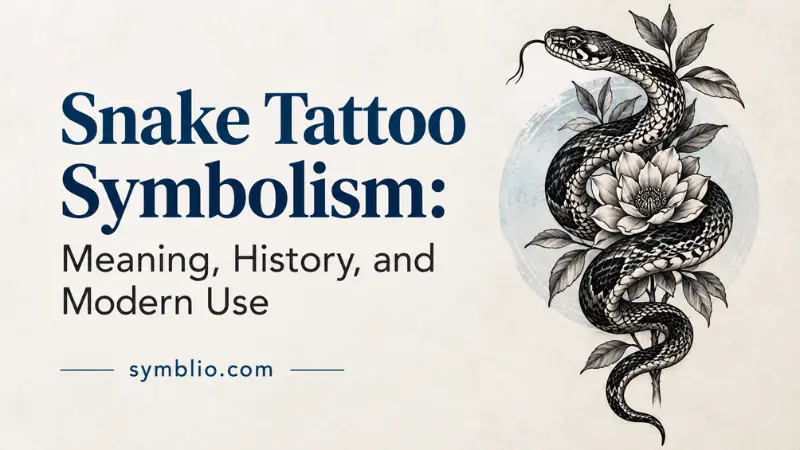
Snake tattoo symbolism often centers on transformation, renewal, wisdom, protection, and the balance between danger and healing. A snake’s ability to shed its skin makes it a natural image for personal change, while its venom, movement, and association with ancient stories give the design a more complicated meaning. Depending on the artwork, a snake can represent independence, survival, temptation, or the courage to face difficult experiences.
In the United States, snake tattoos appear in traditional American tattooing, contemporary blackwork, Japanese-inspired designs, fine-line artwork, and combinations featuring flowers, daggers, skulls, and other symbols. Some people choose them for their visual appeal, while others connect the image to a personal turning point, a cultural tradition, or a particular view of life.
There is no single meaning attached to every snake tattoo. The snake’s posture, surrounding imagery, artistic style, and the wearer’s own story can all influence how the design is understood.
Quick Answer
Snake tattoo symbolism most commonly represents transformation, renewal, wisdom, and personal resilience in modern American culture. Historically, snakes have also symbolized healing, fertility, protection, temptation, and danger across different mythologies and religious traditions.
TL;DR
- Shedding skin makes snakes symbols of change and renewal.
- Venom and fangs can represent danger, defense, and personal boundaries.
- Coiled snakes often suggest vigilance, patience, or readiness.
- Snake-and-flower designs balance strength with beauty and growth.
- Religious interpretations vary between healing, temptation, wisdom, and transformation.
- Modern American snake tattoos combine personal meaning with distinctive artistic styles.
What a Snake Represents as a Tattoo
A snake is an unusual symbol because it can suggest both danger and renewal. It moves quietly, protects itself when threatened, and sheds its outer skin as it grows. These characteristics give the animal several meanings that can coexist in a single tattoo.
For many people, a snake represents the ability to change without losing one’s identity. Someone who has moved beyond a difficult period might connect the image with a new beginning. Another person might associate it with patience, self-reliance, or the importance of recognizing potential threats.
The most common interpretations include:
- Transformation: Leaving an earlier stage of life behind.
- Renewal: Beginning again after a major change.
- Wisdom: Learning through observation and experience.
- Protection: Maintaining boundaries and staying alert.
- Resilience: Adapting to circumstances without giving up.
- Duality: Recognizing that life can contain both beneficial and harmful forces.
These meanings are possibilities rather than universal rules. A snake tattoo does not automatically reveal someone’s personality, beliefs, or experiences.
Transformation, Shedding, and New Beginnings
The snake’s ability to shed its skin is one of the clearest reasons it represents transformation. As a snake grows, it periodically sheds its outer layer. This visible process has encouraged people across different societies to associate serpents with renewal and the continuation of life.
In tattoo art, shedding skin often becomes a metaphor for personal development. The wearer may be marking a change in priorities, the end of an important chapter, or the decision to approach life differently.
A snake emerging from an old skin makes this interpretation especially clear. A design showing a snake moving forward can also suggest progress without needing to include the shed skin itself.
In the United States, where tattoos frequently commemorate milestones and personal experiences, this symbolism can be meaningful after graduation, a major move, a change in family circumstances, or another significant transition.
The idea is not that a person becomes entirely different overnight. Instead, the snake represents gradual change: growth that allows someone to move forward while retaining lessons from the past.
Wisdom, Awareness, and Strategic Thinking
Snakes are often associated with wisdom because of their roles in mythology, religious narratives, and traditional stories. Their quiet movements and ability to remain still before acting have also encouraged associations with observation, patience, and strategic thinking.
A snake tattoo chosen for this reason may represent someone who values careful judgment over impulsive decisions. It can suggest the importance of noticing details, understanding a situation, and acting at the right moment.
This interpretation differs from the idea of transformation. Renewal concerns change, while wisdom concerns what a person learns and how that knowledge influences future choices.
Some designs emphasize this meaning through a snake with an alert head, a composed posture, or a circular arrangement. Others combine the serpent with an eye, a moon, or geometric patterns to create a more personal interpretation.
However, there is no fixed visual code that makes every snake tattoo a symbol of intelligence. The meaning depends on the design and the wearer’s intended message.
Protection, Boundaries, and Self-Reliance
A snake can also represent protection. Many snakes defend themselves when threatened, and their ability to remain concealed or respond quickly makes them useful symbols of alertness and self-preservation.
A coiled snake may communicate readiness rather than aggression. Its posture suggests that it is aware of its surroundings and prepared to respond if necessary.
For some American tattoo wearers, this image represents personal boundaries. It can serve as a reminder to protect their time, respect their own decisions, and recognize situations that require caution.
Others associate the snake with independence. Unlike animals that rely on a group for survival, many snake species live largely solitary lives. This natural behavior can inspire a tattoo that celebrates self-reliance, although the interpretation should not be applied to every species or every person.
A protective snake tattoo does not necessarily communicate hostility. Depending on its expression and composition, it may express calm confidence, caution, or the belief that personal strength includes knowing when not to react.
Ancient Roots of Snake Symbolism
Snake imagery appears in the art, mythology, and religious traditions of many ancient societies. Its meanings varied according to local beliefs, the animals people encountered, and the stories they told about life, death, fertility, and the natural world.
In ancient Egypt, serpents appeared in royal and religious imagery. The uraeus, a stylized rearing cobra, was associated with royal authority and protective power. This imagery gave the serpent a role that extended beyond fear or danger.
In ancient Greece, snakes were connected with healing and the god Asclepius. The single serpent wrapped around his staff remains an important medical emblem. The association may partly reflect the snake’s shedding of skin and the ancient belief that serpents could be connected with renewal.
Serpents also appear in ancient Near Eastern traditions, where their associations could include divine power, creation, wisdom, danger, or the underworld. These traditions were not identical, and their symbols cannot be reduced to one shared meaning.
For modern tattoo wearers, these historical connections offer a range of interpretations. A serpent can evoke healing or authority in one design and danger or temptation in another. Historical context helps explain those differences rather than establishing one universal definition.
Snake Symbolism in American Culture
In the United States, snake imagery draws from several overlapping traditions: biblical stories, classical mythology, traditional tattoo art, popular entertainment, and political iconography.
The snake’s association with renewal is familiar to people who interpret the animal through its shedding skin. Its connection with medicine appears in healthcare imagery, especially the staff of Asclepius. Meanwhile, popular stories often portray snakes as cunning, threatening, or difficult to predict.
American tattoo culture brings these meanings together. A snake might appear as a small, understated outline, a detailed naturalistic animal, or a bold traditional design with heavy outlines and contrasting colors.
The coiled rattlesnake has an additional American association with independence and resistance. The Gadsden flag, created during the American Revolution, features a coiled rattlesnake and the words “Don’t Tread On Me.” Today, that imagery can carry political meanings as well as broader ideas about liberty and resistance to interference.
Not every rattlesnake tattoo expresses a political position. The context, accompanying text, and wearer’s intention matter. A decorative snake and a recognizable political emblem should not automatically be interpreted in the same way.
Religious Interpretations: Healing, Temptation, and Renewal
Religious traditions provide some of the sharpest contrasts in snake symbolism. The same animal can represent healing in one context and moral danger in another.
In the biblical Book of Genesis, the serpent appears in the story of Adam and Eve and is associated with temptation and disobedience. In many later Christian interpretations, the serpent consequently became connected with deception, sin, and the struggle between good and evil.
Yet biblical imagery is not limited to this negative association. In Numbers 21, a bronze serpent is raised as part of a story involving healing and deliverance. Christians have also interpreted this passage in relation to later biblical themes.
Outside Christianity, the serpent may carry different religious meanings. In Hindu traditions, nāgas are serpent or serpent-like beings associated with water, guardianship, fertility, and sacred places. Their significance varies across stories and regional traditions.
A person choosing a religiously inspired snake tattoo should consider the specific story or tradition represented. A biblical serpent, a Hindu nāga, and a medical snake emblem are not interchangeable symbols, even when their artwork looks similar.
Japanese Snake Tattoos and Protective Meaning
In Japanese tattooing, the snake, known as hebi, can represent protection, good fortune, wisdom, and renewal. These associations appear in a broader visual tradition that connects animals, flowers, mythological figures, and natural elements.
Traditional Japanese-inspired snake designs often use flowing movement and a composition that follows the shape of the body. The snake may wind around a flower, emerge from foliage, or curve across a larger scene.
Peonies are a common pairing in Japanese-inspired tattoo imagery. A snake and peony can combine the serpent’s associations with protection and change with the flower’s associations with beauty, prosperity, or honor, depending on the artistic and cultural context.
Japanese tattooing has its own history, conventions, and visual vocabulary. A design described as Japanese-inspired should not be assumed to reproduce a specific traditional meaning accurately. Details such as the snake’s appearance, accompanying imagery, and overall composition can affect the interpretation.
For someone drawn to Japanese art, understanding the cultural context can make the design more meaningful than choosing it solely for its visual style.
What Different Snake Tattoo Designs Can Mean
The snake’s posture and the elements surrounding it can change the message of a tattoo. The following interpretations are common possibilities, not a universal dictionary.
| Design | Common interpretation | What influences the meaning |
|---|---|---|
| Coiled snake | Alertness, protection, readiness | Whether the posture looks calm or threatening |
| Snake shedding skin | Renewal and personal change | Whether the old skin is clearly visible |
| Snake and flower | The relationship between beauty, strength, and growth | The flower species and artistic tradition |
| Snake forming a circle | Cycles, continuity, and eternity | Whether it references the ouroboros |
| Snake with an eye | Awareness, observation, or insight | The eye’s design and surrounding symbols |
| Snake wrapped around a staff | Healing, medicine, or knowledge | Whether it represents Asclepius or another tradition |
A design’s details matter more than the mere presence of a snake. For example, a serpent wrapped around a medical staff has a more specific historical association with healing than an ordinary snake curled around a branch.
Likewise, a snake arranged in a circle may evoke the ouroboros, an ancient image of a serpent consuming its own tail. That symbol has been associated with cycles, continuity, and recurring processes, though its interpretations differ across traditions.
Snake and Flower Tattoos: Beauty, Growth, and Contrast
Snake-and-flower tattoos are popular because they bring together two forms of natural imagery with different visual qualities. The snake’s winding body contrasts with the flower’s petals and leaves, allowing the design to communicate several ideas at once.
A rose paired with a snake may suggest beauty alongside caution, attraction alongside risk, or the coexistence of vulnerability and strength. Some designs draw on religious imagery, while others use the pairing simply to explore visual contrast.
Other flowers can shift the interpretation:
- Peony: May suggest prosperity, beauty, or honor, particularly in Japanese-inspired compositions.
- Lotus: Can introduce themes of spiritual development and renewal in traditions where the flower holds those meanings.
- Lily: May evoke purity, remembrance, or other associations depending on the cultural context.
- Wildflower: Can give the design a more natural, individual, or free-spirited character.
The pairing does not automatically mean that beauty is dangerous or that love involves conflict. Those interpretations depend on the artwork and the story the wearer wishes to express.
For many people, the contrast is enough: a living, growing flower alongside an animal associated with adaptation and self-protection.
Color, Placement, and Artistic Style
Color and artistic style influence the mood of a snake tattoo, although no color has one fixed meaning across all cultures.
Black-and-gray designs often emphasize texture, movement, and realism. Bold traditional artwork may use strong outlines and a limited palette, giving the snake a graphic, immediately recognizable appearance. Fine-line designs can make the image feel delicate, while illustrative or realistic work may emphasize the animal’s anatomy.
Green can reinforce the snake’s connection with the natural world. Red may create a dramatic contrast or draw attention to the design’s intensity. Gold can evoke prestige or prosperity in some artistic contexts. These are design choices, not universal symbolic rules.
Placement also affects the composition. A long, curved snake may follow the natural shape of an arm or leg, while a compact coiled design can fit a smaller area. Larger pieces may allow more detail in scales, flowers, and background elements.
The important distinction is between visual effect and established cultural meaning. A black snake is not automatically a sign of evil, and a green snake does not necessarily symbolize healing. The complete design determines the impression.
Emotional and Psychological Meaning
A snake tattoo can become a personal reminder of how someone understands change, uncertainty, or self-protection. Its appeal often comes from the fact that the animal does not have a single reassuring or threatening identity.
For one person, the snake may represent learning to adapt. For another, it may symbolize caution after an experience that changed their outlook. Someone else may choose it because they appreciate reptiles or admire the snake’s shape and movement.
The image can also represent a willingness to acknowledge complicated parts of life. Snakes can be dangerous, but they are also important members of many ecosystems. Their mixed reputation makes them useful artistic symbols for experiences that cannot be described in simple positive or negative terms.
A tattoo’s meaning may change as the wearer grows older. A design originally chosen to represent independence might later come to represent patience or a period of personal development.
That flexibility is part of the appeal. The tattoo can retain its original significance while gaining new associations over time.
Snake Tattoos in Modern Fashion and Popular Culture
Modern snake tattoos appear in many artistic styles, from small minimalist outlines to elaborate pieces that cover larger areas of the body. Social media, fashion illustration, music imagery, and fantasy entertainment have all helped keep serpent imagery visible in contemporary design.
Snakes also have a strong visual advantage: their long, flexible bodies can create movement in a composition. Artists can arrange the animal into curves, circles, spirals, and flowing patterns that work with the body’s contours.
Some people choose snake tattoos because they communicate a recognizable idea without requiring words. Others prefer them for their visual qualities rather than any particular symbolic message.
Jewelry, clothing, and decorative art also use snake motifs. These designs may borrow from ancient imagery, Art Nouveau ornament, mythological storytelling, or contemporary fashion. A tattoo can draw on the same visual language without carrying precisely the same meaning as a historical artifact.
In digital culture, a snake image may communicate confidence, transformation, danger, or simply an interest in reptiles. Emojis, fictional characters, and stylized graphics can create associations that differ from older religious or cultural interpretations.
Common Misunderstandings About Snake Tattoos
Because snakes appear in so many traditions, several oversimplifications can lead to inaccurate interpretations.
Every snake symbolizes evil. This interpretation is strongly associated with some Christian imagery, but it does not apply to every religious or cultural tradition. Snakes have also represented healing, guardianship, renewal, and divine power.
Every snake tattoo represents transformation. Shedding skin makes renewal a natural association, but some people choose snakes for protection, mythology, aesthetics, or other personal reasons.
A snake tattoo always has a hidden message. Many designs are primarily artistic. A wearer may appreciate the animal’s form without intending a specific philosophical or spiritual statement.
A coiled rattlesnake always signals a political belief. The image has a documented association with American revolutionary symbolism and modern political movements, but context matters. A snake tattoo cannot establish a person’s political views by itself.
All cultural snake designs mean the same thing. Japanese, Hindu, Christian, ancient Egyptian, and Greek traditions have distinct histories. Similar-looking imagery does not make their meanings interchangeable.
Understanding these distinctions helps viewers avoid assigning a personal or cultural meaning that the wearer never intended.
How Snake Tattoo Symbolism Has Evolved
Snake symbolism has changed as societies developed new religious beliefs, artistic styles, medical practices, and forms of popular culture.
In some ancient settings, snakes were associated with fertility, renewal, guardianship, or the divine. Greek healing traditions connected them with Asclepius, while biblical narratives contributed influential associations with temptation and moral conflict.
Later artistic traditions preserved these themes while adapting the serpent to new settings. Medical emblems, decorative art, political flags, and tattoo designs all drew on different parts of the snake’s symbolic history.
In the United States, traditional tattooing added another layer through recognizable snake illustrations and combinations with flowers, daggers, skulls, and banners. Contemporary artists continue to reinterpret these motifs through fine-line work, realism, abstract design, and culturally specific styles.
The result is not one settled definition but a collection of meanings that overlap without becoming identical. A snake tattoo can refer to an ancient tradition, express a personal experience, or function as an appealing piece of artwork.
Its interpretation depends on which elements the design emphasizes and how the wearer relates to them.
FAQs
A snake tattoo may symbolize renewal, wisdom, healing, protection, or spiritual development. Its meaning depends on the religious or cultural tradition informing the design rather than on a universal spiritual definition.
It can be either, or both. Snakes have represented healing and protection in some traditions and temptation or danger in others, so the design’s context is more informative than the animal alone.
A snake shedding its skin commonly represents transformation, renewal, and moving into a new stage of life. It can serve as a personal reminder that growth sometimes involves leaving familiar habits or circumstances behind.
In Christian interpretations, the serpent in Genesis is commonly associated with temptation and disobedience. Other biblical passages connect serpent imagery with healing or deliverance, so the exact meaning depends on the story and design being referenced.
A snake and rose can suggest a contrast between beauty and danger, attraction and caution, or strength and vulnerability. The combination does not have one fixed meaning, and the rose’s color and the snake’s posture can influence the overall impression.
In Japanese tattoo traditions, snakes can represent protection, good fortune, wisdom, and renewal. The interpretation may change with accompanying flowers, mythological references, and the broader composition.
A snake tattoo can express resilience, independence, vigilance, and the ability to adapt. Whether it communicates strength, caution, or another quality depends on the design and the meaning the wearer attaches to it.
Conclusion
Snake tattoo symbolism brings together several ideas that might initially seem contradictory: renewal and danger, wisdom and temptation, protection and vulnerability. The snake’s natural characteristics and its role in mythology have made it a flexible image across many cultures, while American tattoo traditions have added their own artistic and historical associations.
For some wearers, the snake marks personal growth or a new beginning. For others, it represents self-reliance, healing, cultural heritage, or an appreciation for the animal itself. The design may also draw on a specific religious story or artistic tradition that gives it a more focused meaning.
Ultimately, the most useful way to understand a snake tattoo is to consider its imagery, cultural background, and personal context together. A snake can communicate many things, but its most meaningful interpretation is the one supported by the story behind the design.