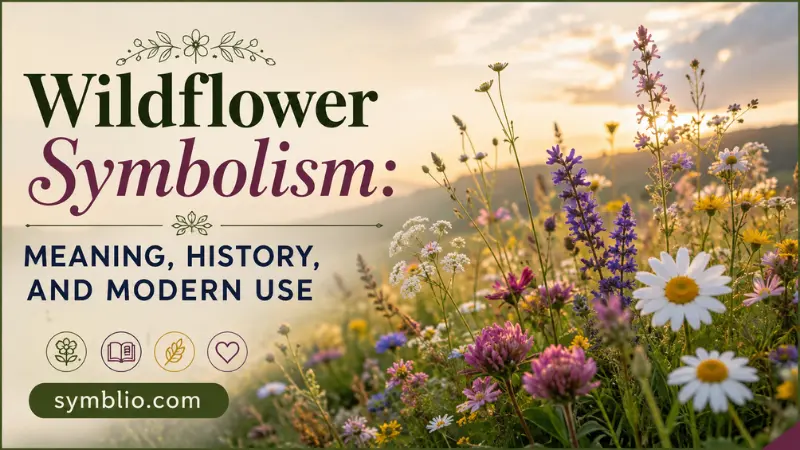
Wildflowers are often associated with freedom, natural beauty, resilience, simplicity, and individuality. Unlike formal garden flowers arranged according to strict design, wildflowers grow in fields, meadows, roadsides, forests, and other less controlled environments. That setting has helped make them a familiar American symbol of beauty that feels spontaneous rather than manufactured.
People are drawn to wildflowers for more than their appearance. A roadside bloom can recall childhood summers, a native meadow can suggest connection to a particular place, and a small bouquet can communicate affection without the formality of an elaborate floral arrangement. In the United States, wildflowers also connect personal symbolism with conservation, regional identity, gardening, and appreciation of native landscapes.
Quick Answer
Wildflower symbolism commonly represents freedom, natural beauty, resilience, individuality, and a connection to nature in modern American culture. Historically, individual wildflowers could carry separate meanings through folklore and the nineteenth-century language of flowers, while modern interpretations often emphasize spontaneity, authenticity, remembrance, and native landscapes.
TL;DR
- Wildflowers commonly symbolize freedom, simplicity, resilience, and natural beauty.
- Their meanings depend heavily on species, color, location, and cultural context.
- Victorian flower language gave individual blooms specific emotional associations.
- Americans often connect wildflowers with childhood, place, conservation, and seasonal change.
- Wildflower imagery appears in tattoos, weddings, fashion, gardens, artwork, and home decor.
- Modern symbolism is usually broader than traditional flower dictionaries.
What Wildflowers Represent in the United States
In contemporary American culture, wildflowers often represent freedom from excessive control. Their appeal comes partly from the impression that they belong where they grow. A flower emerging among grasses or along a woodland edge can look less arranged and more spontaneous than a carefully cultivated rose garden.
That quality has made wildflowers useful symbols of individuality. A person who chooses wildflower imagery may be expressing a preference for authenticity, independence, or a less conventional way of living. The symbolism does not necessarily mean rejecting structure altogether. More often, it suggests leaving room for growth, change, and personal expression.
Wildflowers can also symbolize resilience. Many species survive changing weather, poor soil, seasonal drought, or competition from surrounding plants. The symbolic lesson is straightforward: beauty does not always require ideal conditions.
This interpretation fits an important American relationship with wildflowers. The U.S. landscape contains enormous regional variation, from desert blooms and prairie flowers to Appalachian woodland plants and coastal species. A wildflower therefore can symbolize not just nature in general, but a particular place.
Why Wildflowers Symbolize Freedom and Independence
The association between wildflowers and freedom comes largely from their visual setting.
A cultivated flower is normally planted, pruned, watered, and positioned according to human plans. A wildflower appears less constrained. Even when people deliberately cultivate native wildflowers in gardens, the desired aesthetic often preserves that informal appearance.
This contrast creates a useful symbolic distinction:
- Garden flower: order, cultivation, refinement, ceremony
- Wildflower: spontaneity, independence, informality, natural growth
The symbolism becomes especially clear in phrases such as “growing wild” or imagery of flowers spreading naturally across a meadow. In art and personal design, wildflowers can therefore communicate the idea of becoming oneself without fitting a predetermined pattern.
However, the symbol should not be reduced to rebellion. Wildflowers can represent freedom in a quieter sense: the freedom to develop naturally, to appreciate imperfection, or to find beauty outside conventional standards.
Natural Beauty, Simplicity, and Imperfection
Wildflowers often symbolize beauty without perfection.
A meadow rarely looks like a formal floral arrangement. Different flowers bloom at different heights and times. Some are delicate, some are sturdy, and some are barely noticeable until viewed closely. Their irregularity becomes part of their appeal.
That makes wildflower imagery particularly suitable for modern ideas about authenticity. Instead of communicating polished perfection, it can suggest something genuine, ordinary, and alive.
The symbolism is also connected to simplicity. A small collection of daisies, violets, asters, or other local flowers may feel more personal than an expensive arrangement. The message becomes less about luxury and more about noticing what is already present.
In American visual culture, this quality appears frequently in rustic wedding designs, botanical illustrations, handmade stationery, garden photography, and casual floral arrangements.
Resilience and Growth in Difficult Conditions
Another major interpretation is resilience.
Wildflowers are not a single botanical category. The term generally describes flowering plants growing in natural or relatively unmanaged settings, and the plants involved vary greatly by region. Some thrive in disturbed soils, while others depend on particular habitats.
Symbolically, that variety supports a broad idea: growth does not always happen under perfect circumstances.
A wildflower growing through a roadside environment can become an image of persistence. A flower returning season after season can suggest renewal. A field changing from one season to another can represent adaptation rather than permanence.
This symbolism is strongest when the specific plant’s ecology supports it. It is better to say that a particular wildflower symbolizes resilience because of its ability to survive difficult conditions than to assign the same meaning automatically to every flower described as “wild.”
Wildflowers and the American Sense of Place
Wildflowers have an important relationship with regional identity in the United States.
A person from the Southwest may associate wildflowers with desert landscapes and spring bloom. Someone from the Great Plains may think of prairie flowers. In the Northeast, woodland and meadow species may carry completely different memories. Coastal communities have their own characteristic plants as well.
This creates a form of place-based symbolism.
A wildflower can represent:
- A childhood landscape
- A home state or region
- A favorite hiking area
- A family property
- A particular season
- Memories of rural life
- Appreciation for local ecosystems
The U.S. Forest Service notes that native plants are closely connected to local environments and that people have developed longstanding relationships with plants through food, materials, medicine, ceremonies, and other cultural practices.
For this reason, wildflower symbolism becomes more meaningful when the actual species and location are considered.
Ancient Roots, Folklore, and the Language of Flowers
The idea that flowers communicate meanings is much older than the modern wildflower aesthetic. Different cultures have connected particular plants with mythology, religion, medicine, seasonal traditions, and folklore.
One especially influential tradition for modern Western flower symbolism is floriography, often called the language of flowers.
During the nineteenth century, especially in the Victorian era, books assigning meanings to flowers became popular. Flowers could communicate emotions in situations where direct expression was socially restricted.
Yet Victorian flower symbolism was never a perfectly standardized code. Different books sometimes assigned different meanings to the same flower. Smithsonian Gardens specifically notes these inconsistencies, making it misleading to treat every flower dictionary as a universal historical authority.
This distinction matters when interpreting wildflowers today. A modern article, tattoo, or bouquet may borrow an old association without reproducing the original Victorian meaning exactly.
How Victorian Flower Language Shaped Wildflower Meanings
Victorian flower language helped establish the habit of asking, “What does this flower mean?”
That question remains popular, but the historical system was more complicated than many modern lists suggest. Authors derived associations from botanical characteristics, literature, religion, folklore, color, and cultural references.
Some flowers associated with informal landscapes became linked with qualities such as sincerity, remembrance, affection, humility, or love. Others could carry less flattering meanings.
Color could also change an association. A flower was not always interpreted independently of its hue.
The tradition eventually became old-fashioned, and by the late nineteenth century some observers questioned whether a formal “language” of flowers had practical meaning at all.
Today, the tradition survives more as cultural inspiration than as a fixed communication system.
Individual Wildflowers Can Change the Meaning
“Wildflower” is a broad category, so its symbolism becomes more precise when a specific species is identified.
For example, daisies may suggest innocence, cheerfulness, or simplicity in modern floral imagery. Violets have long associations with modesty and affection in Western flower traditions. Poppies can represent remembrance, particularly in connection with military commemoration.
Forget-me-nots are strongly associated with remembrance in popular flower symbolism. Bluebells have appeared in Victorian flower language with associations including kindness. These meanings come from particular traditions rather than from a universal rule governing all wildflowers.
This is why a bouquet described simply as “wildflowers” can communicate something different from a bouquet containing one intentionally selected species.
Wildflower Symbolism by Context
| Context | Meaning in the USA | Common Associations | Notes |
|---|---|---|---|
| Meadow imagery | Freedom and natural beauty | Openness, growth, simplicity | Often emphasizes an informal landscape |
| Wildflower bouquet | Affection and sincerity | Warmth, individuality, spontaneity | Exact meaning depends on species |
| Native wildflowers | Connection to place | Ecology, regional identity, stewardship | Strongly tied to local landscapes |
| Wildflower tattoo | Personal independence | Resilience, authenticity, memory | Species usually makes the message more specific |
| Memorial imagery | Remembrance | Memory, seasons, continuity | Often depends on the flower chosen |
Wildflowers in American Weddings and Celebrations
Wildflowers have become especially useful in informal American wedding aesthetics.
Instead of perfectly matched arrangements, couples may choose bouquets that look gathered from a meadow or local garden. The effect can communicate simplicity, naturalness, warmth, and individuality.
Flowers have long played roles in weddings and other ceremonies, although the meanings attached to them change across cultures and periods. The nineteenth-century tradition of symbolic bouquets also influenced later floral customs in Europe and America.
A wildflower wedding does not necessarily carry one fixed message. The symbolism might emphasize:
- A relaxed approach to marriage
- Connection with the outdoors
- Regional identity
- Nostalgia
- Handmade or rustic aesthetics
- Personal rather than formal beauty
The choice of flowers matters more than the label “wildflower” alone.
Wildflowers and Remembrance
Certain wildflowers carry associations with memory and remembrance, especially when their histories intersect with war, mourning, or personal loss.
Poppies provide one of the clearest American examples. Their symbolic association with military remembrance became particularly prominent after World War I and remains visible around Memorial Day and related commemorations.
The broader relationship between flowers and mourning is much older. In nineteenth-century America and Europe, flowers were commonly incorporated into funerals, memorial objects, and mourning traditions. Floral designs could communicate religious ideas, grief, hope, and the promise of an afterlife.
Wildflower imagery can therefore carry a quieter form of remembrance. A particular native bloom may remind someone of a person, place, season, or shared experience without requiring an established historical flower code.
Emotional and Psychological Associations
Wildflowers often communicate emotions that feel personal rather than ceremonial.
A formal bouquet may be associated with a specific occasion. Wildflowers can suggest a memory or mood without requiring an event.
Common emotional associations include:
Freedom: The informal growth of wildflowers creates an image of openness and independence.
Nostalgia: Meadows, roadside blooms, and summer flowers often evoke childhood landscapes and familiar places.
Hope: Seasonal flowering can suggest renewal after winter or difficult circumstances.
Comfort: Familiar local flowers may create a sense of home and continuity.
Individuality: Mixed species and irregular arrangements allow a person to reject overly uniform aesthetics.
Resilience: Returning flowers and plants that tolerate difficult conditions can represent persistence.
These associations are psychological and cultural rather than universal laws. The same flower can evoke entirely different emotions depending on someone’s memories.
Wildflower Symbolism in Tattoos and Personal Style
Wildflower tattoos often appeal to people who want botanical imagery without the formality associated with traditional floral motifs.
A single flower may represent a specific memory. A group of different flowers can symbolize several people, experiences, places, or stages of life.
The informal appearance of wildflowers also works well with tattoo styles that emphasize fine botanical lines, natural arrangements, and asymmetry.
Common interpretations include:
- Personal freedom
- Individual identity
- Connection with nature
- A meaningful place
- Growth through change
- Remembrance
- Appreciation for imperfection
A tattoo does not need to follow a historical flower dictionary. Modern tattoo symbolism is often autobiographical. The meaning comes from the relationship between the person and the chosen plant.
Wildflowers in Home Decor, Fashion, and Digital Culture
Wildflower imagery is common in American visual design because it combines botanical familiarity with an informal aesthetic.
You can find it in:
- Wallpaper
- Textiles
- Stationery
- Ceramic patterns
- Art prints
- Jewelry
- Clothing
- Wedding invitations
- Gardening products
- Social media graphics
The image often communicates a particular lifestyle: outdoorsy, handmade, nostalgic, relaxed, or environmentally conscious.
Digital culture has also made botanical imagery easier to personalize. A photograph of a local flower can become a profile image, phone background, illustration, or social-media post. The symbolism may be as simple as “this reminds me of home.”
That personal connection is an important part of modern flower symbolism. People do not need to know an official historical meaning to attach significance to a plant.
Native Wildflowers and Conservation Symbolism
In the United States, wildflowers increasingly carry an ecological message.
Native wildflowers support local ecosystems and can provide resources for pollinators and other organisms. Their importance therefore extends beyond appearance. The USDA has emphasized the ecological role of native wildflowers and their ability to connect people with local landscapes.
This has added a newer layer of symbolism: stewardship.
A native wildflower garden may represent an effort to work with a local ecosystem rather than simply decorate a yard. For some Americans, planting native flowers communicates concern for pollinators, biodiversity, and regional habitats.
The symbolic meaning here is practical as well as emotional. The flower becomes a reminder that beauty and ecological function can exist together.
Cross-Cultural Meanings of Wildflowers
There is no single worldwide meaning for wildflowers because the category includes thousands of species with different histories.
In many cultures, particular flowers have been associated with religious observances, seasonal celebrations, mourning, love, fertility, healing, or local identity. Indigenous communities in North America have also developed diverse relationships with native plants, including practical, ceremonial, and spiritual uses. Those traditions should not be collapsed into one generalized “Native American flower symbolism.” The U.S. Forest Service describes ethnobotany as the study of relationships between particular cultures and indigenous plants, emphasizing the regional nature of these traditions.
This is an important distinction. A wildflower growing in a particular Indigenous cultural landscape may have a specific history that differs completely from a Victorian European flower association.
Respectful interpretation begins with identifying the actual plant and cultural context.
Common Misunderstandings About Wildflower Symbolism
One of the biggest misconceptions is that every flower has one universally accepted symbolic meaning.
It does not.
Flower symbolism changes according to period, culture, species, color, literature, folklore, and personal experience. Even Victorian flower dictionaries disagreed with one another.
Another misconception is that “wildflower” automatically means rebellion. The symbolism can suggest independence, but it can just as easily communicate nostalgia, simplicity, ecological awareness, or affection.
It is also inaccurate to assume that every wildflower is native. Some plants that appear in wild settings were introduced from other regions or countries. “Wildflower” describes a way a plant grows or is perceived in a landscape, not automatically its geographic origin.
Finally, modern flower symbolism should not be presented as an ancient universal code. Many popular meanings developed relatively recently or became popular through Victorian books, modern floral culture, literature, and design.
How Wildflower Meaning Has Evolved
The symbolism of wildflowers has shifted from coded communication toward personal and ecological expression.
In nineteenth-century flower language, people could use bouquets to communicate sentiments indirectly. Flowers were selected according to published dictionaries, although the meanings were inconsistent.
In modern America, people rarely expect someone to decode a bouquet according to a Victorian manual. Instead, wildflowers tend to communicate broader ideas: natural beauty, individuality, memory, regional belonging, and environmental awareness.
That change reflects a broader shift in symbolism. The flower’s meaning increasingly comes from context rather than a predetermined dictionary.
A wildflower tattoo may represent a family member. A native garden may represent environmental responsibility. A bouquet may recall childhood. A photograph may simply celebrate spring.
The same visual object can therefore carry several meanings without contradiction.
What Wildflowers Symbolize Today
Today, wildflowers occupy a particularly flexible place in American symbolism.
They can represent freedom without rebellion, beauty without perfection, growth without rigid control, and remembrance without formality.
Their strongest modern meaning often comes from the setting in which they appear. A field of flowers suggests abundance and openness. One flower pressed inside a book suggests memory. A native garden suggests stewardship. A wedding bouquet suggests affection and individuality. A tattoo suggests a personal story.
That flexibility explains why wildflower imagery continues to work across different forms of American culture.
FAQs
A wildflower commonly symbolizes freedom, natural beauty, individuality, resilience, and simplicity. The exact meaning becomes more specific when the species, color, location, or personal context is known.
A wildflower tattoo can represent independence, personal growth, connection with nature, remembrance, or a meaningful place. Because tattoo symbolism is personal, the chosen species often matters more than the general category.
Yes, freedom is one of the most common modern interpretations. Their informal growth and association with open landscapes make them natural images for independence and an unconstrained way of life.
They can. Flowers that survive seasonal changes, difficult soil, drought, or disturbance are often used as metaphors for persistence and adaptation, although the ecological traits differ from species to species.
Wildflowers in weddings commonly suggest natural beauty, simplicity, individuality, and an informal connection to the outdoors. Their meaning can become more specific when the couple chooses flowers associated with particular memories or places.
Some individual wildflowers and flowering plants have religious or spiritual associations, but there is no universal religious meaning for wildflowers as a whole. The interpretation depends on the specific plant and the tradition involved.
Some flower meanings have genuine historical roots, particularly in nineteenth-century floriography, but many popular modern lists oversimplify the tradition. Victorian flower dictionaries sometimes disagreed, so symbolic meanings should be treated as cultural associations rather than fixed rules.
Conclusion
Wildflower symbolism is best understood as a flexible language of natural beauty, freedom, individuality, resilience, memory, and connection to place. Its history includes folklore and the Victorian language of flowers, but its modern American meaning is less rigid and more personal.
A wildflower can stand for a childhood landscape, a commitment to native plants, an unconventional identity, a remembered person, or simply the pleasure of seeing something beautiful growing without careful arrangement. Its meaning becomes clearest when the flower, setting, and story behind it are considered together.