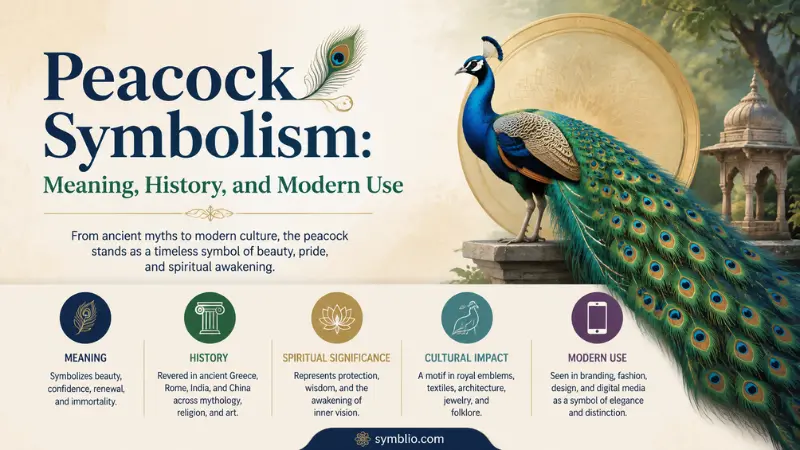
Peacock symbolism reflects a striking tension: the bird can represent beauty and renewal, yet it can also suggest pride and vanity. Its brilliant tail, distinctive “eye” patterns, and dramatic courtship display have made it a recurring subject in mythology, religious art, clothing, architecture, and decorative design.
For readers in the United States, the peacock is usually encountered as an image of beauty, confidence, individuality, or luxury rather than as a fixed religious symbol. Its meaning depends heavily on context. A peacock in a garden may suggest elegance; a feather in jewelry may express individuality; an image in historic Christian art may point toward immortality.
Understanding those differences matters because the bird does not carry one universal message. Its symbolism developed through several cultures, and modern American interpretations often combine older traditions with contemporary ideas about personal style and self-expression.
Quick Answer
Peacock symbolism commonly represents beauty, confidence, individuality, and pride in modern American culture, especially in fashion, art, jewelry, and personal design. Historically, it has also been associated with immortality, renewal, divine protection, paradise, and—in some traditions—vanity.
TL;DR
- Peacocks commonly represent beauty, confidence, and individuality in America.
- Ancient Greek mythology connected the bird with Hera and watchfulness.
- Early Christian art used peacocks to represent immortality and renewal.
- Hindu traditions connect peacocks with major deities and sacred imagery.
- The bird can symbolize vanity when its display becomes excessive.
- Modern design often uses peacock imagery for color, elegance, and self-expression.
What the Peacock Represents at a Glance
The easiest way to understand the symbol is to separate its major associations rather than treating them as one definition.
| Context | Meaning in the USA | Common Associations | Notes |
|---|---|---|---|
| Personal style | Confidence and individuality | Fashion, jewelry, tattoos | Often positive and expressive |
| Home decor | Beauty and elegance | Art, textiles, decorative objects | Usually aesthetic rather than religious |
| Christian art | Immortality and eternal life | Mosaics, funerary imagery | Rooted in late antique traditions |
| Mythology | Watchfulness and divine association | Hera, Argus, sacred birds | Comes from Greco-Roman mythology |
| Negative symbolism | Vanity and excessive pride | Self-display, arrogance | Based partly on the bird’s dramatic behavior |
The important distinction is that pride and confidence are not necessarily the same message. A peacock can symbolize being comfortable with one’s appearance and identity, but it can also represent self-importance when the context emphasizes vanity.
Why the Peacock Looks Symbolic in the First Place
The bird’s physical appearance explains much of its symbolic history.
A male peacock, more precisely a male peafowl, can spread a large train covered with circular markings that resemble eyes. The feathers combine blue, green, bronze, and other iridescent tones, creating an unusually theatrical visual effect.
That display naturally lends itself to symbolism. The bird appears to reveal something hidden when it opens its tail, while the repeated eye-like shapes can suggest observation or awareness.
The symbolism is therefore not arbitrary. Human cultures repeatedly interpreted visible features—especially the changing tail, brilliant colors, and eye-like markings—as signs of larger ideas such as renewal, vigilance, beauty, and pride.
Ancient Greek Roots and the Story of Hera
One of the best-known ancient associations comes from Greek mythology, where the peacock became connected with Hera, the wife of Zeus.
In the myth of Argus, the many-eyed giant was used as a watchful guardian. After his death, Hera was said to have placed his eyes on the peacock’s tail. The story provided an explanation for the bird’s unusual feather patterns while linking it with watchfulness and divine authority.
The Roman goddess Juno was the counterpart of Greek Hera, so the association continued in Roman culture. Peacock imagery consequently appeared in Roman art and decorative objects.
The bird also acquired an association with immortality. Ancient beliefs about the unusual durability of peacock flesh, combined with the seasonal renewal of its feathers, contributed to later interpretations of the bird as something that could survive death or return after apparent loss.
Immortality and Renewal in Christian Art
One of the most important transformations occurred when Christian artists adopted imagery that had already circulated in the Greco-Roman world.
In early Christian art, the peacock became associated with eternal life and immortality. Its appearance in mosaics, catacomb art, and other religious settings allowed an existing image to acquire a new theological interpretation.
The annual renewal of the bird’s tail helped support this meaning. To ancient observers, feathers that disappeared and returned could serve as a visual analogy for renewal after death.
Peacocks also appear in Roman and Byzantine mosaics alongside flowers, vines, grapes, and garden imagery. In these settings, the bird could contribute to a vision of paradise, abundance, spring, or renewed life.
This history is particularly useful when interpreting peacock imagery in churches, cemeteries, historical monuments, and religious artwork. A modern viewer might see decoration; the original audience could have recognized a reference to eternal life.
Pride, Vanity, and the Double Meaning of Beauty
The peacock’s beauty has always had a second side.
Because the bird displays its feathers so dramatically, it became an obvious metaphor for vanity. Someone described as “proud as a peacock” is not simply confident; the phrase can imply excessive self-admiration or showiness.
Art has used this contrast deliberately. A Smithsonian record for a sculpture titled Vanity and Modesty identifies the peacock as a symbol of vanity, demonstrating how the bird could function as a visual shorthand for excessive pride.
This creates one of the symbol’s most interesting tensions:
The same bird can represent healthy confidence or unhealthy vanity.
Context determines which interpretation makes more sense. A peacock used to celebrate individuality may be positive. A peacock placed beside imagery criticizing excessive luxury may carry a warning about self-importance.
What the Peacock Means in the United States
In contemporary American culture, the peacock does not have one official or universally recognized symbolic meaning.
Instead, Americans often encounter it through art, interior design, fashion, gardens, tattoos, jewelry, stationery, and decorative objects. In these settings, the bird tends to communicate visual qualities first: color, elegance, individuality, confidence, and ornamentation.
The American art world has also given the peacock an important cultural presence. James McNeill Whistler’s Peacock Room, now at the Smithsonian’s National Museum of Asian Art, is a particularly notable example. Whistler covered the interior with peacock-inspired forms and used the bird’s blue, green, and gold appearance as a central decorative idea.
The room eventually crossed the Atlantic when American collector Charles Lang Freer purchased it in 1904 and had it reconstructed in Detroit before it became part of the Smithsonian collection.
That history illustrates something important about American interpretations: peacock imagery often works as a bridge between cultures, particularly between European decorative traditions and Asian artistic influences.
Hindu Traditions and Sacred Associations
The peacock has major religious importance in South Asian traditions, especially Hindu art and mythology.
One important association is with Kartikeya, also known as Skanda, Subrahmanya, or Murugan. He is frequently depicted riding or standing beside a peacock, and historical Indian sculpture and painting preserve this imagery across centuries.
The bird is also closely associated with Krishna. Indian museum collections document representations of Krishna wearing a peacock feather, making the feather itself an important part of his visual identity in many artistic traditions.
These traditions should not be reduced to the generic idea that “peacock equals beauty.” Within religious contexts, the bird can carry specific theological and mythological associations that are meaningful to practitioners.
For American readers, this distinction matters when interpreting peacock imagery in Hindu art, religious spaces, or objects created within South Asian traditions.
Peacock Imagery in Chinese Art and Dress
Peacock symbolism also developed differently in China.
The bird was valued for its striking appearance, and peacock feathers were incorporated into textiles and courtly clothing. The Metropolitan Museum of Art documents an eighteenth-century Chinese festival robe embroidered with actual peacock feather filaments, illustrating the high value placed on their unusual color and surface.
Peacock imagery also appears in Chinese theatrical clothing. Museum collections preserve garments featuring elaborate feather designs, with the bird connected to legendary spirits and supernatural figures in Chinese traditions.
These examples show why it is risky to assign one Western meaning to every peacock image. In different cultural settings, the same bird can suggest status, beauty, spirituality, spectacle, or something more specific to a particular legend.
The Meaning of Peacock Colors and “Eyes”
The colors of the peacock often influence how people interpret the symbol today.
Blue commonly contributes a sense of calm, sophistication, or dignity. Green can suggest nature, growth, and renewal. Gold often adds associations with luxury, prestige, or celebration.
These are modern interpretive associations rather than fixed historical rules. A blue-and-gold peacock in an American interior, for example, may simply be chosen because the colors complement a room.
The eye-like markings on the feathers are more complicated. They have been interpreted as signs of watchfulness in connection with the Argus story, while other traditions have associated them with the evil eye or with supernatural protection.
The visual resemblance to eyes is therefore one reason the feather has accumulated such different meanings across cultures.
Peacock Feathers and Superstitions
Not every tradition regards peacock feathers as lucky.
A longstanding theatrical superstition treats peacock feathers as bad luck onstage. The Royal Shakespeare Company notes that the eye pattern has sometimes been associated with the “evil eye,” contributing to the belief that bringing feathers into a theater could invite misfortune.
An American folklore archive likewise documents the belief among theater professionals, showing that the superstition has survived in modern performance culture.
This should be understood as folklore, not as evidence that peacock feathers actually cause bad events.
It is also important not to confuse one regional superstition with a universal rule. In other cultures, peacock imagery can be associated with sacredness, protection, beauty, or good fortune.
Emotional and Psychological Associations
At a psychological level, the peacock often works as a symbol of being seen.
Its open tail is visually difficult to ignore. That makes the bird useful for expressing ideas such as:
- confidence
- self-expression
- individuality
- attractiveness
- visibility
- creativity
- pride
- social presence
But the emotional meaning can move in either direction.
Someone choosing a peacock tattoo may use it to represent becoming more comfortable with individuality. Someone decorating a room with peacock imagery may simply want color and visual drama. An artist might use the bird to question vanity or the desire for attention.
The symbol therefore does not tell us what a person feels automatically. Personal context matters more than a universal dictionary definition.
Why People Choose Peacock Tattoos and Jewelry
Peacock imagery works particularly well in tattoos because the bird has a recognizable silhouette and unusually detailed feathers.
A tattoo may represent confidence, personal transformation, beauty, individuality, or renewal. For someone familiar with Christian symbolism, it might instead suggest eternal life. For someone connected to Hindu culture, a feather or peacock may carry a religious meaning that is much more specific.
Jewelry tends to use a simpler version of the image: a single feather, the eye pattern, or the bird’s curved body.
In American fashion, the motif can also function primarily as decoration. The Metropolitan Museum has documented the continued use of peacock feathers as classical imagery in modern fashion, including designs by major twentieth-century designers.
Peacock Symbolism in Home Decor and Design
Peacock imagery is especially effective in interior design because its colors are visually distinctive.
A peacock motif can bring together blue, green, gold, and jewel-like tones without requiring the room to follow a literal nature theme. Wallpaper, paintings, ceramic pieces, textiles, lamps, and decorative feathers can all use the motif.
The American history of the Peacock Room demonstrates how strongly the image can function as an interior-design language. Whistler transformed the bird into a repeating decorative pattern rather than simply painting an isolated animal.
Today, most American home decor using peacock imagery is secular and aesthetic. It does not necessarily communicate a religious belief or historical symbolism.
How the Meaning Has Changed Over Time
The history of the peacock is best understood as an accumulation of meanings rather than a single uninterrupted tradition.
In Greek and Roman contexts, the bird was connected with Hera or Juno and with watchfulness, divine association, and immortality. Early Christian artists adapted some of those ideas to represent eternal life. Later European traditions also emphasized vanity and pride.
In South Asian religious traditions, the peacock developed specific associations with deities including Kartikeya and Krishna. In Chinese art and dress, its beauty and distinctive feathers became important decorative and cultural features.
Modern America adds another layer: personal style.
The contemporary peacock can be religious, historical, decorative, psychological, or simply beautiful. Its meaning depends on who is using it and why.
Common Misunderstandings About the Symbol
One common mistake is claiming that the peacock always symbolizes vanity. Vanity is certainly part of its history, but so are immortality, renewal, divine association, beauty, and sacred imagery.
Another mistake is treating the feather’s eye pattern as universally negative. The “evil eye” interpretation exists in particular traditions and superstitions, but it does not define the symbol everywhere.
It is also misleading to describe every peacock feather as a religious object. In modern American decor and fashion, feathers are frequently used simply because their colors and patterns are attractive.
Finally, the symbolism should not be detached from its cultural setting. A peacock in a Christian mosaic, a Krishna image, a Chinese textile, and an American tattoo may look similar while communicating very different ideas.
Frequently Asked Questions
What does a peacock symbolize spiritually?
Spiritually, the peacock can represent renewal, immortality, divine beauty, watchfulness, or sacred identity depending on the tradition. Christian, Hindu, and other cultural interpretations should be considered separately rather than combined into one universal meaning.
What does a peacock tattoo mean?
A peacock tattoo often represents confidence, individuality, beauty, creativity, or personal transformation. Its meaning can become more specific when the design draws on a particular religious or cultural tradition.
Is a peacock a symbol of good luck or bad luck?
There is no universal answer. Some traditions and theatrical superstitions associate peacock feathers with bad luck, while other cultures treat the bird as sacred, fortunate, protective, or auspicious.
What does a peacock feather symbolize?
A peacock feather can symbolize beauty, renewal, watchfulness, individuality, or spiritual association. In Hindu imagery, the feather has particular importance through its connection with Krishna.
Why is the peacock associated with vanity?
Its association with vanity comes largely from the bird’s conspicuous display of its elaborate feathers. Western artistic traditions turned that behavior into a metaphor for excessive pride and self-admiration.
Is the peacock a Christian symbol?
Yes, particularly in early Christian and later religious art. It was used to represent immortality and eternal life, partly because ancient beliefs connected the bird with incorruptibility and the seasonal renewal of its feathers.
What does a peacock mean in American culture?
In contemporary American culture, it most often communicates beauty, confidence, individuality, elegance, or visual extravagance. Historical and religious meanings remain important, but everyday decorative uses are usually more personal and aesthetic.
Conclusion
Peacock symbolism brings together several ideas that might initially seem contradictory: beauty and vanity, visibility and humility, mortality and renewal, decoration and religious meaning. Its long history explains why no single definition can cover every appearance of the bird.
In modern America, the peacock most often functions as a symbol of beauty, confidence, individuality, and self-expression, while older traditions continue to give it additional meanings such as immortality, sacred identity, and renewal. The most accurate interpretation comes from looking at the setting, culture, and purpose behind the image.
The peacock is compelling not because it has one fixed message, but because its appearance has given different societies a remarkably flexible way to talk about how people present themselves to the world.