
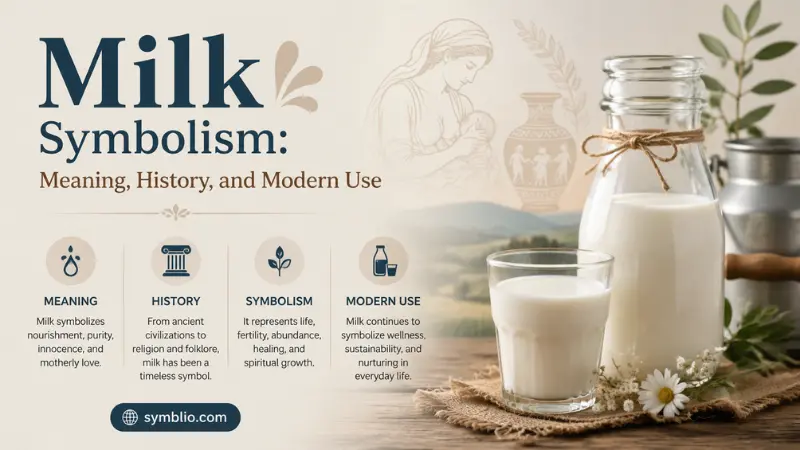
Milk is an ordinary part of daily life, yet it carries a surprising range of symbolic meanings. People often associate it with nourishment, childhood, motherhood, family, health, abundance, and care. Its simple appearance and familiar place in the home have also helped milk become a recognizable image in religion, art, advertising, and popular culture.
In the United States, milk symbolism often centers on childhood, family routines, nutrition, and the idea of wholesome provision. Those associations developed over time through agriculture, religious traditions, public-health campaigns, advertising, and everyday experiences.
Milk also carries older meanings. Ancient agricultural societies connected dairy animals with fertility and prosperity, while religious traditions used milk to express ideas such as blessing, sacred nourishment, purity, and abundance. Looking at these layers helps explain why such a familiar food can communicate so much.
Quick Answer
Milk symbolism commonly represents nourishment, motherhood, childhood, care, and healthy growth in modern American culture. Historically, milk also represented fertility, abundance, purity, prosperity, and divine provision in various religious and agricultural traditions.
TL;DR
- Milk commonly represents nourishment, caregiving, childhood, and growth.
- Motherhood gives milk one of its strongest symbolic associations.
- Religious traditions connect milk with blessing, purity, and sacred provision.
- American culture strongly links milk with family life and childhood nutrition.
- Milk’s white appearance often suggests innocence and cleanliness.
- Modern food culture has expanded milk’s symbolic meanings.
What Milk Represents as a Physical Symbol
Milk begins as a biological substance that sustains young mammals. That basic function gives it one of its clearest symbolic meanings: nourishment.
A mother produces milk to feed her infant, creating an immediate connection between milk and caregiving. The image naturally suggests protection, dependence, growth, and survival. A young child receives something essential from a caregiver, so milk can represent the bond between giving and receiving.
Milk also represents provision because people can collect, store, share, and transform it. A full container can suggest that a household has enough food. Offering milk to another person can suggest hospitality or generosity.
Its appearance adds another layer. Common dairy milk looks white and opaque, which connects it with cultural ideas about cleanliness, innocence, freshness, and simplicity. Western visual traditions often use white to communicate these qualities, although cultures do not interpret white in exactly the same way.
Milk therefore carries several meanings at once. It can suggest physical nourishment, emotional care, domestic security, and visual purity without requiring a single fixed interpretation.
The Core Meanings of Milk
Several symbolic ideas appear repeatedly across cultures and historical periods.
| Context | Meaning in the USA | Common Associations | Notes |
|---|---|---|---|
| Mother and child | Care and nourishment | Protection, growth, dependence | Connected to infant feeding |
| Family life | Childhood and home | Breakfast, routine, comfort | Strong in American culture |
| Religion | Blessing and provision | Purity, fertility, faith | Meaning varies by tradition |
| White appearance | Innocence and cleanliness | Freshness, simplicity | Mainly a visual association |
| Agriculture | Prosperity and productivity | Cattle, farms, food supply | Linked to pastoral life |
| Modern food culture | Choice and identity | Dairy, alternatives, lifestyle | Meanings continue to change |
The central idea remains sustaining life. Because milk provides nourishment, cultures can extend that practical function into ideas about motherhood, fertility, generosity, prosperity, and divine care.
Motherhood, Care, and Early Life
Milk has one of its strongest symbolic connections with motherhood.
Breast milk provides an infant’s first source of nourishment in many circumstances. That intimate relationship gives milk an obvious connection with maternal care and protection. The child depends on another person, while the mother provides something necessary for survival and development.
Art and religious traditions often turn this biological relationship into a broader image of compassion. A mother nursing a child can represent tenderness, protection, fertility, and the continuation of life.
The symbolism can also extend beyond literal breastfeeding. People sometimes use expressions such as “mother’s milk” to describe something fundamental or essential. The phrase works because many cultures recognize maternal milk as an early and basic form of nourishment.
Milk can also suggest dependence. A young child cannot meet every need independently, so receiving milk represents both security and vulnerability. Writers and artists can use that contrast to explore childhood, protection, family relationships, or the transition toward independence.
Fertility and Abundance in Agricultural Traditions
Milk also developed strong connections with fertility and abundance.
Agricultural societies depended heavily on animals such as cattle, goats, and sheep. A healthy herd could provide milk, meat, labor, offspring, trade goods, and long-term economic security. Milk consequently became a visible sign that animals remained healthy and productive.
This connection helped milk symbolize more than biological fertility. It could represent a household’s ability to prosper and continue supporting itself.
For pastoral communities, a productive herd meant reliable food. A plentiful supply of milk suggested that nature and livestock were cooperating with human needs. Over time, those practical realities supported broader associations with prosperity, fertility, and plenty.
Religious imagery often incorporated these agricultural meanings. Milk could represent a land capable of producing food, a blessing that sustained a community, or a prosperous environment where people and animals could thrive.
The specific interpretation varied from one society to another. Still, the connection between milk and productive life remained remarkably intuitive.
Ancient Roots and Early Symbolism
Milk’s symbolic history reaches into societies where dairy production played an important role in everyday life.
People in ancient agricultural communities understood milk as a valuable resource rather than simply another beverage. Producing it required healthy animals, suitable grazing land, and regular care. A dependable supply therefore signaled stability.
Mythology also gave milk symbolic importance. Stories involving divine beings, extraordinary animals, mothers, and nourishment could transform milk into an image of supernatural provision or fertility.
Ancient symbolism did not follow one universal system. Different civilizations assigned different meanings to animals, foods, colors, and bodily substances. Milk sometimes represented fertility and abundance, while another tradition might emphasize nourishment or ritual purity.
The most consistent thread comes from milk’s practical role. People understood its connection to life, growth, reproduction, and food security, then incorporated those ideas into stories and religious practices.
Religious Symbolism of Milk
Several major religious traditions use milk imagery, although their interpretations differ.
In Hindu traditions, cow’s milk holds important ritual and cultural associations. People may use milk in religious offerings and ceremonies, where it can relate to purity, nourishment, fertility, and devotion. The sacred status of the cow also gives milk a significance that goes beyond ordinary food.
Christian traditions contain several forms of milk imagery. Biblical language uses milk in descriptions of nourishment and abundance, while Christian art has frequently depicted the Virgin Mary nursing Jesus. Such imagery emphasizes Mary’s role as a mother and provider of nourishment.
Islamic tradition also includes important references to milk. The Qur’an describes milk among the forms of provision associated with paradise, placing it within a larger image of divine generosity and blessing.
These traditions share certain themes, but they do not assign identical meanings to milk. Religious symbolism depends on specific texts, rituals, beliefs, and historical settings.
Why Milk Became Associated With Purity
Milk’s white color helps explain its association with purity.
In many Western contexts, white suggests cleanliness, innocence, freshness, and simplicity. Milk naturally fits that visual language because its color distinguishes it from many darker or strongly colored foods.
Advertising has reinforced this association. Images of clean glasses, fresh milk, bright kitchens, and healthy children often create an impression of freshness and wholesome living.
Yet history complicates the picture.
Before modern refrigeration, sanitation, and pasteurization, milk could spoil or carry harmful contamination. Nineteenth-century American cities experienced serious public-health concerns involving unsafe milk supplies. Those problems eventually encouraged stronger standards for handling and processing milk.
That history shows why symbolic purity differs from literal safety. Milk can look pure while still requiring careful production and handling. Its cultural image reflects expectations about cleanliness as much as the substance itself.
Milk and American Childhood
Few symbolic associations feel more familiar to many Americans than milk and childhood.
For generations, children encountered milk at breakfast tables, school cafeterias, family dinners, and birthday parties. Cereal with milk, cookies with milk, and a glass of milk at the dinner table became recognizable images of everyday American life.
Schools and public-health campaigns strengthened this relationship. During the twentieth century, nutrition messaging frequently presented milk as an important food for growing children. Advertising reinforced the connection between milk, strong bodies, healthy development, and responsible parenting.
As a result, milk came to symbolize more than nutrition. It could represent a parent’s effort to care for a child and provide a healthy upbringing.
That association remains strong, although it no longer represents every American household. Dietary preferences, allergies, cultural differences, and the growth of plant-based alternatives have broadened the picture.
Milk, Family, and Domestic Comfort
Milk also carries a strong association with the American home.
A carton sitting inside a refrigerator seems ordinary, but its presence can suggest that a household has basic food and follows familiar routines. Milk appears in breakfast scenes, baking, coffee, family meals, and children’s snacks.
Because people encounter it in ordinary domestic settings, milk can trigger feelings of familiarity and comfort. A glass beside a plate of cookies might evoke childhood memories, while a milk jug on a farmhouse table can suggest rural life and family tradition.
The surrounding imagery matters. A glass of milk alone might represent nourishment. Paired with cereal, it can suggest childhood and familiar breakfast routines. Beside a mother and child, the image may emphasize caregiving and maternal support. In a farm setting, milk can instead point toward agriculture, livestock, and rural life.
Symbolic meaning often comes from the combination rather than the object alone.
Milk and the American Idea of Health
American culture has also linked milk with physical health.
Twentieth-century advertising frequently promoted milk as a source of nutrients associated with children’s growth and strong bones. Schools, parents, doctors, farmers, and advertisers all contributed in different ways to the cultural prominence of milk.
This history created an association between milk and responsible health choices. Parents who served milk to children could see the practice as part of providing proper nutrition.
Modern Americans approach the subject with more variety. Dairy milk now shares the market with soy, almond, oat, coconut, and other plant-based beverages. People choose among these options for many reasons, including taste, dietary requirements, culture, environmental concerns, and personal values.
Consequently, milk no longer carries one universally accepted health message. Its symbolic role now reflects a wider debate about food and lifestyle.
Milk in Art, Advertising, and Design
Milk makes an effective visual symbol because people recognize it immediately.
Artists can use a glass of milk to suggest nourishment or childhood. A milk bottle can evoke an earlier period of American domestic life. A farm scene can use cows and milk containers to represent agriculture and rural traditions.
Advertising has expanded these possibilities. Marketers have paired milk with children, athletes, families, cereal, cookies, kitchens, and farm imagery. Each combination highlights a different meaning.
Milk’s color also helps designers create a visual impression of simplicity and freshness. White liquid against a contrasting background can look clean and visually striking.
Because most viewers already understand milk’s everyday associations, designers can communicate an idea quickly without explaining it.
Why People Use Milk Imagery in Personal Expression
Milk appears less frequently in tattoos and jewelry than symbols such as flowers, animals, hearts, or religious objects. When people do choose milk imagery, the meaning usually comes from personal experience.
A milk bottle might represent childhood or a family memory. A cow might express agricultural heritage. A nursing mother could represent motherhood and caregiving. A milk glass could symbolize a particular person, place, or period of someone’s life.
For that reason, no single tattoo dictionary can define milk imagery for everyone.
Personal symbolism works through context. The surrounding objects, words, colors, and memories often matter more than milk itself.
Milk and Nostalgia in Modern American Culture
Milk has become a useful symbol of nostalgia because it belongs to many familiar childhood routines.
A cereal bowl, glass of milk, school lunch, or old-fashioned milk bottle can immediately suggest an earlier period. Films, television programs, advertisements, packaging, and social-media creators sometimes use these images when they want to create a retro or comforting mood.
The nostalgia usually comes from the routine surrounding milk, rather than milk itself.
Someone may remember drinking milk at a grandparent’s house, eating cereal before school, or seeing glass milk bottles delivered to a home. Those memories give the symbol an emotional meaning that varies from person to person.
That variation explains why milk can feel comforting to one person and completely ordinary to another.
How Milk Symbolism Has Changed
Milk’s symbolic meaning has shifted alongside changes in society.
Early agricultural communities connected milk with animal health, fertility, food security, and prosperity. Religious traditions added associations with sacred nourishment, blessing, purity, and divine provision.
Industrialization changed milk’s place in everyday life. Refrigeration, transportation, sanitation, pasteurization, and mass production made milk easier to distribute across large populations.
In the United States, twentieth-century nutrition campaigns and advertising then connected milk with childhood, health, family responsibility, and domestic life.
Today’s food culture adds another layer. Dairy farming, plant-based alternatives, sustainability, personal nutrition, cultural traditions, and changing consumer habits all influence how Americans view milk.
The symbol has therefore evolved from a basic image of nourishment into a more complicated cultural marker.
Common Misunderstandings About Milk Symbolism
People sometimes assume that milk always symbolizes purity. Its appearance supports that association in many Western settings, but milk can just as easily represent motherhood, fertility, abundance, nourishment, or family life.
Another mistake involves religious symbolism. Different faiths use milk in different ways, so readers should avoid combining separate traditions into one generalized meaning.
Modern interpretations also deserve careful treatment. Not every American associates milk with health or comfort. Someone’s family background, cultural experience, dietary choices, or relationship with agriculture can change the meaning.
Milk imagery has also appeared in modern extremist rhetoric that attempts to connect whiteness with racial “purity.” Such interpretations do not represent the older agricultural, maternal, or religious meanings of milk. They reflect a later ideological appropriation of an existing symbol.
Keeping those interpretations separate prevents historical symbolism from becoming confused with modern misuse.
Why Milk Remains a Familiar Symbol Today
Milk continues to work as a symbol because its basic function remains easy to understand.
It nourishes young life. People share it, produce it, store it, and associate it with family meals. Those ordinary experiences provide a foundation for broader ideas about care, provision, growth, fertility, and belonging.
Modern culture has added new interpretations without eliminating the older ones. Milk can now suggest childhood nostalgia, agricultural identity, changing food habits, or personal choices alongside its traditional associations.
Its symbolism survives because people keep connecting the familiar object with changing experiences.
FAQs
Milk can represent nourishment, blessing, fertility, purity, and divine provision in religious contexts. The exact meaning depends on the tradition, text, ritual, and surrounding imagery.
Yes. Milk strongly represents motherhood because maternal milk provides nourishment for infants and creates a direct connection between caregiving and early life. Religious and artistic traditions have expanded this idea into broader images of maternal protection and compassion.
Milk can symbolize purity because its white appearance often suggests cleanliness and innocence in Western visual culture. However, purity represents only one part of its broader symbolism.
Milk commonly represents childhood, family routines, nutrition, health, and domestic comfort in the United States. Advertising, schools, agriculture, and family traditions helped establish these associations.
Dream symbolism has no single scientific dictionary. Milk might relate to nourishment, caregiving, childhood, comfort, dependence, or abundance depending on the dreamer’s personal experiences and the rest of the dream.
Milk and honey traditionally suggest abundance, prosperity, fertile land, and plentiful provision. The pairing has a particularly strong association with biblical descriptions of a richly productive land.
Yes. A steady milk supply traditionally depended on healthy animals, productive land, and successful farming. For that reason, milk can represent fertility, prosperity, food security, and the ability to provide for a household.
Conclusion
Milk carries a wide range of meanings, but nourishment sits at the center of most interpretations. From motherhood and childhood to agriculture and religion, milk represents the act of providing what living beings need to grow and survive.
In the United States, milk became especially connected with family life, childhood nutrition, health, and domestic routines. Older associations with fertility, abundance, purity, and sacred provision continue to influence how people understand it.
The meaning of milk symbolism ultimately depends on context. A glass on a breakfast table, a religious offering, a farm scene, and a childhood photograph can all communicate different ideas. What connects them is the familiar human experience of receiving, sharing, and providing nourishment.


