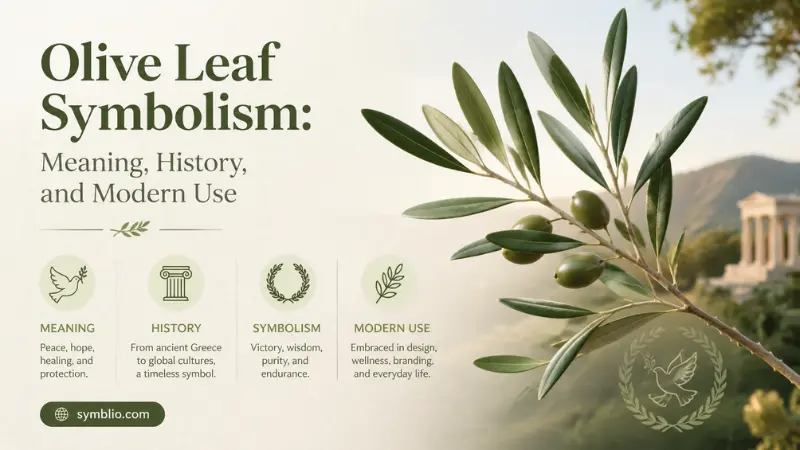
The olive leaf is one of the most recognizable symbols of peace in Western culture, especially when it appears in the beak of a dove or in the hand of a person offering reconciliation. Olive leaf symbolism also reaches beyond peace, carrying associations with victory, renewal, endurance, prosperity, and religious tradition.
Its meanings developed over a very long period rather than coming from one single culture. Ancient Mediterranean societies valued the olive tree for food, oil, agriculture, and religious reasons, while Greek and Roman traditions connected olive branches with victory and peaceful intentions. Biblical traditions later gave the olive leaf a particularly familiar place in the story of Noah and the flood.
In the United States, the symbol took on an especially civic meaning. The olive branch appears on the Great Seal of the United States alongside arrows, creating a visual contrast between the desire for peace and the ability to defend the nation. That history helps explain why the olive leaf still feels appropriate in American political art, diplomacy, weddings, memorial designs, jewelry, tattoos, and home decor.
Quick Answer
Olive leaf symbolism commonly represents peace, reconciliation, and a willingness to avoid conflict in modern American culture. Historically, olive leaves and branches have also represented victory, renewal, prosperity, sacred tradition, and peaceful intentions across Mediterranean, biblical, and classical cultures.
TL;DR
- Olive leaves most commonly symbolize peace and reconciliation.
- Ancient Greeks associated olive wreaths with victory and honor.
- Biblical traditions connected the olive leaf with renewed life.
- America adopted the olive branch as a national peace symbol.
- Today it appears in weddings, tattoos, jewelry, and decor.
- Its meaning depends strongly on context and design.
What an Olive Leaf Symbol Actually Looks Like
An olive leaf is narrow, elongated, and usually pointed at both ends. Its upper surface is typically gray-green to silvery green, while the underside can appear noticeably lighter because of its fine hairs.
That appearance contributes to some modern decorative interpretations. Olive leaves look understated rather than showy, which makes them popular in minimalist botanical designs.
It is also important to distinguish an olive leaf from an olive branch. A single leaf can suggest the broader symbolism of the olive tree, while a branch—especially one being offered or held—more specifically communicates peace or reconciliation.
This distinction matters when interpreting artwork. A wreath of olive leaves may suggest victory or achievement, whereas a single olive branch extended toward another person is much more likely to mean peace.
What Olive Leaves Commonly Mean in the United States
For Americans, the strongest association is peace.
This meaning is particularly clear because of the Great Seal of the United States. The bald eagle holds an olive branch in one talon and arrows in the other. The two objects represent the nation’s capacity for peace and war, while the eagle’s orientation toward the olive branch emphasizes the preference for peace.
The symbol therefore has a distinctly American political dimension. It does not necessarily mean weakness, surrender, or refusing to defend oneself. Instead, it can communicate a preference for peaceful resolution while acknowledging the possibility of conflict.
That distinction is important. In American civic symbolism, an olive branch can mean something closer to “peace is preferable” than simply “there should never be conflict.”
The Historical Roots of Olive Leaf Symbolism
The symbolism of the olive tree developed in the Mediterranean, where olive cultivation was deeply connected with everyday life.
Olive oil was valuable for cooking, lighting, personal care, religious practices, and commerce. Because olive trees can survive difficult growing conditions and remain productive for many years, the tree naturally became associated with continuity and abundance.
In ancient Greece, the olive tree was also connected with Athena and the city of Athens. Olive wreaths became associated with honor and athletic achievement, including the ancient Olympic Games, where victorious competitors received wreaths made from sacred wild olive branches.
The symbolism therefore was never limited to peace. Depending on the setting, an olive leaf could represent victory, status, honor, fertility, prosperity, or divine favor.
Later Mediterranean and European traditions combined several of these associations, gradually giving the olive branch an increasingly recognizable role as an emblem of peaceful intentions.
The Olive Leaf in the Bible and Christian Tradition
One of the best-known stories associated with the olive leaf appears in Genesis.
After the flood, Noah sends out a dove. The dove eventually returns carrying a freshly plucked olive leaf, showing that vegetation has reappeared and that the waters are receding. The biblical passage itself focuses on the physical sign that the land is becoming habitable again; the later Christian tradition increasingly connected this image with peace and reconciliation.
This distinction is worth remembering.
The familiar image of a dove carrying an olive branch as a universal peace symbol developed over time. It is not simply a one-to-one definition of every reference to an olive tree or leaf in the Bible.
Christian art eventually made the dove-and-olive image especially recognizable. It came to suggest peace after turmoil, reconciliation, and the restoration of life.
The olive tree also has other biblical meanings. In Romans, for example, the apostle Paul uses an olive tree and its branches as an extended metaphor concerning Israel, Gentile believers, faith, and belonging. That passage is about religious relationships and covenant imagery rather than the modern idea of a peace offering.
Olive Leaves in Ancient Greek Culture
Ancient Greek symbolism adds another important layer: victory and honor.
Athletic winners at the ancient Olympic Games were crowned with olive wreaths rather than the gold medals familiar today. The wreath therefore represented exceptional achievement.
Greek tradition also associated the olive tree with Athena. In the mythology surrounding Athens, Athena’s gift of the olive tree helped establish her relationship with the city.
This history explains why an olive wreath can carry a different message from a single olive branch.
A wreath may suggest:
- achievement
- victory
- honor
- athletic excellence
- distinction
- connection with classical Greece
A branch offered toward someone else usually points more directly toward peace.
The physical form changes the interpretation.
Olive Leaf Symbolism in American History
The olive branch became particularly important to the United States during the Revolutionary era.
In 1775, the Continental Congress sent the Olive Branch Petition to King George III in an effort to prevent further escalation with Britain. Although the attempt failed, the episode reinforced the association between the olive branch and a desire for peaceful settlement.
The symbol was then incorporated into the developing visual language of the new nation.
The Great Seal, approved in 1782, placed an olive branch and arrows in the eagle’s talons. Charles Thomson’s explanation described them as representing the power of peace and war vested in Congress.
This is one reason olive symbolism has such a strong place in American civic culture. It is not merely an imported classical image. The olive branch became part of the visual vocabulary of the United States during the country’s founding period.
| Context | Meaning in the USA | Common Associations | Notes |
|---|---|---|---|
| Great Seal | Peace and diplomatic preference | Government, diplomacy, national identity | Paired with arrows |
| Dove with olive branch | Peace and reconciliation | Religious art, humanitarian imagery | Widely recognized |
| Olive wreath | Achievement and honor | Sports, awards, classical imagery | Rooted in ancient Greece |
| Wedding design | Peace and harmony | Marriage, unity, new beginnings | Modern decorative use |
| Tattoo or jewelry | Personal peace or renewal | Identity, healing, remembrance | Meaning varies by wearer |
Why Olive Leaves Suggest Peace
The peace association works partly because of how the branch is used.
An olive branch is not naturally a weapon. Offering one therefore creates a visual contrast with aggression. Someone extending an olive branch is symbolically choosing communication or reconciliation instead of confrontation.
The image became especially effective when combined with the dove. The dove itself had religious and cultural associations, while the olive leaf supplied the recognizable sign of restored land and peaceful intention.
Over time, the combination became easy to understand without explanation.
That is why an olive branch can appear in a political cartoon, a memorial, a diplomatic emblem, or a greeting card and still communicate roughly the same basic idea: “Let us move toward peace.”
Olive Leaves as Symbols of Renewal and New Beginnings
Peace is the most familiar interpretation, but renewal is another important meaning.
The biblical flood story is central to this association. The returning dove carrying an olive leaf indicates that the devastated landscape is becoming habitable again. The image naturally lends itself to ideas of restoration and a new beginning.
This makes olive leaves particularly suitable for occasions involving transition.
People may choose olive imagery for:
- weddings
- new homes
- graduation announcements
- memorial artwork
- recovery-themed designs
- new-business branding
- personal milestones
In these contexts, the leaf does not necessarily mean political peace. It can instead communicate “life is beginning again” or “a difficult period has passed.”
Olive Leaves, Victory, and Achievement
The ancient Olympic tradition gives olive leaves another established meaning: victory.
This is one reason olive wreath imagery appears in medals, awards, academic designs, sports graphics, and classical-inspired artwork.
The wreath carries a different emotional message from the peace branch. Instead of asking for reconciliation, it celebrates accomplishment.
This creates an interesting duality in olive symbolism. The same plant can represent both peace and victory, depending on how it is arranged.
A wreath placed around a person’s head or an emblem usually suggests honor or achievement. A branch held out toward another person usually suggests peaceful intentions.
Context is therefore more reliable than the plant alone.
Religious and Cross-Cultural Meanings
Olive symbolism appears across several religious and cultural traditions, particularly those connected with the Mediterranean and Near East.
In Jewish and biblical traditions, olive trees are associated with agricultural abundance, oil, anointing, prosperity, and the land. Biblical imagery also uses olive trees metaphorically when discussing communities and relationships with God.
In Christianity, the olive leaf became strongly associated with peace through the development of the dove-and-olive image. Christian funerary and artistic traditions have also used the motif to communicate peace and hope.
In ancient Greek culture, olive branches were associated with victory, sacred tradition, and peaceful supplication. Roman culture inherited and adapted several of these associations.
Other Mediterranean and Middle Eastern cultures have also treated the olive tree as an important marker of land, continuity, livelihood, and peace.
These traditions overlap, but they should not be treated as though they all assign exactly the same meaning. Olive symbolism has always depended on cultural setting.
The Emotional Meaning of an Olive Leaf
At an emotional level, an olive leaf tends to communicate calm rather than excitement.
People may choose it when they want a symbol that feels restrained, mature, and non-aggressive. Unlike a heart, which immediately suggests affection, or a rose, which can suggest romance, an olive leaf tends to express a quieter form of feeling.
Its emotional associations can include:
- reconciliation after disagreement
- acceptance
- calm
- hope after hardship
- emotional balance
- respect
- remembrance
- a desire for harmony
This makes olive imagery useful when someone wants to communicate peace without using words.
The muted green and silver coloring can reinforce that impression. Green is often associated with life and renewal, while the silvery underside of an olive leaf gives botanical designs a subdued, natural appearance.
Olive Leaves in Weddings and Home Decor
Olive branches have become popular in American wedding design because they can symbolize harmony without being overly sentimental.
They appear in invitations, table arrangements, ceremony arches, printed menus, place cards, and floral compositions. In these settings, the symbolism usually combines peace, partnership, growth, and a new chapter.
Home decor uses the imagery in a similar way.
An olive branch print can suggest hospitality and calm. A wreath may create associations with natural simplicity, Mediterranean design, or traditional craftsmanship.
Not every decorative olive leaf is intended to carry a formal symbolic message. Sometimes it is simply chosen because the shape is attractive. Good interpretation therefore requires considering the surrounding design rather than assigning a fixed meaning to every botanical image.
Why People Choose Olive Leaves for Tattoos and Jewelry
Olive leaf tattoos often have personal meanings rather than universally established ones.
Someone might choose an olive branch to represent peace after a difficult period, reconciliation with another person, a new beginning, or a commitment to living calmly.
An olive wreath can instead represent accomplishment or a personal milestone.
Jewelry follows the same principle. A small olive branch pendant can function as a reminder of peace, while an olive-leaf motif incorporated into a larger design may simply reflect Mediterranean aesthetics.
The most accurate interpretation is therefore often the wearer’s own explanation.
Unlike a national emblem, a personal tattoo does not have to follow one historical definition.
Olive Leaf Symbolism in Modern Digital Culture
The olive branch remains easy to recognize online because its meaning can be understood quickly.
A small olive branch emoji, illustration, icon, or line drawing can communicate peace without requiring much text. It may appear in posts about reconciliation, humanitarian causes, memorials, personal reflection, or international events.
Digital design has also simplified the olive leaf into clean outlines and minimalist graphics. This has made the motif especially compatible with contemporary branding and social-media aesthetics.
At the same time, online use can weaken historical distinctions. A decorative olive branch may be used simply because it looks elegant, while viewers assume a symbolic meaning that the designer never intended.
Common Misunderstandings About Olive Leaf Symbolism
One common mistake is treating peace as the only meaning of every olive leaf.
Historically, olive symbolism includes victory, honor, prosperity, religious significance, agricultural abundance, and renewal. The peace association is extremely important, but it is only one part of the larger tradition.
Another misunderstanding is assuming that the olive leaf has always meant peace in exactly the same way across every culture. Its meanings developed differently in Greek, Roman, Jewish, Christian, American, and other traditions.
There is also a tendency to treat the biblical story of Noah as though it directly created the entire modern peace symbol. The connection is important, especially in Christian visual culture, but the broader history of the olive branch as a peace gesture extends into classical and later political traditions.
Finally, an olive branch should not automatically be interpreted as a political statement. In modern America, it can be religious, personal, decorative, romantic, commemorative, or simply botanical.
How Olive Leaf Meaning Has Changed Over Time
The symbolism has gradually expanded rather than simply changing from one meaning to another.
In ancient Mediterranean societies, the olive was tied to practical survival, agriculture, sacred traditions, victory, and status. Biblical traditions added associations with land, abundance, covenant, restoration, and religious identity.
Christian art helped establish the dove carrying an olive branch as an image of peace. European political culture later used the branch as a diplomatic emblem.
The United States gave the image a particularly clear civic expression by placing it beside arrows on the Great Seal.
Modern American culture has taken the symbol into personal and commercial settings. Today an olive leaf can appear on a government emblem, a wedding invitation, a tattoo, a piece of jewelry, a restaurant logo, or a living-room print.
The basic meaning survives, but the context determines which layer matters most.
What Olive Leaf Symbolism Means Today
For most Americans today, the first interpretation of an olive branch or olive leaf is peace.
But a closer look reveals a broader vocabulary: reconciliation, renewal, victory, honor, endurance, prosperity, and connection to long-standing religious and Mediterranean traditions.
That range is what makes the symbol useful. It can express peace between nations, harmony between partners, hope after hardship, or pride in an achievement without changing its basic visual identity.
Its strongest meanings are not created by vague ideas of “energy” or “mystery.” They come from recognizable historical stories, political emblems, religious imagery, and everyday human experiences.
FAQs
An olive leaf can symbolize peace, restoration, hope, and renewed life in spiritual contexts. In Christianity, its association with Noah and the dove has made it especially recognizable as an image of peace and reconciliation.
On the Great Seal, the olive branch represents the power of peace, while the arrows represent the power of war. Together they communicate that the United States seeks peace while retaining the ability to defend itself.
Yes. Olive wreaths represented victory and honor in ancient Greek athletic traditions, including the ancient Olympic Games. A wreath therefore has a stronger association with achievement than a single olive branch.
An olive branch tattoo often represents peace, reconciliation, renewal, or overcoming a difficult period. Its personal meaning can vary considerably depending on the other imagery and the reason the person chose it.
No. Olive symbolism predates Christianity and appears in ancient Greek, Roman, Jewish, and other Mediterranean traditions. Christianity adopted and developed particular associations, especially through the dove and olive image.
At a wedding, olive leaves commonly suggest harmony, peace, partnership, and a new beginning. They can also simply provide a natural Mediterranean-inspired decorative style.
Not necessarily. An olive wreath is strongly associated with victory, achievement, and honor because of ancient Greek traditions, while an offered olive branch is more commonly understood as a gesture of peace or reconciliation.
Conclusion
The meaning of the olive leaf is broader than the familiar phrase “symbol of peace.” Its history connects the plant with victory in ancient Greece, religious imagery in biblical and Christian traditions, and diplomacy and national identity in the United States.
Today, olive leaf symbolism most commonly communicates peace and reconciliation, but it can also represent renewal, achievement, endurance, prosperity, and a new beginning. The surrounding context—whether a Great Seal, wedding arrangement, wreath, tattoo, or decorative print—determines which meaning comes forward.
What makes the olive leaf enduring is its ability to express a simple human preference: choosing restoration, cooperation, or hope when conflict and hardship could otherwise define the moment.