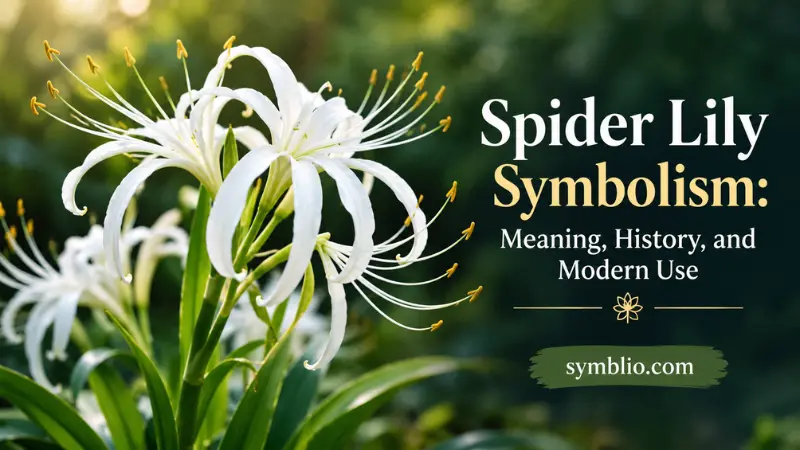
Spider lilies are striking flowering plants known for their long, narrow petals and curved, spiderlike stamens. Their unusual shape makes them easy to recognize, but their symbolism depends on the species, cultural tradition, flower color, and circumstances in which people encounter them. In spider lily symbolism, themes such as remembrance, transition, separation, beauty, and renewal often appear together.
In the United States, spider lilies attract attention through ornamental gardening, floral photography, tattoo designs, and interest in Japanese and East Asian cultural traditions. Their vivid red flowers, in particular, can suggest intense emotion, farewell, or the beauty of something that does not last forever.
However, spider lilies do not have one universal meaning. The red spider lily associated with Japanese autumn traditions carries different cultural associations from the red, white, and pink spider lilies grown in American gardens. Understanding these distinctions helps explain why the same flower can represent both loss and hope.
Quick Answer
Spider lily symbolism commonly connects the flower with remembrance, separation, transformation, and the beauty of life’s transitions, particularly when people encounter red spider lilies in Japanese-inspired art and popular culture. Historically, red spider lilies have strong associations with death and the afterlife in Japanese folklore, while other spider lily varieties are also appreciated for their seasonal beauty, renewal, and ornamental appeal.
TL;DR
- Remembrance: Red spider lilies often evoke memories of people or times gone by.
- Separation: Japanese traditions associate them with farewells and the boundary between life and death.
- Transformation: Their seasonal appearance can suggest change and life’s passing stages.
- Beauty: Curved petals and long stamens create a distinctive, dramatic floral form.
- Renewal: Autumn blooms can mark a seasonal transition rather than an ending alone.
- Modern use: Tattoos, gardens, illustrations, and fashion draw on their visual and cultural associations.
What a Spider Lily Looks Like and Why Its Shape Matters
The spider lily gets its name from its unusually shaped flowers. Depending on the species, its petals or petal-like segments extend outward in narrow, curling lines, while long stamens reach beyond the flower’s center. The result resembles a spider’s legs, a burst of fireworks, or delicate ribbons suspended in the air.
The red spider lily, scientifically known as Lycoris radiata, is particularly recognizable. Its vivid red flowers appear on tall, mostly leafless stems, creating the impression that the blossoms have emerged suddenly from the ground. White spider lilies belonging to the genus Hymenocallis look different, with pale, often fragrant flowers and a distinctive central structure.
These physical characteristics help explain several common symbolic interpretations:
- Fragility: The slender petals suggest delicacy and the temporary nature of beauty.
- Individuality: Its unusual shape makes the flower stand apart from familiar garden blooms.
- Sudden change: Some varieties flower before their leaves appear, giving the plant a surprising, almost unexpected presence.
- Connection and distance: The spreading petals can suggest reaching outward, although this is a personal interpretation rather than an established traditional meaning.
The flower’s appearance provides a starting point for symbolism, but cultural history gives certain varieties much more specific associations.
The Central Meanings of Spider Lily Symbolism
Spider lilies can represent several ideas at once, and their associations are not always positive or negative. Remembrance, separation, beauty, and transformation are among the most common interpretations, especially when the red spider lily is the focus.
Remembrance reflects the way flowers become connected to people, places, and moments from the past. A spider lily may serve as a personal reminder of someone who is absent or of a chapter of life that has ended.
Separation has a more specific cultural connection to the red spider lily in Japan. Its association with autumn memorial observances and graves has helped link it with farewells and the distance between the living and the dead.
Transformation comes partly from the plant’s unusual growth cycle. The flowers emerge on bare stems, while the leaves develop at a different time. This separation creates a visual reminder that change does not always happen in a predictable or continuous way.
Beauty amid sadness is another interpretation. The brilliant color and elaborate shape can make the flower beautiful even in settings associated with mourning. Its appearance does not remove the sadness of a farewell; instead, it offers a visual expression of remembrance.
These meanings overlap, but they are not interchangeable. Someone choosing a spider lily for a garden may simply appreciate its appearance, while someone selecting it for a memorial artwork may be responding to its cultural associations.
Ancient Roots and the History of the Red Spider Lily
The red spider lily has a long history in East Asia. Lycoris radiata originated in China and became established in Japan long ago. Its presence near agricultural fields, roadsides, embankments, and burial grounds contributed to the ways communities encountered and interpreted it.
In Japan, the flower is known as higanbana, a name associated with higan, the Buddhist observance connected with the autumn and spring equinoxes. The autumn observance falls around the time when red spider lilies commonly bloom, creating a close relationship between the flower and seasonal remembrance.
The plant’s striking appearance and association with graves helped establish its somber reputation. Over generations, local names, stories, religious associations, and practical uses contributed to a complex cultural identity.
The flower is also called manjushage, a name connected with Buddhist imagery and the Sanskrit term mañjūṣaka, often associated with a celestial flower in Buddhist tradition. This connection introduces a different interpretation: the flower is not simply an emblem of death or misfortune but can also carry sacred or auspicious associations.
It is important to distinguish documented cultural practices from later legends. Popular stories may offer dramatic explanations for why the flower grows near graves or represents separation, but not every story has a verified ancient origin.
The history of the spider lily is therefore not a single story about death. It is a combination of seasonal observation, religious tradition, community practices, and changing interpretations.
Why Spider Lilies Are Associated With Death and Farewells
The association between red spider lilies and death is especially strong in Japanese culture. Their autumn flowering period coincides with Ohigan, when families traditionally honor ancestors and visit graves. The flowers’ presence around burial grounds reinforced their connection with mourning and remembrance.
Their unusual growth pattern may also contribute to their symbolism. The blossoms appear without accompanying leaves, and the foliage emerges later. Japanese descriptions sometimes express this separation through the idea that the flowers and leaves never meet. As a symbolic image, this suggests two things that belong together but remain apart.
That image lends itself to themes of farewell, missed connections, and relationships interrupted by circumstance.
In contemporary storytelling, red spider lilies often appear in scenes involving death, memory, separation, or the boundary between different worlds. Their recognizable shape and cultural background make them useful visual shorthand for emotionally complicated situations.
Still, the flower does not carry the same meaning everywhere. A red spider lily growing in an American garden is not automatically a sign of grief, and an illustration featuring one does not necessarily predict a loss.
The distinction matters because symbolism describes cultural associations, not supernatural rules. The flower’s connection with death comes from history, setting, and storytelling rather than any inherent ability to signal future events.
Spider Lily Symbolism in the United States
In the United States, spider lilies have a more varied public identity. Many Americans encounter them through ornamental gardening, botanical photography, floral artwork, or online discussions of Japanese culture.
In warmer regions, gardeners may grow spider lilies for their distinctive flowers and seasonal color. The plants can also be encountered in public gardens and landscapes where suitable species thrive. In these settings, the flower’s visual appeal and horticultural qualities often matter more than its associations with mourning.
American interpretations are also shaped by the country’s multicultural population. People familiar with Japanese traditions may recognize the red spider lily as a symbol of remembrance or separation, while others may encounter the flower without knowing its history.
Its appearance in digital art, animation-inspired illustrations, and popular storytelling has expanded its recognition among audiences interested in East Asian imagery. Some people adopt its associations with memory, change, or bittersweet beauty, while others simply appreciate its dramatic form.
Unlike roses for Valentine’s Day or white flowers at many American memorial services, spider lilies do not have one widely established national role in American ceremonies. Their meaning is usually more personal or dependent on cultural knowledge.
For this reason, the most accurate interpretation in the United States begins with context. The flower may represent a horticultural interest, a connection to Japanese culture, an artistic preference, or a private memory.
What Different Spider Lily Colors Can Represent
Color can influence how people interpret a flower, but there is no universal dictionary that assigns a fixed meaning to every spider lily color. Some associations come from established cultural traditions, while others are modern or personal interpretations.
The red variety has the strongest association with Japanese autumn traditions, remembrance, separation, and death. Its vivid color can also suggest passion, intensity, and dramatic beauty in contemporary art.
White flowers may suggest peace, simplicity, purity, or remembrance in personal and floral designs. These interpretations depend on the culture and occasion rather than a single established spider lily tradition.
Pink-toned lilies, including related Lycoris varieties sometimes grouped under common spider lily names, may be used to express affection, tenderness, or gentle remembrance. Botanical identification matters because not every pink Lycoris is the same species as the red spider lily.
Yellow varieties and related species can suggest warmth, optimism, or seasonal brightness in modern floral interpretation. These meanings are generally broader color associations, not universal traditional meanings attached specifically to spider lilies.
When choosing a flower for a gift, tattoo, or memorial, consider both the actual species and the message you want to communicate. A color alone cannot determine the flower’s meaning.
Spider Lilies in Japanese and Other Cultural Traditions
Japan provides the clearest example of a spider lily developing a distinctive cultural meaning. The red spider lily’s flowering season, its presence near graves and rural pathways, and its association with Ohigan have connected it with remembrance and the boundary between life and death.
Buddhist imagery adds another dimension. The name manjushage is associated with a celestial flower mentioned in Buddhist tradition, demonstrating that the same flower can carry both solemn and auspicious associations. Its meaning depends on the story or religious context in which it appears.
In China, where Lycoris radiata originated, the plant has a long botanical and cultural history of its own. However, interpretations should not be assumed to match Japanese traditions exactly. Regional names, religious practices, folklore, and local uses can differ.
The phrase spider lily also covers multiple plant species, including white-flowered Hymenocallis species found in parts of the Americas. These plants do not automatically inherit every association attached to the red Japanese higanbana.
This distinction is important when discussing cultural symbolism. A flower may share a common English name with another species while having a different history and role in its native environment.
Rather than treating Asian traditions as one unified belief system, it is more accurate to identify the particular plant and cultural setting. That approach preserves the richness of the flower’s history without turning regional meanings into universal claims.
The Emotional and Psychological Meaning of Spider Lilies
Flowers often become emotionally meaningful because people connect them with personal experiences. A spider lily may remind someone of a family member, a place visited during a difficult period, or an important transition in life.
Its visual qualities can support these interpretations. The red flower is vivid and dramatic, while its narrow, curling petals create an impression of movement. This combination may feel expressive rather than calm, making the plant appealing to people who want floral imagery with a strong emotional character.
For some people, the flower represents the ability to remember without remaining trapped in the past. For others, it expresses the complicated feeling of accepting that a relationship, opportunity, or period of life has ended.
Its seasonal appearance can also encourage reflection. Flowers bloom, fade, and return according to their own cycles. People may use that pattern as a metaphor for changing circumstances, renewed understanding, or the continuation of life after a loss.
These responses are personal interpretations, not psychological effects proven to be caused by the flower itself. Someone who finds spider lilies unsettling may respond differently from someone who considers them beautiful or comforting.
The most meaningful interpretation is often the one that reflects the person’s actual experience rather than a prescribed symbolic definition.
Spider Lily Tattoos and Personal Identity
Spider lily tattoos appeal to people who want floral artwork with a recognizable shape and an association that can carry emotional weight. Their long stamens and curling petals create a design that works well in both delicate linework and larger, detailed compositions.
A tattoo featuring a red spider lily may express remembrance, acceptance of change, or a personal connection to Japanese culture. It may also represent a character, story, or artistic work that uses the flower as a recurring image.
Other people choose spider lilies for their appearance alone. A tattoo does not need to carry a traditional or spiritual meaning to be personally significant.
The surrounding design can influence its interpretation. A flower paired with a date may commemorate a particular event. A composition featuring several blooms may represent a period of personal growth, while a single flower can emphasize individuality or a specific memory. These are creative choices, not fixed cultural rules.
Anyone considering a spider lily tattoo should also understand the cultural associations of the red variety if the design draws explicitly on Japanese imagery. Learning the background can help prevent an unintended message, particularly when the artwork includes other religious or memorial symbols.
Ultimately, a spider lily tattoo can be both visually distinctive and personally meaningful without claiming that its symbolism is universal.
Spider Lilies in Art, Literature, and Popular Culture
The red spider lily has become a recognizable image in modern visual storytelling, especially in works that draw on Japanese cultural imagery. Its bright petals contrast sharply with dark backgrounds, misty landscapes, and muted surroundings, making it useful for creating an atmosphere of suspense or sadness.
Artists may use the flower to suggest that a character has reached a turning point. A field of red blooms can evoke a boundary between past and present, while a single flower may stand for a memory that remains important after a separation.
In literature and screen-based storytelling, the flower can operate as a visual motif rather than a literal statement. Its appearance might foreshadow a farewell, reinforce a character’s grief, or recall an earlier event.
Online illustrations and fan communities have also introduced the red spider lily to people who may not encounter it in gardens or traditional cultural settings. These audiences sometimes associate it with particular fictional scenes or characters.
Such uses can expand the flower’s modern meaning, but they should not be confused with historical Japanese beliefs. A symbol used in a contemporary story may reflect an artist’s interpretation rather than a universal cultural tradition.
How Spider Lilies Are Used in Gardens and Floral Design
In American gardening, spider lilies are often valued for their unusual flowers and seasonal appearance. Different species suit different growing conditions, so the common name alone is not enough to determine which plant belongs in a particular landscape.
White Hymenocallis species are grown for their elegant flowers and can suit warm-climate gardens. Red Lycoris radiata is known for its striking late-summer or autumn display, often appearing after its foliage has died back.
In design, the flower can create a strong focal point because its shape differs from the rounded petals of roses or peonies. Gardeners may plant it alongside grasses or other seasonal plants to highlight the contrast between its slender flowers and surrounding foliage.
Its symbolic meaning may influence placement. A person creating a reflective garden might choose red spider lilies for their association with remembrance, while another gardener may select white varieties for their appearance and fragrance.
Spider lilies are not standard choices for every American wedding, funeral, or holiday. Their suitability depends on availability, climate, the event’s cultural context, and the preferences of the people involved.
The practical meaning of the flower is therefore often straightforward: it brings a distinctive form and seasonal character to a space, with symbolic associations available to those who want them.
Spider Lily Symbolism in Dreams and Spiritual Interpretations
Some contemporary spiritual and dream interpretations treat spider lilies as symbols of transition, letting go, memory, or personal reflection. A person who dreams of a spider lily might interpret it as an invitation to think about an ending or a relationship that still matters.
Such interpretations are best understood as personal reflection rather than established fact. There is no reliable basis for claiming that seeing a spider lily in a dream predicts death, guarantees reunion, or signals a supernatural message.
Religious interpretations also require care. The red spider lily’s associations with Buddhist imagery and Japanese memorial traditions are historically and culturally specific. They do not establish that every spider lily has a universal spiritual meaning.
For someone who finds the flower spiritually significant, it may serve as a reminder to honor memories, accept change, or consider what deserves attention in the present. Those meanings can be valuable without being treated as supernatural guarantees.
The distinction between cultural tradition and personal spirituality allows people to appreciate the flower while remaining respectful of the traditions that shaped its reputation.
Common Misunderstandings About Spider Lily Symbolism
Several misconceptions arise because different plants share the same common name and because modern media often simplifies cultural symbols.
The first misunderstanding is that every spider lily means death. The red Lycoris radiata has a well-established connection with mourning and separation in Japan, but the common name also applies to other species whose cultural and horticultural contexts differ.
The second is that the flower is universally unlucky. Some Japanese folk names reflect fear or avoidance, while Buddhist associations and modern artistic interpretations offer other perspectives. A negative association in one setting does not define every use.
The third is that all spider lily colors have fixed meanings. Color symbolism varies across cultures and occasions. Interpretations such as hope, purity, or affection may be meaningful to individuals without representing a formal tradition.
The fourth is that the flower predicts future events. Its appearance in a garden, artwork, or dream is not evidence that a particular event will occur.
Finally, the common name can cause botanical confusion. The white spider lily Hymenocallis littoralis and the red spider lily Lycoris radiata belong to the same broader plant family but are different plants. Their appearance, growth requirements, and cultural associations should not be treated as identical.
Understanding these differences makes the symbolism more accurate and prevents folklore from being presented as universal fact.
Comparing Spider Lily Meanings Across Different Contexts
The following table summarizes common interpretations while distinguishing traditional associations from modern personal uses.
| Context | Common interpretation | Important distinction |
|---|---|---|
| Japanese autumn traditions | Remembrance, separation, death | Particularly associated with red Lycoris radiata |
| Buddhist imagery | Celestial or auspicious flower | Depends on the specific religious context |
| American gardens | Seasonal beauty and individuality | Often chosen for ornamental value |
| Tattoos and personal art | Memory, change, or personal identity | Meaning depends on the individual |
| Modern storytelling | Farewell, loss, suspense, or transition | May reflect an artist’s interpretation |
| Personal spirituality | Reflection and acceptance | Not a universal prediction or established rule |
These comparisons show why the setting matters. A red spider lily in a Japanese-inspired memorial scene may communicate a specific cultural association, while a white spider lily in a garden may simply represent elegance and seasonal beauty.
How Spider Lily Meanings Have Evolved Over Time
The spider lily’s symbolism has developed through the interaction of nature, religious traditions, local practices, and modern media. Its seasonal flowering helped connect the red variety with autumn observances in Japan, while its presence around graves strengthened associations with remembrance and death.
Religious imagery introduced additional meanings, including celestial associations connected with manjushage. These interpretations complicate the idea that the flower has always been considered exclusively negative.
In the United States, the flower’s meaning has continued to expand through gardening, global cultural exchange, illustration, and digital entertainment. People who encounter it through contemporary art may first associate it with a fictional story, then later learn about its historical background.
This process does not erase older meanings. Instead, it adds new layers that coexist with established cultural associations.
The result is a flower that can suggest farewell in one setting, artistic individuality in another, and simple botanical beauty in a third. Its meaning depends on who uses it, which species they mean, and what they want the flower to express.
FAQs
A red spider lily commonly symbolizes remembrance, separation, and death in Japanese cultural traditions. In modern art, it can also express emotional intensity, transformation, or the beauty of a passing moment.
Neither interpretation applies universally. Some Japanese folk associations are somber, while Buddhist imagery connected with manjushage can carry auspicious meanings; modern gardeners may simply appreciate the flower’s appearance.
A spider lily tattoo may represent remembrance, personal change, acceptance, or a connection to Japanese-inspired art. Its meaning depends on the wearer, the design, and whether the tattoo intentionally references a particular cultural tradition.
Some people interpret spider lilies as reminders of life’s transitions, the importance of memory, or the need to accept change. These are personal or culturally influenced interpretations rather than proof of supernatural messages.
The red spider lily blooms around the autumn Ohigan observance, when families traditionally honor ancestors and visit graves. Its presence near burial grounds and its seasonal timing helped establish its association with mourning and farewell.
Not necessarily. The red Lycoris radiata has particularly strong associations with Japanese memorial traditions, whereas white spider lilies may be grown primarily for their beauty and fragrance or given personal meanings related to peace and remembrance.
It can be, but context matters. Because red spider lilies may evoke death and farewell for people familiar with Japanese traditions, consider the recipient’s cultural background and preferences before choosing them for a celebratory occasion.
Conclusion
Spider lily symbolism brings together remembrance, separation, transformation, and the beauty of change. The red spider lily has particularly strong associations with Japanese autumn traditions and the remembrance of the dead, while other species and modern interpretations offer a broader range of meanings.
In the United States, the flower may appear in gardens, tattoos, illustrations, and personal memorials, with its meaning shaped by cultural knowledge and individual experience. Recognizing the differences between species and traditions helps preserve the flower’s historical context without restricting its modern uses.
A spider lily does not have to represent loss alone. Its unusual beauty can also serve as a reminder that memories, changes, and new beginnings can all be part of the same life.