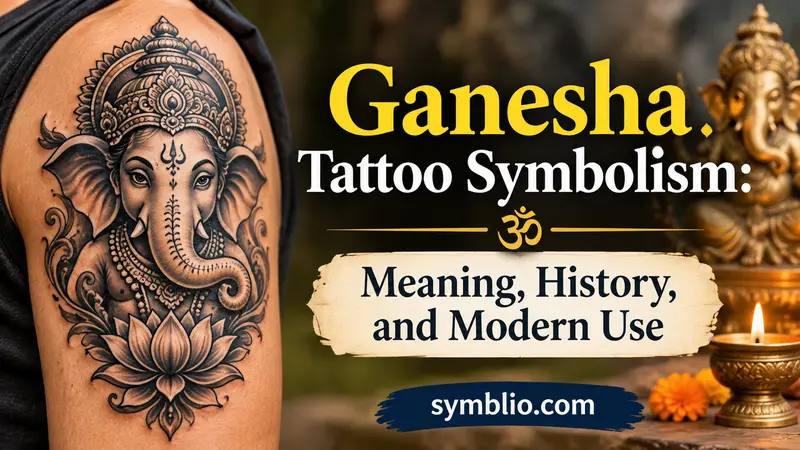
Ganesha tattoo symbolism commonly represents wisdom, good fortune, protection, and the ability to overcome obstacles. Ganesha, also known as Ganesh or Ganapati, stands among the most recognizable deities in Hinduism. His distinctive elephant head, human body, and traditional attributes give him an important place in religious art and contemporary culture.
In Hindu traditions, Ganesha represents auspicious beginnings and helps devotees seek favorable circumstances before important activities. People honor him when starting journeys, ceremonies, educational pursuits, and business ventures. His traditional associations explain why many people connect his image with ambition, learning, and personal growth.
In the United States, Ganesha imagery appears in religious artwork, jewelry, decorative objects, and tattoos. Some people choose his image to express their connection to Hindu traditions, while others associate it with overcoming difficulties or entering a new chapter of life. Understanding his religious background helps distinguish traditional beliefs from modern personal interpretations.
Quick Answer
Ganesha tattoo symbolism commonly represents wisdom, protection, good fortune, and overcoming obstacles in modern American tattoo culture. Historically, Ganesha has represented auspicious beginnings, learning, prosperity, and the ability to overcome barriers in Hindu traditions.
TL;DR
- Ganesha represents wisdom, good fortune, and auspicious beginnings.
- His elephant head symbolizes intelligence and discernment.
- Hindu traditions honor him before important undertakings.
- His mouse companion represents adaptability and controlled desires.
- Americans often associate his image with resilience and personal transformation.
- Understanding Hindu traditions encourages respectful use of his image.
What Ganesha Looks Like and Why His Image Is Recognizable
Ganesha features an elephant’s head and a human body. His rounded belly, large ears, curved trunk, and distinctive tusks make his appearance recognizable. Traditional artwork often shows him seated on a lotus, holding symbolic objects in several hands, with a small mouse nearby.
These features communicate different aspects of his divine character.
Common visual features include:
- Elephant head: Represents wisdom, intelligence, strength, and discernment.
- Large ears: Suggest careful listening and the ability to receive knowledge.
- Curved trunk: Represents adaptability and the ability to handle different challenges.
- Broken tusk: Connects with sacrifice, determination, and the story of writing the Mahabharata.
- Round belly: Represents abundance and the ability to embrace life’s experiences.
- Mouse companion: Suggests adaptability and the ability to navigate difficult situations.
Artists interpret these features in different ways. Some traditional sculptures include several symbolic objects, while contemporary illustrations simplify his appearance.
For tattoo symbolism, these details matter because Ganesha represents more than an ordinary elephant. His complete image identifies a specific Hindu deity with an established religious history.
The Main Meaning Behind Ganesha Tattoos
Ganesha’s traditional associations provide the foundation for modern interpretations of his image.
Wisdom and intelligence rank among his most recognized qualities. His elephant head represents divine understanding. People who connect his image with education, thoughtful decisions, and lifelong learning often appreciate this aspect of his symbolism.
Overcoming obstacles represents another central meaning. Hindus traditionally call Ganesha Vighnaharta, a Sanskrit title that means the remover of obstacles. Devotees seek his blessings when they face important decisions or begin demanding activities.
Good fortune and prosperity also contribute to his religious identity. Ganesha represents auspicious circumstances and favorable beginnings, especially when people undertake something important.
Other interpretations include:
- Patience during uncertain times.
- Confidence during personal transitions.
- Spiritual guidance and protection.
- Self-discipline and thoughtful action.
- Gratitude for opportunities and achievements.
These meanings connect with one another, but each person may emphasize a different quality. Someone who values education may connect with Ganesha’s wisdom, while another person may appreciate his association with new beginnings.
Ancient Origins of Ganesha and His Religious Importance
Ganesha’s history comes from the development of Hindu religious traditions in the Indian subcontinent. Religious texts, sculptures, and regional stories document the development of his identity.
Hindu traditions identify Ganesha as the son of Shiva and Parvati. Several stories explain his elephant head. The best-known account describes how Shiva replaced Ganesha’s original head with an elephant’s head after a conflict involving his parents.
Different religious texts present variations of this story, so no single version represents every Hindu tradition.
Ganesha gained particular importance through his connection with auspicious beginnings. Devotees traditionally honor him before religious ceremonies, journeys, important decisions, and other activities.
Historical artwork also demonstrates his growing religious importance. Ancient Indian sculptures and temple artwork helped establish the recognizable visual features that artists continue to use today.
Over subsequent centuries, artists across India and neighboring regions developed different representations of Ganesha. His image appeared in temple sculptures, devotional paintings, bronze figures, and household religious objects.
Why Ganesha Is Known as the Remover of Obstacles
Ganesha’s association with removing obstacles forms an important part of his religious identity.
In Hindu traditions, obstacles can represent external difficulties as well as internal problems. Poor judgment, confusion, ignorance, and impatience can all prevent people from making progress.
Devotees honor Ganesha because they believe he helps them approach these challenges with wisdom and favorable circumstances.
For example, a student may seek his blessings before beginning an academic journey. A family may honor him during an important ceremony, while a business owner may pray to him before opening a new enterprise.
For personal interpretation, this association can represent:
- Moving forward after a difficult period.
- Approaching problems with patience.
- Learning from earlier mistakes.
- Finding direction after uncertainty.
- Recognizing the importance of thoughtful decisions.
Ganesha’s traditional role involves religious devotion rather than a promise that his image will automatically remove every problem.
Ganesha Tattoo Symbolism in American Culture
In the United States, Ganesha imagery carries different meanings depending on a person’s background and relationship with Hinduism.
For Hindu Americans, his image may represent religious devotion, family heritage, cultural identity, and personal faith. It can also remind families of childhood experiences, religious celebrations, temple visits, and traditional teachings.
People outside Hindu communities may recognize Ganesha through his associations with wisdom, new beginnings, and overcoming difficulties. They may encounter his image through museums, yoga-related spaces, Indian cultural events, or decorative artwork.
These interpretations do not carry identical religious significance. Hindu traditions give Ganesha a specific identity, while individual Americans may connect his image with personal values.
American tattoo culture often emphasizes individual expression. People choose meaningful imagery to represent important experiences, personal beliefs, and life changes. Ganesha’s association with overcoming obstacles can therefore remind someone to approach challenges with patience and determination.
However, Ganesha remains sacred to many Hindus. Understanding that religious background helps people appreciate his image beyond its decorative appearance.
The Symbolism of Ganesha’s Elephant Head, Trunk, and Broken Tusk
Each part of Ganesha’s appearance contributes to his religious identity.
The Elephant Head
The elephant head represents intelligence, strength, patience, and thoughtful understanding. Elephants also hold an important place in Indian cultural and religious traditions.
In personal interpretations, this feature can remind people to look beyond immediate appearances and approach difficult situations with sound judgment.
The Large Ears
Ganesha’s prominent ears represent careful listening in many traditional interpretations. They suggest the importance of receiving information before making decisions.
This association makes his image meaningful to people who value education, communication, and personal development.
The Trunk
His trunk represents adaptability and flexibility in several interpretations. Its strength also suggests the ability to handle demanding circumstances.
Some traditions connect the trunk with balancing practical responsibilities and spiritual understanding.
The Broken Tusk
Ganesha often appears with one broken tusk. A well-known Hindu tradition connects this feature with the Mahabharata, the ancient Sanskrit epic.
According to this account, Ganesha used his tusk as a writing instrument while recording the epic as the sage Vyasa dictated it.
The broken tusk therefore represents knowledge, dedication, sacrifice, and commitment to learning.
What Ganesha’s Multiple Arms and Objects Represent
Traditional artwork often depicts Ganesha with four arms, although some representations include a different number. These multiple arms communicate divine abilities and responsibilities.
The objects he holds also carry symbolic meanings.
| Symbolic feature | Traditional association | Common personal interpretation |
|---|---|---|
| Axe | Cutting through obstacles and attachments | Letting go of limitations |
| Noose | Guiding or restraining difficulties | Self-control and discipline |
| Sweet or modak | Fulfillment and abundance | Enjoying life’s rewards |
| Broken tusk | Knowledge and sacrifice | Commitment to learning |
| Lotus | Spiritual development | Growth and renewal |
| Prayer beads | Devotion and contemplation | Mindfulness and reflection |
Not every depiction includes all these objects, and different traditions sometimes interpret them differently.
For example, the axe and noose connect with Ganesha’s traditional role in helping devotees overcome obstacles and exercise control over their lives.
The sweets represent another aspect of his character. Ganesha often appears with modak, a traditional sweet associated with his worship. This imagery connects spiritual understanding with prosperity and enjoyment.
The Mouse Companion and Its Hidden Significance
One interesting detail in traditional Ganesha imagery is the small mouse beside him. Hindus call this companion his vahana, or divine vehicle.
At first glance, the enormous elephant-headed deity and tiny mouse seem like an unusual combination. However, their contrast contributes to Ganesha’s symbolism.
Some interpretations associate the mouse with desire, restless thoughts, and small impulses that distract people from important goals. Ganesha’s relationship with this animal suggests the ability to control these tendencies rather than allow them to control one’s actions.
The pairing also highlights the relationship between strength and adaptability. An elephant represents physical power, while a mouse can enter narrow spaces that larger creatures cannot reach.
For modern personal interpretation, this combination can suggest:
- Strength accompanied by humility.
- Intelligence applied to small problems.
- Self-control over impulsive behavior.
- Adaptability in different circumstances.
- Respect for things that appear insignificant.
The mouse therefore plays an important role in Ganesha’s traditional identity.
Ganesha’s Connection With Hindu Festivals and New Beginnings
Ganesha’s importance becomes especially visible during religious celebrations in India and Hindu communities around the world.
One of the most recognizable celebrations is Ganesh Chaturthi, a festival dedicated to Ganesha. Maharashtra hosts particularly prominent celebrations, although other Indian regions and international Hindu communities also observe the festival.
During this celebration, devotees honor Ganesha through prayers, offerings, music, decorations, and community gatherings. Public celebrations often feature temporary images of the deity, followed by ceremonial immersion in water according to local customs.
The festival highlights his association with auspicious beginnings, community participation, and religious devotion.
Some Hindu traditions also honor Ganesha during Diwali. His presence alongside Lakshmi, the goddess associated with prosperity, reflects the importance of seeking blessings for favorable circumstances and responsible prosperity.
For Hindu Americans, these celebrations strengthen connections with family traditions and cultural heritage. Temples and cultural organizations also help preserve these practices across generations.
Emotional and Psychological Meaning of Ganesha Imagery
Ganesha’s symbolism connects with emotions and personal experiences that many people encounter throughout life.
People often choose meaningful symbols to represent personal values or remind themselves of important lessons. Ganesha’s associations with patience, learning, and overcoming obstacles offer several possible connections.
Resilience represents one such association. His role as the remover of obstacles can remind people that difficulties often accompany meaningful goals.
Patience provides another connection. His traditional imagery encourages thoughtful action instead of immediate reactions.
Confidence also contributes to his modern personal meaning. His connection with new beginnings may appeal to someone entering a new educational, professional, or personal chapter.
Other emotional associations include:
- Hope during periods of uncertainty.
- Gratitude for personal opportunities.
- Commitment to education and self-improvement.
- Respect for family and cultural traditions.
- Acceptance of change and personal responsibility.
These interpretations describe personal associations rather than guaranteed psychological effects. Each individual develops a connection according to personal experiences and beliefs.
Ganesha Tattoo Designs and Their Different Interpretations
Artists represent Ganesha through many styles, from traditional religious artwork to contemporary illustrations. Different approaches emphasize different aspects of his identity.
Traditional Ganesha imagery
Traditional representations preserve recognizable features such as the elephant head, multiple arms, religious objects, and mouse companion. These designs often reflect an interest in Hindu art and religious history.
Seated Ganesha
A seated figure often represents contemplation, stability, and spiritual understanding. Hindu sculptures frequently use this familiar composition.
Dancing Ganesha
Dancing representations connect the deity with movement, celebration, and divine expression. They highlight a more dynamic aspect of his character.
Ganesha with a lotus
The lotus introduces associations with spiritual development, purity, and growth. Several Indian religious traditions also use this familiar motif.
Minimalist Ganesha imagery
Simplified illustrations emphasize recognizable features, especially the trunk and elephant head. However, removing religious details can change how viewers understand the original image.
No single artistic style determines the meaning. Religious background, visual attributes, and personal interpretation all influence how people understand Ganesha imagery.
Colors and Their Associations in Ganesha Artwork
Color influences how people interpret religious imagery, although traditional associations vary across regions and artistic traditions.
Artists depict Ganesha in several colors. Some representations feature red, while others use gold, white, orange, or natural stone and bronze tones.
Common modern associations include:
- Red: Often represents auspiciousness, celebration, and vitality in Indian religious contexts.
- Gold: Suggests prosperity, abundance, and divine dignity.
- White: Commonly represents purity, peace, and spiritual clarity.
- Orange: Connects with devotion, religious celebration, and sacred traditions.
- Green: Often suggests renewal, growth, and natural life in contemporary visual interpretation.
- Black: Creates contrast and emphasizes the sculptural details of an image.
These associations do not establish universal rules. A white Ganesha representation, for example, may carry a particular religious or artistic meaning beyond the general symbolism of its color.
Contemporary American artwork may also reflect individual artistic preferences. Still, understanding traditional associations helps people appreciate the religious background of Ganesha imagery.
Cultural Respect and Misunderstandings About Ganesha Tattoos
Ganesha represents a living religious tradition, not simply a mythological character or a general symbol of good luck. Many Hindus regard his image as sacred and approach it with devotion.
This distinction matters when people interpret his appearance in contemporary American culture.
One common misunderstanding reduces Ganesha to an elephant-headed symbol of success. Although success and good fortune form part of his traditional associations, this interpretation overlooks his role in Hindu worship and his relationship with Shiva and Parvati.
Another misunderstanding treats every depiction as interchangeable. A devotional image, historical sculpture, and modern decorative illustration may all represent Ganesha, but each can communicate a different intention.
Placement and presentation also raise cultural concerns. Some Hindus consider images of deities on the lower body, feet, or other locations they regard as disrespectful to be inappropriate. Views differ among Hindu communities and individuals, but people should consider these concerns.
Cultural appreciation requires more than recognizing a symbol’s popularity. People should understand its origins, respect the communities that honor it, and avoid inaccurate descriptions of its religious meaning.
How Ganesha’s Meaning Has Evolved in Modern Culture
Ganesha’s identity has developed through centuries of religious practice, regional storytelling, artistic interpretation, and cultural exchange.
Earlier Hindu traditions connected his role with auspicious beginnings, protection from obstacles, and religious devotion. Temple sculptures, household worship, manuscripts, and ceremonial objects helped spread his image.
As Hindu communities established themselves beyond South Asia, Ganesha’s image also gained recognition in international religious and cultural settings.
In the United States, several factors have contributed to his visibility.
Hindu immigration and cultural communities: Hindu Americans maintain religious traditions through temples, festivals, family ceremonies, and cultural organizations.
Museums and educational institutions: Collections of South Asian art introduce Ganesha to wider audiences through historical sculptures and religious artwork.
Yoga and wellness culture: Some Americans encounter Ganesha through spaces influenced by Indian religious and philosophical traditions. However, an interest in yoga does not automatically indicate an understanding of his religious background.
Contemporary visual culture: His distinctive appearance attracts attention in artwork, decorative objects, and personal interpretations of religious symbolism.
These developments have expanded the settings in which people encounter Ganesha. However, modern visibility does not erase his original religious identity.
Ganesha Symbolism Beyond Tattoos: Art, Jewelry, and Everyday Objects
Ganesha imagery appears in many forms beyond tattoos. Religious sculptures, paintings, pendants, household decorations, and ceremonial objects offer different ways to encounter his image.
In Hindu households, families may place a Ganesha figure in a dedicated prayer area. They often honor him before important activities or during religious celebrations.
Jewelry featuring Ganesha can represent devotion, cultural heritage, or a personal connection to Hindu traditions. The wearer’s background and intentions help determine its meaning.
Museums and galleries offer another way to explore his significance. Historical sculptures help visitors understand the development of Indian religious art and Ganesha’s importance across different periods.
On social media, his image appears in discussions about Hindu festivals, Indian culture, spirituality, and decorative art. However, short captions sometimes reduce complex religious traditions to simplified statements about luck or positive thinking.
The context in which Ganesha appears matters just as much as his recognizable appearance.
The Difference Between Traditional Religious Meaning and Personal Interpretation
Understanding Ganesha symbolism requires recognizing the difference between established religious beliefs and meanings individuals develop through personal experiences.
In Hinduism, Ganesha holds a defined religious identity. Devotees worship him as a deity associated with wisdom, prosperity, auspicious beginnings, and the removal of obstacles. Religious traditions continue to shape his importance.
Personal interpretations may emphasize different qualities. Someone might connect his image with perseverance after a difficult experience, while another person may associate it with education, family heritage, or spiritual curiosity.
These interpretations can coexist, but they do not carry identical meanings.
A personal connection can add another layer of significance without changing Ganesha’s place within Hinduism. Recognizing this distinction helps explain why his image can hold personal meaning in contemporary culture while remaining sacred to Hindu devotees.
FAQs
Ganesha imagery traditionally represents wisdom, prosperity, good fortune, and the removal of obstacles. Modern personal interpretations may also emphasize resilience, patience, education, and new beginnings.
Hindus traditionally call Ganesha Vighnaharta, or the remover of obstacles. Devotees invoke his name before important activities and ceremonies, seeking favorable circumstances and guidance.
Yes. Ganesha is an important Hindu deity and the traditional son of Shiva and Parvati. Devotees honor him for wisdom, prosperity, auspicious beginnings, and protection from obstacles.
His elephant head commonly represents intelligence, wisdom, strength, and discernment. It also forms an essential part of his divine identity in Hindu religious traditions.
The mouse serves as Ganesha’s traditional vahana, or divine vehicle. Many interpretations connect it with controlled desires, adaptability, and the ability to navigate difficult situations.
Yes. Ganesha traditionally represents good fortune and auspicious beginnings. Devotees honor him before journeys, ceremonies, educational pursuits, and business activities.
Yes. Ganesha is a revered Hindu deity, and his image plays an important role in worship and religious celebrations. People should recognize its sacred significance when they encounter it outside religious settings.
Conclusion
Ganesha tattoo symbolism brings together wisdom, prosperity, protection, and the ability to overcome obstacles. His elephant head, broken tusk, multiple arms, and mouse companion each contribute to a religious identity that developed over centuries within Hindu traditions.
In contemporary American culture, people may associate Ganesha with resilience, education, personal growth, and new beginnings. However, these individual interpretations exist alongside his continuing importance as a Hindu deity.
Understanding Ganesha means looking beyond his distinctive appearance and recognizing the religious history, cultural traditions, and values behind his image. His significance connects thoughtful action, spiritual devotion, and the pursuit of a meaningful path forward.