Cecropia moth symbolism is commonly associated with transformation, personal growth, renewal, and the beauty of change. As one of North America’s largest native moths, the cecropia attracts attention through its impressive wings, distinctive colors, and unusual life cycle. Its appearance offers a natural starting point for understanding why people connect moths with personal development and life’s transitions.
Unlike butterflies, which often receive widespread attention in art, literature, and popular symbolism, large moths have a quieter cultural presence. Yet the cecropia moth has characteristics that make it particularly interesting. It spends much of its life developing inside a protective cocoon before emerging as a fully formed adult.
For people in the United States, encountering this moth can create a memorable connection with nature. It may appear on a tree, near an outdoor light, or resting against the side of a house during warmer months. Its unexpected size and detailed wing patterns often encourage people to look beyond its appearance and consider what it might represent.
Although no widely established ancient tradition assigns specific symbolic meanings to this particular species, its natural life cycle provides several meaningful interpretations. These include patience, preparation, adaptation, and the importance of recognizing beauty in unexpected places.
Quick Answer:
Cecropia moth symbolism commonly represents transformation, personal growth, resilience, renewal, and the beauty of change in modern American interpretations. Its long development inside a protective cocoon also makes it a meaningful personal symbol of patience, preparation, and emerging into a new stage of life.
TL;DR
- Represents transformation and the possibility of personal renewal.
- Its cocoon suggests patience, preparation, and gradual development.
- Large patterned wings symbolize individuality and natural beauty.
- Its seasonal emergence connects it with fresh beginnings.
- Its short adult life encourages appreciation of temporary moments.
- Its North American presence creates a connection with local wildlife.
What Is a Cecropia Moth?
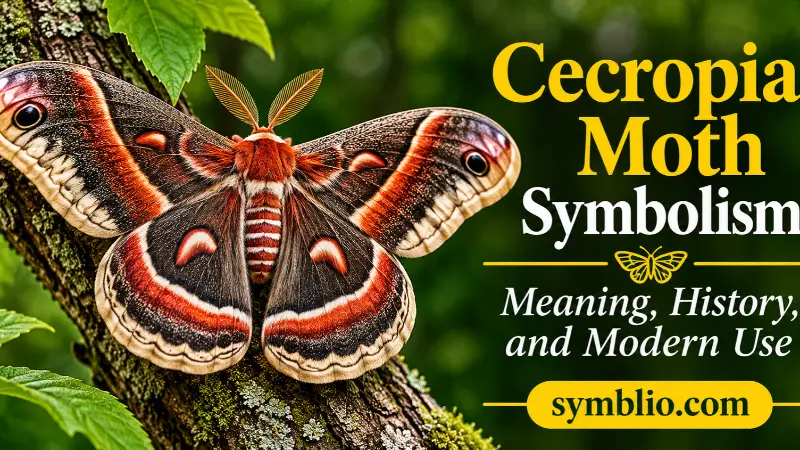
The cecropia moth (Hyalophora cecropia) belongs to the Saturniidae family, commonly known as the giant silk moths. It is recognized as the largest native moth in North America, with some individuals reaching wingspans of approximately six inches or more.
Its wings display an intricate combination of brown, reddish-orange, black, cream, and white markings. Each wing contains distinctive pale crescent-shaped spots, while the body has a reddish appearance with contrasting light-colored bands.
The caterpillar looks equally unusual. As it grows, it develops a green body decorated with colorful raised structures in shades of yellow, orange, red, and blue.
The species lives across much of eastern North America, with its range extending westward toward the Rocky Mountains. In the United States, people may encounter it in wooded areas, gardens, parks, and residential neighborhoods.
These physical characteristics help explain its modern symbolic appeal. Its unusual appearance suggests individuality, while its development from a caterpillar into an adult provides a natural connection with transformation.
The Main Symbolic Meanings of the Cecropia Moth
Several symbolic interpretations can be drawn from this moth’s appearance and life cycle. These are modern interpretations rather than universally documented historical beliefs.
Transformation: Its development from caterpillar to adult represents significant change and the possibility of becoming something different.
Resilience: Surviving seasonal conditions inside a protective cocoon can represent endurance through difficult periods.
Renewal: Emerging in spring connects the moth with fresh beginnings and new opportunities.
Patience: Its extended development encourages the idea that meaningful changes require time.
Individuality: Its unusually large wings and distinctive patterns suggest the importance of personal identity.
Appreciation of life: Its relatively brief adult stage provides a reminder to value meaningful experiences and temporary opportunities.
Together, these interpretations make the species an appealing symbol for people thinking about personal transitions, creativity, and their relationship with nature.
Transformation and Personal Growth
Transformation is one of the strongest meanings associated with moth imagery, and the cecropia provides a particularly interesting natural example.
Its life begins as a small egg. After hatching, the caterpillar spends the summer feeding and growing. Eventually, it creates a protective silk cocoon, where it remains through the colder months before emerging as an adult.
This process offers a useful comparison with human development.
People also experience periods when their lives seem to change slowly. Education, relationships, family responsibilities, and personal ambitions can require long periods of preparation before visible results appear.
The moth’s development suggests that change does not always happen immediately. Sometimes, progress takes place quietly before other people can recognize it.
In modern personal symbolism, this interpretation can represent someone entering adulthood, beginning a different career, recovering confidence after a difficult experience, or discovering a new direction.
Its message is not that every difficult experience automatically produces a better outcome. Rather, it represents the possibility of development through time and changing circumstances.
Resilience and the Strength to Continue
Resilience is another meaningful interpretation.
The cecropia moth spends much of its life in a protective cocoon attached to a tree or branch. This structure helps protect the developing insect during winter.
The cocoon can therefore serve as a metaphor for protection, preparation, and endurance.
In American culture, resilience is often associated with continuing through uncertainty while maintaining a sense of purpose. People may connect this idea with recovering from setbacks, adjusting to unexpected changes, or learning to approach unfamiliar situations.
The moth’s life cycle offers a natural illustration of this process.
Its development does not happen without challenges. Eggs, caterpillars, and pupae face predators, environmental conditions, and other natural pressures. Only some individuals survive to adulthood.
This makes the species an interesting reminder that resilience involves adaptation rather than simply remaining unchanged.
For someone choosing this insect as a personal symbol, it may represent the ability to keep developing despite circumstances that cannot always be controlled.
The Symbolism of the Cocoon
The cocoon is one of the most recognizable elements of the cecropia moth’s life cycle.
Unlike the familiar image of a butterfly chrysalis, the cecropia creates a substantial silk structure that remains attached to vegetation. Inside, the insect develops through its pupal stage.
Symbolically, the cocoon can represent several ideas:
- Protection: A safe environment during a period of development.
- Patience: The importance of allowing natural processes to take time.
- Preparation: Getting ready for a new stage before making a visible change.
- Privacy: Developing away from outside attention.
- Potential: The possibility of becoming something different.
These interpretations can be meaningful in situations where people feel that their lives are changing behind the scenes.
For example, a student preparing for graduation may identify with the cocoon as a representation of a period of learning before entering a new environment.
Similarly, someone developing a creative project might see it as a reminder that preparation deserves as much attention as the finished result.
The cocoon does not symbolize permanent isolation. Its natural purpose is connected to development and eventual emergence.
Renewal and New Beginnings
The emergence of an adult cecropia moth is closely connected with seasonal change.
In much of its range, adult moths appear during spring and early summer. Their arrival follows months of development inside their cocoons.
This timing provides a natural connection with renewal.
In the United States, spring has long been associated with returning vegetation, warmer weather, gardening, and the beginning of outdoor activities. It is also a familiar time for people to think about new plans and changes in their daily lives.
The cecropia moth fits naturally into this seasonal interpretation.
Its emergence can represent the beginning of a different chapter, especially after a long period of preparation.
People might connect this meaning with:
- Starting a new educational program.
- Moving into a different home.
- Beginning a creative project.
- Rebuilding confidence.
- Exploring unfamiliar interests.
- Developing healthier personal routines.
Unlike symbols associated with dramatic or sudden change, this moth suggests that new beginnings often follow an extended period of development.
Beauty, Individuality, and Self-Expression
The cecropia moth has an appearance that is difficult to confuse with many other North American insects.
Its broad wings feature contrasting colors and carefully arranged markings. The pale crescents, reddish patches, and dark background create a distinctive visual pattern.
These characteristics make individuality a natural modern interpretation.
In personal expression, individuality means recognizing that people do not need to follow identical paths or adopt the same interests to develop meaningful identities.
The moth’s unusual appearance provides a useful metaphor for this idea.
Its beauty is different from the delicate appearance commonly associated with butterflies. It has its own visual character, and that difference is part of what makes it memorable.
In American design culture, natural patterns frequently appear in illustrations, clothing, jewelry, stationery, and decorative artwork. Large moths can fit these styles because their wings provide interesting shapes, colors, and symmetrical details.
For some people, the species represents confidence in being different without needing constant approval.
What Its Colors Symbolize
Color provides another way to interpret the cecropia moth.
Its wings contain several shades that have recognizable associations in modern Western color symbolism.
| Color | Common Symbolic Association | Connection to the Moth |
|---|---|---|
| Brown | Stability, nature, and grounding | Its earthy wing background |
| Orange | Creativity, warmth, and enthusiasm | Its reddish-orange markings |
| Cream and white | Clarity, simplicity, and renewal | Its pale wing patterns |
| Black | Mystery, change, and the unknown | Its darker wing areas |
| Red | Vitality, passion, and determination | Its reddish body and wing details |
These associations are interpretive rather than fixed meanings assigned to the insect.
For example, someone might focus on its orange markings when connecting it with creativity, while another person might find the darker wings more representative of personal change.
The combination of colors also creates a connection with natural environments. Its earthy appearance helps it blend with tree bark, leaves, and woodland surroundings.
Cecropia Moth Symbolism in the United States
The cecropia moth has a particularly interesting place in American nature appreciation.
It is native to North America and can be encountered in several environments, including wooded neighborhoods, gardens, and natural parks.
Unlike animals that appear frequently in national celebrations or established religious traditions, this moth does not have a widely recognized national symbolic role.
Its importance is more closely connected with wildlife education, biodiversity, gardening, and personal encounters with nature.
In the United States, people may discover one resting near a porch light or attached to a tree in their yard. Because of its size, the encounter can be surprising, especially for someone who has never seen a giant silk moth before.
This experience may encourage curiosity about local wildlife.
The species also provides an opportunity to discuss the importance of native insects. Its caterpillars feed on the leaves of several trees and shrubs, while different stages of its life cycle contribute to the surrounding ecosystem.
For nature enthusiasts, the moth can therefore represent a connection with local landscapes and the value of protecting native species.
Its symbolism in American culture is best understood as a developing personal and environmental interpretation rather than an established historical tradition.
Ancient Greek and Roman Connections
Although the cecropia moth does not have a widely documented ancient religious or mythological meaning, its scientific name has an interesting connection with classical mythology.
The name Cecropia refers to Cecrops, a legendary early king of Athens in Greek mythology. Cecrops was traditionally described as having a human upper body and a serpent-like lower body.
The naming connection is associated with the unusual markings and wing shapes of the moth, which can resemble the appearance of a snake’s head.
The moth also belongs to the family Saturniidae, a name connected with Saturn in Roman mythology.
These classical references provide historical interest, but they should not be confused with evidence that ancient Greeks or Romans worshipped the cecropia moth or assigned it a specific spiritual meaning.
The distinction matters because scientific naming often borrows from mythology to describe appearance or create memorable classifications.
The modern symbolic interpretations of transformation and renewal come primarily from observing the insect’s life cycle rather than from an established ancient tradition.
Emotional and Psychological Meaning
People often connect animals with emotions because natural behavior provides familiar ways to think about human experiences.
The cecropia moth can inspire several emotional interpretations.
Hope: Its emergence after a long period of development can represent the possibility of a new beginning.
Patience: Its extended pupal stage illustrates that important processes do not always produce immediate results.
Curiosity: Its unusual appearance encourages people to explore unfamiliar aspects of the natural world.
Confidence: Its distinctive wings can represent accepting personal differences.
Appreciation: Its short adult life encourages attention to experiences that may not last forever.
From a psychological perspective, these interpretations can work as personal metaphors. They help people describe their feelings and experiences through something they observe in nature.
However, there is no scientific evidence that seeing a cecropia moth predicts a particular emotional event or reveals information about someone’s future.
Its value as a personal symbol comes from the meaning an individual chooses to associate with it.
Cecropia Moth Symbolism in Dreams
Dream interpretations involving moths often focus on change, nighttime, uncertainty, and attraction to light.
A cecropia moth appearing in a dream may therefore invite reflection on personal development or an unfamiliar situation.
Different details can influence the interpretation.
- A moth spreading its wings: May represent confidence or readiness for change.
- A moth emerging from a cocoon: Can suggest preparation and a new beginning.
- A moth resting on a tree: May represent stability and connection with nature.
- A moth near a light: Can suggest curiosity or a search for direction.
- A moth flying through darkness: May represent navigating uncertainty.
These interpretations are personal and cultural rather than scientifically established explanations of dreams.
A useful approach is to consider what was happening in the dream and which emotions stood out.
For instance, someone preparing for a major life transition might associate the moth’s emergence with their own expectations about the future.
The dream does not need to predict anything to provide a useful opportunity for reflection.
Modern Uses in Tattoos, Jewelry, and Art
The cecropia moth’s appearance makes it suitable for several forms of contemporary artistic expression.
Although it is not among the most universally recognized tattoo subjects, its large wings and distinctive patterns offer plenty of visual detail.
Tattoos
A cecropia moth tattoo may represent transformation, individuality, patience, or an appreciation of nature. Some designs emphasize realistic wing markings, while others use botanical illustrations or simplified outlines.
For someone who has experienced an important personal transition, the insect can serve as a reminder of development over time.
Jewelry
Moth-inspired jewelry often includes wing-shaped pendants, engraved patterns, and nature-inspired metalwork.
A cecropia-inspired design may appeal to people who appreciate unusual insects and detailed natural imagery.
Home Decor
Vintage insect illustrations, framed moth artwork, and botanical prints can bring a natural-history theme into a room.
The species works particularly well in traditional scientific illustration styles because its markings are visually distinctive.
Fashion and Accessories
Moth imagery sometimes appears on printed clothing, decorative accessories, and artistic designs.
Its combination of earthy colors and contrasting markings makes it suitable for nature-inspired fashion.
Digital Art and Social Media
Online nature photography and illustration communities provide opportunities for people to share unusual insect encounters.
The cecropia moth’s impressive appearance makes it an interesting subject for photography, educational posts, and wildlife artwork.
Common Misunderstandings About Its Symbolism
Several misconceptions can arise when people interpret moths through spiritual or cultural symbolism.
One common mistake is assuming that every moth has the same meaning.
Different species have different physical characteristics, habitats, and life cycles. Although some general moth associations overlap, the cecropia has distinctive features that support its own personal interpretations.
Another misunderstanding involves its connection with ancient mythology.
Its name has a Greek mythological origin, but that does not establish that the insect held a recognized religious or ceremonial role in ancient Greece.
People may also interpret moths near artificial lights as signs of spiritual attraction or destiny.
In reality, artificial lighting can interfere with moth navigation. The exact reasons behind moth attraction to different light sources remain an area of scientific investigation.
Finally, the cecropia moth should not automatically be interpreted as a warning or negative omen.
Its nighttime activity does not make it a symbol of danger. In natural settings, it is simply a nocturnal insect following its biological patterns.
Understanding these distinctions allows people to appreciate its symbolic possibilities without confusing personal beliefs with documented history or scientific evidence.
What the Cecropia Moth Teaches About Nature and Conservation
Beyond personal interpretation, the cecropia moth represents an opportunity to appreciate North American biodiversity.
Its caterpillars feed on the leaves of numerous trees, including maple, cherry, birch, and other woody plants.
As part of the natural food web, caterpillars provide food for birds and other wildlife. Their development also illustrates the connections between plants, insects, and the animals that depend on them.
The species faces natural challenges, including predation and parasitism. In some areas, introduced biological-control organisms have also affected native giant silk moth populations.
These details highlight why conservation requires more than protecting large or familiar animals. Native insects also contribute to healthy ecosystems.
In gardens and residential landscapes, people can support local wildlife by maintaining suitable native vegetation and reducing unnecessary nighttime lighting.
The moth’s connection with nature therefore extends beyond its appearance. It can encourage a greater appreciation of insects that often receive less attention than birds and mammals.
How Cecropia Moth Symbolism Has Evolved
The meaning people associate with the cecropia moth is best understood through the difference between its natural history and modern personal interpretation.
Historically, its scientific name reflects an interest in classical mythology and natural classification. Its physical characteristics also attracted attention from naturalists, collectors, and wildlife observers.
Over time, photography, nature education, and online communities have made it easier for people to encounter images of this impressive insect.
Modern interpretations increasingly connect its life cycle with familiar human experiences.
Its cocoon suggests preparation, its emergence suggests renewal, and its distinctive wings suggest individuality.
These ideas are not evidence of a single ancient belief that has survived unchanged. They are contemporary meanings developed through observation and personal reflection.
This evolution is part of what makes nature symbolism interesting: people can find new ways to understand familiar natural processes as their experiences and cultural interests change.
Cecropia Moth Symbolism Compared With Other Moths
Different moth species can inspire different symbolic interpretations based on their appearance and natural behavior.
| Moth | Common Modern Interpretation | Distinctive Feature |
|---|---|---|
| Cecropia moth | Transformation, renewal, individuality | Large patterned wings |
| Luna moth | Renewal, change, and beauty | Pale green wings and long tails |
| Death’s-head hawkmoth | Mortality, mystery, and folklore | Skull-like marking |
| Polyphemus moth | Natural wonder and transformation | Large eyespots |
| Atlas moth | Strength, scale, and endurance | Exceptionally broad wings |
These meanings are broad modern interpretations rather than universal cultural definitions.
The comparison also shows why the cecropia moth deserves its own identity. Its combination of size, colors, and seasonal development creates a different visual and symbolic character from other familiar moths.
FAQs
Seeing a cecropia moth can represent transformation, renewal, personal growth, and appreciation of nature. These interpretations come from its distinctive appearance and life cycle rather than an established belief that every sighting carries a special message.
Some people may interpret an unexpected encounter with this impressive insect as a positive experience associated with new beginnings or personal development. However, there is no widely recognized cultural tradition establishing it as a specific good-luck symbol.
In personal spiritual interpretations, the moth may represent renewal, patience, and the process of becoming a different version of oneself. These interpretations are individual beliefs rather than established teachings of a particular religion.
A cecropia moth tattoo can represent transformation, individuality, resilience, and the ability to embrace change. Its detailed wings also make it an appealing subject for people who appreciate natural-history artwork.
Its life cycle includes several distinct developmental stages, from egg to caterpillar, pupa, and adult moth. The emergence of a fully developed adult after months inside a cocoon provides a natural metaphor for personal transformation.
It is a native North American species, but people may not encounter it frequently because adults are nocturnal and have relatively short adult lives. Its distribution extends across much of the eastern United States and toward the Rocky Mountains.
In personal dream interpretation, it may represent change, uncertainty, self-discovery, or the beginning of a new stage. The meaning depends on the dreamer’s circumstances and emotional associations rather than a fixed universal interpretation.
Conclusion
Cecropia moth symbolism offers a natural way to explore transformation, resilience, renewal, patience, and individuality. Its remarkable development from a small caterpillar into one of North America’s largest native moths provides a meaningful example of how change can take place gradually.
In modern American culture, the species is appreciated primarily for its unusual appearance, connection with native wildlife, and fascinating life cycle. Its Greek mythological name adds historical interest, while its modern symbolic interpretations remain largely personal rather than part of an established ancient tradition.
Ultimately, the cecropia moth reminds us that development takes time, unexpected beauty exists in nature, and meaningful changes do not always happen in public view. Sometimes, the most interesting part of a transformation is everything that happens before anyone notices the result.