
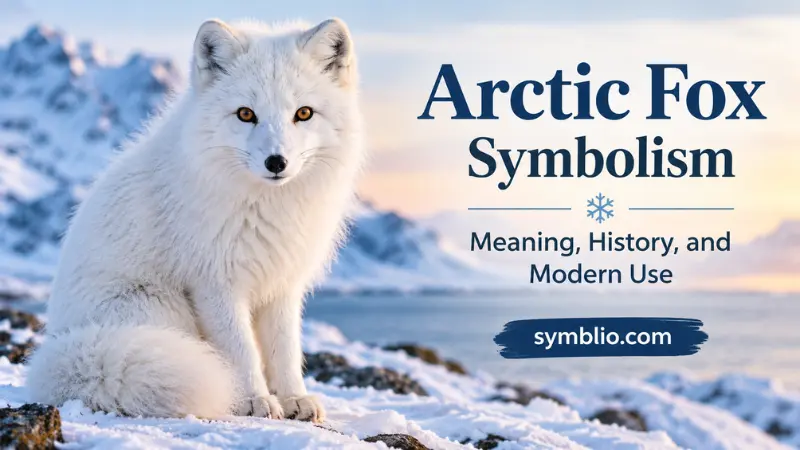
The arctic fox symbolism often centers on adaptability, resourcefulness, patience, and survival in difficult conditions. Its ability to live in severe cold, change its coat with the seasons, and find food when conditions are harsh gives the animal a natural connection with flexibility and practical intelligence.
For many Americans, the arctic fox is also associated with winter, solitude, camouflage, and the remote landscapes of Alaska and the Far North. Unlike symbols with one established religious meaning, the arctic fox gathers much of its symbolism from its real behavior, regional folklore, wildlife imagery, and modern personal interpretation.
Its meaning becomes especially interesting when the animal is considered beyond its attractive white winter coat. The same fox that represents quiet beauty can also represent cleverness, caution, opportunism, and the ability to adjust when circumstances change.
Quick Answer
Arctic fox symbolism commonly represents adaptability, resourcefulness, resilience, and discretion in modern American culture, especially in wildlife imagery, tattoos, art, and personal symbolism. Historically, foxes in northern traditions have also been connected with cleverness, survival, seasonal change, and the practical relationship between people and Arctic environments.
TL;DR
- Represents adaptability when circumstances change.
- Reflects resourcefulness in difficult environments.
- Its changing coat suggests transformation and flexibility.
- Northern traditions connect foxes with cleverness and caution.
- American symbolism often emphasizes wilderness and winter.
- Modern tattoos can represent independence and resilience.
What the Arctic Fox Looks Like and Why That Matters
The arctic fox is a small fox species built for one of the planet’s coldest environments. It has a compact body, short ears, a short muzzle, heavily furred feet, and exceptionally dense winter fur. These features reduce heat loss and help it move across snowy terrain.
Its appearance contributes strongly to its symbolic associations. A white winter coat naturally suggests snow, quietness, concealment, and the Far North. Yet the animal does not remain white year-round. Many arctic foxes change into brown or gray summer coats as the landscape changes.
That seasonal transformation gives the animal a useful symbolic lesson: adapting does not necessarily mean abandoning one’s identity. It can mean changing one’s outward approach while remaining the same individual underneath.
What the Arctic Fox Commonly Symbolizes in the United States
In contemporary American symbolism, the arctic fox is most naturally connected with adaptability. It survives by responding to its surroundings rather than relying on a single strategy.
Resourcefulness is another major association. Arctic foxes eat a varied diet and can take advantage of different food sources depending on what is available. In some Arctic environments, they also follow larger predators such as polar bears and feed on remains left behind.
The animal therefore works well as a symbol for people who make practical decisions during uncertain circumstances.
Other common interpretations include:
- resilience
- patience
- cleverness
- independence
- observation
- discretion
- seasonal transformation
- wilderness
- survival
These meanings are interpretations rather than a single official symbolic definition.
Adaptability Is the Central Meaning
The strongest symbolic connection comes from the arctic fox’s ability to adjust to dramatic environmental changes.
Its seasonal coat is an obvious example. White winter fur provides camouflage against snow, while the summer coat becomes darker and better matches vegetation and exposed ground.
As a symbol, this can represent knowing when to change course.
An arctic fox does not symbolize constant resistance to circumstances. Instead, it can suggest responding intelligently to them. For someone moving to a new place, entering a new stage of life, or dealing with changing expectations, the animal can represent flexibility without losing personal direction.
This makes it different from symbols that emphasize permanence or stability. Its message is closer to: adjust when necessary, observe carefully, and keep moving.
Resourcefulness in a Harsh Environment
Arctic landscapes offer limited food and shelter, especially during winter. The fox’s ability to use different food sources and survive periods of scarcity contributes to its association with resourcefulness.
This meaning can be understood in everyday American life without turning the animal into a supernatural figure.
Someone may choose an arctic fox image because it represents making the most of limited opportunities. It can stand for practical problem-solving, preparedness, and finding alternatives when an original plan fails.
The symbolism is particularly appropriate for people who value self-reliance. However, self-reliance does not have to mean complete isolation. Arctic foxes also demonstrate the importance of responding to relationships within an ecosystem.
Cleverness, Observation, and Caution
Foxes have long carried associations with intelligence and cleverness in folklore. The arctic fox inherits some of this broader fox symbolism, although its specific cultural meanings vary among northern communities.
Cleverness can have either a positive or negative interpretation. In a positive sense, it means noticing details, thinking ahead, and avoiding unnecessary conflict. In a negative context, fox imagery can suggest trickery or deception.
That distinction matters.
Calling an arctic fox “clever” does not automatically mean dishonest. In modern personal symbolism, cleverness is more often understood as practical intelligence: knowing when to act, when to wait, and when remaining unnoticed is the better choice.
Ancient and Northern Roots of Fox Symbolism
Foxes appear in many northern storytelling traditions, but it would be inaccurate to claim that every Arctic community shares one universal belief about the arctic fox.
In Inuit and other Indigenous Arctic contexts, foxes have been part of stories and everyday life, while their skins also had practical economic importance. Historical accounts from the Canadian Arctic show that arctic fox trapping became an important source of income for Inuit families during parts of the twentieth century.
This practical history adds an important layer to symbolism. The fox was not simply a decorative representation of winter. Its fur could provide clothing, warmth, and trade income.
In Alaska, the animal likewise has a direct relationship with human communities. The species occurs across Arctic and coastal areas of the state, and Iñupiaq cultural use historically included trapping for fur.
These realities make northern fox symbolism more complicated than modern fantasy imagery sometimes suggests.
Arctic Foxes in Indigenous and Northern Traditions
Stories involving foxes differ significantly between communities, so broad statements about “Indigenous fox symbolism” should be treated carefully.
Some northern folklore presents foxes as clever or troublesome figures. Other stories emphasize their unusual behavior, relationship with humans, or ability to move through environments that people find difficult.
Fox stories can therefore communicate lessons about curiosity, caution, survival, or human behavior. Their meanings depend on the particular tradition rather than on one universal Arctic interpretation.
Modern writers sometimes use terms such as “spirit animal” or “totem” as if they describe one shared Indigenous belief. That can erase important cultural differences. The arctic fox can certainly be discussed as a modern personal symbol, but that should not be confused with specific Indigenous traditions.
The Arctic Fox and Transformation
Few physical characteristics contribute more strongly to the animal’s symbolism than its seasonal color change.
White winter fur can make the fox nearly disappear against snowy surroundings, while its warmer-season coat becomes darker. The change is biological adaptation, not a deliberate disguise.
Symbolically, however, this creates a natural connection with transformation.
An arctic fox may represent:
- adapting to a new environment
- changing one’s approach
- leaving an earlier stage behind
- becoming comfortable with uncertainty
- knowing that identity can develop over time
The symbolism works particularly well when someone wants an image that represents personal growth without suggesting that the past should be erased.
What the Arctic Fox Represents in American Culture
In the United States, the arctic fox is most visible through wildlife education, conservation imagery, photography, children’s media, nature art, and interest in Alaska and Arctic ecosystems.
Because the animal lives in Alaska, it can also evoke America’s northern wilderness. The National Park Service describes the species as occurring along Alaska’s coastal Arctic regions, including areas extending from the Aleutian Islands toward the state’s northern coast.
Outside Alaska, Americans are more likely to encounter the arctic fox as an image than as a familiar wild animal. This gives its symbolism a somewhat idealized character. A photograph of a white fox in snow can communicate quiet wilderness, endurance, and isolation even to someone who has never seen one in person.
The symbol therefore sits between real wildlife and cultural imagination.
Emotional Meaning of the Arctic Fox
Emotionally, the arctic fox can represent quiet strength rather than outward force.
Its small size is significant. It survives in an environment where much larger animals live, yet it does so through specialized adaptations and flexible behavior.
For this reason, people may connect the animal with:
- staying calm under pressure
- protecting personal boundaries
- finding alternatives
- surviving difficult transitions
- valuing solitude
- remaining observant
- trusting practical judgment
The symbol can also communicate a preference for subtlety. Someone drawn to the arctic fox may identify with the idea that not every challenge needs to be confronted directly.
Arctic Fox Symbolism in Tattoos
An arctic fox tattoo can carry several meanings depending on its design.
A white fox surrounded by snow may emphasize winter, independence, solitude, or calmness. A fox changing from white to brown can highlight transformation and adaptability. A fox beneath northern lights may connect the image with the Arctic landscape and northern folklore.
Some people may choose the animal simply because they admire its appearance. Symbolic tattoos do not require a single established interpretation.
The surrounding elements often make the intended message clearer. Mountains can emphasize wilderness, flowers can soften the design toward personal growth, while geometric artwork can make the fox feel more modern and minimalist.
Arctic Foxes in Fashion, Decor, and Digital Culture
Modern fox imagery frequently appears in illustrations, prints, winter-themed decor, clothing, stationery, and digital artwork.
The arctic fox is particularly suited to visual design because its white coat contrasts strongly with darker backgrounds. Snow, evergreen forests, stars, mountains, and northern lights are common visual companions.
In digital culture, the animal can also communicate a personality style: quiet, observant, independent, clever, or outdoors-oriented.
This use is generally contemporary rather than tied to an established religious tradition. A social-media illustration of an arctic fox should not automatically be interpreted as representing an ancient belief.
Positive and Negative Interpretations
The arctic fox usually has positive associations, but fox symbolism has never been exclusively positive.
| Context | Meaning in the USA | Common Associations | Notes |
|---|---|---|---|
| Wildlife imagery | Adaptability | Survival, nature | Based strongly on real behavior |
| Tattoos | Personal resilience | Independence, change | Meaning depends on design |
| Winter artwork | Quiet endurance | Snow, solitude, wilderness | Often aesthetic as well as symbolic |
| Folklore | Cleverness | Caution, trickery | Varies by tradition |
| Personal identity | Flexibility | Resourcefulness, observation | Usually modern interpretation |
The negative side usually appears through the broader fox association with deception or opportunism.
That does not mean an arctic fox image represents dishonesty. Context matters. A fox in a children’s story may be mischievous, while the same animal in a conservation poster may represent ecological resilience.
Common Misunderstandings About Arctic Fox Symbolism
One common mistake is assuming that every meaning attached to a fox applies equally to the arctic fox.
Another is treating all northern Indigenous traditions as one belief system. Arctic peoples have distinct languages, histories, communities, and storytelling traditions, so interpretations should remain specific when possible.
A third misunderstanding comes from treating the white coat as evidence of spiritual purity. The fox’s winter coloration has a biological purpose: camouflage.
People may still interpret that whiteness symbolically, but it is better to separate personal symbolism from biological fact.
How Climate Change Adds a New Layer of Meaning
The arctic fox’s camouflage also highlights how closely animals can depend on seasonal environmental patterns.
Research on seasonal color change has shown that declining snow cover can create a mismatch between white winter coats and the landscape. When an animal turns white before sufficient snow arrives, camouflage becomes less effective.
This creates a modern interpretation of the animal that goes beyond traditional ideas of survival.
The arctic fox can now symbolize environmental vulnerability as well as adaptation. Its changing coat demonstrates how evolution can prepare an animal for a particular seasonal rhythm while environmental change can disrupt that relationship.
For American audiences interested in wildlife conservation, this makes the fox a useful reminder that adaptation has limits.
How the Symbol Has Changed Over Time
Older northern relationships with the arctic fox were closely connected to practical survival. Fur could be clothing and a source of trade, while the animal itself competed for food and occupied the same landscape as human communities.
Modern American audiences often encounter the fox differently. Photography, wildlife documentaries, art, social media, and conservation messaging can transform the animal into a symbol of beauty, independence, or environmental awareness.
The result is a shift from practical relationship to symbolic representation.
That does not make modern interpretations meaningless. It simply means that the symbolism comes from a different relationship with the animal.
Why the Arctic Fox Appeals to Modern Symbolism
The arctic fox combines several qualities that people readily recognize as meaningful: it is small but capable, adaptable without losing its identity, visually distinctive, and associated with one of the world’s most demanding environments.
Its symbolism also avoids requiring a single interpretation.
Someone may see resilience in the animal’s ability to survive cold temperatures. Another person may see transformation in its seasonal coat. Someone else may focus on cleverness or the beauty of northern wilderness.
That flexibility is one reason the animal works well in personal art and contemporary symbolism.
FAQs
In modern spiritual or personal symbolism, the arctic fox is often associated with adaptability, intuition, resilience, and careful observation. These interpretations should be distinguished from specific Indigenous or religious traditions rather than presented as one universal spiritual belief.
An arctic fox tattoo can represent adaptability, independence, transformation, resilience, or connection with northern wilderness. The surrounding imagery can change the emphasis, so the personal meaning is often more important than a fixed definition.
There is no universal tradition establishing the arctic fox as a good-luck symbol. Some modern interpretations connect its cleverness and survival skills with favorable qualities, but that is different from a widely shared historical belief.
A white arctic fox can symbolize winter, camouflage, adaptability, quietness, and transformation. Its white coat has a biological function, so ideas such as purity or spirituality are modern symbolic interpretations rather than the reason for its coloration.
Yes, independence is a common modern interpretation, particularly because the animal survives in a remote and demanding environment. However, resourcefulness and adaptability are more directly connected to its documented behavior.
Arctic foxes have had practical and cultural importance in several northern Indigenous communities, but there is no single Indigenous interpretation that applies everywhere. Historical relationships include hunting, fur use, trade, storytelling, and knowledge of the animal’s behavior.
General fox symbolism often emphasizes cleverness, trickery, curiosity, and adaptability. Arctic fox symbolism adds associations with extreme environments, seasonal transformation, winter, camouflage, northern wilderness, and survival in cold conditions.
Conclusion
The arctic fox symbolism is best understood through the animal’s actual relationship with its environment. Adaptability, resourcefulness, observation, resilience, and transformation emerge naturally from its seasonal coat, specialized body, varied diet, and ability to live in severe Arctic conditions.
In modern American culture, the arctic fox can represent a person who adjusts without losing their identity, remains observant during uncertainty, and finds practical ways forward. Its meaning is strongest when it stays connected to the real animal rather than being turned into a vague mystical symbol.
The arctic fox ultimately represents a simple idea: survival can depend less on being the strongest and more on knowing how to adapt.


