
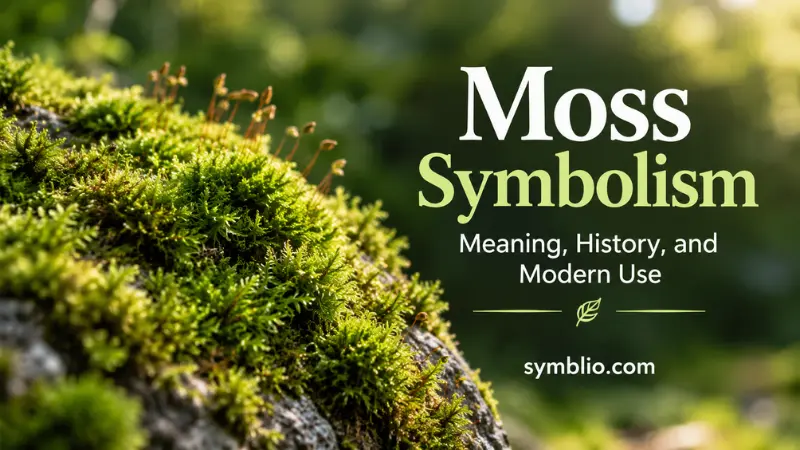
Moss is a small, soft plant often found on rocks, tree bark, forest floors, walls, and shaded gardens. Moss symbolism has developed around qualities that are easy to observe in the plant itself: patience, persistence, age, quiet growth, and a close relationship with the natural world.
Unlike flowers that attract attention through color or fragrance, moss usually works in the background. It slowly spreads across surfaces, holds moisture, softens hard landscapes, and can make an old stone or fallen tree look even older. Those qualities have given moss different meanings across cultures, from longevity and passing time to humility, calm, and renewal.
In the United States, moss is commonly associated with forests, peaceful gardens, environmental awareness, and an appreciation for natural landscapes. Its meaning can also change depending on whether it appears in a garden, tattoo, piece of artwork, photograph, or personal design.
Quick Answer
Moss commonly symbolizes patience, resilience, natural growth, and quiet beauty in modern American culture, especially in gardens, artwork, nature-inspired design, and personal symbolism. Historically, moss has also represented age, the passage of time, longevity, simplicity, and the changing relationship between people and nature.
TL;DR
- Moss often represents patience, persistence, and gradual growth.
- Its slow appearance on stones connects it with age and passing time.
- Japanese garden traditions associate moss with simplicity, age, and imperfection.
- Americans often connect moss with forests, conservation, and peaceful landscapes.
- Moss tattoos can suggest resilience, natural identity, or appreciation for quiet beauty.
- Modern design uses moss to create organic, aged, and understated environments.
What Moss Looks Like and Where It Grows
Moss belongs to a group of small, non-flowering plants known as bryophytes. Unlike flowering plants and trees, mosses do not have conventional vascular systems or true roots. Instead, they absorb water across their surfaces and use root-like structures called rhizoids mainly for attachment.
There are thousands of moss species worldwide, and they can occupy remarkably different environments. Many thrive in moist or humid places, particularly where light is filtered rather than intense. In the United States, people commonly encounter moss on forest floors, stones, tree trunks, stream banks, shaded soil, old structures, and garden surfaces.
Its physical behavior explains much of its symbolism.
Moss does not usually announce itself with a large flower. It establishes itself gradually. A stone may remain in place for years while moss slowly spreads across its surface. That visual relationship makes moss appear connected with time, persistence, and quiet transformation.
Its green color also contributes to its associations with life and renewal. When moisture returns after a dry period, many mosses become visibly greener and more active, creating a natural image of recovery.
What Moss Commonly Means in the United States
Modern American interpretations of moss tend to focus on patience, resilience, natural beauty, age, and peacefulness.
The idea of patience comes from the way moss develops gradually. It does not need to dominate its surroundings to become established. Instead, it occupies small spaces and expands over time.
Resilience comes from its ability to live in environments where many larger plants may struggle. Moss can occupy rock, compacted surfaces, tree bark, and other locations where traditional garden plants are not always successful.
Age is another obvious association. When people see moss covering an old stone wall, tree stump, or abandoned structure, the moss can visually communicate that the object has existed for a long time.
In gardens and landscape photography, moss can also create a sense of calm. Its low height, soft texture, and muted green color provide a quieter visual presence than brightly colored flowers.
For many Americans, therefore, moss does not have one fixed symbolic definition. Its meaning depends heavily on the setting.
Why Moss Is Associated With Patience and Persistence
Moss is a natural example of gradual development.
A moss-covered rock does not usually become covered overnight. The transformation happens through countless small stages. That makes moss a useful metaphor for achievements that develop slowly rather than suddenly.
Someone choosing moss as a personal symbol might therefore use it to represent:
- steady progress
- patience with personal development
- persistence during difficult periods
- appreciation for small changes
- growth without competition
- acceptance of a slower pace
This interpretation works particularly well because it does not require a supernatural explanation. The symbolism comes directly from observing how moss lives.
Moss can also suggest persistence because it often returns to suitable environments when moisture and other conditions allow. Its ability to occupy overlooked spaces reinforces the idea that growth does not always require ideal circumstances.
Moss, Age, and the Passage of Time
One of moss’s strongest historical associations comes from its relationship with old surfaces.
A moss-covered stone seems older than a bare stone, even when both are physically the same age. Moss becomes a visible marker of time because people tend to associate its presence with prolonged exposure to weather, moisture, and changing seasons.
This is especially important in Japanese cultural traditions. Moss has appeared in Japanese poetry and garden design as an image connected with age, longevity, and the passage of time. Its presence on stones can make a landscape appear established rather than newly constructed.
The symbolism can carry two ideas at once.
First, moss can represent longevity because it accompanies objects that have remained in place for years. Second, it can represent change, because even apparently permanent stone surfaces gradually acquire living growth.
That contrast makes moss particularly useful as a symbol of time: the stone stays, while its appearance changes.
Ancient Roots and Early Cultural Associations
Moss does not have one single symbolic origin. Different societies have interpreted it according to local environments, religious traditions, literature, gardening practices, and folklore.
In many places, moss was simply part of the natural landscape rather than a formal symbolic object. Its meanings became more developed where people repeatedly encountered moss in gardens, forests, poetry, decorative arts, or spiritual settings.
Japan provides the clearest example of an established cultural tradition surrounding moss. References to moss appear in Japanese literary history, while later garden traditions turned it into an intentional design element.
By contrast, Western traditions did not develop one universally accepted symbolic meaning for moss comparable to some flower traditions. Victorian flower language assigned meanings to numerous plants, but those meanings were not always standardized, and moss itself does not have one universally authoritative Victorian definition.
This distinction matters. Claims that moss has one ancient meaning shared across every culture usually oversimplify its history.
Moss in Japanese Gardens and Aesthetics
Japanese garden culture is one of the most important traditions for understanding moss symbolism.
Moss became increasingly valued as a deliberate garden element during the medieval period, particularly alongside Zen-influenced garden design and tea traditions. Gardeners learned to use moss as groundcover around stones, trees, pathways, and other landscape features.
Its appeal relates closely to Japanese aesthetic ideas involving simplicity, imperfection, age, and transience.
A moss-covered stone does not look newly manufactured. Its surface appears softened by time. Instead of hiding weathering and irregularity, the garden incorporates those qualities into the visual experience.
This is one reason moss is frequently associated with wabi-sabi, although it is important not to reduce the entire aesthetic concept to a single plant. Moss fits comfortably within an appreciation for natural irregularity, subtle change, weathering, and understated beauty.
Japanese gardens also demonstrate how symbolism can emerge from landscape design. Moss is not necessarily symbolic because someone assigns a definition to it. Its meaning can arise from the way it interacts with stones, water, trees, paths, and seasonal changes.
Moss and Simplicity
Moss can symbolize simplicity because of its understated appearance.
A moss garden does not depend on large blooms or dramatic colors. Its beauty often comes from texture, layers of green, moisture, shadows, and the relationship between living plants and stone.
That makes moss especially relevant to minimalist design.
In American homes, moss-inspired decor may appear in terrariums, botanical artwork, preserved plant displays, garden arrangements, and nature-themed interiors. The goal is often to create a natural atmosphere without overwhelming the space.
Symbolically, this can suggest a preference for:
- modesty rather than display
- natural materials rather than artificial decoration
- quiet surroundings rather than visual clutter
- gradual change rather than constant novelty
The symbolism is subtle, which is part of its appeal.
Moss Symbolism in American Nature and Conservation
In the United States, moss also carries an ecological meaning.
Moss contributes to forest ecosystems by retaining moisture, helping stabilize soil, and providing small habitats for organisms. Some mosses are also useful as environmental indicators because they can respond to changes in air or water quality.
This ecological role has strengthened modern associations between moss and environmental awareness.
A photograph of moss-covered rocks in a national park, for example, can communicate more than beauty. It can represent an intact ecosystem, moisture, biodiversity, and the importance of leaving natural environments undisturbed.
This is particularly relevant to American nature culture, where national parks, forests, hiking areas, botanical gardens, and conservation projects have made close observation of plants part of outdoor recreation.
Moss therefore fits naturally into contemporary environmental symbolism: small, easily overlooked, but important to the larger ecosystem.
Emotional and Psychological Meaning of Moss
Moss often evokes emotions associated with quiet observation rather than excitement.
Its soft texture and green color can create visual associations with calmness and natural surroundings. A moss-covered forest may remind someone of childhood walks, hiking trips, gardens, rain, or secluded outdoor spaces.
For this reason, moss can symbolize rest and reflection.
It can also represent a desire to slow down. A person who chooses moss imagery may be expressing appreciation for gradual growth rather than immediate results.
At the same time, moss can have a more reflective or melancholy meaning. Because it frequently appears on old stones, fallen trees, and neglected structures, it can suggest memory, age, absence, or the way nature gradually reclaims human spaces.
The emotional meaning therefore depends heavily on context.
Moss Symbolism in Tattoos and Personal Style
Moss can make an unusual tattoo choice because its symbolism is less conventional than that of roses, birds, butterflies, or common celestial designs.
A moss-inspired tattoo may represent personal growth, patience, connection with nature, or an appreciation for overlooked forms of beauty.
Some people may choose moss because it reminds them of a particular forest, hiking location, childhood landscape, or meaningful outdoor experience. In those cases, the personal association matters more than any universal symbolic definition.
Moss can also work well as part of a larger natural composition. A design combining moss with stones, mushrooms, ferns, trees, water, or woodland imagery can emphasize themes of forest life and ecological connection.
The same imagery can carry a quieter message when used alone: growth does not have to be loud to be meaningful.
Moss in Home Decor and Modern Design
Modern design has helped move moss from the forest floor into indoor and decorative spaces.
People use living moss, preserved moss, moss-like materials, terrariums, botanical displays, and moss-inspired artwork to introduce natural textures into homes and workplaces.
In this context, moss can symbolize a connection with nature within an increasingly built environment.
Preserved moss is particularly interesting because it changes the relationship between the plant and time. Living moss continues growing under suitable conditions, while preserved moss becomes a decorative representation of natural texture.
Designers may also use moss imagery to create an atmosphere associated with forests, quietness, organic materials, or ecological awareness.
The symbolism is often less about a specific cultural tradition and more about bringing the visual language of nature into modern interiors.
A Quick Comparison of Moss Meanings
| Context | Meaning in the USA | Common Associations | Notes |
|---|---|---|---|
| Forests and nature | Resilience and natural growth | Greenery, moisture, ecosystems | Often connected with outdoor experiences |
| Gardens | Calm and understated beauty | Shade, stone, water, age | Especially influenced by Japanese garden design |
| Tattoos | Patience or nature connection | Growth, individuality, persistence | Personal meaning varies widely |
| Home decor | Simplicity and organic style | Texture, greenery, tranquility | Often used in minimalist spaces |
| Old stones and structures | Age and passing time | Memory, weathering, history | Meaning comes from visual association |
Cross-Cultural Meaning and Religious Connections
Moss has stronger documented cultural symbolism in some regions than others.
Japanese traditions provide the clearest example, especially through gardens, literature, tea culture, and aesthetics. Moss can suggest age, quietness, continuity, and the visible effects of time.
In Buddhist-influenced garden traditions, moss can contribute to an environment designed for contemplation. However, it would be misleading to claim that Buddhism universally defines moss as having one official symbolic meaning.
Christian symbolism does not assign moss one standard theological meaning either. When moss appears around old religious buildings, cemeteries, or stones, its association with age and mortality may arise from the setting rather than from Christian doctrine.
Folklore can add further interpretations, particularly where moss appears in woodland stories or traditional herbal practices. These should be treated as local or historical associations rather than universal definitions.
Positive and Negative Interpretations of Moss
Moss is mostly positive in modern nature-oriented symbolism, but it can also carry less flattering meanings.
On the positive side, moss can represent:
- patience
- resilience
- longevity
- natural beauty
- humility
- renewal
- environmental awareness
- peacefulness
Negative interpretations usually come from contexts where moss suggests neglect or excessive dampness. A neglected building covered with moss might symbolize abandonment, decay, or lack of maintenance.
There is an important distinction here.
Moss itself is not inherently a symbol of decay. It is a living organism that can grow on healthy natural landscapes as well as old structures. The negative meaning emerges when people interpret its presence through a particular human context.
Common Misunderstandings About Moss Symbolism
One common mistake is assuming that moss has one universal symbolic meaning.
It does not.
A Japanese garden, an American forest, a tattoo, and an abandoned stone wall can all use moss differently. Context determines whether the plant suggests serenity, age, resilience, neglect, memory, or ecological connection.
Another misconception is that moss always indicates an unhealthy environment. Moss can grow successfully in many natural habitats and does not automatically mean that a landscape is damaged.
It is also important not to confuse moss with every green growth found on trees and stones. Lichens, liverworts, algae, and mosses are biologically different, even though they can appear together.
Understanding those distinctions makes symbolic interpretations more accurate.
How Moss Meaning Has Changed Over Time
Moss has moved from being an ordinary feature of the landscape to becoming a deliberate artistic and cultural element in several traditions.
In some Western lawns, moss has traditionally been treated as something to remove when maintaining grass. In other settings, particularly Japanese gardens, it has been carefully encouraged and maintained as an important design feature.
That contrast reveals something interesting about symbolism: cultural values influence what people notice and appreciate.
Modern environmental awareness has further changed the perception of moss. Rather than seeing it simply as an unwanted growth, many people now recognize its ecological role and aesthetic value.
Digital photography and social media have also made moss more visible. Close-up photographs of forest floors, miniature landscapes, terrariums, and moss gardens can turn something once overlooked into a subject of artistic attention.
Its modern meaning is therefore increasingly connected with intentional observation: noticing beauty in something small and easily missed.
What Moss Can Symbolize in Modern American Culture
For a modern American audience, moss works particularly well as a symbol of quiet persistence.
It does not suggest instant success. Instead, it represents a process that unfolds gradually.
It can also communicate a relationship with nature that is less formal than traditional floral symbolism. Moss belongs to forests, rocks, streams, shaded gardens, and weathered landscapes. Its presence can suggest someone who values the natural world without needing a dramatic visual symbol.
Moss can further represent the idea that age does not necessarily diminish beauty. A stone becomes visually richer when moss begins to cover it. An old garden can become more atmospheric as its plants mature.
That interpretation makes moss relevant to modern conversations about sustainability, slower living, natural design, and appreciation for imperfect landscapes.
FAQs
Moss can symbolize patience, humility, renewal, continuity, and a close relationship with nature. These meanings are interpretive rather than universal religious doctrines, so the spiritual significance depends on the tradition and context.
A moss tattoo may represent gradual growth, resilience, patience, individuality, or a personal connection to forests and nature. Someone may also choose it simply because moss reminds them of a meaningful place or period of life.
Yes, moss can symbolize longevity because its gradual growth across old stones and trees creates a strong visual connection with age and time. Japanese literary and garden traditions have especially developed this association.
Moss is associated with age, simplicity, quiet beauty, and the passage of time in Japanese cultural traditions. Its role in gardens also connects it with aesthetic ideas that appreciate natural irregularity, weathering, and understated beauty.
Moss is not inherently a symbol of death. However, because it can grow over old stones, fallen trees, graves, or abandoned structures, it can sometimes suggest mortality, memory, or the passage of time.
Usually, yes. Modern interpretations commonly connect moss with resilience, patience, natural beauty, peace, and renewal, although moss on a neglected structure can sometimes suggest abandonment or decay.
Moss often grows in quiet, shaded, humid environments and has a soft texture and subdued green color. These visual qualities make it useful in gardens and artwork intended to create a peaceful, natural atmosphere.
Conclusion
Moss symbolizes patience, resilience, age, natural growth, and quiet beauty, with its meaning shaped by the setting in which it appears. In the United States, it often reflects an appreciation for forests, gardens, environmental connection, and gradual change, while Japanese traditions have given moss especially strong associations with age, simplicity, and the passage of time.
The most useful way to understand moss symbolism is to look at what the plant actually does. It grows gradually, occupies overlooked spaces, softens hard surfaces, retains moisture, and becomes part of landscapes over time. That makes it a fitting symbol for forms of growth that are steady, understated, and easy to appreciate only when someone takes the time to look closely.


