
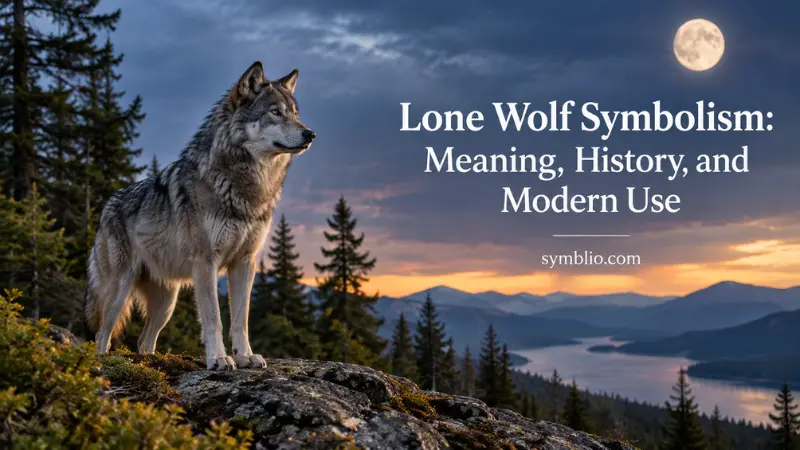
A lone wolf often represents independence, self-reliance, solitude, and the choice to follow one’s own path. The phrase lone wolf symbolism builds on older ideas about wolves as wild, intelligent, territorial animals while adding a distinctly modern meaning centered on individual identity.
The image can suggest confidence and freedom, but it can also express loneliness, emotional distance, or separation from a group. That contrast is important because the real animal is highly social: gray wolves normally live and cooperate in family-based packs rather than spending their lives alone.
In the United States, the lone wolf has become a familiar figure in tattoos, clothing, artwork, literature, movies, social media, and personal storytelling. Its meaning depends heavily on context. Someone may use a lone wolf image to say, “I am comfortable on my own,” while another person may use it to represent a period of isolation or a decision to leave an old identity behind.
Quick Answer
Lone wolf symbolism commonly represents independence, self-reliance, and individuality in modern American culture, especially when someone wants to express an unconventional or solitary identity. Historically, wolf imagery has also been connected with wilderness, hunting, loyalty, danger, family groups, and spiritual or mythological traditions.
TL;DR
- Lone wolves commonly symbolize independence and self-reliance.
- Wolves have long represented wilderness, danger, loyalty, and survival.
- American culture often connects the lone wolf with individualism.
- The symbol can express solitude without necessarily meaning loneliness.
- Wolf tattoos frequently personalize independence, resilience, or identity.
- “Lone wolf” can also have negative meanings in modern language.
What a Lone Wolf Actually Represents
The basic image is simple: a wolf standing or traveling apart from other wolves.
That visual separation creates much of the symbolism. A group suggests belonging, cooperation, family, or community. A solitary animal suggests distance from the group and the ability to function independently.
This is why the lone wolf can communicate two very different ideas at once.
On the positive side, it may represent:
- Independence
- Freedom
- Self-direction
- Personal strength
- Resilience
- Nonconformity
- Confidence
- Solitude by choice
On the more difficult side, it can suggest:
- Loneliness
- Alienation
- Emotional distance
- Rejection
- Isolation
- Distrust
- Feeling misunderstood
The meaning therefore depends on the surrounding imagery and the person’s intention. A wolf walking beneath a mountain may emphasize freedom and wilderness, while a wolf separated from a pack in a darker scene may communicate loneliness.
Why Wolves Became Symbols of Independence
The association between wolves and independence partly comes from how people have historically viewed wild predators.
Wolves survive without human domestication. They travel through large territories, hunt prey, protect their young, and adapt to difficult environments. To many observers, these characteristics made the wolf an obvious representation of life outside ordinary human control.
But there is an important correction to the popular lone-wolf image: wolves are not naturally solitary animals.
Gray wolves are social predators that commonly live in family groups. Members cooperate in raising young, defending territory, and obtaining food. A wolf outside a pack can therefore represent something more complicated than simple independence.
In symbolism, the solitary wolf is often an artistic or metaphorical idea rather than an accurate description of normal wolf behavior.
Ancient Roots of Wolf Symbolism
Wolf symbolism is much older than the modern phrase “lone wolf.”
Across Europe and Asia, wolves appeared in myths, legends, religious traditions, folklore, and stories about wilderness. Their reputation varied considerably. Some traditions treated wolves as dangerous predators, while others associated them with protection, courage, fertility, warriors, or supernatural forces.
In ancient Roman tradition, the she-wolf became associated with the legendary founding of Rome through the story of Romulus and Remus. In Norse mythology, wolves appear as formidable supernatural beings, including Fenrir and the wolves associated with Odin.
These traditions demonstrate an important point: wolves have never had only one symbolic meaning. Their interpretation has always depended on the culture and story surrounding them.
The solitary wolf is therefore best understood as a later development built from several older ideas about the animal.
Wolves in Indigenous North American Traditions
Wolf symbolism also appears in the traditions of numerous Indigenous peoples of North America. However, it is misleading to describe one universal “Native American wolf meaning.”
Hundreds of Indigenous nations have distinct languages, histories, ceremonies, and belief systems. Their interpretations of wolves differ accordingly.
In some traditions, wolves can be associated with qualities such as hunting ability, loyalty, family relationships, guidance, or spiritual significance. Stories involving wolves may emphasize cooperation and kinship rather than isolation.
That distinction matters when interpreting a lone-wolf design. Modern American tattoo culture sometimes presents wolves as universally representing a single spiritual concept attributed to “Native Americans.” Such generalized claims can erase important differences between nations and traditions.
A respectful interpretation identifies a specific cultural tradition when one is genuinely being discussed rather than treating Indigenous cultures as one symbolic system.
Lone Wolf Symbolism in the United States
The American meaning of the lone wolf is strongly connected to individualism.
American culture frequently celebrates ideas such as independence, personal freedom, self-determination, and choosing one’s own path. The lone wolf fits naturally into that language.
A person might describe themselves as a “lone wolf” because they prefer working independently, do not seek large social groups, or feel comfortable making decisions without constant approval.
The image can also appeal to people who see themselves as unconventional. A lone wolf does not visually blend into a crowd. It stands apart, which makes it useful as an identity symbol.
At the same time, American culture often values community and family. That creates an interesting tension: the lone wolf can represent freedom while simultaneously suggesting the cost of separating oneself from others.
Independence Versus Loneliness
One of the most useful ways to understand this symbol is to distinguish chosen solitude from unwanted isolation.
Chosen solitude means a person deliberately spends time alone and values independence. In this interpretation, the lone wolf may represent peace, self-knowledge, freedom, or confidence.
Loneliness is different. It involves wanting connection but feeling separated from other people.
The same wolf image can communicate either experience.
For example, a tattoo showing a calm wolf in an open landscape might emphasize independence. A design showing a wolf looking toward a distant pack might communicate separation or longing.
This flexibility explains why the symbol appears in both empowering and emotionally reflective artwork.
What the Lone Wolf Means Emotionally
At an emotional level, the symbol can represent a person who has learned to rely on themselves.
Someone may connect with the image after changing friendships, leaving an unhealthy environment, moving to a new place, or simply becoming more comfortable with their individuality. The wolf becomes a visual shorthand for a personal transition.
It can also symbolize guardedness. A solitary wolf may suggest someone who does not easily trust others or prefers keeping emotional boundaries.
For some people, that interpretation is temporary. A lone wolf may represent a particular period of life rather than a permanent personality trait.
That is one reason personal context matters more than a fixed dictionary definition.
Lone Wolf Versus Wolf Pack Symbolism
The difference between a lone wolf and a wolf pack creates one of the clearest symbolic contrasts.
| Context | Common U.S. Meaning | Common Associations | Typical Emotional Tone |
|---|---|---|---|
| Lone wolf | Independence | Freedom, self-reliance | Individualistic |
| Wolf pack | Belonging | Family, loyalty, cooperation | Connected |
| Wolf with pups | Protection | Parenthood, responsibility | Caring |
| Howling wolf | Expression | Communication, wilderness | Reflective |
| Wolf in wilderness | Freedom | Nature, survival, exploration | Adventurous |
A pack generally emphasizes relationships, while a lone wolf emphasizes separation from those relationships.
Neither automatically represents a better way of living. They simply communicate different ideas.
Lone Wolf Symbolism in Tattoos
Wolf tattoos are especially common because the animal has a strong visual identity. Sharp ears, thick fur, expressive eyes, and a recognizable silhouette make wolves adaptable to many tattoo styles.
A lone wolf tattoo may represent:
- Independence after a major life change
- Personal resilience
- Freedom from social expectations
- A preference for solitude
- Connection with nature
- Family history involving wolves
- A personal interpretation of strength or survival
The surrounding design changes the message.
A mountain landscape can emphasize wilderness and freedom. A moon can create a nocturnal or reflective atmosphere. Trees can connect the wolf to nature. A geometric design may make the symbol feel more contemporary and abstract.
Some people also combine a wolf with a meaningful date, landscape, initials, or other personal imagery. In those cases, the individual story usually matters more than a universal symbolic definition.
Why the Wolf Appears in Fashion and Decor
Wolf imagery works well visually because it can feel natural, rugged, dramatic, or minimalist depending on how it is presented.
In American decor, wolf images sometimes appear in cabins, outdoor-themed rooms, wildlife artwork, blankets, wall art, and nature-inspired designs. The message may have little to do with solitude and instead emphasize wilderness and a connection to the outdoors.
Fashion uses the wolf differently. A wolf graphic on clothing can communicate independence, toughness, wilderness, or simply an interest in wildlife.
The context surrounding the image is essential. A realistic wildlife photograph is not necessarily a statement about personal identity, while an intentionally stylized solitary wolf may be.
Wolves, Nature, and American Conservation
Modern American attitudes toward wolves have also been shaped by changing ideas about wildlife.
Wolves were once widely persecuted in the United States because many settlers and livestock owners viewed them as threats. Government-supported predator-control programs contributed to their disappearance from much of their former range.
Later, conservation thinking changed. Wolves became part of broader discussions about ecosystems, biodiversity, and the role of predators. Yellowstone’s wolf reintroduction in 1995 became a particularly visible example of this shift.
As a result, the wolf can now symbolize not only wilderness but also wildlife conservation and the restoration of natural ecosystems.
This adds another layer to contemporary American wolf imagery: the animal may represent a wild landscape that people want to understand and protect rather than simply conquer.
The Wolf as a Symbol of Loyalty
The lone-wolf concept can sometimes obscure another important wolf association: social loyalty.
Because wolves generally live in family groups, the broader wolf symbol can represent cooperation, protection, communication, and attachment to a social group.
This creates an interesting contradiction in modern symbolism. The lone wolf represents separation from the pack, while the wolf itself often represents the importance of the pack.
A person who chooses a lone wolf tattoo may therefore be emphasizing independence without rejecting relationships altogether. They may simply be saying that their identity does not depend completely on belonging to a particular group.
Common Misunderstandings About the Lone Wolf
One common misconception is that wolves naturally prefer permanent isolation. They generally do not. Their social behavior is an important part of understanding why the lone wolf works as a metaphor.
Another misconception is that every wolf symbol has a spiritual or supernatural meaning. Many modern wolf images are simply artistic representations of wildlife, nature, independence, or personal identity.
It is also worth being careful with claims that assign a single meaning to wolves across all Indigenous cultures. Different nations have different traditions, and symbolic interpretations should not be blended into one generalized belief system.
Finally, “lone wolf” does not always carry a positive meaning in modern language.
When “Lone Wolf” Has a Negative Meaning
In everyday conversation, calling someone a lone wolf can simply mean that they prefer to work independently.
However, the phrase has also developed a separate meaning in discussions of violent extremism and terrorism. Government and law-enforcement sources have used terms such as “lone actor” and “lone wolf” for individuals who commit ideologically motivated violence without operating under direct organizational control.
That usage is distinct from ordinary symbolism.
A person wearing a wolf necklace or getting a wolf tattoo is not automatically expressing anything related to violence or extremism. Context is necessary. The ordinary cultural meaning of a lone wolf is much broader and frequently centers on independence, solitude, and individuality.
How Social Media Changed the Lone Wolf Image
Digital culture has made the lone-wolf concept particularly easy to use as an identity label.
On social media, phrases about walking one’s own path, avoiding crowds, or becoming independent frequently accompany wolf photographs and artwork. The imagery works because the message can be understood quickly without a long explanation.
At the same time, online culture can simplify complicated ideas. Independence may become confused with refusing all relationships, and solitude may be presented as automatically superior to connection.
A more balanced interpretation recognizes that people can value independence while still maintaining friendships, family relationships, teamwork, and community.
Positive and Negative Meanings Can Exist Together
The most realistic interpretation of lone-wolf symbolism allows both sides to remain visible.
Positive associations include:
- Independence
- Courage
- Self-direction
- Freedom
- Resilience
- Individual identity
- Comfort with solitude
Negative associations can include:
- Loneliness
- Alienation
- Distrust
- Isolation
- Emotional withdrawal
- Social disconnection
The symbol does not decide which interpretation applies. The artwork, words, setting, and personal story provide that context.
How the Meaning Has Evolved
Earlier wolf traditions often focused on the animal itself: its role as predator, its danger to livestock, its place in mythology, or its relationship to wilderness.
Modern symbolism increasingly uses the wolf as a metaphor for identity.
The “lone wolf” is especially suited to this change because modern individualism gives people a language for describing personal independence. The animal becomes less about literal wildlife behavior and more about the question, “How do I relate to other people?”
At the same time, conservation has softened some older American associations between wolves and destruction. The modern wolf can represent ecological balance and protected wilderness as readily as it can represent danger.
Its meaning has therefore expanded rather than simply changed from one definition to another.
FAQs
A lone wolf tattoo commonly represents independence, self-reliance, individuality, or a preference for choosing one’s own path. Depending on the design, it can also represent a period of loneliness, separation, or personal change.
It can be positive, negative, or neutral depending on context. Independence and resilience are common positive interpretations, while loneliness and isolation are possible negative interpretations.
Sometimes, but loneliness is only one interpretation. A solitary wolf can also represent chosen solitude, freedom, independence, or confidence in making decisions without relying on a group.
Wolves can symbolize wilderness, freedom, survival, loyalty, family, danger, and conservation. The meaning depends on whether the image emphasizes the individual wolf, a pack, a natural landscape, or a particular cultural story.
There is no single Native American interpretation of the lone wolf. Indigenous nations have distinct traditions involving wolves, and those traditions should not be combined into one universal meaning.
A lone wolf usually emphasizes independence, individuality, or solitude. A wolf pack more often represents family, cooperation, loyalty, communication, and belonging.
Yes. Some people use the image to represent becoming more independent after a major life transition. In that context, the wolf represents a person’s changing relationship with themselves and with other people.
Conclusion
The meaning of lone wolf symbolism comes from the meeting point between an actual social predator and a modern metaphor for individuality. In the United States, the image most often communicates independence, self-reliance, freedom, and the willingness to follow a personal path.
Yet the symbol has another side. Because wolves are naturally social animals, a lone wolf can also suggest separation, loneliness, or distance from a community. That tension is what makes the image more flexible than a simple symbol of strength.
Whether it appears in a tattoo, painting, piece of clothing, story, or social-media image, the lone wolf ultimately says more when its context is considered. It can represent standing apart without necessarily rejecting the value of belonging.


