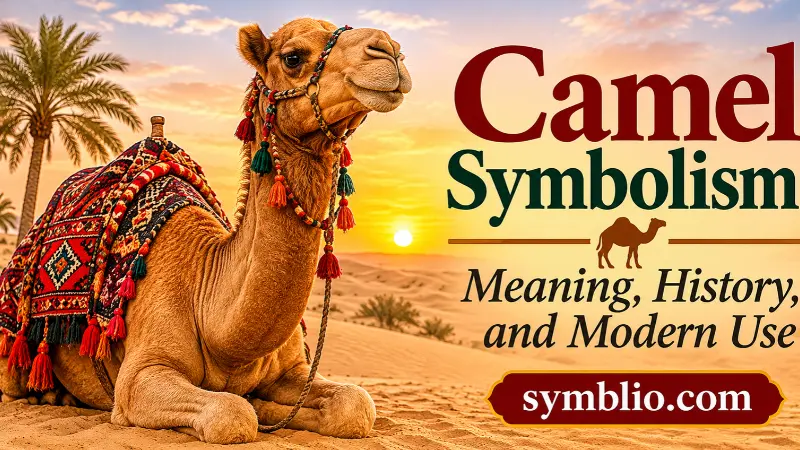
Camel symbolism is closely connected to endurance, patience, survival, and the ability to keep moving through difficult circumstances. Known for traveling across dry deserts and enduring challenging environments, the camel has become an image of resilience and practical strength in many cultures. Its distinctive appearance and unusual adaptations have also made it an important figure in folklore, religion, literature, and art.
In the United States, camels often represent perseverance, independence, adaptability, and the ability to handle demanding situations. People encounter camel imagery in books, tattoos, travel designs, decorative art, and discussions about desert life. The animal can also suggest a slower, more deliberate approach to life, especially when circumstances require patience.
Understanding this animal’s symbolism means looking beyond its reputation as a desert traveler. Its historical role in trade, transportation, and cultural exchange helps explain why different societies have associated it with endurance, wealth, hospitality, and resourcefulness.
Quick Answer
Camel symbolism commonly represents endurance, patience, resilience, and adaptability in modern American culture, particularly the ability to overcome difficult circumstances without giving up. Historically, camels have also symbolized wealth, trade, transportation, hospitality, and survival in desert environments.
TL;DR
- Camels represent endurance, patience, and survival through challenging conditions.
- Their historical role in trade connects them with wealth and prosperity.
- American interpretations often emphasize resilience and independence.
- Religious traditions associate camels with humility, generosity, and responsibility.
- Camel tattoos can represent perseverance, travel, and personal growth.
- Their symbolism also reflects adaptability and practical intelligence.
What a Camel Looks Like and Why Its Appearance Matters
Camels are large mammals recognized by their long legs, broad feet, curved necks, thick eyelashes, and distinctive humps. There are two main types: the dromedary, which has one hump, and the Bactrian camel, which has two.
Their physical features contribute to their symbolic identity. Long legs and broad feet suggest movement across difficult landscapes, while their ability to conserve water and tolerate extreme temperatures makes them natural representations of survival.
The hump is particularly important to understanding camel symbolism. Although people sometimes believe camels store water in their humps, the humps actually store fat, which provides energy when food becomes scarce. This adaptation reinforces the animal’s association with resourcefulness and preparation.
In symbolic artwork, a camel crossing a desert often communicates determination, independence, and the ability to continue despite limited resources.
The Core Symbolic Meanings of Camels
Several meanings appear repeatedly in different interpretations of the camel. Some come directly from its physical characteristics, while others developed through its relationship with human communities.
Endurance: Camels can travel through demanding environments and tolerate conditions that challenge many other animals. They therefore represent the ability to withstand difficulties without abandoning a goal.
Patience: Their steady movement has made them an image of persistence. A camel can represent someone who understands that meaningful progress sometimes takes time.
Adaptability: Camels survive in environments with limited food and water. Symbolically, they represent flexibility and the ability to adjust when circumstances change.
Resourcefulness: Their historical importance to desert communities connects them with practical intelligence, preparation, and making effective use of available resources.
Prosperity: For communities that depended on camels, owning these animals could represent wealth, social standing, and economic security.
These meanings are related, but they are not identical. A camel crossing a desert might communicate perseverance, while a decorated camel in a historical caravan might represent prosperity, cultural heritage, or social importance.
Ancient Roots and Early Camel Symbolism
The relationship between humans and camels developed over thousands of years. Different camel species were domesticated in different regions, and their usefulness transformed transportation, trade, and everyday life.
In the Arabian Peninsula, the dromedary became particularly important because it could transport people and goods across long distances. Communities relied on camels for milk, meat, leather, hair, and transportation. These practical contributions gradually gave the animal a place in poetry, visual art, folklore, and social traditions.
Camels also became associated with responsibility and economic security. A healthy herd represented valuable resources, while the ability to maintain animals demonstrated knowledge of the local environment.
In Central Asia, Bactrian camels supported transportation across difficult routes connecting distant settlements. Their involvement in commercial networks helped establish associations with travel, exchange, and cultural contact.
As a result, the camel developed meanings that extended beyond physical survival. It became a representation of the relationships between people, animals, landscapes, and economic life.
Camel Symbolism in Trade and Prosperity
One of the most important historical associations of the camel is trade.
Before modern transportation, merchants depended on animals capable of carrying valuable goods across long distances. Camel caravans transported spices, incense, textiles, grains, and other commodities through the Arabian Peninsula, North Africa, and Central Asia.
The camel’s ability to travel through dry environments made it especially useful for connecting settlements separated by deserts. Its contribution to the movement of merchandise also helped connect communities that might otherwise have remained isolated.
This historical role explains why camels became associated with:
- Wealth and material security.
- Commercial opportunity.
- Long-distance relationships.
- Cooperation between communities.
- Economic independence.
For many trading communities, a camel represented more than transportation. It was an important investment and a source of livelihood.
Today, this historical association can still appear in decorative artwork, cultural exhibitions, and representations of traditional commerce.
What Camels Represent in American Culture
In the United States, camels do not occupy the same everyday position that they historically held in desert societies. Most Americans encounter them through zoos, wildlife documentaries, children’s books, travel imagery, museums, and popular entertainment.
Their familiar association with desert environments makes them convenient visual representations of endurance and survival.
American interpretations commonly emphasize several qualities:
Independence: The camel is often pictured traveling across an open desert, creating an association with self-reliance and personal freedom.
Perseverance: Its ability to survive difficult conditions makes it an appropriate symbol for people who value determination.
Adventure: Camel imagery frequently appears in travel illustrations and representations of distant landscapes.
Practical strength: Rather than representing aggressive power, the camel suggests the ability to accomplish demanding tasks through steady effort.
The animal also has a specific place in American history. During the 1850s, the United States military imported camels to test their usefulness for transportation in the Southwest. The experiment became known as the U.S. Camel Corps. Although camels demonstrated practical advantages, the project eventually ended because of logistical difficulties and resistance to using unfamiliar animals.
This episode gives the camel a distinctive place in American historical imagination: an example of experimentation, adaptation, and the challenges of introducing unfamiliar solutions.
Religious Meaning of the Camel
Camels appear in several religious traditions, particularly those connected with the Middle East.
In Islam, the camel has an important place in scripture, historical life, and pilgrimage traditions. The Quran invites people to reflect on how camels are created, drawing attention to the animal as an example of creation. Camels also played an important role in transportation and travel associated with pilgrimage.
Their traditional association with patience, strength, and service reflects their contribution to communities living in demanding environments.
In the Bible, camels appear in several accounts involving travel, wealth, and daily life. They are mentioned in connection with Abraham, Rebekah, Jacob, and other biblical figures. In these narratives, camels often communicate material prosperity, transportation, and the movement of people across distant places.
A well-known biblical passage also uses a camel in an illustration about the difficulty of entering the kingdom of God when wealth becomes an obstacle. This gives the animal a different symbolic dimension: a reminder of the relationship between material possessions and spiritual priorities.
Religious interpretations therefore depend on the particular passage and tradition. A camel does not have one universal religious meaning.
Camel Symbolism in Different Cultures
Different societies developed their own relationships with camels, and these experiences influenced the animal’s cultural meaning.
| Cultural context | Common symbolic meaning | Historical connection |
|---|---|---|
| Arabian traditions | Endurance, dignity, prosperity | Desert transportation and pastoral life |
| Islamic traditions | Creation, patience, service | Quranic references and pilgrimage |
| Central Asian cultures | Travel and resilience | Bactrian camel trade routes |
| North African traditions | Survival and cooperation | Trans-Saharan commerce |
| Western representations | Adventure and exotic landscapes | Travel literature and historical imagery |
In Arabian communities, camels have long been connected with heritage, social identity, and economic life. Their importance extends into traditional poetry, ceremonies, and contemporary cultural celebrations.
In parts of North Africa, camels became essential to transportation across the Sahara. Their association with survival reflects the practical knowledge required to travel through challenging landscapes.
In Central Asia, the two-humped Bactrian camel represents an important part of traditional pastoral life and long-distance transportation.
Western artistic representations sometimes presented camels as symbols of unfamiliar or distant societies. These portrayals could reflect limited cultural understanding rather than the perspectives of the communities that depended on the animals.
The Emotional and Psychological Meaning of Camels
The camel can communicate several emotional qualities because its physical behavior is closely connected with survival and steady movement.
Emotional resilience is one of its strongest associations. A person who identifies with the camel may see it as a reminder to remain composed during demanding periods.
Patience is another important interpretation. The animal’s steady pace suggests that not every achievement requires immediate results.
Self-reliance comes from its ability to function in environments with limited resources. As a personal symbol, it can represent confidence in one’s ability to manage challenges.
Practical wisdom is connected with preparation. Camels are adapted to their environments, and their symbolism can encourage thoughtful planning rather than unnecessary risk-taking.
There is also an emotional connection with travel and independence. A camel moving across an open landscape can suggest the desire to explore unfamiliar places while remaining grounded.
These interpretations are personal rather than scientific psychological conclusions. Different people may connect with the same animal for different reasons.
Why Camels Symbolize Patience and Perseverance
Patience is among the most recognizable qualities associated with camels.
Unlike animals commonly portrayed through speed or sudden movement, camels are often represented traveling steadily across extensive landscapes. This creates a natural connection with gradual progress.
Their reputation for endurance also comes from genuine biological adaptations. Camels can tolerate substantial changes in body temperature and conserve water effectively. These characteristics help them survive in environments where resources are limited.
The symbolic lesson is not that people should tolerate every difficult situation indefinitely. Instead, the camel can represent knowing how to manage challenges, conserve energy, and recognize when a different approach is necessary.
For this reason, camel imagery often suits messages about long-term goals, education, personal development, and overcoming temporary obstacles.
Camel Symbolism in Dreams and Folklore
Camels appear in traditional stories and dream interpretations across several cultures. Their meanings often depend on the surrounding circumstances and the beliefs of the person interpreting them.
A camel traveling through a desert may represent a long journey, patience, or preparation for an unfamiliar experience. A group of camels might suggest cooperation, shared responsibilities, or commercial prosperity.
A resting camel can be interpreted as a reminder to slow down and consider personal responsibilities. A camel carrying goods may suggest hard work, obligations, or the rewards of preparation.
In some religious and cultural traditions, dream interpretations carry established meanings. However, these interpretations are not universal facts or scientifically established predictions.
In modern American culture, people often approach animal dreams through personal associations. Someone who connects camels with travel may interpret the animal differently from someone who associates it with religious history.
The most useful interpretation usually considers the dreamer’s circumstances, feelings, and personal experiences rather than treating one explanation as definitive.
Why People Choose Camel Tattoos
Camel tattoos can represent personal qualities, travel experiences, cultural appreciation, or meaningful connections with desert landscapes.
Some common interpretations include:
- Endurance: A reminder to remain determined through challenging periods.
- Patience: Recognition that progress takes time.
- Travel: A connection with exploration and memorable journeys.
- Cultural heritage: Appreciation for traditions in which camels have an important role.
- Adaptability: A personal reminder to adjust when circumstances change.
A minimalist camel silhouette can communicate simplicity and independence, while a detailed desert scene may emphasize adventure and connection with nature.
People choosing culturally inspired designs should also consider the traditions behind particular imagery. Appreciating an animal’s cultural importance is different from using religious or ceremonial symbols without understanding their context.
Camel Imagery in Fashion, Art, and Modern Design
Camel imagery has remained recognizable in contemporary visual culture.
In fashion, the word camel is also associated with a warm tan or sandy brown color. Camel-colored coats, scarves, handbags, and other clothing items are popular because the neutral shade works with many different colors.
This fashion meaning is separate from the animal’s traditional symbolism, although both draw on associations with desert landscapes and natural materials.
In interior design, camel illustrations and desert-inspired artwork can create a connection with travel, nature, and traditional craftsmanship.
In children’s literature, camels frequently appear in stories about journeys, friendship, and unfamiliar environments. Their distinctive appearance makes them easy to recognize and remember.
Social media also uses camel illustrations and photographs in travel posts, educational content, and cultural celebrations.
The animal’s visual identity allows designers to communicate desert environments and long-distance travel without requiring extensive explanation.
Common Misunderstandings About Camel Symbolism
Although camels are widely associated with endurance and desert survival, some popular interpretations oversimplify their cultural importance.
One common misunderstanding is that camels represent laziness or stubbornness. Their relatively steady movement and distinctive behavior sometimes lead to these descriptions. However, their historical role involved demanding physical work, transportation, and close relationships with human communities.
Another misconception is that camels belong exclusively to Arabian culture. Although they are strongly associated with the Arabian Peninsula, different camel species have also supported communities in North Africa, Central Asia, and other regions.
Western representations have sometimes portrayed camels as symbols of an exotic or unchanging East. Such imagery can overlook the sophisticated societies, trading networks, and cultural traditions connected with camel ownership.
It is important to distinguish the animal’s historical importance from stereotypes created by outside observers. Respectful interpretations recognize camels as living animals with important roles in different communities rather than reducing them to decorative desert imagery.
How Camel Symbolism Has Changed Over Time
The camel’s symbolic identity has developed alongside changes in transportation, technology, and human society.
In earlier societies, camels represented practical necessities. They provided transportation, food, materials, and economic security. Their value was directly connected with everyday survival.
As commercial networks expanded, the animal became associated with long-distance trade, cultural exchange, and prosperity. Its image appeared in art, poetry, and historical accounts.
During later periods, Western travel writing and artwork increasingly presented camels as recognizable features of distant landscapes. These representations sometimes emphasized adventure while overlooking the animal’s deeper cultural significance.
In contemporary society, the camel has acquired additional meanings. It can represent environmental adaptation, cultural heritage, wildlife conservation, and the importance of traditional knowledge.
Modern interpretations therefore combine historical associations with personal meanings. The camel remains recognizable as an image of endurance, but its significance now extends into education, design, travel, and cultural identity.
FAQs
A camel commonly represents patience, endurance, humility, and the ability to continue through challenging circumstances. In Islamic traditions, it also appears as an example of God’s creation and a reminder to reflect on the natural world.
Camels are associated with prosperity and economic security in some traditional cultures because they historically represented valuable possessions and reliable transportation. However, there is no universal belief that seeing a camel guarantees good fortune.
A camel tattoo commonly represents perseverance, independence, patience, and adventure. Some people also choose camel designs to express their connection with desert landscapes, travel experiences, or cultural heritage.
In biblical narratives, camels are frequently associated with wealth, transportation, and travel. They also appear in teachings that use the animal to illustrate spiritual lessons about material possessions and religious priorities.
Camels have biological adaptations that allow them to survive in environments with limited water and food. Their ability to travel across demanding landscapes has made them recognizable symbols of resilience and persistence.
A camel in a dream may represent patience, a personal journey, responsibility, or the ability to manage difficult circumstances. Interpretations vary according to cultural beliefs and individual experiences, so dreams should not be treated as reliable predictions.
Conclusion
Camel symbolism represents endurance, patience, adaptability, and resourcefulness. Its historical connections with trade, transportation, religious traditions, and desert communities have also established associations with prosperity, cultural identity, and cooperation.
In modern American culture, the camel is often understood as an image of perseverance and independence. Whether it appears in artwork, tattoos, literature, or travel imagery, it communicates the idea of continuing toward a destination despite challenging circumstances.
Ultimately, the camel reminds us that resilience is not always about speed or physical strength. Sometimes it means preparing carefully, adapting to changing conditions, and maintaining a steady direction when the journey becomes difficult.