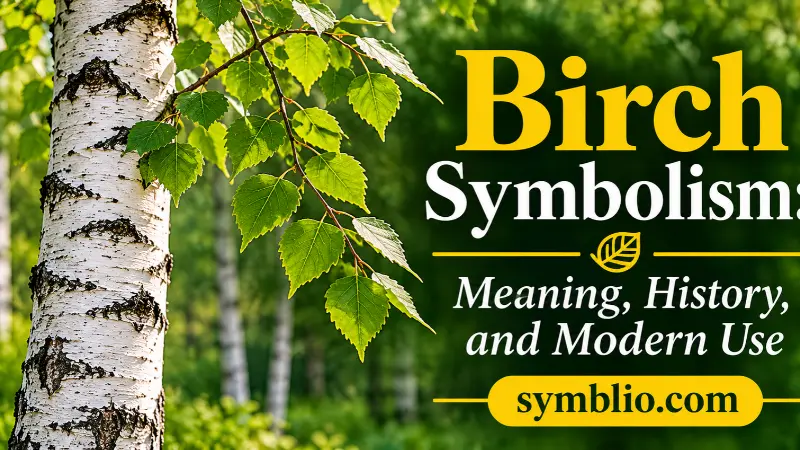
Birch symbolism is closely associated with renewal, new beginnings, purity, resilience, and personal growth. Recognized by its distinctive pale bark, delicate leaves, and graceful branches, the birch tree has held an important place in folklore, traditional practices, literature, and landscape design. Its appearance often suggests simplicity and fresh possibilities, making it an appealing symbol for people who connect nature with personal change.
Birch trees belong to the genus Betula, which includes several species found across North America, Europe, and Asia. In the United States, paper birch, also called white birch or canoe birch, is particularly recognizable. Its bright bark and ability to grow in challenging northern environments have helped establish its place in American natural imagery.
People encounter birch symbolism in many settings, from woodland photography and home decoration to tattoos, jewelry, poetry, and seasonal artwork. Understanding its meaning requires looking beyond its appearance to the historical traditions and practical relationships that shaped how different communities viewed the tree.
Quick Answer:
Birch commonly symbolizes new beginnings, renewal, purity, resilience, and personal growth in modern American culture. Historically, European folklore connected it with protection, fertility, purification, and the arrival of a new season, while its practical importance in North American Indigenous communities gave it additional associations with resourcefulness and relationships with the natural world.
TL;DR:
- Renewal: Represents fresh starts, recovery, and the beginning of a new chapter.
- Purity: Its pale bark suggests simplicity, clarity, and cleanliness.
- Resilience: Reflects the ability to grow after environmental disturbances.
- Protection: European folklore associated birch branches with protective household traditions.
- New beginnings: Its historical connection with spring and regeneration reinforces this interpretation.
- Resourcefulness: Its bark and wood represent practical relationships with nature.
What Is a Birch Tree and What Makes It Recognizable?
Birch is a deciduous tree belonging to the birch family, Betulaceae. Different species vary in size, bark color, leaf shape, and growing conditions, but many share a slender appearance and distinctive bark.
Paper birch (Betula papyrifera) is one of the best-known North American varieties. Its trunk develops characteristic white bark that can peel into thin, papery layers. Other varieties have silver, yellowish, gray, or darker bark.
The tree’s leaves are usually simple and toothed along their edges. During spring and summer, they create a light green canopy. In autumn, many birch varieties develop yellow foliage before dropping their leaves.
People often recognize birch trees in:
- Northern American forests and woodland landscapes.
- Parks, gardens, and residential landscaping.
- Nature photography and landscape paintings.
- Seasonal decorations and botanical illustrations.
- Furniture, crafts, and traditional household objects.
These physical characteristics contribute to the tree’s symbolic associations. Its pale trunk suggests simplicity, while its seasonal changes provide a natural connection to growth and renewal.
The Core Symbolic Meanings of Birch
Birch has several established symbolic associations, although their importance varies between cultures and historical periods.
Renewal and fresh beginnings are among its most recognizable meanings. Birch is often described as a pioneer tree because it can establish itself in open areas following environmental disturbances. This natural behavior provides a fitting image of beginning again.
Purity and clarity connect to its light-colored bark. The clean visual appearance of white birch has encouraged associations with innocence, simplicity, and peaceful surroundings.
Resilience and adaptability reflect its ability to grow in different northern environments and colonize disturbed landscapes. Its presence can suggest persistence and the possibility of recovery.
Protection and fertility appear in several European folk traditions. People historically used birch branches in seasonal ceremonies and household customs intended to encourage good fortune or protect against harmful influences.
Growth and transformation relate to the tree’s changing appearance throughout the year. Its spring leaves, summer canopy, autumn colors, and winter branches provide a natural reminder that change is part of life.
These meanings are related, but they are not interchangeable. A birch tree in a wedding arrangement may communicate fresh beginnings, while one in a winter landscape may suggest endurance and quiet strength.
Ancient European Roots and Early Birch Traditions
Birch appears in the folklore and traditional practices of several northern European communities. Its widespread presence, useful wood, and recognizable appearance helped it acquire cultural importance long before modern landscape design.
In Celtic traditions, birch became associated with beginnings, purification, and renewal. Some modern accounts of Celtic tree traditions connect it with the first character of the Ogham tree alphabet, known as Beithe.
The Ogham alphabet was an early medieval Irish writing system. Although modern interpretations sometimes present it as a complete ancient tree-based spiritual system, its historical development is more complicated. Its later connections with individual trees have become particularly influential in contemporary Celtic-inspired symbolism.
Birch also appeared in seasonal customs associated with the transition from winter to spring. Fresh branches could represent the return of vegetation and the possibility of a productive growing season.
In some Scottish traditions, birch was connected with Brigid, an important figure in Irish and Scottish religious folklore. Birch crosses were associated with celebrations around the beginning of February.
These traditions demonstrate why the tree became connected with renewal. Its cultural meaning developed through everyday observations, seasonal ceremonies, and practical uses rather than through one universal religious interpretation.
Birch Symbolism in Celtic Folklore
Celtic folklore gives birch a particularly strong association with purification and new beginnings.
Traditional accounts describe birch branches being used to clear away unwanted influences and mark the transition into a fresh period. Bundles of twigs also played a role in household and agricultural customs.
The connection with Samhain is especially interesting. Samhain marked an important seasonal transition in the traditional Gaelic calendar. It was associated with the end of the harvest period and the beginning of winter.
Some modern interpretations connect birch branches with the symbolic clearing away of the previous year’s difficulties. This interpretation reinforces the tree’s association with starting over.
Birch also appears in Irish and Welsh literary traditions. Its graceful appearance made it suitable for poetic comparisons involving beauty, affection, and femininity.
However, it is important not to treat every modern Celtic interpretation as an unchanged ancient belief. Some popular explanations combine historical folklore, later literary interpretations, and contemporary spiritual practices.
The central associations with renewal, seasonal transition, and purification remain useful when understanding the tree’s place in European folklore.
What Birch Represents in American Culture
In the United States, birch symbolism is strongly influenced by the country’s northern forests, outdoor traditions, and appreciation of natural landscapes.
Paper birch grows across much of northern North America, including Alaska, the Great Lakes region, New England, and parts of the Appalachian Mountains. Its bright trunk makes it a familiar feature of woodland environments.
American interpretations commonly connect the tree with:
- Fresh starts: A visual reminder that new opportunities can follow difficult periods.
- Natural simplicity: Its pale bark and delicate foliage suggest an uncomplicated relationship with nature.
- Endurance: Its ability to establish itself after disturbances makes it a symbol of persistence.
- Peaceful living: Its appearance in woodland settings creates associations with quietness and relaxation.
- Environmental appreciation: Its presence in northern forests encourages interest in conservation and native landscapes.
Birch also appears in American residential landscaping. Designers use its distinctive bark to create contrast against darker trees, evergreen plants, and garden structures.
In photography and decorative artwork, a group of white birch trunks can create an atmosphere of calmness and openness. This visual appeal helps explain why the tree appears in cabin interiors, nature-inspired home designs, and seasonal decorations.
Unlike some symbols connected with specific American holidays, birch does not have one nationally established ceremonial meaning. Its contemporary significance is largely associated with nature, renewal, and personal interpretation.
Birch and Indigenous North American Traditions
Birch has a significant practical and cultural history among several Indigenous peoples of North America. Its importance cannot be reduced to a single symbolic meaning because different nations have distinct relationships with their environments, materials, and cultural traditions.
Paper birch bark was especially valuable because it could be shaped into useful objects. Depending on the community and local practices, birch bark was used for canoes, containers, coverings, mats, and other essential items.
Birchbark canoes are particularly well-known examples of this craftsmanship. Their construction demonstrates detailed knowledge of materials, seasonal conditions, and transportation needs.
Birch bark also served as a medium for artistic and cultural expression. Some Anishinaabe communities, for example, have traditions involving birchbark scrolls associated with the Midewiwin, a religious and cultural institution.
These objects were not simply decorative. They could preserve important knowledge and support ceremonial practices.
For American readers, this history provides a different perspective on birch. Rather than viewing the tree only as an image of purity or renewal, it also represents practical knowledge, craftsmanship, cultural continuity, and relationships between people and their environments.
It is important to recognize these traditions accurately without assuming that every Indigenous nation assigns the same meaning to birch. Milwaukee Public Museum+1
Birch Symbolism in Russian and Northern European Culture
Birch holds a particularly visible place in Russian cultural imagery. It is often associated with the countryside, familiar landscapes, seasonal change, and national literary traditions.
In Russian poetry and visual art, birch trees frequently appear as recognizable features of the homeland. Their white trunks and delicate leaves have made them popular subjects for painters, poets, and photographers.
The tree also appears in traditional seasonal customs. In some historical Russian communities, birch branches were incorporated into springtime celebrations and village ceremonies.
Finnish traditions provide another example of birch’s cultural importance. The tree appears in the Kalevala, Finland’s national epic, where it is presented within a broader relationship between nature and human life.
In Finland and other northern European countries, birch has also been valued for practical purposes, including household objects and traditional sauna whisks.
These examples show that birch can represent more than individual emotional qualities. It can also communicate belonging, cultural memory, and attachment to familiar landscapes.
Birch as a Symbol of Renewal and New Beginnings
Renewal is one of the strongest modern interpretations of birch.
The association makes sense when considering the tree’s natural behavior. Paper birch is a pioneer species, meaning it can establish itself in open spaces following events such as wildfires, logging, and other disturbances.
Its seeds can spread into exposed areas, where young trees begin developing under suitable conditions. Birch may eventually become part of a changing forest community.
This process offers a natural comparison with human experiences.
Someone beginning a new career, moving to another city, recovering from a difficult period, or entering a different stage of life might find the birch a meaningful representation of that transition.
The tree does not suggest that change happens without difficulty. Instead, it represents the possibility of development after disruption.
In modern American design, this interpretation makes birch particularly suitable for artwork associated with new homes, personal milestones, and fresh starts.
Its meaning is not limited to dramatic life changes. Even small decisions, such as learning a new skill or developing a healthier routine, can be represented through its symbolism.
The Connection Between Birch and Purity
The pale bark of many birch species creates an immediate visual association with cleanliness and simplicity.
White has traditionally been connected with purity in many Western cultural settings. Wedding clothing, ceremonial decorations, and certain religious artworks often use white to communicate innocence, peace, or spiritual cleanliness.
Birch shares some of these visual associations because its trunk provides a natural example of a light-colored surface within a woodland environment.
However, its symbolic meaning is not identical to the meaning of the color white.
Birch is a living tree with rough textures, changing leaves, and natural imperfections. Its appearance suggests that simplicity can exist alongside complexity.
This makes it an appealing symbol in minimalist design and nature-inspired interiors.
A decorative arrangement featuring white birch branches, neutral fabrics, and natural wood can create a clean visual atmosphere without relying on elaborate decoration.
For individuals, birch may represent a desire for greater clarity, a simpler lifestyle, or a renewed sense of direction.
Birch Symbolism and Emotional Meaning
Birch often communicates feelings of calmness, optimism, and quiet determination.
These emotional associations come partly from its appearance and partly from the natural environments where people encounter it.
A birch woodland can feel open and peaceful because its pale trunks contrast with surrounding greenery. The spaces between trees allow light to move through the forest, creating a different atmosphere from dense evergreen woodland.
Several emotional interpretations are commonly connected with the tree.
Hope: New leaves and fresh growth provide a visual reminder that conditions can change.
Peace: Its light appearance and delicate foliage are often associated with quiet natural settings.
Confidence: Its ability to grow in changing environments can suggest persistence.
Clarity: Its pale bark and simple form make it an appropriate image for reflection and a fresh perspective.
Independence: A birch standing alone in an open landscape can represent individuality and self-direction.
Psychologically, these interpretations are personal associations rather than scientifically established effects of the tree itself.
A person who grew up near birch forests may associate them with childhood memories, family trips, or a familiar hometown. Someone else may connect the same tree with travel, solitude, or an important personal experience.
That individual connection is often what makes natural symbolism meaningful.
Birch in Tattoos, Jewelry, and Personal Style
Birch-inspired designs offer a natural alternative to more traditional symbolic images such as roses, birds, or celestial objects.
In tattoo culture, a birch tree can communicate several personal ideas:
- Starting over: A reminder of personal change and new opportunities.
- Resilience: Recognition of the ability to move forward after challenges.
- Connection with nature: Appreciation for forests, outdoor experiences, and environmental identity.
- Family memories: A tribute to a meaningful place or childhood landscape.
- Simplicity: A preference for understated imagery rather than elaborate designs.
Some people choose a single birch trunk, while others prefer a small woodland scene featuring multiple trees.
A design showing young leaves may emphasize growth and optimism. A winter birch may communicate endurance, reflection, or the ability to remain steady during difficult periods.
Birch also appears in jewelry through engraved pendants, botanical illustrations, and nature-inspired accessories.
Unlike some traditional symbols, birch does not have one universally recognized tattoo interpretation. Its meaning depends on the design and the personal story attached to it.
Birch Symbolism in Home Decor and Interior Design
Birch is a popular choice in nature-inspired interiors because of its light appearance and recognizable texture.
Its pale wood and distinctive bark work well with minimalist, Scandinavian-inspired, rustic, and contemporary design styles.
In American homes, birch-inspired decorations can communicate:
- Simplicity and uncluttered living.
- A connection with forests and outdoor environments.
- Freshness and seasonal change.
- Warmth through natural materials.
- A peaceful atmosphere.
Decorators sometimes use birch logs, decorative branches, framed botanical illustrations, and furniture made from birch wood.
The material also creates interesting visual contrast. Its light surface works alongside darker furniture, green plants, stone, and neutral fabrics.
Birch decorations are particularly common in winter-inspired arrangements. White branches can create a snowy appearance without requiring artificial seasonal imagery.
The symbolism remains flexible. In one home, birch may represent a connection to a family cabin, while in another it may simply express an appreciation for natural textures.
Birch in Literature, Art, and Photography
Birch has a recognizable place in literature and visual art because of its graceful structure and distinctive bark.
One particularly famous example is Robert Frost’s poem Birches. The poem uses the image of birch trees bent by ice storms and imagines a child swinging from their branches.
The natural image becomes a starting point for reflections on childhood, imagination, responsibility, and the desire for temporary escape.
This literary treatment demonstrates how birch can communicate several ideas at once. It can represent the natural world while also suggesting memory, freedom, and the movement between youthful imagination and adult experience.
Birch is also a frequent subject in landscape photography. Photographers use its pale trunks to create contrast, depth, and visual rhythm.
During winter, dark branches against snow can create a restrained composition. In summer, green leaves provide a softer and more inviting appearance.
Artists may use birch to suggest solitude, simplicity, or the relationship between people and their surroundings.
Its visual identity is strong enough to remain recognizable even in relatively simple illustrations.
Different Birch Colors and Their Symbolic Associations
Birch species have different bark colors, and these visual differences can influence how people interpret them.
Although color symbolism is subjective and varies between cultures, the following associations are common in contemporary Western design.
| Birch Appearance | Common Symbolic Association | Visual Impression |
|---|---|---|
| White birch | Purity, clarity, and fresh beginnings | Clean and peaceful |
| Silver birch | Grace, reflection, and renewal | Elegant and delicate |
| Yellow birch | Warmth, endurance, and natural maturity | Earthy and inviting |
| Gray birch | Simplicity and adaptability | Subtle and understated |
| Dark-marked birch | Contrast, complexity, and strength | Distinctive and dramatic |
These interpretations are not fixed historical rules. They are modern visual associations that can help explain why different birch varieties appeal to artists and designers.
Misunderstandings and Distorted Interpretations of Birch
Birch has accumulated many symbolic meanings, but not every popular explanation has a reliable historical foundation.
One common misunderstanding is that birch has a single universal meaning across all cultures. In reality, its significance changes according to geography, religion, historical experience, and local customs.
Another misconception involves modern Celtic tree symbolism. Online descriptions sometimes present every association between birch and spiritual practices as an established ancient Celtic belief. Some interpretations come from later folklore or contemporary spiritual movements rather than clearly documented ancient practices.
The tree’s connection with purification is also sometimes exaggerated. Historical communities used birch branches in particular customs, but that does not establish that the tree has supernatural protective properties.
Similarly, white bark does not mean that every birch variety represents innocence or perfection. These interpretations reflect cultural associations with color rather than an inherent quality of the tree.
There is also a tendency to overlook Indigenous North American knowledge when discussing birch symbolism. Focusing entirely on European folklore leaves out the practical, artistic, and cultural relationships that several Indigenous communities developed with birch bark.
A balanced understanding recognizes that birch has many cultural interpretations without forcing them into one universal explanation.
How Birch Symbolism Has Evolved Over Time
Birch symbolism has developed through changing relationships between people and the natural world.
In earlier societies, the tree’s meaning was closely connected with practical usefulness, seasonal ceremonies, agriculture, and local folklore.
Its branches appeared in traditional customs, while its wood and bark supported everyday activities. These relationships helped establish associations with protection, fertility, renewal, and resourcefulness.
During later periods, literature and visual art expanded the tree’s cultural identity. Writers and artists used birch to explore themes such as childhood, beauty, memory, and the relationship between people and nature.
In contemporary America, its symbolism is increasingly visible through personal expression and environmental appreciation.
People may choose birch-inspired tattoos to represent a new chapter. Interior designers use its pale wood to create natural-looking spaces. Photographers capture its appearance to communicate calmness or the changing seasons.
Digital platforms have also made botanical imagery easier to share. Birch forests frequently appear in nature photography, seasonal mood boards, and artwork associated with minimalist lifestyles.
Despite these changes, the central ideas remain recognizable: growth, renewal, simplicity, and the ability to continue through changing conditions.
Birch Symbolism Compared With Other Trees
Birch shares some symbolic meanings with other trees, but its appearance and cultural history give it a distinct identity.
Comparing different trees can help readers understand which qualities make birch especially meaningful.
| Tree | Common Symbolic Meaning | Main Distinction |
|---|---|---|
| Birch | Renewal, purity, and new beginnings | Associated with fresh growth and pale bark |
| Oak | Strength, wisdom, and endurance | Represents long-lasting stability |
| Willow | Flexibility, emotion, and adaptability | Known for its flowing branches |
| Pine | Longevity, persistence, and resilience | Often associated with evergreen life |
| Maple | Balance, generosity, and seasonal change | Recognized for its autumn foliage |
These associations are broad cultural interpretations rather than universal definitions.
Birch stands apart because its symbolic identity combines the visual impression of purity with the ecological idea of beginning again after disturbance.
FAQs
Birch is commonly associated with renewal, purification, protection, and fresh beginnings in various spiritual and folk traditions. Its meaning depends on the specific cultural or religious context rather than one universal spiritual definition.
Yes. Birch is widely associated with new beginnings because it is a pioneer tree capable of establishing itself in open areas following environmental disturbances. Its fresh spring leaves also reinforce its connection with growth and renewal.
A birch tree tattoo can represent resilience, personal transformation, simplicity, or a connection with nature. Some people also choose it to remember a meaningful location or celebrate a new stage in life.
The association largely comes from the pale bark found on several birch varieties. In Western cultural traditions, white often represents cleanliness, innocence, and clarity, which influences how people interpret the tree’s appearance.
Birch is associated with renewal, purification, beginnings, and seasonal transitions in several accounts of Celtic folklore. It is also connected with the Ogham tree tradition, where Beithe represents birch.
Yes. Birch can represent resilience because certain species establish themselves in disturbed landscapes and adapt to changing environmental conditions. Its symbolism emphasizes recovery and persistence rather than physical dominance.
In the United States, birch commonly represents natural beauty, renewal, simplicity, and resilience. Its distinctive appearance and importance in northern forests also make it recognizable in American landscape art and nature-inspired design.
Conclusion
Birch symbolism brings together several closely connected ideas, including renewal, purity, resilience, protection, and personal growth. Its pale bark creates associations with clarity and simplicity, while its ability to establish itself in changing environments provides a natural comparison with recovery and new beginnings.
Its cultural history also extends beyond modern American interpretations. European folklore connected birch with purification and seasonal transitions, while Indigenous North American communities developed important practical, artistic, and cultural relationships with its bark and wood. Literature, photography, tattoos, and interior design have continued to expand the ways people interpret the tree.
Ultimately, birch symbolism represents the possibility of beginning again while remaining connected to the experiences that shaped us. Its meaning is found not only in its appearance but also in its ability to grow, adapt, and become part of a changing landscape.