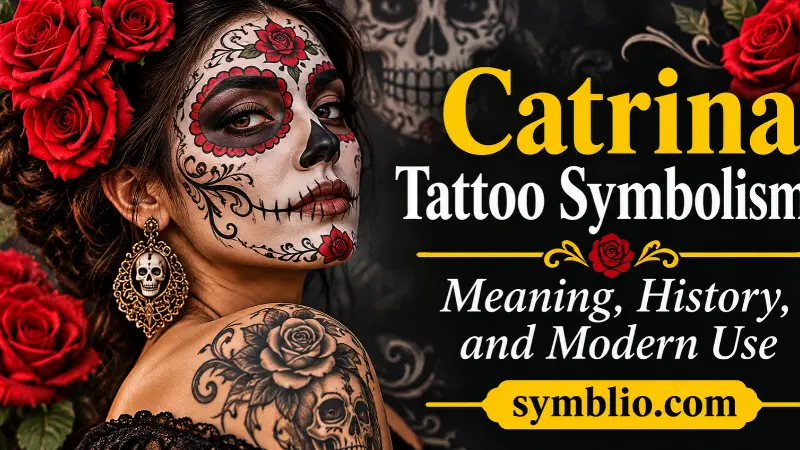
Catrina tattoo symbolism connects ideas of mortality, cultural identity, beauty, remembrance, and the relationship between life and death. Inspired by La Catrina, the elegant female skeleton associated with Mexican art and Día de Muertos, this tattoo design combines striking visual details with a meaningful cultural history. Its recognizable appearance often includes a decorated skull, elaborate clothing, flowers, and a fashionable hat.
In the United States, Catrina tattoos appeal to people interested in Mexican heritage, memorial artwork, traditional imagery, and designs that explore the contrast between beauty and mortality. Some choose the image to honor family members, while others appreciate its historical connection to Mexican printmaking and social commentary.
However, La Catrina represents more than a decorative skeleton. Her original image carried a pointed message about social class, European fashion, and cultural identity in Mexico. Understanding that background helps explain why the design continues to attract attention and why it deserves thoughtful treatment.
Quick Answer:
Catrina tattoo symbolism commonly represents mortality, remembrance, Mexican cultural heritage, beauty, and the acceptance of life’s temporary nature. Its historical roots connect to Mexican artist José Guadalupe Posada’s social satire and the later association of La Catrina with Día de Muertos, a celebration honoring deceased loved ones.
TL;DR:
- Mortality: Reminds people that death is part of everyone’s journey.
- Remembrance: Honors relatives, ancestors, and loved ones who have passed away.
- Cultural identity: Celebrates Mexican heritage, art, and traditions.
- Beauty: Contrasts elegant feminine imagery with the appearance of a skeleton.
- Equality: Reflects the idea that death comes to everyone, regardless of wealth.
- Personal transformation: Represents acceptance, resilience, and changing perspectives on life.
What Is a Catrina Tattoo?
A Catrina tattoo depicts an elegant female skeleton inspired by La Catrina, a famous character in Mexican visual culture. Artists commonly portray her with a decorative hat, elaborate clothing, flowers, and a skull-like face. Some designs feature realistic skeletal details, while others emphasize colorful patterns and traditional Mexican decorative elements.
The original artistic figure is closely associated with the Mexican printmaker José Guadalupe Posada. His famous skeleton illustration eventually became one of the country’s most recognizable cultural images.
Modern tattoo artists interpret the character in several ways. Some create highly detailed black-and-gray portraits, while others use colorful flowers, ornamental patterns, and elaborate clothing to produce a more contemporary design.
Common visual elements include:
- Skull face: Represents mortality and the physical reality of death.
- Decorative hat: Connects the character to her historical appearance and fashionable clothing.
- Flowers: Suggest remembrance, beauty, and connections with Día de Muertos.
- Elegant clothing: Highlights the contrast between social status and human mortality.
- Ornamental details: Reflect Mexican decorative traditions and individual artistic expression.
Together, these elements create an image that balances elegance with the unavoidable reality of human mortality.
The Historical Origins of La Catrina
The history of La Catrina begins in Mexico during the late nineteenth and early twentieth centuries. Mexican printmaker and illustrator José Guadalupe Posada created the famous skeleton image around 1910.
The original illustration is associated with the name La Calavera Garbancera. It depicted a female skull wearing an elaborate European-style hat rather than the elegant full-length clothing seen in many modern representations.
Posada used skeleton imagery to criticize social attitudes in Mexican society. His work frequently mocked wealthy people, political figures, and individuals who attempted to imitate European lifestyles while rejecting their Mexican cultural backgrounds.
The term garbancera referred to people associated with selling garbanzo beans who adopted European customs and fashions while distancing themselves from Indigenous identity.
This historical background gives the image a meaning that goes beyond death. It also represents criticism of social pretension, cultural insecurity, and the desire to appear wealthier or more European than one’s circumstances suggested.
Posada died in 1913, but his illustrations continued to influence Mexican artists and popular culture. His skeleton character eventually became an important part of the country’s artistic identity.
How Diego Rivera Changed the Catrina Image
Mexican muralist Diego Rivera played an important role in making La Catrina recognizable in her modern form.
In 1947, Rivera included the skeleton character in his famous mural Sueño de una tarde dominical en la Alameda Central. He placed her among historical figures and other recognizable personalities from Mexican history.
Rivera gave the character an elegant full-length appearance, including a fashionable dress and elaborate accessories. He also helped establish the name La Catrina, which became widely associated with the figure.
This transformation helped move the character beyond her original satirical illustration.
Today, many tattoo designs draw inspiration from Rivera’s elegant interpretation rather than Posada’s simpler original engraving. The fashionable clothing, decorative accessories, and distinctive skull face have become defining features of contemporary Catrina artwork.
The difference between these two artistic versions matters because the original image focused strongly on social criticism, while later interpretations expanded its associations with Mexican identity, death, and cultural celebration.
Mortality and the Acceptance of Death
One of the most common meanings associated with a Catrina tattoo is mortality.
The skeleton face reminds viewers that physical appearance, wealth, popularity, and social position cannot protect anyone from death. Everyone eventually shares the same human condition.
This interpretation connects directly to Posada’s original social commentary. His skeleton illustrations often placed people from different social backgrounds in situations that exposed the temporary nature of status and privilege.
For someone choosing this tattoo, the image may represent a personal understanding that life is limited. It can serve as a reminder to value relationships, appreciate ordinary experiences, and avoid judging people according to outward appearances.
The design does not necessarily communicate sadness or fear. Many people interpret it through humor, acceptance, and an appreciation of life’s contrasts.
Its combination of elegant appearance and skeletal features makes that message particularly recognizable.
Remembrance and Honoring Loved Ones
Catrina tattoos can also carry personal meanings connected to remembrance and family history.
Some people choose the design to honor a parent, grandparent, sibling, or another loved one who has passed away. They may include meaningful dates, names, flowers, or other details associated with the person being remembered.
This interpretation relates to the broader cultural themes of Día de Muertos, when families honor deceased relatives through gatherings, photographs, food, and carefully prepared altars.
A Catrina tattoo can therefore serve as a permanent personal tribute. Rather than focusing exclusively on loss, it may express gratitude for shared memories and the continuing importance of family connections.
The surrounding artwork often makes the tribute more personal. For example:
- A marigold may connect the design with Día de Muertos traditions.
- A meaningful name can identify the person being remembered.
- A portrait-inspired face may represent a family connection.
- A date may mark an important moment in someone’s life.
These additions create individual meaning rather than changing the historical identity of La Catrina.
Mexican Cultural Heritage and Identity
For many people, Catrina imagery represents a connection to Mexican heritage.
The character has become internationally recognizable as an image associated with Mexican art, popular culture, and Día de Muertos. Her appearance brings together visual elements that many people associate with Mexican artistic traditions.
In the United States, Mexican American communities may encounter Catrina imagery at cultural festivals, public art exhibitions, family celebrations, and Día de Muertos events.
A tattoo inspired by this character can express pride in family background, cultural continuity, or an interest in preserving artistic traditions.
However, Mexican identity is not represented by a single image. Mexico includes many regional, Indigenous, and contemporary cultural traditions. Not every Mexican community celebrates Día de Muertos in the same way, and La Catrina does not represent every aspect of Mexican heritage.
For people who choose the design as a cultural expression, understanding its origins makes the tattoo more meaningful and respectful.
Día de Muertos and the Connection to Catrina Tattoos
Día de Muertos, commonly translated as Day of the Dead, is one of the most important cultural traditions associated with La Catrina today.
Observed primarily on November 1 and 2, the celebration honors deceased family members and remembers their place within the lives of the living.
Families may prepare ofrendas, or offerings, featuring photographs, candles, marigolds, favorite foods, and personal objects connected to deceased relatives.
The celebration has roots in Indigenous traditions and developed through centuries of cultural interaction with Catholic observances introduced during Spanish colonization.
La Catrina became closely associated with the holiday through Mexican art and popular culture. However, her original illustration was created as social satire, not specifically as a Día de Muertos character.
That distinction is important when interpreting tattoos. A Catrina design may reference the holiday, but it does not automatically represent every religious or spiritual belief connected with remembering the dead.
In contemporary American communities, the image frequently appears in festival artwork, decorative displays, clothing, and tattoo designs.
Beauty, Femininity, and the Contrast Between Life and Death
The visual appeal of La Catrina comes partly from the contrast between her elegant appearance and skeletal face.
Traditional depictions often combine decorative clothing, carefully arranged hair, flowers, and fashionable accessories with the unmistakable features of a skull.
This contrast creates several possible interpretations.
Some people see the character as a reminder that outward beauty is temporary. Others appreciate the combination as an artistic statement about the relationship between appearance and identity.
The feminine presentation can also communicate elegance, confidence, individuality, and artistic expression.
It is important to recognize that these are modern interpretations rather than fixed historical meanings. Posada’s original work primarily criticized social attitudes and class pretension.
Contemporary tattoo artists have expanded the character’s visual possibilities, allowing people to connect the image with personal experiences and individual artistic preferences.
Equality and Social Class
One of the most important historical ideas behind La Catrina is equality in the face of death.
Posada’s skeleton illustrations challenged the assumption that wealthy or influential people occupied a fundamentally different position from ordinary workers.
His imagery suggested that clothing, money, and social status become meaningless when viewed against the certainty of mortality.
This message remains relevant in modern American interpretations.
A Catrina tattoo may represent the belief that people deserve respect regardless of their financial circumstances, occupations, or social positions.
It can also serve as a reminder not to measure human worth through expensive possessions or outward appearances.
This meaning connects the tattoo to its original satirical purpose. It is not simply an image of a skeleton dressed beautifully; it is also a visual challenge to the idea that privilege makes someone superior.
Emotional and Psychological Interpretations
People often connect Catrina tattoos with experiences that have changed how they understand life.
For some, the image represents acceptance of mortality. For others, it recalls family members, cultural traditions, or important moments that influenced their personal identity.
Several emotional interpretations commonly appear in modern tattoo artwork:
Acceptance: The skeleton represents an acknowledgment that life and death are connected parts of human existence.
Resilience: The character can symbolize the ability to continue through difficult periods and appreciate life despite uncertainty.
Remembrance: Decorative elements and personal details can preserve memories of important people.
Individuality: The distinctive appearance allows people to express their interests in art, history, and cultural identity.
Reflection: The image encourages consideration of personal priorities, relationships, and the limited nature of time.
These meanings vary between individuals. A tattoo does not have one universal psychological interpretation, and the personal story behind a design often matters more than its appearance alone.
Popular Catrina Tattoo Styles and Their Meanings
Tattoo artists use different artistic approaches to interpret La Catrina. Each style creates a slightly different visual impression.
Realistic Catrina tattoos
Realistic designs emphasize facial structure, skull details, clothing textures, and lifelike shading. They often create a portrait-like appearance and may represent remembrance or appreciation of traditional artwork.
Black-and-gray Catrina tattoos
These designs rely on contrast, shadows, and detailed linework instead of bright colors. Their restrained appearance often emphasizes mortality, reflection, and the historical engraving tradition.
Colorful Catrina tattoos
Bright flowers, decorative patterns, and colorful clothing connect the character with contemporary Día de Muertos artwork. These designs may emphasize celebration, cultural pride, and artistic expression.
Traditional Chicano-inspired designs
Some designs incorporate visual elements associated with Chicano tattoo traditions, including detailed portraiture, lettering, and black-and-gray shading. Their meaning may connect to Mexican American identity and personal cultural experiences.
Floral Catrina tattoos
Flowers soften the skeletal imagery and introduce associations with remembrance, beauty, and the natural cycle of life.
The chosen style influences the overall impression, but the personal and historical context remains central to understanding the design.
Common Symbols Used Alongside Catrina Tattoos
Artists frequently combine La Catrina with other recognizable images. These additional elements help communicate a more specific message.
| Symbol | Common Meaning | Connection to Catrina |
|---|---|---|
| Marigold | Remembrance and Día de Muertos | Connects the design with Mexican traditions honoring the dead |
| Roses | Love, beauty, and remembrance | Adds personal or romantic associations |
| Butterflies | Transformation and change | Suggests life’s transitions |
| Candles | Memory and remembrance | Reflects elements of traditional ofrendas |
| Sugar skulls | Día de Muertos and remembrance | Connects the artwork with decorated calavera imagery |
| Clock | Time and mortality | Emphasizes the temporary nature of life |
These combinations allow tattoo designs to communicate more than one idea.
For example, a Catrina surrounded by marigolds may emphasize remembrance and cultural heritage, while a design featuring a clock may focus on mortality and the importance of time.
The meaning depends on the complete composition rather than any single decorative element.
Catrina Tattoos in Modern American Culture
In the United States, Catrina imagery appears in tattoo studios, art exhibitions, cultural festivals, fashion, and seasonal decorations.
Its popularity reflects several overlapping interests.
First, Mexican American communities have helped bring Día de Muertos traditions into public cultural life. Community celebrations, educational programs, and art exhibitions have introduced the imagery to wider American audiences.
Second, tattoo culture provides a way for people to express personal history and cultural interests through permanent artwork.
Third, the distinctive appearance of La Catrina makes her recognizable even to people unfamiliar with the original historical engraving.
American interpretations are not always identical to Mexican ones. Some emphasize family remembrance and cultural heritage, while others focus on the visual contrast between elegance and mortality.
For Mexican American individuals, the tattoo may carry connections to family traditions, ancestral history, or community identity.
For people outside Mexican heritage, the design may represent an appreciation of Mexican art, but understanding its cultural background remains important.
Cultural Appreciation, Misunderstandings, and Misuse
Because La Catrina has become internationally popular, her image sometimes appears in contexts that overlook its historical and cultural background.
One common misunderstanding is treating her as simply a Halloween skeleton or a generic gothic female character.
Although Catrina makeup and costumes sometimes appear during Halloween celebrations in the United States, Día de Muertos has a distinct cultural purpose. It centers on remembering deceased loved ones rather than simply creating frightening decorations.
Another misunderstanding involves assuming that every skull design represents the same tradition. A sugar skull, a traditional calavera illustration, and La Catrina are related visual forms, but they are not interchangeable.
Cultural appropriation is another consideration. Using a recognizable cultural figure without understanding its origins or reducing it to a costume-like aesthetic can cause offense, particularly when commercial representations ignore the communities connected to the tradition.
A thoughtful approach recognizes the character’s Mexican origins, historical social criticism, and contemporary cultural importance.
People can appreciate artistic traditions from different backgrounds while acknowledging the communities that developed and continue to maintain them.
How Catrina Tattoo Symbolism Has Evolved
La Catrina’s meaning has changed considerably since Posada created the original skeleton illustration.
During the early twentieth century, the character served primarily as social satire. Her appearance criticized people who copied European fashions and attempted to distance themselves from their Mexican identity.
Diego Rivera’s 1947 mural gave her a more recognizable elegant appearance and helped establish her as a major figure in Mexican art.
Over subsequent decades, La Catrina became increasingly connected with Día de Muertos, particularly through public celebrations, artwork, and popular cultural representations.
Her international recognition introduced additional interpretations involving beauty, remembrance, mortality, and personal identity.
Tattoo culture expanded these possibilities even further. People began combining the character with family portraits, flowers, names, dates, and other personal symbols.
Today, a Catrina tattoo can communicate historical appreciation, cultural pride, remembrance, or an individual’s perspective on life and death.
Although her interpretations continue to evolve, her original connection to Mexican social criticism remains an important part of understanding the image.
FAQs
A Catrina tattoo commonly represents mortality, remembrance, Mexican cultural heritage, beauty, and equality. Its interpretation may also reflect personal experiences, family connections, or appreciation of Mexican artistic traditions.
Yes. La Catrina has become one of the most recognizable images associated with Día de Muertos. However, her original creation was a satirical illustration by José Guadalupe Posada rather than a character originally designed for the holiday.
It can represent both. The skeleton symbolizes mortality, while the flowers, elegant clothing, and celebratory associations can communicate appreciation for life, family, and remembrance.
Yes. La Catrina is an important figure in Mexican art and popular culture. Her historical origins connect to Mexican printmaking, social criticism, and the later development of national cultural imagery.
Flowers commonly introduce associations with beauty, remembrance, and renewal. Marigolds have a particularly recognizable connection to Día de Muertos because families traditionally use them in offerings honoring deceased relatives.
People from different backgrounds may appreciate Mexican art, but they should understand the character’s cultural history and avoid treating her as a generic decorative skeleton. Respectful interpretation involves recognizing the communities and traditions associated with the image.
Her fashionable appearance originally helped criticize social pretension and the imitation of European upper-class lifestyles. Diego Rivera later developed the elegant full-length representation that influenced many contemporary artistic interpretations.
Conclusion
Catrina tattoo symbolism brings together mortality, remembrance, cultural identity, beauty, and social equality. Its origins in José Guadalupe Posada’s satirical artwork give the image a historical meaning that extends beyond its recognizable skeleton face and elegant clothing.
In modern American culture, the design can represent Mexican heritage, family memories, appreciation of Día de Muertos, or a personal understanding of life’s temporary nature. Its interpretation depends on the individual, the accompanying imagery, and the cultural context.
Ultimately, La Catrina reminds viewers that appearances and social positions are temporary, while the memories, relationships, and traditions people leave behind continue to matter.