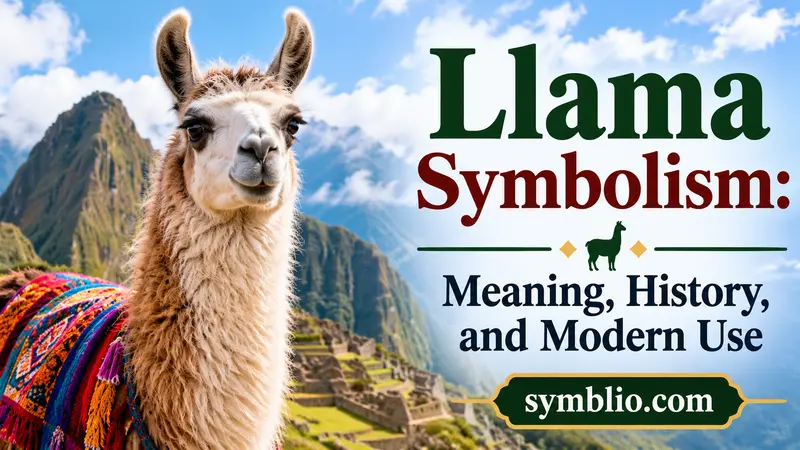
Llamas are recognizable South American animals known for their long necks, upright ears, thick coats, and calm but sometimes stubborn personalities. For thousands of years, they have played an important role in the lives of Andean communities, providing transportation, wool, food, and support for everyday survival. Today, llama symbolism extends beyond their practical value, representing resilience, independence, cooperation, and a connection to nature.
In the United States, llamas often appear as friendly, amusing, and unusual animals. They feature in children’s books, decorative artwork, farm experiences, clothing, toys, and social media. Their distinctive appearance makes them popular, but their cultural history gives them a much broader meaning.
Understanding what llamas represent requires looking beyond their modern reputation. Their importance in South American history, particularly within Andean societies, reveals connections to community life, spiritual traditions, economic exchange, and relationships between humans and animals.
Quick Answer:
Llama symbolism commonly represents resilience, independence, patience, cooperation, and adaptability in modern American culture. Historically, llamas have also symbolized prosperity, community responsibility, spiritual connection, and agricultural fertility in Andean traditions, where they supported transportation, trade, and religious ceremonies.
TL;DR:
- Resilience: Surviving and working in demanding mountain environments.
- Independence: Representing confidence and an individual personality.
- Cooperation: Reflecting shared responsibilities and community relationships.
- Prosperity: Connecting livestock with wealth, resources, and livelihood.
- Spiritual connection: Holding ceremonial importance in Andean traditions.
- Adaptability: Representing the ability to adjust to changing circumstances.
What Makes the Llama a Recognizable Symbol?
The llama is a domesticated South American camelid with a long neck, slender legs, large ears, and a woolly coat. It resembles a camel but does not have a hump. Its appearance is distinctive enough that people often recognize it immediately, even if they have never encountered one in person.
Llamas are closely related to alpacas, guanacos, and vicuñas. However, they have different physical characteristics and traditional uses. Llamas are generally larger than alpacas and have historically served as pack animals, while alpacas are particularly valued for their fine fiber.
Their appearance contributes to their modern symbolic identity. Their upright posture can suggest alertness and confidence, while their thick coats evoke warmth and protection.
Llamas also have recognizable personalities. They can be social and attentive, but they may resist handling when uncomfortable or overloaded. Their occasional stubborn behavior has become part of their popular image.
These characteristics help explain why people associate llamas with independence, endurance, and individuality.
The Historical Origins of Llama Symbolism
Llamas have been domesticated in the Andes for thousands of years. Archaeological evidence places early camelid domestication in the South American highlands several millennia before the rise of the Inca Empire.
Their relationship with people developed because they could survive in environments where transportation and resources were difficult to obtain.
Andean communities depended on llamas for several essential purposes:
- Carrying agricultural products and household supplies.
- Providing meat and usable animal fiber.
- Producing dung for fuel and agricultural purposes.
- Supporting long-distance trade between different ecological regions.
- Participating in important social and ceremonial activities.
Because llamas contributed to so many aspects of daily life, their importance extended beyond ordinary livestock.
They became associated with economic security, family survival, and the ability of communities to maintain connections across mountainous landscapes.
Their historical symbolism therefore developed from practical relationships rather than from appearance alone.
Llama Symbolism in the Inca Empire
Ancient Andean civilization and religious traditions
The llama occupied an important position in the Inca Empire, which flourished across much of the western Andes between the fifteenth century and the Spanish conquest in the sixteenth century.
The Incas relied on llamas to transport goods along extensive mountain routes. Their ability to carry loads made them valuable for communication, military organization, administration, and commercial exchange.
Llamas also appeared in religious ceremonies. Archaeological discoveries include miniature llama figures made from precious metals and shell, sometimes placed in ceremonial deposits at important locations.
These figures were not simply decorative objects. They could represent livestock, abundance, and hopes for the continued prosperity of herds.
The Inca religious world connected animals, landscapes, ancestors, and divine powers. Llamas participated in this larger system of relationships.
Their historical associations included:
- Abundance: Healthy herds represented valuable resources.
- Sacrifice: Llamas were important ceremonial offerings.
- Social responsibility: Herding supported household and community life.
- Exchange: Pack animals helped connect distant populations.
- Continuity: Livestock supported generations of Andean families.
The Inca relationship with llamas demonstrates why the animal became much more than a symbol of transportation or farming.
Resilience and Endurance: Why Llamas Represent Strength
One of the most recognizable symbolic meanings of a llama is resilience.
Llamas are adapted to the demanding environments of the Andes, where high elevations, changing temperatures, and challenging terrain shape everyday life.
Llamas carried supplies across difficult mountain routes, helping people move resources between communities.
For this reason, the llama can represent:
- Endurance during difficult periods.
- Patience when progress takes time.
- Strength without aggression.
- Adaptability in unfamiliar situations.
- The ability to continue despite obstacles.
In modern American symbolism, these qualities make the llama an appealing representation of perseverance.
Someone might choose a llama illustration for a personal project because it communicates the idea of remaining steady when circumstances become challenging.
Its symbolism emphasizes practical endurance rather than physical dominance.
Independence and Confidence in Llama Symbolism
Llamas are social animals, but they also have individual temperaments. They can show clear preferences, respond to uncomfortable situations, and resist demands that exceed their limits.
This behavior has contributed to their association with independence.
In popular American culture, llamas frequently appear as confident animals with amusing expressions and strong personalities. Their distinctive appearance makes them natural subjects for illustrations about individuality.
The llama can represent someone who:
- Thinks independently.
- Maintains personal boundaries.
- Does not automatically follow others.
- Values personal space.
- Remains comfortable with being different.
This interpretation is particularly common in contemporary decorative and humorous designs.
However, independence should not be confused with complete isolation. Llamas are herd animals and depend on social relationships. Their symbolism can therefore express a balance between individuality and belonging.
That combination makes the llama an interesting symbol of self-confidence without rejecting community.
Community, Cooperation, and Shared Responsibility
Although llamas can display independent behavior, their history is closely connected to cooperation.
For generations, Andean households have relied on camelid herding as part of their economic and social organization. Caring for animals involves shared responsibilities, knowledge passed between generations, and an understanding of local environmental conditions.
Llamas also helped connect communities through transportation and exchange.
Their caravans moved goods between highland settlements and lower agricultural regions. This movement supported relationships between populations with different resources and economic needs.
As a result, llama symbolism can represent:
Teamwork: Achieving something through shared effort.
Family responsibility: Maintaining resources that support future generations.
Community relationships: Building connections between different groups.
Mutual dependence: Recognizing that individuals and communities benefit from one another.
This historical meaning provides a useful contrast to the modern image of the llama as a funny, independent animal.
Its cultural importance also reflects the value of cooperation and collective responsibility.
Spiritual and Religious Meaning in Andean Traditions
Llamas have held spiritual importance in several Andean communities, particularly among populations whose traditions connect animals with mountains, land, agriculture, and ancestral relationships.
In some Quechua-speaking communities, mountain beings known as apus are understood as important spiritual presences associated with particular landscapes.
Certain Andean traditions also connect llamas with the wamani, mountain spirits associated with the surrounding environment.
In these settings, llamas can participate in ceremonial relationships between people, animals, and the natural world.
Some communities decorate their animals with flowers, ribbons, bells, and other ornaments during important occasions. These practices can express care, respect, and the cultural importance of livestock.
Llamas have also appeared in ceremonies associated with agricultural prosperity and herd fertility.
It is important to recognize that Andean spiritual traditions are diverse. Practices and interpretations differ between regions and communities, so there is no single religious meaning shared by everyone.
Nevertheless, the llama’s spiritual associations demonstrate an understanding of animals as participants in relationships that extend beyond their economic usefulness.
Prosperity, Fertility, and Abundance
Historically, a healthy llama herd represented an important source of security for Andean households.
Animals provided materials and resources that families could use, exchange, or distribute. Their ability to carry goods also helped maintain economic connections across long distances.
This practical importance explains the llama’s association with prosperity.
In some Andean agricultural and pastoral traditions, miniature animal figures called illas have been associated with livestock fertility and abundance.
These objects can represent hopes for healthy animals and expanding herds. They reflect the relationship between material prosperity and ceremonial practices.
The llama’s connection with abundance can be understood through several ideas:
- Livelihood: Animals provide resources that support everyday life.
- Fertility: Healthy herds represent future generations of livestock.
- Security: Livestock can help households manage uncertainty.
- Generosity: Animals and animal products can participate in exchanges and gifts.
- Continuity: Maintaining a herd supports long-term family traditions.
In modern American decorative symbolism, prosperity is sometimes represented through farm animals and pastoral imagery.
However, the llama’s association with abundance has particularly meaningful historical roots in Andean pastoral communities.
What Llamas Symbolize in American Culture
In the United States, llamas have developed a popular identity that combines their historical reputation with contemporary entertainment and decorative culture.
Many Americans encounter llamas through petting zoos, educational farms, children’s entertainment, and animal-themed products.
Their unusual appearance makes them memorable, while their generally approachable image helps them appeal to different age groups.
Several meanings are particularly common in modern American interpretations.
Individuality: Their distinctive appearance makes them suitable symbols of being different.
Humor: Their expressions and occasional stubbornness make them popular subjects for jokes and playful designs.
Friendship: Their social behavior can represent companionship and positive relationships.
Nature appreciation: Their association with mountain landscapes and traditional farming encourages interest in wildlife and agriculture.
Adventure: Their connection to Andean travel and mountain transportation can suggest exploration.
Llamas have also appeared at American weddings, festivals, public events, and social gatherings.
Their presence in these settings often communicates entertainment and originality rather than a formal cultural or religious message.
Modern American interpretations should not replace the animal’s original Andean context. Both are important parts of its broader cultural identity.
Llama Symbolism in Art, Fashion, and Home Decor
Llamas have become recognizable subjects in contemporary visual design.
Artists and designers use their unusual shape, expressive faces, and textured coats to create playful and memorable artwork.
In American home decor, llama illustrations frequently appear in children’s bedrooms, wall prints, cushions, blankets, and decorative accessories.
Their popularity comes partly from their friendly appearance and partly from their association with nature and individuality.
In fashion, llama patterns can communicate a relaxed, humorous personality. They appear on socks, shirts, bags, and other accessories.
Traditional Andean textiles offer a different interpretation. Llama imagery can appear alongside geometric patterns, regional designs, and references to local landscapes.
These designs may reflect cultural identity, traditional craftsmanship, and relationships with pastoral life.
The difference is important: a cartoon llama and a traditional Andean textile do not necessarily communicate the same message.
Understanding their individual contexts makes llama-inspired design more meaningful and culturally respectful.
Llama Tattoos: Personal Meaning and Interpretation
Llama tattoos offer a distinctive alternative to more familiar animal designs.
People may choose them because of their unusual appearance, personal experiences with the animal, interest in South American culture, or appreciation for their historical role.
A llama tattoo can communicate several personal ideas.
| Tattoo Design | Possible Symbolic Meaning | Common Association |
|---|---|---|
| Standing llama | Confidence and independence | Individuality |
| Mountain llama | Resilience and endurance | Overcoming challenges |
| Decorated llama | Cultural appreciation | Andean traditions |
| Llama with flowers | Growth and connection to nature | Renewal |
| Cartoon llama | Humor and playfulness | Positive personality |
A mountain landscape surrounding a llama may emphasize endurance and the ability to adapt to difficult environments.
A simple llama portrait might communicate individuality, while a colorful design could express an appreciation for traditional Andean visual art.
Some people may also choose llama tattoos because the animal reminds them of a particular journey, friendship, farm experience, or meaningful memory.
There is no universal interpretation. The significance of a tattoo ultimately depends on the person wearing it and the context behind the design.
The Emotional and Psychological Meaning of Llamas
Llamas can communicate a combination of emotional qualities that make them appealing symbols in modern culture.
Their soft-looking coats and expressive faces often create associations with comfort and friendliness. At the same time, their independent personalities suggest confidence and personal boundaries.
These qualities allow the llama to represent several emotional ideas.
Comfort and warmth: Their thick coats and gentle appearance can suggest security and coziness.
Self-acceptance: Their unusual appearance makes them suitable symbols of embracing individuality.
Patience: Their association with difficult mountain journeys suggests steady progress.
Humor: Their recognizable expressions often create lighthearted emotional associations.
Connection: Their social behavior can represent companionship and belonging.
From a psychological perspective, people often connect familiar animal characteristics with human personality traits.
A person who chooses a llama illustration might appreciate its independence, while someone else may simply enjoy its amusing appearance.
The emotional meaning is therefore personal rather than fixed.
Cross-Cultural Meanings and the Difference Between Llamas and Alpacas
Llamas have their strongest historical symbolic associations in South America, particularly in the Andes. However, their modern popularity has introduced them to audiences around the world.
In Peru and Bolivia, llamas remain connected to pastoral traditions, regional identity, textile production, and community life.
In parts of Argentina, Chile, and other Andean regions, their historical importance is also reflected in local farming practices and cultural traditions.
Outside South America, the llama is often interpreted through more general ideas such as independence, friendliness, and endurance.
An important distinction concerns the alpaca.
Although llamas and alpacas are closely related, they are different domesticated animals.
| Feature | Llama | Alpaca |
|---|---|---|
| Physical appearance | Larger body and longer face | Smaller body and softer-looking face |
| Historical role | Transportation and carrying goods | Primarily valued for fiber |
| Traditional symbolism | Travel, endurance, livelihood | Textiles, warmth, craftsmanship |
| Modern image | Independent and humorous | Soft, gentle, and decorative |
| Cultural connection | Andean pastoral traditions | Andean textile traditions |
Confusing the two animals can lead to inaccurate interpretations of their historical roles.
Both are important to Andean communities, but their practical contributions and cultural associations are not identical.
Common Misunderstandings About Llama Symbolism
As llamas have become popular outside their original cultural environment, several misunderstandings have developed.
One common mistake is assuming that every llama image represents the same spiritual meaning.
In reality, the symbolism depends on the community, historical period, artistic context, and intended use.
Another misunderstanding is treating llamas as interchangeable with alpacas. Their similarities can make identification difficult, but their historical roles differ.
Some modern products also use generalized Andean patterns without acknowledging the cultural traditions behind them.
This can reduce meaningful cultural designs to simple decoration.
A few distinctions are worth remembering:
- Not every llama image has a religious meaning.
- Not every Andean community shares identical ceremonial practices.
- Modern humorous illustrations do not represent ancient beliefs.
- Llamas and alpacas have different physical and historical characteristics.
- Their spiritual significance should be understood within specific cultural traditions.
There is also no established universal belief that seeing a llama predicts good fortune or guarantees prosperity.
Such interpretations may appear in personal spirituality or contemporary symbolic discussions, but they should not be presented as universal historical facts.
Respecting these distinctions helps preserve the cultural background of the animal.
How Llama Symbolism Has Changed in Modern Times
The meaning of llamas has evolved as their relationships with people have expanded beyond traditional Andean societies.
Historically, their importance came primarily from transportation, farming, trade, and ceremonial practices.
During the twentieth century, llamas also became increasingly familiar outside South America.
In the United States, interest in keeping llamas grew, particularly during the later decades of the century. They became visible at agricultural events, educational farms, and animal exhibitions.
Their appearance in children’s entertainment and popular merchandise further expanded their recognition.
By the 2020s, llamas had become familiar subjects in decorative products, internet humor, toys, and social media.
Their modern image often combines several qualities:
- An unusual but recognizable appearance.
- A humorous and expressive personality.
- An association with nature and farming.
- A connection to South American cultural history.
- An image of independence and individuality.
This evolution has created two overlapping identities.
The first is the historically important Andean animal associated with livelihood, community, and ceremonial life.
The second is the modern international image of a friendly, amusing, and distinctive animal.
Both identities contribute to how people understand llamas today.
FAQs
In some Andean spiritual traditions, llamas are associated with mountain spirits, agricultural prosperity, livestock fertility, and relationships between humans and the natural world. Their spiritual significance varies between communities and should not be reduced to one universal interpretation.
Llamas are not universally recognized as good-luck symbols. However, their historical connections with livestock abundance, household security, and prosperity can make them positive symbols in certain cultural and personal interpretations.
A llama tattoo can represent independence, resilience, patience, individuality, or an appreciation for Andean culture. Some people also choose the design because of personal memories or its humorous appearance.
Llamas provided transportation, meat, fiber, and other essential resources for the Inca Empire. They also appeared in religious ceremonies and offerings, making them important to both economic and ceremonial life.
Llamas are commonly associated with independence, patience, confidence, adaptability, and individuality. Their social behavior also makes them suitable symbols of companionship and cooperation.
Llama symbolism is particularly connected to transportation, endurance, trade, and pastoral livelihood. Alpaca symbolism is more closely associated with fine fiber, textiles, warmth, and traditional craftsmanship.
In contemporary symbolic interpretations, seeing a llama may remind someone of independence, patience, humor, or adaptability. However, there is no universally accepted spiritual prediction attached to encountering one.
Conclusion
Llama symbolism brings together several ideas, including resilience, independence, cooperation, prosperity, and cultural connection. Its historical roots are especially important in the Andes, where llamas supported transportation, agriculture, trade, and religious traditions for thousands of years.
In modern American culture, llamas have developed an additional identity as friendly, amusing, and distinctive animals. Their appearance in artwork, tattoos, fashion, and entertainment reflects contemporary appreciation for individuality and nature.
Ultimately, understanding llama symbolism means recognizing both its historical importance and its changing modern identity. Behind the familiar animal is a long relationship between people, animals, and the landscapes they share.