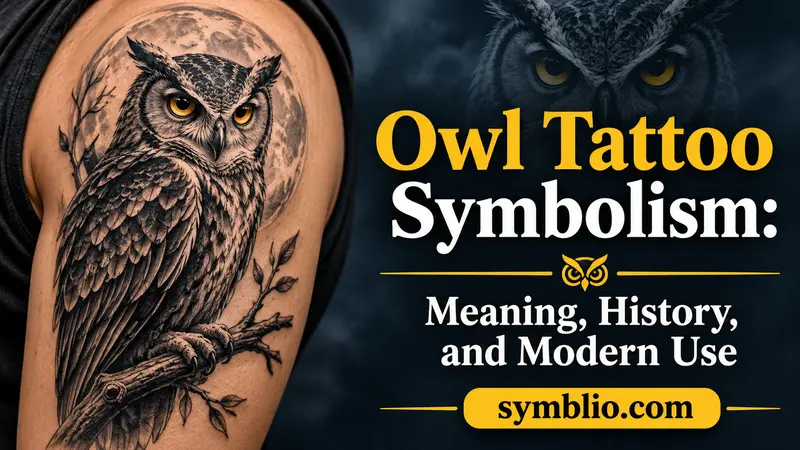
Owl tattoo symbolism is commonly connected with wisdom, intelligence, intuition, independence, and the ability to see clearly when others cannot. In modern American culture, an owl tattoo can represent a love of learning, personal growth, spiritual curiosity, or an appreciation for the natural world. Its meaning often depends on the owl’s appearance, the surrounding artwork, and the personal experiences of the individual.
Owls have occupied an unusual place in human imagination for thousands of years. Their large forward-facing eyes, silent flight, nocturnal habits, and distinctive calls have made them symbols of knowledge and mystery in some traditions and warnings of misfortune in others. Few birds carry such contrasting cultural associations.
Today, owl imagery appears in tattoos, clothing, artwork, jewelry, literature, and popular entertainment. Some people appreciate the connection to ancient Greek wisdom, while others associate owls with nighttime, independence, family, or the ability to navigate difficult periods.
Understanding the history behind these interpretations helps explain why the owl remains such a recognizable and adaptable tattoo subject.
Quick Answer
Owl tattoos most commonly symbolize wisdom, intelligence, intuition, independence, and knowledge in modern American culture. They can also represent protection, transformation, mystery, and the ability to find direction during difficult times, reflecting older associations with Athena, nighttime, and the spiritual world.
TL;DR
- Wisdom: Represents knowledge, education, and thoughtful decision-making.
- Intuition: Reflects awareness and the ability to recognize what others overlook.
- Independence: Symbolizes self-reliance and confidence in individual choices.
- Protection: Connects with watchfulness and ancient guardian traditions.
- Transformation: Represents personal development and important life changes.
- Mystery: Expresses fascination with nighttime, nature, and the unknown.
What an Owl Tattoo Looks Like and Why People Choose It
An owl tattoo usually depicts a bird with a rounded head, prominent eyes, a short hooked beak, and detailed feathers. Depending on the species, its design may include ear tufts, a heart-shaped facial outline, patterned wings, or distinctive feather markings.
Artists represent owls in several visual styles. Some designs feature realistic birds with carefully illustrated feathers and lifelike eyes. Others use geometric shapes, decorative patterns, traditional tattoo elements, or simplified outlines.
The choice of owl species can also influence the interpretation.
For example, a snowy owl may suggest patience, adaptability, and the beauty of winter landscapes. A barn owl, with its distinctive heart-shaped face, may communicate gentleness, observation, or a connection with the countryside. A great horned owl often creates a stronger impression of alertness and authority.
People are drawn to owl imagery for different reasons. Someone interested in education may connect it with intellectual curiosity, while another person may appreciate its connection to solitude and independence.
The design does not have one universal meaning. Its significance comes from the combination of cultural associations and personal interpretation.
The Ancient Greek Origins of Owl Wisdom
One of the strongest historical connections between owls and wisdom comes from ancient Greece.
The owl was closely associated with Athena, the Greek goddess of wisdom, strategic warfare, crafts, and civilization. The little owl, scientifically known as Athene noctua, became one of her most recognizable symbols.
Athena represented intelligence, practical judgment, and the thoughtful use of knowledge. Her owl became a visual expression of those qualities.
The association extended beyond religious imagery. Owls appeared on ancient Athenian coins, including the famous silver tetradrachms that featured Athena on one side and an owl on the other. These coins helped establish the bird as a recognizable emblem of Athens.
The connection also explains why owls became associated with education and intellectual achievement in later Western traditions.
For modern Americans, an owl tattoo inspired by this history may communicate respect for learning, a commitment to knowledge, or an appreciation for classical mythology.
It can also represent the idea that intelligence involves more than collecting information. Wisdom requires understanding situations and making responsible decisions.
What Wisdom and Intelligence Mean in Owl Tattoos
Wisdom is probably the most familiar interpretation of an owl tattoo.
The bird’s alert expression and ability to operate at night have helped create its reputation as a thoughtful observer. In Western popular culture, the owl frequently appears as an intelligent character, an academic mascot, or a visual representation of learning.
In the United States, owl imagery is particularly recognizable in educational settings. Schools, libraries, academic organizations, and children’s literature sometimes use owls to communicate knowledge and intellectual curiosity.
An owl tattoo can carry a similar message.
It may represent:
- A lifelong interest in education.
- Respect for experience and thoughtful judgment.
- A commitment to understanding different perspectives.
- Intellectual independence.
- The importance of learning from mistakes.
However, wisdom and intelligence are not identical.
Intelligence generally refers to the ability to understand, learn, and solve problems. Wisdom involves applying knowledge with patience, experience, and good judgment.
Someone who chooses an owl as a symbol of wisdom may value both qualities rather than academic achievement alone.
Owl Tattoos and the Meaning of Intuition
Owls are nocturnal birds, meaning many species are active during nighttime. Their specialized hearing, vision, and ability to navigate low-light environments contribute to their distinctive reputation.
These natural characteristics have influenced symbolic interpretations involving intuition and awareness.
In tattoo imagery, an owl can represent the ability to recognize important details, trust one’s judgment, and remain observant when circumstances are uncertain.
This interpretation does not mean an owl literally predicts events or possesses supernatural knowledge. Rather, it uses the bird’s natural abilities as a metaphor for human awareness.
For some people, an owl represents the importance of listening carefully before making decisions. For others, it expresses confidence in their ability to recognize situations that deserve attention.
The symbolism also connects with self-reflection. An owl looking directly outward can suggest alertness, while an owl looking downward may create a quieter impression of contemplation.
An owl tattoo associated with intuition can therefore communicate thoughtfulness without relying on religious or supernatural beliefs.
Independence and Self-Reliance in Owl Symbolism
Many owl species spend considerable time alone, particularly outside breeding and family activities. Their solitary hunting habits have contributed to the popular image of the independent owl.
This behavior has become an important part of modern owl symbolism.
An owl tattoo can represent someone who values personal space, individual judgment, and the freedom to follow an independent path.
In American culture, independence is often connected with personal responsibility and the ability to make decisions without constantly seeking approval from others.
An owl can communicate these ideas through its quiet, observant appearance.
The symbolism may be especially relevant to people who associate important life experiences with becoming more confident, accepting responsibility, or discovering their own priorities.
However, independence does not necessarily mean avoiding relationships. An owl tattoo can represent someone who appreciates solitude while maintaining meaningful connections with family, friends, and community.
Its message is often about knowing how to stand independently without rejecting other people.
Protection and the Watchful Guardian
Another interpretation of owl tattoos involves protection.
Owls possess excellent senses and are highly attentive to their surroundings. Their ability to detect movement in low light makes them effective hunters.
People have sometimes interpreted these characteristics as signs of vigilance and guardianship.
In different historical traditions, owl imagery appeared in protective objects, household beliefs, and spiritual practices. These interpretations were not universal, but they demonstrate how people connected the bird’s natural abilities with ideas about safety and awareness.
In a contemporary tattoo, a watchful owl may symbolize:
- Looking after loved ones.
- Remaining alert to changing circumstances.
- Protecting personal values.
- Remembering someone who provided guidance.
- Developing confidence after difficult experiences.
An owl with outstretched wings can create an impression of guardianship, while a bird positioned on a branch may suggest quiet observation.
For some Americans, this meaning is personal rather than religious. The owl becomes a reminder to remain aware, responsible, and attentive to the people who matter.
Mystery, Nighttime, and the Unknown
Owls are closely connected with nighttime because many species hunt after sunset.
Their silent flight, reflective eyes, and distinctive calls can make them difficult to observe in the wild. These characteristics have encouraged associations with mystery and the unknown.
In tattoo art, the owl often appears against a dark background, beneath a moon, or surrounded by stars and nighttime landscapes.
These elements can introduce additional interpretations.
A moon behind an owl may represent the natural cycles of life, changing circumstances, or an interest in astronomy. Dark backgrounds can emphasize introspection and the less familiar aspects of human experience.
Some people choose nighttime owl designs because they appreciate the contrast between darkness and awareness.
The meaning is not necessarily negative. Darkness can represent privacy, quiet, rest, or a period of uncertainty rather than danger.
An owl in this setting can communicate the idea of remaining observant even when the future is unclear.
Historical Owl Symbolism Across Different Cultures
Owl symbolism developed differently across the world. The bird’s nighttime habits and unusual appearance encouraged admiration in some communities and fear in others.
Understanding these differences is important because there is no single interpretation shared by every culture.
Ancient Greece: Owls were associated with Athena and became recognizable symbols of wisdom, knowledge, and the city of Athens.
Ancient Rome: Owls sometimes carried negative associations, including warnings of death or misfortune. Roman writers recorded traditions connecting their calls with unfavorable events.
Japan: The owl can have positive associations with good fortune and protection. Some Japanese interpretations connect the word for owl, fukurō, with favorable wordplay involving good fortune and freedom from hardship.
South Asia: Owl symbolism varies considerably across religious and regional traditions. In Hindu traditions, an owl is associated with Lakshmi, the goddess of prosperity, and is commonly depicted as her vehicle. Other folk beliefs may interpret the bird differently.
Some Indigenous North American traditions: Owls may be associated with nighttime, warnings, death, spiritual knowledge, or ceremonial roles. These meanings differ between individual nations and communities and should never be treated as one universal Native American belief.
These cultural differences explain why an owl tattoo can communicate very different ideas depending on its visual references and the traditions behind it.
Owl Tattoos in Modern American Culture
In the United States, owl imagery has become especially recognizable through education, popular entertainment, nature conservation, and decorative design.
The association with wisdom remains particularly strong.
School mascots, library illustrations, academic artwork, and educational materials often use owls because the bird has an established connection with knowledge.
Popular entertainment has also influenced how Americans understand owls.
The Harry Potter series, for example, introduced memorable owl characters and strengthened the bird’s association with communication, companionship, and magical storytelling. Hedwig, Harry’s snowy owl, became a widely recognized fictional representation.
Nature documentaries and wildlife photography have introduced another perspective. They present owls as important predators that contribute to healthy ecosystems rather than simply as mysterious creatures.
This ecological awareness has expanded the bird’s modern associations with wildlife appreciation, environmental protection, and respect for nature.
In tattoo culture, these influences come together. One design may celebrate education, another may reflect a favorite fictional story, and another may express an appreciation for birds and the natural world.
The same image can carry several meanings without becoming contradictory.
Popular Owl Tattoo Designs and Their Meanings
Different design elements can change how people interpret an owl tattoo. The species, posture, colors, and surrounding objects all contribute to its visual message.
Here are some common design interpretations:
| Owl Tattoo Design | Common Symbolic Meaning | Visual Association |
|---|---|---|
| Flying owl | Freedom and independence | Movement and open wings |
| Owl with a moon | Intuition and mystery | Nighttime and reflection |
| Owl with a clock | Time and experience | Aging and life transitions |
| Owl with flowers | Growth and renewal | Nature and beauty |
| Owl with an open book | Knowledge and education | Learning and intelligence |
A realistic owl often emphasizes the bird’s natural appearance and connection to wildlife.
A geometric owl uses symmetrical shapes and repeated patterns, creating associations with structure, balance, and precision.
Traditional tattoo artwork may use bold outlines and limited colors to produce a recognizable, decorative image.
Watercolor-inspired designs create a softer appearance, often emphasizing creativity and artistic expression.
These interpretations are possibilities rather than fixed rules. A particular design may have a personal meaning that differs from its common cultural associations.
Color Symbolism in Owl Tattoos
Color can introduce another layer of meaning.
Some owl tattoos use natural feather colors, while others incorporate decorative shades to communicate particular moods or ideas.
Black and gray: These designs emphasize contrast, realism, and the owl’s connection with nighttime. They may suggest contemplation, seriousness, or a preference for understated artwork.
White: A white owl can evoke snowy landscapes, clarity, peace, and simplicity. Snowy owls are particularly recognizable because of their pale feathers.
Brown: Natural brown tones emphasize the bird’s connection with forests, earth, and wildlife.
Blue: Blue can introduce associations with calmness, thoughtfulness, and reflection.
Purple: Purple often appears in artistic owl designs associated with imagination, creativity, and individuality.
Gold: Gold details can emphasize knowledge, achievement, and the historical connection between owls and wisdom.
Red: Red may introduce themes of courage, intensity, and strong personal feelings.
The meaning of color depends on the design and cultural context. A blue owl does not automatically represent tranquility, for example. The color may simply reflect an artistic preference.
Emotional and Psychological Meanings of Owl Tattoos
Owl tattoos can carry emotional meanings that extend beyond traditional folklore.
For some individuals, the bird represents a period of personal development. Its connection with observation and awareness can serve as a reminder to approach difficult situations thoughtfully.
Others associate the owl with solitude. Because owls are frequently depicted alone, they can represent the value of quiet time, reflection, and personal boundaries.
The bird can also become a symbol of remembrance.
Someone may associate an owl with a family member who valued education, enjoyed wildlife, or provided thoughtful guidance. In that situation, the tattoo becomes a personal reminder rather than a general cultural statement.
Common emotional interpretations include:
- Reflection: Taking time to understand personal experiences.
- Confidence: Trusting one’s judgment and abilities.
- Remembrance: Maintaining a connection with someone important.
- Resilience: Continuing through periods of uncertainty.
- Curiosity: Remaining interested in learning and discovery.
- Individuality: Appreciating personal differences and independent thinking.
Psychologically, symbols do not have identical effects on everyone. The meaning of an image is influenced by memory, cultural background, personal beliefs, and emotional experiences.
This explains why two people with nearly identical owl tattoos may attach entirely different stories to them.
Religious and Spiritual Interpretations of the Owl
Owl symbolism also appears in religious and spiritual traditions, although its meaning varies.
In ancient Greek religion, the bird’s relationship with Athena connected it with wisdom, strategic judgment, and divine protection.
In Hindu religious imagery, the owl is associated with Lakshmi, who represents prosperity, abundance, and good fortune. Its presence alongside the goddess gives the bird a religious context that differs from its Western association with education.
Some European folklore connected owls with witches, nighttime spirits, and supernatural activity. These beliefs developed partly from the bird’s unusual appearance and nocturnal behavior.
Christian interpretations have also varied. Certain biblical translations and later European traditions associated owls with desolate places, loneliness, or mourning. These descriptions should not be confused with a universal Christian rule about the bird.
In modern American spiritual communities, an owl may represent intuition, awareness, transformation, or a connection with nature.
However, spiritual interpretations are personal and should not be presented as scientifically established facts.
An owl tattoo can express spiritual curiosity without necessarily representing membership in a particular religion.
Common Misunderstandings About Owl Tattoos
Despite its familiar association with wisdom, owl symbolism is sometimes oversimplified.
One common misunderstanding is that every owl represents intelligence. Although this interpretation has a strong historical foundation in Greek culture, other traditions have connected owls with fear, death, protection, or misfortune.
Another misconception is that an owl tattoo always represents witchcraft or occult beliefs. Nighttime imagery and European folklore contributed to those associations, but modern owl tattoos have many unrelated meanings.
It is also inaccurate to describe all Indigenous North American owl traditions as identical. Individual nations have distinct histories, spiritual practices, and relationships with wildlife. A generalized owl-and-dreamcatcher design does not represent every Indigenous tradition.
There is also a difference between cultural symbolism and actual bird behavior. Owls do not possess supernatural knowledge, predict personal events, or guarantee protection.
Finally, the presence of an owl in a tattoo does not automatically reveal someone’s personality, religious beliefs, or life experiences.
The most reliable interpretation considers the artwork, its cultural references, and the meaning assigned to it by the person who identifies with the image.
How Owl Symbolism Has Changed Over Time
The owl’s symbolic history demonstrates how cultural meanings evolve.
In ancient Greece, its connection with Athena helped establish the bird as a recognizable image of wisdom and knowledge. This association continued through classical literature and later European artistic traditions.
Elsewhere, owls were sometimes treated as warnings or signs of misfortune. Their calls, nighttime activity, and presence around abandoned buildings contributed to these beliefs.
During later periods, European literature and folklore frequently connected owls with witches, magic, and supernatural characters.
In modern America, the educational meaning became especially familiar. The wise owl appeared in children’s stories, school imagery, advertising, and popular entertainment.
Contemporary tattoo culture has expanded these associations further. The owl can now represent independence, emotional growth, nature appreciation, personal memories, and artistic identity.
Its meaning has not changed in one direction. Older interpretations continue to exist alongside newer ones.
That flexibility helps explain why the owl remains a recognizable subject in modern visual culture.
Owl Tattoo Symbolism Compared With Other Bird Tattoos
People sometimes compare owl tattoos with other bird designs because each species carries different cultural associations.
The differences can help clarify why someone might connect with an owl rather than another bird.
| Bird Tattoo | Common Symbolism | Main Association |
|---|---|---|
| Owl | Wisdom, intuition, awareness | Knowledge and nighttime |
| Eagle | Freedom, strength, leadership | Power and independence |
| Raven | Mystery, intelligence, transformation | Folklore and mythology |
| Dove | Peace, hope, reconciliation | Harmony and spirituality |
| Phoenix | Renewal, resilience, rebirth | Transformation and mythology |
The owl stands apart because its strongest Western association is intellectual rather than primarily physical or emotional.
An eagle often communicates strength and authority. A dove commonly represents peace. A phoenix represents renewal after destruction.
An owl, by contrast, is frequently chosen to represent careful observation, thoughtful judgment, and knowledge.
These distinctions are not absolute, but they help explain the different visual and cultural roles of bird imagery.
FAQs
An owl tattoo can represent intuition, awareness, wisdom, and a connection with the spiritual world. Its interpretation depends on the person’s beliefs and the cultural tradition influencing the design.
In some cultural traditions, owls have been associated with good fortune, protection, and prosperity. Other traditions have interpreted them as warnings, so an owl tattoo does not have one universally accepted meaning.
A flying owl commonly represents freedom, independence, movement, and personal development. Its outstretched wings can also communicate confidence and the ability to move forward through changing circumstances.
An owl combined with a moon often represents nighttime, intuition, reflection, and mystery. The design may also express an appreciation for nature and the relationship between wildlife and the natural world.
Yes. The association comes largely from ancient Greek mythology, where the owl was connected with Athena, the goddess of wisdom. This historical connection remains influential in modern American education and popular culture.
A white owl tattoo may represent clarity, peace, awareness, and adaptability. Its meaning can also reflect the snowy owl’s natural environment and distinctive appearance.
Some historical traditions connected owls with death, bad fortune, darkness, or supernatural activity. However, modern interpretations are often positive or neutral, and a tattoo’s meaning depends heavily on personal and cultural context.
Conclusion
Owl tattoos bring together several interpretations, including wisdom, intelligence, intuition, independence, protection, and mystery. Their historical connection with Athena established the owl as a recognizable symbol of knowledge, while other cultural traditions developed different associations involving fortune, nighttime, and the spiritual world.
In contemporary American culture, owl tattoo symbolism extends beyond ancient mythology. It can represent intellectual curiosity, personal growth, independence, remembrance, or an appreciation for wildlife. Its meaning often depends on the species, artistic style, surrounding imagery, and personal experiences connected with the design.
Ultimately, the owl remains an adaptable symbol because it combines a recognizable natural appearance with a long history of cultural interpretation.