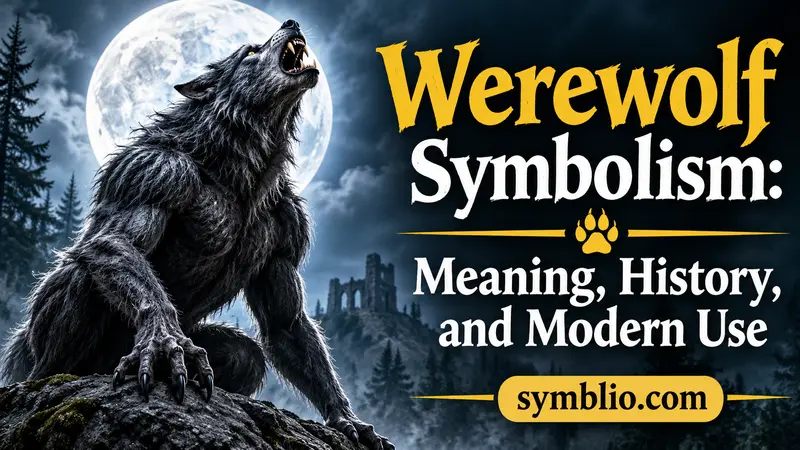
Werewolf symbolism represents the complicated relationship between human nature, animal instincts, personal identity, and the struggle to control one’s darker impulses. A werewolf is traditionally a human who transforms into a wolf or a human-wolf creature, often under particular supernatural conditions. In modern American culture, werewolves frequently symbolize transformation, hidden emotions, independence, aggression, and the tension between civilization and the wild.
People encounter werewolves in horror movies, fantasy novels, television shows, Halloween decorations, video games, and tattoo designs. Their familiar appearance, usually combining human intelligence with wolf-like features, makes them an interesting symbol of two competing sides of human nature.
Unlike ordinary wolves, which can represent loyalty, family bonds, wilderness, and survival, werewolves introduce another layer of meaning. They raise questions about what happens when a person loses control, discovers an unfamiliar part of themselves, or struggles to belong in society.
The meaning of this creature has changed considerably over time. Earlier European stories sometimes presented transformation as a curse, punishment, or supernatural condition. Contemporary American entertainment often gives werewolves more sympathetic roles, portraying them as outsiders, misunderstood individuals, or characters learning to accept their identities.
Understanding these different interpretations helps explain why the werewolf remains an important figure in folklore and modern storytelling.
Quick Answer
Werewolf symbolism commonly represents transformation, uncontrolled instincts, hidden emotions, and the struggle between human identity and animal nature in modern American culture. Historically, werewolves were associated with supernatural transformation, wilderness, fear, and the uncertain boundaries between humanity and animals.
TL;DR
- Transformation: Represents major personal changes and shifts in identity.
- Instinct: Reflects emotions and impulses that are difficult to control.
- Duality: Connects civilized behavior with untamed natural instincts.
- Independence: Represents outsiders who struggle to fit into society.
- Fear: Reflects anxieties about losing control or becoming unfamiliar.
- Acceptance: Modern stories often explore self-understanding and belonging.
What Does a Werewolf Look Like as a Symbol?
A traditional werewolf combines recognizable human characteristics with the physical appearance of a wolf. Depending on the story, it may look like an ordinary wolf with supernatural abilities, a human with animal features, or a large creature that walks upright.
Common visual characteristics include pointed ears, sharp teeth, claws, thick fur, glowing eyes, and an unusually powerful body. Some modern representations show a nearly complete wolf transformation, while others emphasize the creature’s human face and posture.
These physical details contribute to its symbolic meaning.
The human features represent identity, intelligence, memory, and social relationships. The wolf-like characteristics suggest instinct, physical strength, independence, and the natural world.
The combination creates a visual contrast between two different ways of existing.
Werewolves commonly appear in:
- Horror and fantasy films.
- Folklore illustrations and mythology-inspired artwork.
- Halloween decorations and costumes.
- Fantasy video games and television series.
- Tattoos representing transformation or independence.
- Gothic fashion and supernatural-themed jewelry.
Their appearance is important because the creature is not entirely human or entirely animal. It exists between two identities, making it a natural symbol of internal conflict and personal change.
The Core Symbolism of Transformation
Transformation is one of the most recognizable meanings associated with werewolves.
In traditional stories, a person changes from human to wolf through a supernatural process. Some tales describe this change as voluntary, while others portray it as an unwanted condition that the person cannot easily escape.
This transformation can represent major changes in someone’s personality, circumstances, or understanding of themselves.
In modern storytelling, the transformation often becomes a metaphor for growing up, discovering unfamiliar emotions, or experiencing changes that challenge an established identity.
For example, a fictional character who suddenly develops extraordinary abilities may struggle to understand who they are becoming. The werewolf provides a visual way to communicate that internal experience.
Transformation can also represent the difficulty of accepting change. A character might want to return to an earlier version of themselves, even when their circumstances have permanently changed.
This interpretation explains why werewolves appear in stories about adolescence, family relationships, identity, and personal responsibility.
Rather than representing change as entirely positive or negative, the creature illustrates that transformation can bring opportunities and difficult responsibilities at the same time.
Ancient Origins of Werewolf Beliefs
Stories about people becoming wolves are much older than modern horror movies.
Ancient Greek and Roman literature contains accounts of human-to-wolf transformation. One particularly well-known example involves Lycaon, a king in Greek mythology whose story became connected with the origin of wolves and the idea of lycanthropy.
In versions of the myth, Lycaon’s behavior angers Zeus, who transforms him into a wolf. The story connects animal transformation with punishment, moral failure, and the consequences of disturbing accepted social or religious boundaries.
Another important example appears in the Roman novel Satyricon by Petronius. Its werewolf episode reflects the existence of transformation folklore in the ancient Roman world.
These early stories did not establish one universal werewolf tradition. Instead, they demonstrate that people in different historical periods used animal transformation to explore human behavior, morality, and supernatural fears.
The Greek word lycanthropy comes from words associated with wolf and human transformation. It eventually became closely connected with the broader tradition of werewolf stories.
Ancient accounts helped establish themes that later European folklore developed further: the relationship between humans and predators, the possibility of supernatural change, and the fear of losing one’s familiar identity. OUP Academic+1
Werewolves in Medieval European Folklore
During the Middle Ages, werewolf stories became part of several European literary and folk traditions.
However, medieval werewolves were not always the terrifying monsters familiar from contemporary horror films.
Some medieval romances portrayed transformed individuals as intelligent, honorable, or unjustly treated people trapped in animal bodies. Their humanity remained important even when their physical appearance changed.
A notable example is Bisclavret, a twelfth-century narrative by Marie de France. It tells the story of a nobleman who regularly becomes a wolf and experiences betrayal within his marriage.
The story is particularly interesting because the werewolf is not presented simply as an evil creature. His conduct and personal qualities remain central to the narrative.
Other European traditions associated wolf transformation with magic, curses, dangerous wilderness, and supernatural forces.
By the early modern period, some European communities connected werewolves with witchcraft and accusations of harmful supernatural activity. Such beliefs contributed to fear and persecution, particularly during periods of religious and social uncertainty.
The werewolf consequently became a symbol of several competing ideas: human vulnerability, moral disorder, supernatural danger, and the difficulty of distinguishing appearance from character.
These medieval traditions helped shape the creature’s later literary identity. University of Warwick+1
What Werewolves Symbolize in American Culture
In the United States, werewolves are primarily recognized through entertainment, popular folklore, and Halloween culture.
American interpretations combine older European stories with twentieth-century horror cinema, fantasy literature, television, and contemporary supernatural fiction.
The creature often represents someone who possesses an ordinary public identity but experiences a hidden transformation.
This interpretation connects with familiar American themes, including individuality, personal freedom, social acceptance, and the challenge of controlling powerful emotions.
Werewolves also represent the tension between civilization and wilderness. Their human side belongs to organized society, while their animal side suggests freedom from social expectations.
This contrast makes them especially useful in American stories about outsiders and people who do not feel comfortable following established rules.
Several meanings are particularly common:
Individuality: A werewolf may represent someone who refuses to fit conventional expectations.
Personal freedom: Its animal nature can suggest independence from social restrictions.
Hidden identity: The transformation represents aspects of personality that remain concealed from other people.
Self-control: The creature’s struggle with its instincts reflects the importance of responsibility.
Belonging: Werewolf characters frequently search for communities where their differences are accepted.
These meanings help explain why American audiences sometimes view werewolves with sympathy rather than seeing them exclusively as frightening creatures.
The Symbolic Relationship Between Humans and Wolves
The symbolism of a werewolf depends heavily on the cultural meaning of the wolf itself.
Wolves have represented different qualities across human societies. Some traditions associate them with danger and predatory behavior, while others emphasize their social organization, intelligence, endurance, and connection with the natural environment.
In European folklore, wolves frequently represented threats to livestock, rural communities, and travelers. Their presence in forests and remote landscapes made them suitable figures for stories about danger beyond familiar settlements.
However, wolves also appear as respected animals in traditions that emphasize hunting ability, cooperation, and strength.
The werewolf combines these contrasting associations.
Its human side suggests reasoning, relationships, and social responsibility. Its wolf side introduces physical independence, instinct, and an existence less restricted by human rules.
This combination creates an important symbolic question: How much of human behavior comes from conscious decisions, and how much comes from instinct?
Werewolf stories rarely provide one simple answer. Instead, they use the creature to explore the complicated relationship between natural impulses and social expectations.
The Full Moon and the Symbolism of Cycles
The full moon is one of the most familiar images associated with modern werewolf stories.
Many contemporary representations show a person transforming when the moon becomes full. This connection has become so recognizable that it is often treated as an essential part of werewolf mythology.
However, the full-moon transformation is not a universal feature of older werewolf folklore.
Its popularity grew through modern literature, cinema, and repeated storytelling conventions. Early twentieth-century horror films helped establish many details that audiences now consider traditional.
Symbolically, the moon introduces ideas about cycles, change, uncertainty, and emotions.
Its changing appearance provides a natural visual comparison for the werewolf’s changing identity.
The full moon can also represent the moment when hidden characteristics become visible. A character who normally maintains an ordinary appearance may reveal another side of themselves under unusual circumstances.
In American popular culture, this imagery appears in Halloween decorations, fantasy illustrations, movie posters, and supernatural-themed artwork.
The connection between moonlight and transformation therefore represents the relationship between familiar routines and unexpected personal change.
Werewolf Symbolism in Horror Movies and Literature
American entertainment has played a major role in shaping the modern werewolf.
One of the most influential early films was The Wolf Man (1941), which helped establish the tragic, cursed figure familiar to generations of horror audiences.
Later films expanded the creature’s personality and symbolic possibilities.
Some stories emphasize fear and uncontrollable transformation. Others explore family inheritance, social isolation, romantic relationships, or the difficulty of accepting an unfamiliar identity.
The 1957 film I Was a Teenage Werewolf connected the monster with teenage frustration and concerns about youth culture. Later American werewolf films also used transformation as a way to discuss social tension and changing cultural attitudes.
Modern fantasy television and literature frequently give werewolves more complicated personalities.
They may appear as protective family members, misunderstood outsiders, supernatural guardians, or individuals trying to reconcile their human and animal identities.
These portrayals have expanded the creature beyond its traditional horror role.
| Entertainment context | Symbolic meaning | Common interpretation |
|---|---|---|
| Classic horror | Fear and loss of control | A person becomes something unfamiliar |
| Teen fantasy | Identity and change | Growing into an unfamiliar self |
| Supernatural drama | Belonging and loyalty | Finding acceptance within a group |
| Dark fantasy | Instinct and conflict | Balancing personal desires with responsibility |
| Modern fiction | Independence and identity | Accepting differences and individuality |
Werewolves remain effective fictional characters because they can represent both a frightening threat and a sympathetic individual. OUP Academic+2
Emotional and Psychological Meaning of Werewolves
Werewolves often represent emotions that people find difficult to understand or express.
Their transformation can symbolize the difference between a person’s outward behavior and private feelings.
Someone may appear calm and controlled in public while experiencing frustration, anxiety, anger, or uncertainty internally. Fictional transformation gives these emotions a visible form.
This does not mean that strong emotions make someone dangerous. Rather, the creature provides a storytelling metaphor for the challenges of recognizing feelings and responding to them responsibly.
Several psychological themes appear regularly in werewolf narratives.
Fear of losing control: The transformation may represent anxiety about situations that seem difficult to manage.
Identity conflict: The human and wolf forms illustrate competing expectations about who someone should be.
Social isolation: A werewolf may feel different from everyone around them and struggle to find acceptance.
Personal responsibility: Learning to manage the transformation can represent maturity and self-awareness.
Self-acceptance: Some modern stories present the creature as someone who gradually learns to accept an unusual part of their identity.
These interpretations make werewolves useful characters in coming-of-age stories and narratives about emotional development.
Their appeal comes partly from the recognition that people can experience different emotions and identities without losing their fundamental humanity.
Werewolf Symbolism in Tattoos and Personal Style
Werewolf tattoos appeal to people interested in folklore, fantasy, mythology, and animal symbolism.
Unlike a simple wolf tattoo, a werewolf design usually communicates a combination of human identity and animal characteristics.
People may choose these designs to express individuality, transformation, independence, or an interest in supernatural storytelling.
The specific artwork can influence the interpretation.
Human-wolf hybrid
Represents dual identity, personal transformation, and the relationship between different sides of one’s personality.
Werewolf beneath a full moon
Connects with transformation, changing circumstances, and the mysterious atmosphere of traditional folklore.
Glowing wolf eyes
Can communicate alertness, hidden identity, determination, and awareness.
Werewolf silhouette
Suggests independence, wilderness, solitude, and an interest in supernatural folklore.
Color also influences the overall presentation.
Black and gray designs often create a traditional horror or gothic atmosphere. Red accents can suggest intensity, while blue and silver tones may emphasize moonlight and nighttime settings.
There is no universal meaning attached to a werewolf tattoo. Its interpretation depends on the artwork and the personal reasons behind choosing it.
Positive and Negative Symbolism
Werewolves carry both positive and negative associations.
Their meaning depends on the story, artistic context, and cultural perspective.
Positive interpretations generally emphasize independence, transformation, courage, survival, and the acceptance of personal differences.
Negative interpretations often focus on aggression, fear, uncontrolled behavior, deception, and the dangers associated with losing self-control.
Neither interpretation describes every werewolf story.
For example, a fictional werewolf who protects a community may represent loyalty and responsibility. Another character who becomes dangerous because of an inability to control their transformation may represent fear and internal conflict.
This contrast is one reason the creature remains interesting in modern fiction.
It does not automatically represent good or evil. Instead, it raises questions about how people use their abilities, respond to difficult emotions, and treat others.
Werewolves in Other Cultural Traditions
Although the familiar European werewolf developed through particular historical traditions, the broader idea of human-animal transformation appears in many cultures.
However, not every shapeshifting tradition should be classified as werewolf folklore. Different societies have their own animals, beliefs, spiritual concepts, and storytelling traditions.
In Norse literature, for example, animal transformations and wolf-related warrior imagery appear in stories about supernatural abilities and unusual forms of identity.
Some Icelandic and Scandinavian narratives describe people connected with wolves through transformation, animal disguises, or extraordinary warrior characteristics.
Other traditions around the world feature people becoming animals such as tigers, bears, or other locally significant creatures.
These stories may explore similar themes, including the relationship between humans and nature, the limits of ordinary identity, and the responsibilities associated with supernatural abilities.
It is important to distinguish these traditions rather than treating them as interchangeable versions of European werewolf mythology.
In particular, Indigenous American spiritual and cultural traditions should not be casually equated with European werewolf stories. Specific Native American beliefs and teachings have their own cultural contexts and should be understood through the communities that maintain them.
The wider comparison shows that animal transformation is a recurring storytelling theme, but its meaning changes according to the culture in which it appears. IUScholarWorks+2
Werewolf Symbolism in Halloween and American Decorations
Halloween is one of the most recognizable occasions for werewolf imagery in the United States.
During October, werewolves appear alongside vampires, ghosts, witches, skeletons, and other traditional supernatural characters.
Their connection with Halloween comes from their established place in horror entertainment and folklore.
Werewolf decorations commonly feature:
- Wolf-like figures beneath a full moon.
- Artificial claw marks and animal silhouettes.
- Gothic forest backgrounds.
- Howling creatures and supernatural shadows.
- Human-wolf illustrations and costumes.
These decorations usually communicate suspense, fantasy, and playful fear rather than a serious belief in supernatural transformation.
Werewolves also fit naturally into Halloween storytelling because their changing appearance creates a recognizable visual contrast between ordinary life and the supernatural.
In American popular culture, the creature has become part of a shared collection of fictional monsters used for costumes, entertainment, themed parties, and seasonal decorations.
Its appearance during Halloween therefore reflects the cultural enjoyment of folklore and horror traditions.
Common Misunderstandings About Werewolf Symbolism
Werewolves are familiar fictional creatures, but several popular assumptions about their history are inaccurate.
Every werewolf transforms during a full moon.
This is primarily a modern storytelling convention. Historical traditions contain different explanations for how and when transformations occur.
Werewolves have always been evil monsters.
Some medieval stories portray werewolves as sympathetic or honorable characters who suffer because of their condition.
Silver bullets are an ancient universal tradition.
The association between silver and werewolves became established through modern horror storytelling. It is not a universal feature of older folklore.
All shapeshifting traditions describe werewolves.
Many cultures have their own animal-transformation stories. Similarities do not make them identical traditions.
Werewolves always represent aggression.
They can also symbolize personal change, social exclusion, independence, loyalty, and the difficulty of balancing different aspects of identity.
Understanding these distinctions prevents modern entertainment conventions from being mistaken for universal historical beliefs.
How Werewolf Symbolism Has Changed Over Time
The meaning of the werewolf has developed alongside changing cultural attitudes toward nature, morality, identity, and human behavior.
In ancient stories, human-to-wolf transformation often appeared in supernatural narratives about punishment, unusual abilities, and the relationship between humanity and the animal world.
During the medieval period, European accounts developed several different interpretations. Some emphasized supernatural danger, while others explored betrayal, injustice, and the suffering of transformed individuals.
Early modern beliefs sometimes connected werewolves with witchcraft and religious fears. These associations contributed to a darker interpretation of the creature.
Twentieth-century cinema introduced a recognizable horror figure, establishing conventions such as the full-moon transformation and the tragic individual struggling with a supernatural condition.
Contemporary American entertainment has broadened this image.
Modern werewolves may represent misunderstood outsiders, complicated family relationships, personal independence, or the challenges of accepting an unfamiliar identity.
The creature has therefore moved beyond its traditional role as a frightening monster.
Today, its symbolism can communicate fear, freedom, personal development, and the importance of understanding different sides of human nature.
FAQs
Werewolves can symbolize transformation, the relationship between human identity and animal nature, and the tension between instinct and conscious behavior. Spiritual interpretations vary, and there is no single universally accepted religious meaning.
A werewolf can represent either positive or negative qualities depending on the story. It may symbolize independence, courage, and transformation, or fear, aggression, and a struggle with self-control.
A werewolf tattoo commonly represents individuality, personal transformation, independence, and the acceptance of different aspects of identity. Some people also choose the design because of their interest in fantasy, folklore, and horror culture.
The connection became popular through modern literature and horror films. The moon provides a recognizable image of cycles and transformation, although older werewolf traditions did not always require a full moon.
A werewolf in a dream may be interpreted symbolically as representing change, uncertainty, conflicting feelings, or concerns about control. Dream interpretations are personal rather than scientifically established predictions, so the dream’s context matters more than a fixed definition.
Yes, in folklore and modern fiction, werewolves frequently represent the relationship between human reasoning and animal instincts. Their transformations provide a metaphor for emotions, impulses, and behaviors that characters struggle to understand or manage.
A regular wolf often represents loyalty, cooperation, survival, and independence. A werewolf adds the themes of human identity, transformation, internal conflict, and the relationship between civilization and the natural world.
Conclusion
Werewolf symbolism represents transformation, instinct, identity, independence, and the complicated relationship between human behavior and the natural world. Its historical roots include ancient transformation stories and medieval European folklore, while modern American culture has expanded its meaning through horror movies, fantasy literature, Halloween traditions, and personal artwork.
The creature can represent something frightening, but it can also communicate the experience of feeling different, accepting personal changes, or learning to balance competing parts of one’s identity. Its meaning depends on the cultural setting and the way the character is portrayed.
Ultimately, werewolf symbolism remains relevant because it explores a familiar human question: How do people understand and accept the different sides of themselves?