The Cheshire Cat is one of the most recognizable characters in Lewis Carroll’s Alice’s Adventures in Wonderland. Known for its broad grin, playful personality, and ability to appear and disappear, this fictional feline has become a symbol of curiosity, cleverness, unpredictability, and the strange relationship between appearance and reality. Its smile is often recognizable even when the rest of the character is absent.
Cheshire Cat symbolism appeals to readers because the character can be interpreted in several ways. Some people see it as a sign of confidence and mischievous humor, while others associate it with independent thinking, shifting perspectives, or the uncertainty of navigating unfamiliar situations.
In the United States, the Cheshire Cat remains a familiar figure in books, animation, costumes, artwork, and personal accessories. Its meaning depends on context: a cheerful grin might suggest amusement, while a fading cat might represent something elusive, surreal, or difficult to understand.
Quick Answer
Cheshire Cat symbolism commonly represents mischievous intelligence, curiosity, unpredictability, and the ability to see situations from an unusual perspective in modern American culture. Originating in Lewis Carroll’s Alice’s Adventures in Wonderland, the character also suggests the uncertain boundaries between appearance and reality, particularly through its disappearing body and lingering grin.
TL;DR
- Cleverness: The cat represents wit, wordplay, and unconventional thinking.
- Curiosity: Its conversations encourage questions about reality and logic.
- Unpredictability: Its ability to vanish reflects uncertainty and change.
- Individuality: Its unusual behavior represents independence and nonconformity.
- Humor: Its famous grin suggests amusement, mischief, and playful confidence.
- Popular culture: Books, films, costumes, and artwork keep the character recognizable.
What the Cheshire Cat Looks Like and Why Its Appearance Matters
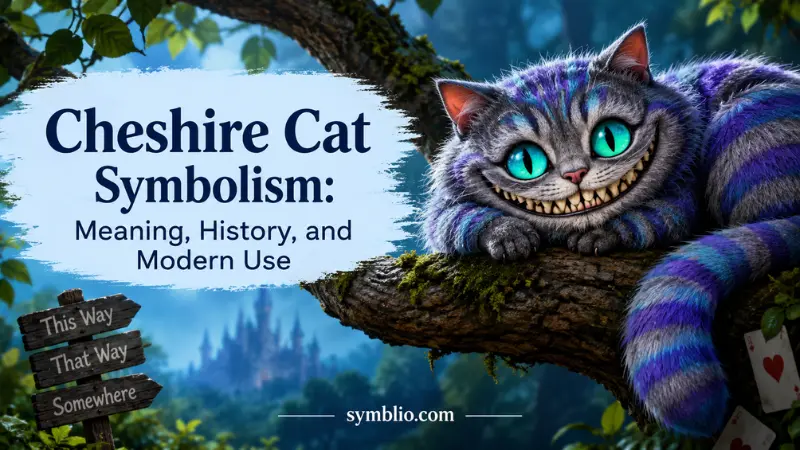
The Cheshire Cat is usually depicted as a striped feline with a wide smile, bright eyes, and an expression that seems both friendly and unsettling. Depending on the illustration or adaptation, its fur may appear purple, pink, gray, or a combination of vivid colors. Some versions show the entire cat perched on a tree branch, while others emphasize its floating grin.
The character’s appearance is central to its symbolism. Unlike an ordinary cat, it can separate its visible features from its physical body. Its grin may remain after the rest of it disappears, creating an image that challenges the expectation that an expression must belong to a visible face.
This unusual design allows the Cheshire Cat to represent several ideas at once. Its smile can suggest humor and confidence, but its separation from the body can also make the image feel surreal. The contrast between a recognizable animal and an impossible physical transformation is what makes the character so memorable.
In modern American illustration, the Cheshire Cat is often made more colorful and expressive than in early book illustrations. These changes give artists room to emphasize whichever quality they prefer, whether that is playful charm, eccentricity, or uncertainty.
The Main Symbolic Meanings of the Cheshire Cat
The Cheshire Cat does not have one universally accepted symbolic meaning. Its significance depends on the scene, the artistic treatment, and the person interpreting it. Several associations, however, recur in contemporary discussions of the character.
Cleverness and wit are among its most recognizable qualities. The cat responds to Alice with riddles, jokes, and observations that force her to reconsider what she assumes to be true.
Curiosity and exploration are also important. The character appears in a world where familiar rules no longer apply, encouraging readers to question their expectations rather than accept every situation at face value.
Unpredictability comes from its ability to appear, disappear, and change its visible form. It represents situations in which certainty is difficult to maintain.
Individuality emerges from the cat’s refusal to behave according to ordinary expectations. It speaks confidently, disregards conventional manners, and seems comfortable with its unusual nature.
Finally, the Cheshire Cat can symbolize the gap between appearances and reality. A grin may look reassuring, but the character’s strange behavior makes it difficult to know exactly what that smile communicates.
These interpretations work together rather than canceling one another out. The same illustration can look cheerful to one person and unsettling to another.
Historical Origins: From an English Saying to a Literary Character
The Cheshire Cat became famous through Lewis Carroll’s Alice’s Adventures in Wonderland, published in the nineteenth century. Carroll’s real name was Charles Lutwidge Dodgson, and he spent part of his childhood in Cheshire, England.
However, the expression “grinning like a Cheshire cat” existed before Carroll’s novel. Its precise origin remains uncertain. Various explanations connect the saying to local imagery, including inn signs that may have depicted unusually cheerful-looking animals and stories about Cheshire cheese shaped to resemble a cat.
These explanations should be treated as theories rather than established facts. There is no conclusive evidence identifying a single source for the expression.
Carroll transformed the familiar phrase into a distinctive fictional character. The cat’s exaggerated grin became more than a description of a smiling animal: it became part of a fantasy figure capable of challenging ordinary logic.
The illustrations by John Tenniel helped establish the character’s visual identity. Later adaptations developed the design in different directions, but the combination of an unusual smile and an unpredictable presence remained essential.
The historical development matters because the Cheshire Cat was not invented as a formal religious emblem or a traditional symbol with one fixed definition. Its modern associations largely grew from literature, illustration, and subsequent popular culture.
What the Cheshire Cat Symbolizes in the United States
In the United States, the Cheshire Cat is primarily understood as a fictional character associated with imagination, eccentric humor, and the world of Alice in Wonderland. Its familiarity allows people to use the image without necessarily knowing every detail of the original book.
In everyday conversation, the phrase “grinning like a Cheshire cat” describes someone wearing a broad, often knowing smile. Depending on the situation, that smile might suggest satisfaction, amusement, self-confidence, or the impression that someone knows a secret.
The character also fits American traditions of playful self-expression. It appears in fantasy-themed events, illustrated merchandise, costumes, and decorative designs. Some people choose it because they enjoy the story, while others appreciate its unconventional appearance.
Its symbolism can be especially appealing to people who value humor and independent thinking. The cat rarely behaves as expected, and it does not seem concerned with making itself understandable to everyone around it.
Nevertheless, the character does not automatically represent rebellion or wisdom. Its role is more complicated: it can offer useful observations while also confusing Alice. That combination makes it a flexible cultural figure rather than a straightforward moral example.
The Cheshire Cat’s Smile: Confidence, Mischief, and Ambiguity
The smile is the character’s defining feature and one of the strongest reasons it has become a lasting symbol.
A broad grin commonly communicates happiness or amusement. In the Cheshire Cat’s case, however, the expression is unusually persistent. It remains prominent even when the cat’s body disappears, making the smile seem independent of any ordinary emotion.
This creates several possible interpretations.
- Confidence: The cat appears comfortable with itself, even when its surroundings become chaotic.
- Mischief: Its expression suggests that it enjoys confusing others or keeping them guessing.
- Secrecy: The grin can imply that the character knows something it has not fully explained.
- Ambiguity: Because its expression rarely changes, the reader cannot always determine what the cat actually feels.
In American visual culture, a Cheshire-style grin can be used for a humorous character, a playful Halloween decoration, or an illustration with a slightly unsettling edge. The meaning changes according to the surrounding imagery.
A smiling face alone usually communicates a recognizable emotion. A grin detached from its owner, by contrast, encourages questions about what expressions can tell us and what they leave hidden.
Disappearing and Reappearing: Change and Uncertainty
The Cheshire Cat can appear when Alice needs information and vanish when she tries to make sense of its behavior. This ability gives the character a strong association with uncertainty and change.
Its disappearance can be interpreted as a reminder that not everything remains available, visible, or easy to explain. People may encounter similar feelings when adjusting to a new school, entering an unfamiliar environment, or facing a situation without clear answers.
The image can also suggest freedom from fixed expectations. The cat is not limited to one stable appearance, and its movements make it difficult for other characters to control or predict.
There is an important distinction between uncertainty and danger, however. The cat’s unpredictable behavior is part of a fantasy story, not a general warning that unfamiliar situations are threatening.
For artists and readers, the disappearing cat offers a way to represent the temporary nature of experiences. A moment can remain memorable even after the circumstances that created it have changed.
Its lingering grin makes this idea especially striking: the character can disappear, but the impression it leaves behind remains.
The Cheshire Cat and the Question of Reality
One of the character’s most interesting qualities is its ability to make familiar ideas seem strange. In Wonderland, ordinary logic frequently fails, and the cat seems unusually comfortable with that condition.
The image of a grin remaining after the cat has vanished creates an immediate question: what does it mean to see an expression without seeing the person or creature expressing it?
This is a literary puzzle rather than a scientific claim. It separates two things that people normally experience together and asks readers to reconsider their assumptions.
The cat’s conversations with Alice reinforce this theme. It often gives her information without providing the straightforward guidance she expects. Instead of resolving every question, its answers can introduce new problems.
For modern readers, this behavior can symbolize independent thought and the willingness to question familiar explanations. It may also represent the discomfort that comes with realizing that a situation has more than one possible interpretation.
The character does not prove that reality is unknowable. Rather, it dramatizes how limited a person’s understanding can be when the available information is incomplete or contradictory.
Psychological and Emotional Interpretations
The Cheshire Cat can represent different emotional experiences depending on how readers relate to its personality.
For some, it embodies the freedom to be unusual. Its unconventional behavior suggests that a person does not have to follow every social expectation to possess a recognizable identity.
For others, it represents the appeal of humor during confusing circumstances. The cat remains playful while Alice struggles to understand Wonderland, demonstrating how comedy can coexist with uncertainty.
Its fixed grin can also invite reflection on the difference between outward expression and inner feelings. In everyday life, people sometimes smile because they are amused, but a smile can also communicate politeness, nervousness, embarrassment, or an attempt to hide uncertainty. The Cheshire Cat exaggerates this gap between appearance and interpretation.
That does not mean the character is a psychological diagnosis or a universal representation of a particular personality type. Literary symbolism works through possibilities, not fixed clinical definitions.
A reader who values logic may see the cat as a clever challenger of assumptions. Someone who enjoys fantasy may focus on its freedom and unusual appearance. Another reader may simply find the character funny.
Each response can be valid without becoming the only correct interpretation.
Cheshire Cat Symbolism in Tattoos and Personal Style
The Cheshire Cat appears in tattoo art because its recognizable grin and unusual form can be adapted to many artistic styles.
A person might choose a Cheshire Cat design to express a love of fantasy literature, appreciation for wordplay, or interest in characters who challenge conventional expectations. Others may simply enjoy the combination of a familiar animal and an impossible smile.
Different designs can communicate different ideas:
- A simple grin: May suggest humor, secrecy, or the idea that appearances do not tell the whole story.
- A complete, smiling cat: Often emphasizes playfulness and affection for the character.
- A fading silhouette: Can suggest change, impermanence, or an elusive quality.
- A colorful fantasy design: May highlight imagination, eccentricity, and artistic individuality.
The meaning of a tattoo remains personal. A Cheshire Cat tattoo does not automatically indicate a particular personality, belief, or life experience.
The same principle applies to clothing, jewelry, bags, and accessories. Wearing the character can be a reference to a beloved story, a visual joke, or a way to display a taste for surreal art.
The Cheshire Cat in Home Decor, Fashion, and Digital Culture
The character’s recognizable shape makes it useful in designs that need to communicate a fantasy theme quickly.
In home decor, the Cheshire Cat may appear on posters, wall art, figurines, bookends, and decorative objects. These items can create a whimsical atmosphere, particularly in reading spaces, children’s rooms, or collections inspired by fantasy fiction.
Fashion uses the image in a similar way. Printed shirts, socks, bags, and accessories can turn the cat’s grin into a playful visual statement. Bright colors emphasize its cartoon identity, while monochrome designs can make the image more understated.
Digital culture gives the character another role. Its smile can work as an avatar, profile image, illustration, or visual reference in conversations about confusion and unusual situations. Because many people recognize the character, even a small image can communicate a particular mood.
The Cheshire Cat also fits artwork that mixes cute and unsettling elements. Its friendly expression contrasts with its ability to disappear, creating a design that is simultaneously amusing and strange.
These uses do not require a single shared interpretation. The character’s flexibility is part of its appeal: the same grin can represent humor, fantasy, curiosity, or deliberate ambiguity.
The Cheshire Cat in American Film and Popular Entertainment
Although the character originated in English literature, American film and entertainment have helped make it familiar to generations of audiences.
The 1951 animated adaptation by Walt Disney Productions introduced a particularly influential visual interpretation of the cat. Its vivid coloring, exaggerated grin, and playful delivery strengthened the association between the character and colorful fantasy.
Later adaptations, theatrical productions, games, and fan art have reimagined the character in different styles. Some emphasize comedy, while others highlight its unsettling ability to appear and disappear.
These adaptations influence how audiences understand the cat. Someone who encounters it primarily through animation may associate it with bright colors and humorous dialogue. A reader familiar with Carroll’s original text may be more interested in its riddles, philosophical implications, and role in Alice’s journey.
Neither interpretation is necessarily more valid than the other. Adaptations select particular features and make them more prominent for their audiences.
The character’s continued presence in entertainment shows how a literary figure can acquire a cultural life beyond the book in which it first appeared.
Cross-Cultural Meaning and Religious Interpretations
The Cheshire Cat comes from English literary tradition rather than a specific religious system. Its most recognizable associations with cleverness, uncertainty, and the unusual relationship between appearance and reality developed through the story and its adaptations.
Readers outside the United States and United Kingdom may encounter the character through translated books, cartoons, films, games, and online illustrations. Their interpretations can vary according to which adaptation they know and how fantasy characters are understood in their local cultural settings.
It is important not to confuse the Cheshire Cat with traditional cat symbolism in other cultures. Cats have held different roles in Egyptian, European, Japanese, and other cultural traditions, but those meanings do not automatically apply to Carroll’s fictional character.
Likewise, the Cheshire Cat is not a standard Christian, Islamic, Jewish, Buddhist, or Hindu religious symbol. Individuals may personally connect it with spiritual questions about perception, illusion, or the limits of knowledge, but these are personal or literary interpretations rather than established religious teachings.
The most reliable starting point is the character’s actual literary context. Broader cultural comparisons can be useful, provided they distinguish the Cheshire Cat’s modern associations from unrelated traditions.
Common Misunderstandings About Cheshire Cat Symbolism
Because the character is visually distinctive and open to interpretation, several claims about its meaning can become exaggerated.
Misunderstanding 1: The Cheshire Cat always represents something sinister.
Its grin can seem unsettling, but the character is also witty, conversational, and occasionally helpful to Alice. The mood depends on the scene and the artistic portrayal.
Misunderstanding 2: The cat has one secret, historically established meaning.
No single hidden interpretation explains every appearance of the character. Literary analysis offers several possibilities, and many are interpretations rather than confirmed statements of Carroll’s intention.
Misunderstanding 3: The character is an ancient spiritual symbol.
The Cheshire Cat’s familiar identity is rooted in English language and literature. It should not be presented as an ancient religious emblem without reliable evidence.
Misunderstanding 4: Its grin always means happiness.
A grin may communicate amusement, but it can also suggest mischief, confidence, secrecy, or ambiguity. The character’s unusual smile makes those alternatives especially relevant.
Misunderstanding 5: Every modern reference has the same meaning.
A tattoo, cartoon, costume, and literary illustration may use the character for entirely different reasons. Context is essential when interpreting the image.
Separating documented literary history from modern interpretation makes the symbolism more useful and avoids assigning unsupported meanings to the character.
How the Cheshire Cat’s Meaning Has Evolved
The Cheshire Cat’s cultural meaning has developed in stages.
Before Carroll’s novel, the phrase about a Cheshire cat’s grin already circulated in English usage, although its origin remains uncertain. The saying supplied a starting point for the fictional character.
In 1865, Alice’s Adventures in Wonderland gave the image a distinctive personality. The cat’s disappearance, strange logic, and memorable smile expanded the phrase into a literary character whose actions could be interpreted in several ways.
Illustrations and adaptations then made the character recognizable beyond readers of the original novel. Film, theater, merchandise, and popular art emphasized different aspects of its personality.
In contemporary American culture, the Cheshire Cat can function as a shorthand for fantasy, mischievous humor, unconventional thinking, or surreal uncertainty. Online images and personal designs allow people to use it without committing to one literary interpretation.
This evolution reflects a broader feature of popular symbols: their meanings can grow as audiences encounter them in new settings. The original story remains important, but it does not limit every later use.
Cheshire Cat Symbolism at a Glance
The table below summarizes common interpretations across different contexts.
| Context | Common Meaning | Main Association | Important Note |
|---|---|---|---|
| Original literature | Curiosity and ambiguity | Riddles and strange logic | Interpretation depends on the scene |
| Famous grin | Wit and mischief | Confidence and amusement | A smile does not always indicate happiness |
| Disappearing body | Uncertainty and change | Appearance versus reality | Primarily a literary image |
| Tattoos and fashion | Individuality and fantasy | Personal expression | Meaning varies by wearer |
| Film and animation | Playfulness and eccentricity | Colorful fantasy | Adaptations emphasize different traits |
| Online imagery | Humor and surrealism | Unusual situations | Context determines the intended message |
The common thread is not a single hidden meaning but the character’s ability to make ordinary expectations seem less certain. Its grin, disappearance, and unusual conversations give audiences several ways to interpret the same image.
FAQs
The Cheshire Cat has no universally established religious or spiritual meaning. Some people interpret its disappearing body and lingering grin as reflections on illusion, perception, or uncertainty, but these readings are personal interpretations rather than formal religious teachings.
A Cheshire Cat tattoo may represent curiosity, humor, individuality, fantasy, or a fondness for Alice’s Adventures in Wonderland. A fading cat or isolated grin may emphasize uncertainty or the difference between appearances and reality.
It can be either, depending on the context. Its wit and playful confidence may seem positive, while its cryptic behavior and unsettling smile can create a more ambiguous impression.
In Carroll’s story, the cat can disappear gradually until its grin is the only visible part remaining. This unusual event creates a memorable contrast between an expression and the creature normally associated with it, inviting questions about perception and reality.
The character discusses madness while explaining Wonderland’s unusual rules to Alice. Readers may interpret it as a challenge to conventional ideas about normal behavior, but it is not a universal symbol of mental illness.
No known real cat has the character’s supernatural ability to disappear and leave a visible grin behind. Carroll may have drawn on the older English expression about Cheshire cats, but the precise origin of that saying and the character’s inspiration remain uncertain.
Its distinctive grin, colorful appearance in many adaptations, and association with a widely recognized fantasy story make it easy to identify. Its flexible meaning also allows artists, readers, and fans to use it for humor, individuality, and surreal imagination.
Conclusion
The Cheshire Cat is more than a smiling character from a classic children’s book. Its wit, unpredictability, and ability to disappear have made it a lasting image of curiosity, unconventional thinking, and the uncertainty of appearances. Its meaning changes with the context, from a playful reference to a favorite story to a visual exploration of ambiguity.
In modern American culture, Cheshire Cat symbolism continues through literature, animation, tattoos, fashion, and digital art. Its appeal lies in the fact that the grin never provides a complete explanation. Sometimes it invites a laugh; other times, it leaves the viewer wondering what lies behind the smile.