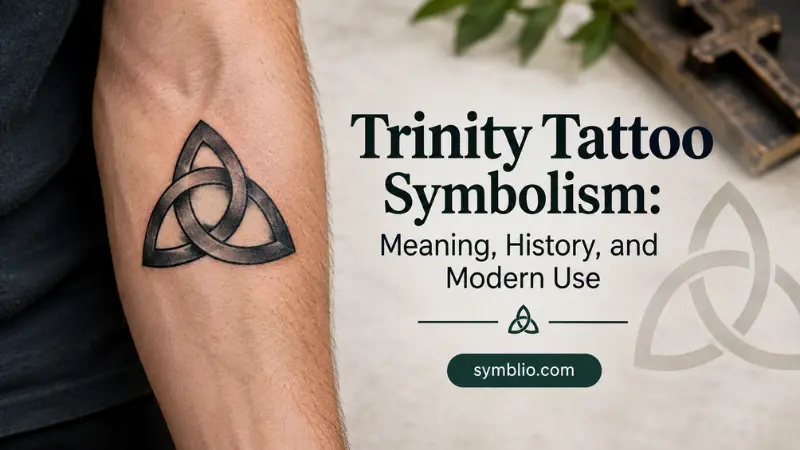
A trinity tattoo can represent Christian faith, unity, three connected parts, or a personal idea of balance and continuity. In the United States, trinity tattoo symbolism often depends on the exact design, especially whether it shows a Christian Trinity symbol, a triquetra, three interlocking shapes, or another three-part pattern.
The appeal of a trinity design comes partly from its ability to communicate a relationship between separate elements without making them identical. For some people, that relationship is explicitly religious. For others, three connected forms may represent family, life stages, personal values, or an important three-part relationship.
Understanding the history of the design matters because not every symbol containing three elements has the same origin. A Christian Trinity symbol, a Celtic-inspired triquetra, and a modern geometric tattoo may look related while carrying different historical associations.
Quick Answer
Trinity tattoo symbolism commonly represents unity among three connected elements, especially the Christian Father, Son, and Holy Spirit in modern American culture. Depending on the design and the wearer’s intention, it can also suggest family, interconnectedness, balance, continuity, or three stages of life.
TL;DR
- The Trinity traditionally refers to Father, Son, and Holy Spirit.
- Three connected forms can symbolize unity without sameness.
- Triquetra designs have both pre-Christian and Christian associations.
- American tattoo meanings often depend on personal interpretation.
- Design details can change the religious or cultural association.
- Modern tattoos may use three-part imagery for personal identity.
What a Trinity Tattoo Usually Looks Like
There is no single universal appearance for a trinity tattoo. The word “trinity” describes a three-part concept, so tattoo artists and wearers use several different visual forms to express it.
One familiar design is the triquetra, often called a Trinity Knot. It consists of three interwoven arcs that create a compact, continuous shape. Another design may use three connected circles, three overlapping forms, or a triangular arrangement.
Christian artwork can also depict the Trinity through more explicitly religious imagery. A tattoo might combine three-part geometry with a cross, biblical imagery, or lettering referring to the Father, Son, and Holy Spirit.
Because these designs overlap visually, it is important not to assume that every three-part tattoo has the same religious meaning. The surrounding imagery and the person’s stated intention provide important context.
The Christian Meaning Behind the Trinity
In Christianity, the Trinity refers to one God understood as Father, Son, and Holy Spirit. The three are distinct, but Christian doctrine does not describe them as three separate gods.
This distinction is central to the symbol’s meaning. The Trinity represents unity together with distinction: the three persons are not simply three versions of the same person, yet Christianity teaches that they share one divine nature.
For Christians, therefore, a Trinity tattoo can express faith, devotion, baptism, Christian identity, or a personal connection to a particular understanding of God.
The concept is central to Christian theology rather than simply being a decorative interpretation of the number three. In Catholic teaching, for example, the Trinity is described as a central mystery of Christian faith and life.
Ancient Roots and the Development of Trinity Imagery
The Christian doctrine of the Trinity developed from early Christian teachings about God, Jesus Christ, and the Holy Spirit. The familiar theological language surrounding the Trinity became increasingly defined as Christian communities developed formal statements of belief.
The visual history is more complicated because three-part designs existed in different cultures before modern tattoo culture.
The triquetra is especially important here. Three interwoven arcs appear in early medieval art, including artwork associated with the British Isles and Ireland. Later Christian artists used the three-part form as a visual representation of the Trinity.
That history does not mean that every earlier use of a three-loop design was originally Christian. Symbols can acquire new meanings as cultures reinterpret older visual forms.
Why Three Connected Parts Matter
Three is a particularly useful number for symbolic design because it allows a relationship to be shown visually.
Two elements can represent opposition, partnership, or a pair. Three introduces another possibility: a group or system in which each part relates to the others.
That makes three-part imagery suitable for ideas such as:
- family relationships
- past, present, and future
- beginning, middle, and end
- mind, body, and spirit
- three personal values
- three generations
- faith, hope, and love
These interpretations are not automatically Christian. They are broader modern associations that people may apply to three-part designs.
For a tattoo, the structure also has a practical advantage: three connected shapes can form a compact design that works at different sizes.
Trinity Symbolism in the United States
In the United States, a Trinity tattoo can carry a clearly Christian identity, particularly when the design includes recognizable religious elements.
A person may choose the design to represent Christian belief, baptism, family faith, or a connection to church traditions. For someone raised in a Christian household, the tattoo may also serve as a personal reminder of beliefs learned during childhood.
At the same time, American tattoo culture frequently separates symbols from their original religious settings. A person might choose a triquetra because of its visual structure, Celtic associations, or personal connection to three important people without intending a specifically theological message.
This makes context particularly important. The same basic design can communicate different things to different people.
The Triquetra and Celtic Associations
The triquetra is one of the designs most commonly associated with modern ideas of Celtic symbolism. Its three interwoven points create a continuous form, making it easy to interpret as a representation of connection and continuity.
Its history deserves some caution, however. Modern popular culture sometimes presents the triquetra as if it had one fixed meaning extending unchanged from ancient Celtic society to the present. Historical evidence is more complicated.
The design appears in early medieval art, and Christian communities later used it in ways connected with the Trinity. Modern Celtic-inspired tattoo culture has expanded its associations further, linking it with heritage, family, continuity, and interconnectedness.
Someone choosing a triquetra tattoo may therefore be expressing several layers of identity at once: religious belief, interest in Celtic art, family heritage, or simply appreciation for the design.
Religious Meaning Compared With Personal Meaning
A useful distinction is whether the tattoo is intended as a religious statement or a personal interpretation.
A Christian may understand three connected forms as a reminder of the Father, Son, and Holy Spirit. Another person might use three circles to represent three family members. Someone else could associate the design with past, present, and future.
| Tattoo Context | Common Meaning in the USA | Common Associations | Important Context |
|---|---|---|---|
| Christian Trinity design | Christian faith | Father, Son, Holy Spirit | Strongly religious |
| Triquetra | Unity and interconnectedness | Celtic art, Christianity, heritage | Meaning varies by wearer |
| Three connected circles | Relationships | Family, friendship, partnership | Usually personalized |
| Three-part geometric design | Balance or completeness | Identity, growth, life stages | Often nonreligious |
| Trinity with a cross | Christian devotion | Faith, baptism, discipleship | Clearly Christian imagery |
The design alone cannot always establish the wearer’s intended meaning. Personal explanation remains the most reliable guide.
Emotional and Psychological Associations
A trinity tattoo can carry emotional significance because it turns a relationship between three things into a permanent visual reminder.
For one person, those three things might be family members. For another, they may represent important stages of life or principles they want to remember.
The symbolism can also provide a way to express continuity. A three-part design may remind someone that different experiences belong to the same personal story, even when circumstances change.
This interpretation is individual rather than universal. There is no psychological rule that says a Trinity tattoo produces a particular emotional response. Its significance comes largely from the associations the wearer attaches to it.
Trinity Tattoos and Family Identity
Family is one of the clearest modern personal interpretations of three-part tattoo designs.
Someone might choose three linked elements to represent a parent and two children, three siblings, or three generations. In this context, the meaning comes from the relationship rather than from Christian theology.
The continuous structure of a triquetra can be especially suitable for this interpretation because its lines visually connect the three parts.
Some people also choose matching or coordinated designs with relatives. In those cases, the tattoo can function as a permanent marker of shared identity rather than simply an individual decoration.
Faith, Baptism, and Christian Identity
For Christian wearers, a Trinity tattoo may relate specifically to baptism because baptism is traditionally performed in the name of the Father, Son, and Holy Spirit.
The design can therefore serve as a reminder of a religious commitment or an important moment in a person’s spiritual life.
A cross, scripture reference, dove, or other Christian imagery can make the intended interpretation more apparent. Without those additions, however, an interwoven three-part design may be read more broadly.
This distinction can matter when choosing a design intended to communicate a particular religious message.
How Modern Tattoo Culture Changes the Meaning
Tattoo culture often takes established symbols and combines them with individual stories.
A traditional three-part design might be incorporated into a larger sleeve, surrounded by flowers, dates, initials, geometric patterns, or other imagery. Each addition can shift the overall impression.
For example, a trinity design combined with a cross strongly emphasizes Christianity. A triquetra surrounded by Celtic-inspired artwork may emphasize heritage. Three small connected shapes with family initials may function primarily as a personal family symbol.
Social media and tattoo communities have also made visual symbolism easier to share and reinterpret. As a result, people increasingly encounter symbols outside their original cultural settings.
Colors and Design Choices
Color can influence how a trinity tattoo is perceived, although there is no universal color code for the symbol.
Black linework tends to emphasize the geometry itself. Gold, red, blue, or other colors can introduce associations from a particular artistic tradition or simply reflect personal taste.
Adding a cross, dove, crown, circle, flame, or other religious image can make the Christian interpretation clearer. Celtic-inspired knotwork can strengthen the connection to medieval and Celtic visual traditions.
Minimalist designs often leave more room for personal interpretation because they provide fewer clues about the intended meaning.
Common Misunderstandings About Trinity Tattoos
One common misunderstanding is that every three-part tattoo represents the Christian Trinity. Threefold symbolism exists in many contexts, so the number three by itself does not establish a religious meaning.
Another misconception is that every triquetra is exclusively ancient Celtic or exclusively Christian. The symbol has a more complicated visual history, and different communities have used and interpreted related forms in different ways.
It is also easy to confuse different three-part symbols. A triquetra, three triangles, and a Christian Trinity diagram may have very different histories despite sharing a three-part structure.
The safest interpretation is therefore to consider the specific design, accompanying imagery, cultural context, and the wearer’s stated intention.
Religious Symbolism and Cultural Respect
Religious tattoos can carry significance beyond personal fashion, particularly when they use symbols recognized by practicing communities.
Someone considering a Trinity design should understand whether they are using explicitly Christian imagery or a broader three-part motif. That distinction can help prevent accidental misrepresentation.
Cultural respect does not require every person who uses a symbol to share the beliefs associated with its historical origin. It does, however, help to understand those origins before presenting the design as a cultural or religious emblem.
The same principle applies to Celtic-inspired tattoos. Modern ideas about Celtic symbolism often combine historical art, Christian interpretation, contemporary heritage movements, and popular culture.
How the Meaning Has Changed Over Time
The Trinity itself has remained a central Christian theological concept, but the visual language used to represent it has changed.
Early Christian communities relied heavily on words, teachings, scripture, and theological formulas. Artists gradually developed visual approaches for communicating complex religious ideas, including three-part imagery.
Later, medieval art incorporated symbols such as interlaced forms into Christian visual culture. In modern tattoo culture, those same forms can move beyond explicitly religious settings.
Today, a trinity-inspired tattoo may therefore represent Christian doctrine, heritage, family, personal continuity, or simply an appreciation for interlocking geometry.
The evolution is not a replacement of one meaning by another. Instead, several meanings now coexist.
Why People Choose a Trinity Tattoo Today
Modern tattoo choices are often personal rather than purely symbolic. A person may choose a trinity design because it connects several parts of their life in one image.
Common motivations include:
- expressing Christian faith
- honoring family relationships
- representing three important people
- marking a significant life transition
- expressing cultural or artistic interests
- representing continuity between past and future
- appreciating the visual simplicity of three connected forms
The meaning becomes strongest when the design reflects a specific story. A small three-part symbol may look simple to someone else while carrying a very specific memory for the wearer.
FAQs
A Trinity tattoo commonly symbolizes unity among three connected elements. In a Christian context, it specifically refers to the Father, Son, and Holy Spirit, while modern personal designs may represent family, continuity, or three important values.
No. Some Trinity tattoos are explicitly Christian, but three-part designs can also have personal, artistic, cultural, or family meanings. The exact design and accompanying symbols usually provide clues about the intended interpretation.
A triquetra tattoo can represent interconnectedness, continuity, or the Christian Trinity. Modern wearers may also associate it with Celtic-inspired art, heritage, family, or personal ideas about three connected parts.
Some Trinity tattoo designs, especially triquetras, are strongly associated with modern Celtic-inspired imagery. However, the historical development of the triquetra is more complicated than the idea that it has one exclusively Celtic meaning.
Yes. Three connected forms can be used personally to represent parents and children, siblings, generations, or another group of three relatives. In this case, the family meaning comes from the wearer’s personal story rather than from Christian doctrine.
Without a cross or other Christian imagery, the meaning may be less obviously religious. A three-part tattoo without explicit religious elements can represent interconnectedness, family, balance, continuity, or another personal interpretation.
The Christian Trinity is a religious concept and an important part of Christian belief. A tattoo based specifically on the Father, Son, and Holy Spirit is therefore religious, while a generic three-part design may not be.
Conclusion
A Trinity tattoo can represent several connected ideas, but its most established religious meaning comes from Christianity’s understanding of the Father, Son, and Holy Spirit as one God. Other three-part designs, particularly the triquetra, have developed additional associations involving continuity, interconnectedness, heritage, and personal identity.
The meaning of trinity tattoo symbolism ultimately depends on the design and the story behind it. Understanding the Christian history and the broader development of three-part imagery makes it easier to distinguish established religious symbolism from modern personal interpretations.
A small three-part design can therefore carry very different messages: faith for one person, family for another, and a reminder of life’s connected stages for someone else.