
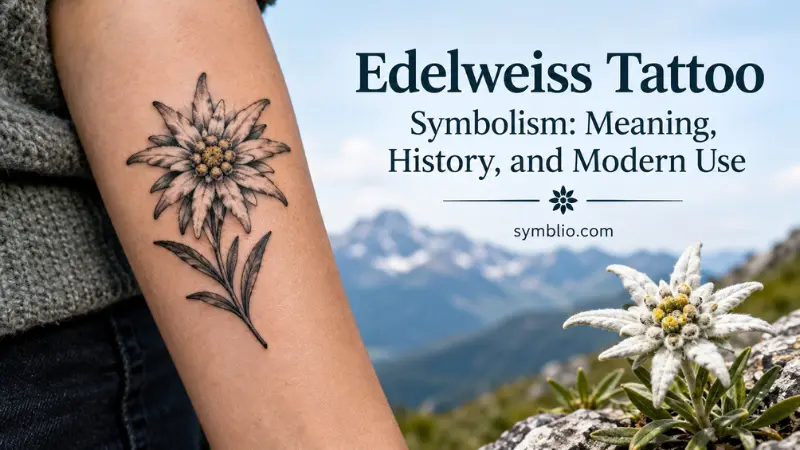
Edelweiss tattoo symbolism draws its meaning from a small white mountain flower associated with the Alps, especially Switzerland and Austria. In tattoo art, the flower commonly represents courage, resilience, purity, devotion, and a connection to mountain landscapes or Alpine heritage.
The edelweiss is visually distinctive: its white, star-like bracts surround tiny yellow flower heads, while its woolly surface gives it a silvery appearance. It grows in difficult Alpine environments, which helped turn the plant into a cultural emblem associated with endurance and courage.
For Americans, the image can carry several layers of meaning. Some people recognize it through European ancestry or travel, while others associate it with mountains, outdoor life, nature, perseverance, or the cultural image of Austria and Switzerland. The flower also became familiar to a broad American audience through The Sound of Music, although its historical symbolism is considerably older than the musical.
Quick Answer
Edelweiss tattoo symbolism commonly represents courage, resilience, purity, and devotion in modern American tattoo culture, especially when connected with mountains, personal endurance, nature, or Alpine heritage. Historically, the flower also became associated with Alpine identity, mountaineering, romantic devotion, and regional pride in parts of Central Europe.
TL;DR
- Edelweiss commonly represents courage and resilience.
- Its white appearance supports associations with purity and simplicity.
- Alpine traditions connected the flower with bravery and mountain life.
- American interpretations often emphasize nature, adventure, and personal endurance.
- Tattoos may also express Swiss, Austrian, or German heritage.
- Historical political associations make context important for some designs.
What the Edelweiss Flower Looks Like
The edelweiss is not a conventional daisy-like flower. Its most recognizable feature is a cluster of white, woolly structures arranged around small yellow flower heads.
The plant, scientifically known as Leontopodium alpinum, is strongly associated with Alpine landscapes, although the broader plant group has origins extending beyond the Alps. The flower’s fuzzy covering helps protect it from the challenging conditions found at high elevations.
That appearance contributes to its visual symbolism. A tattoo artist can emphasize the flower’s pointed white bracts, compact center, and silvery texture to make the design immediately recognizable.
Unlike a rose, which often depends on color and thorn imagery to communicate meaning, an edelweiss can convey its associations through shape and setting alone. Adding mountains, snow, leaves, or Alpine scenery can make the geographic connection even clearer.
What Edelweiss Commonly Symbolizes Today
The most common modern interpretations center on courage, resilience, purity, devotion, and connection with nature.
Courage comes from the flower’s Alpine reputation and its historical connection with mountaineering. During the growth of Alpine tourism and organized mountaineering in the 19th century, the edelweiss became associated with the challenge of reaching remote mountain areas.
Resilience has a similar origin. The flower’s ability to grow in exposed mountain environments made it a natural metaphor for persistence under difficult conditions.
Purity comes partly from its white appearance and partly from cultural traditions that treated the flower as an emblem of clean Alpine landscapes and noble character.
Devotion has a more romantic connection. Alpine stories and traditions sometimes portrayed the flower as a difficult-to-obtain gift for a loved one. Over time, that association helped connect edelweiss with affection, loyalty, and commitment.
A tattoo can therefore combine several meanings without requiring one fixed interpretation.
Ancient Roots and the Growth of Alpine Symbolism
The modern symbolism of edelweiss developed relatively late compared with some ancient floral traditions.
The flower became especially prominent in Alpine culture during the 19th century. Growing interest in mountain tourism and alpinism transformed the edelweiss from a relatively obscure plant into a recognizable emblem of Alpine landscapes.
Its rarity and the difficulty of reaching some places where it grew encouraged stories about the bravery required to collect it. Literary works also helped strengthen this reputation. In the 1861 novel Edelweiss, German writer Berthold Auerbach exaggerated the difficulty of obtaining the flower, reinforcing the connection between possession of the flower and daring.
This history matters because the flower’s symbolism was not simply created from its white color. Geography, literature, tourism, folklore, and changing ideas about the Alps all contributed to its cultural identity.
Edelweiss, Courage, and Mountain Life
Courage is one of the clearest meanings attached to an edelweiss tattoo.
The association developed partly from the flower’s environment. Alpine landscapes became symbols of physical challenge during the rise of European mountaineering. Reaching high mountain locations required preparation, endurance, and willingness to face difficult terrain.
An edelweiss tattoo can therefore represent a person’s relationship with challenge without depicting the challenge itself.
For someone who enjoys hiking or mountain landscapes, the flower may simply represent outdoor adventure. For another person, it may stand for getting through a difficult period or remaining committed to a goal.
The important distinction is that the tattoo does not automatically mean the wearer has overcome a specific hardship. Personal symbolism belongs to the individual wearing it.
Purity, Simplicity, and the White Flower
The white appearance of edelweiss contributes strongly to its symbolic associations with purity.
In American tattoo culture, white flowers are often interpreted through ideas such as innocence, simplicity, remembrance, peace, or clean beginnings. Edelweiss adds another dimension because its white color is closely connected with its Alpine appearance.
The flower’s modest size also gives it a different visual character from large ornamental blooms. A small edelweiss can communicate restraint rather than extravagance.
That makes it suitable for designs where the wearer wants the symbolism to remain subtle. The meaning can come from the flower’s cultural background rather than from an elaborate composition.
Love, Loyalty, and Devotion
Edelweiss also carries romantic associations.
Alpine folklore and later popular representations often connected the flower with lovers and the effort involved in obtaining a rare bloom from difficult terrain. That story helped establish the flower as an emblem of affection and devotion.
In a tattoo, this meaning can represent loyalty to a partner, family member, homeland, or important memory.
It does not have to be romantic. Someone might choose an edelweiss to symbolize dedication to family or a long-standing connection to a particular place.
This flexibility is one reason floral tattoos can remain personally meaningful even when viewers interpret them differently.
Edelweiss Symbolism in the United States
In the United States, edelweiss does not have one universally recognized symbolic meaning.
Its strongest American association is often cultural rather than traditional. Many Americans encounter the flower through images of the Alps, European travel, German-speaking heritage, Alpine-themed design, or The Sound of Music.
The 1959 musical helped make the word “edelweiss” familiar to American audiences. The flower’s association with Austria in popular culture became especially noticeable through the story’s historical setting. However, the flower’s real cultural history predates the musical by many decades.
For Swiss-American, Austrian-American, or German-American families, an edelweiss tattoo may serve as a heritage symbol. Someone without European ancestry might instead choose it because of a love of mountains, hiking, flowers, travel, or the visual character of the design.
This distinction is useful: an edelweiss tattoo can have cultural meaning without automatically claiming a particular ethnic identity.
Edelweiss and Alpine Heritage
Switzerland has particularly strong associations with the flower. The edelweiss appears across Swiss commercial and cultural imagery, including tourism-related design and other representations of national identity.
Austria also has a long relationship with the flower. Historical military units used edelweiss imagery, and the plant became connected with Alpine military and mountaineering traditions.
Consequently, an edelweiss tattoo can communicate regional heritage.
For someone with family roots in the Alps, the tattoo might represent grandparents, a family homeland, childhood memories, or an interest in European ancestry. A mountain range or national colors may make that interpretation more explicit.
Without those additions, however, the flower can remain a general Alpine symbol rather than a specific national statement.
Cross-Cultural Meanings of Edelweiss
Edelweiss symbolism is strongest in Central European and Alpine contexts, but the flower has also acquired meanings elsewhere.
In some cultural interpretations, its ability to survive difficult conditions has made it a metaphor for endurance. In Japan, for example, the flower has appeared in artistic and literary contexts, where its unusual appearance can support ideas about beauty and transience. Such interpretations should not be treated as universal Japanese symbolism.
The same caution applies to claims about folklore. Edelweiss has accumulated stories involving love, protection, healing, and good fortune, but these traditions vary by region and historical period.
For tattoo interpretation, it is better to distinguish documented cultural traditions from newer spiritual meanings that individuals may create for themselves.
Emotional and Psychological Associations
A tattoo does not have a scientifically fixed psychological meaning, but symbols can help people communicate personal identity and memory.
An edelweiss may remind someone of a mountain trip, a family background, a difficult achievement, or a relationship. The flower’s connection with difficult terrain can also provide a visual metaphor for persistence.
The emotional message may therefore be quiet rather than dramatic.
Someone might choose an edelweiss because it represents the idea of staying grounded while facing difficult circumstances. Another person might simply appreciate its unusual appearance and connection with nature.
Both interpretations are legitimate because tattoo symbolism depends heavily on personal experience.
Why People Choose Edelweiss Tattoos
People can choose the design for very different reasons.
Heritage: An edelweiss can represent a connection to Switzerland, Austria, Germany, or Alpine family history.
Nature: The flower works naturally for people interested in mountains, hiking, wildflowers, and outdoor environments.
Resilience: Its reputation for surviving harsh Alpine conditions provides a straightforward metaphor for perseverance.
Devotion: Historical romantic associations make it suitable for commemorating relationships or family bonds.
Adventure: The flower’s connection with mountaineering can represent exploration and travel.
Aesthetic preference: Some people simply like its unusual star-like form and soft white appearance.
No single interpretation should be assumed from the tattoo alone.
Edelweiss in Tattoo Design and Personal Style
The design style can change what viewers notice first.
A botanical edelweiss emphasizes the actual structure of the flower and tends to feel naturalistic.
A minimalist edelweiss focuses on the outline and recognizable shape, making the cultural symbolism more subtle.
An edelweiss with mountains strongly emphasizes Alpine geography and adventure.
An edelweiss with a date or name can turn the flower into a personal memorial or milestone symbol.
An edelweiss combined with other flowers may shift the interpretation toward family, friendship, romance, or a broader nature theme.
Color also matters. A mostly white-and-green design keeps the Alpine botanical appearance, while additional colors can make the tattoo more decorative and less geographically specific.
Edelweiss in Military and Political History
The flower has a complicated historical record that should not be ignored.
Edelweiss imagery appeared in Austrian and German military contexts, including Alpine troops. That connection reflected the flower’s established association with mountain environments and the qualities expected of mountain soldiers.
At the same time, edelweiss imagery became associated with resistance to Nazism through the Edelweiss Pirates, a loosely connected group of young people in Nazi Germany who opposed aspects of Nazi control. The flower therefore cannot accurately be reduced to one political meaning.
The Swiss government’s cultural history of the flower also notes its complicated relationship with nationalism, German and Austrian politics, and resistance movements.
For most contemporary American tattoo wearers, an edelweiss design may have no political intention at all. Nevertheless, historical context can matter when the tattoo incorporates specific military insignia, uniforms, nationalist imagery, or other symbols alongside the flower.
Common Misunderstandings About Edelweiss Symbolism
One common misunderstanding is that the edelweiss has always been a universally recognized symbol of courage. Its reputation for bravery became especially prominent during the 19th-century development of Alpine tourism and mountaineering.
Another misconception is that the flower is exclusively Austrian or exclusively Swiss. It is strongly associated with both countries, as well as the wider Alpine region.
It is also inaccurate to assume that every edelweiss tattoo represents European ancestry. In the United States, people can choose the flower for nature, travel, personal resilience, aesthetics, or popular cultural associations.
Finally, the Sound of Music connection should not be mistaken for the origin of the flower’s symbolism. The cultural history of edelweiss in the Alps substantially predates the musical.
Modern Meanings at a Glance
| Context | Meaning in the USA | Common Associations | Notes |
|---|---|---|---|
| Personal tattoo | Resilience and courage | Overcoming challenges | Meaning depends on the wearer |
| Heritage tattoo | Alpine or Central European roots | Switzerland, Austria, family history | Does not automatically indicate nationality |
| Nature design | Love of mountains and wildflowers | Hiking, travel, outdoors | Often paired with mountain imagery |
| Romantic tattoo | Devotion and loyalty | Relationships, family, commitment | Draws partly from Alpine traditions |
| Cultural design | Alpine identity | Folk art, tourism, traditional imagery | Historical context varies |
How Edelweiss Symbolism Has Changed
The meaning of edelweiss has developed in stages.
It began as a distinctive Alpine plant before becoming a subject of folklore and regional interest. During the 19th century, increasing fascination with the Alps transformed it into a symbol associated with mountain landscapes and daring.
Later, tourism and national imagery made the flower more commercially recognizable. Military use added another layer, while literature, music, and popular culture introduced the flower to audiences far beyond the Alps.
Modern tattoo culture then personalized the symbol. Instead of representing one community or institution, an edelweiss tattoo can now stand for an individual’s relationship with nature, family, endurance, travel, or heritage.
That shift from collective symbol to personal symbol explains why the same flower can mean different things on different people.
FAQs
An edelweiss tattoo commonly represents courage, resilience, purity, devotion, and a connection with Alpine landscapes. The wearer may also use it to express heritage, love of nature, adventure, or a personal experience.
It can. Edelweiss is strongly associated with Swiss identity and the Alps, but the flower also has important Austrian and broader Alpine associations. A tattoo alone does not establish that the wearer is Swiss.
Yes. Edelweiss has a long cultural association with Austria, particularly its Alpine regions. It has appeared in Austrian cultural and military contexts and remains an important Alpine image.
It can symbolize love or devotion, particularly when the design draws on Alpine traditions involving the flower as a gift to a loved one. In modern tattoo culture, that meaning can extend to romantic relationships, family, or loyalty to an important person.
Mountains usually strengthen the flower’s associations with Alpine landscapes, adventure, endurance, and outdoor life. The combination can also represent a personal connection to hiking, climbing, travel, or overcoming challenges.
Not inherently. The flower has appeared in several historical political and military contexts, including both nationalist imagery and resistance symbolism, so surrounding imagery and historical context matter.
No. The musical made the flower especially familiar to many Americans, but edelweiss had already developed important Alpine cultural associations during the 19th century. Its history includes folklore, mountaineering, tourism, national identity, and military use that predates the musical.
Conclusion
Edelweiss tattoo symbolism combines the visual simplicity of a white Alpine flower with a history shaped by mountains, folklore, mountaineering, regional identity, and popular culture. In modern American use, the design commonly communicates courage, resilience, devotion, purity, nature, or a personal connection to Alpine heritage.
The flower’s meaning is not limited to one interpretation. Someone may see it as a tribute to family roots, while another person may associate it with a mountain journey, perseverance, or an appreciation for wildflowers.
Ultimately, an edelweiss tattoo becomes most meaningful when its historical associations and the wearer’s personal story meet in the same design.