Hydra symbolism centers on a creature that becomes harder to defeat when attacked in the ordinary way. In Greek mythology, the Lernaean Hydra was a multi-headed serpent associated with the region of Lerna and became the opponent Heracles faced during his second labor.
The Hydra remains recognizable in the United States because its image appears in mythology books, fantasy stories, movies, games, tattoos, artwork, and other forms of popular culture. Its many heads also provide an easy visual metaphor for problems that multiply instead of disappearing.
Understanding the Hydra requires looking beyond the image of a giant serpent. The most important part of its symbolism comes from the way the creature responds to attack: removing one head could cause additional heads to appear. That unusual feature turned the monster into a lasting symbol of multiplying problems, persistence, danger, and the need for a different strategy.
Quick Answer
Hydra symbolism commonly represents a problem that multiplies when confronted directly, especially in modern American culture. In Greek mythology, the Hydra was a dangerous many-headed serpent defeated by Heracles with help from Iolaus, giving the creature additional associations with persistence, adversity, and overcoming complicated threats.
TL;DR
- The Hydra commonly symbolizes problems that multiply when attacked.
- Its best-known story comes from Greek mythology.
- Heracles defeated the Hydra through strategy and assistance.
- Multiple heads represent complexity, repetition, and persistent obstacles.
- Modern Americans often encounter Hydra imagery in fantasy and pop culture.
- Hydra tattoos can represent resilience, struggle, or confronting adversity.
What the Hydra Actually Looks Like
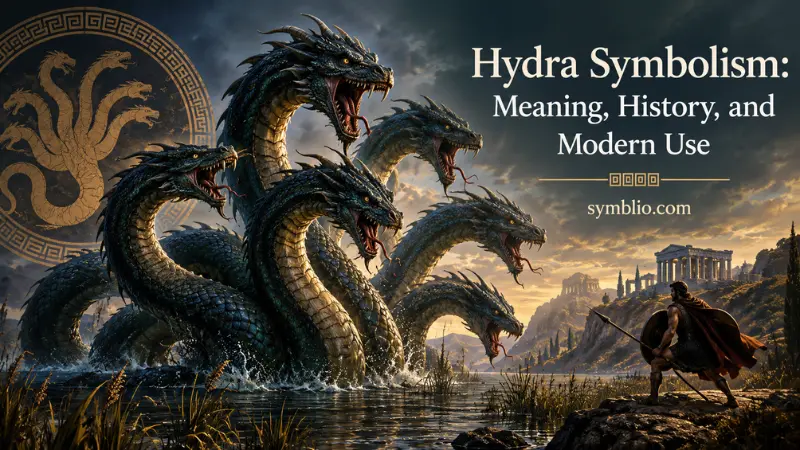
The mythological Hydra is generally described as a large serpent or water-serpent with multiple heads. Ancient accounts do not agree on one fixed number of heads. Later artistic traditions often settled on a nine-headed form, while some ancient writers described substantially different numbers.
The creature was associated with the waters and marshes of Lerna in the Argolid region of ancient Greece. Its serpent-like body helped distinguish it from later fantasy creatures that combine the Hydra with features of dragons, reptiles, or other monsters.
Modern illustrations often make the Hydra much larger and more elaborate than ancient representations. Artists may give it horns, legs, wings, fiery breath, or dragon-like bodies. These additions are part of the creature’s later visual development rather than a single consistent description from ancient Greek mythology.
The most recognizable feature remains the collection of heads rising from one body.
The Core Symbolism of the Hydra
The Hydra’s central symbolic idea comes from regeneration. According to familiar versions of the myth, cutting off one of its heads could cause additional heads to grow in its place.
That creates a simple metaphor: a problem can become larger when handled without addressing the conditions that allow it to continue.
This interpretation works in everyday language as well as mythology. Someone might describe a complicated situation as “hydra-like” when solving one part creates several new problems.
The creature can therefore symbolize:
- multiplying difficulties
- persistent opposition
- complexity
- regeneration
- resistance to simple solutions
- repeated setbacks
- strategic thinking
- the consequences of incomplete solutions
The Hydra does not usually represent perseverance in a purely positive sense. Its persistence is threatening. The symbolic lesson comes from recognizing that persistence can belong to an obstacle as much as to the person confronting it.
Ancient Roots of the Lernaean Hydra
The Hydra belongs to the mythology surrounding Heracles, one of the best-known heroes of ancient Greek tradition. Hesiod’s Theogony, an early surviving Greek literary source, identifies the Hydra as an offspring of Typhon and Echidna and connects it with Hera’s hostility toward Heracles.
Later mythographers provide more detailed accounts of the creature and Heracles’ encounter with it.
The Hydra lived near Lerna, an area associated with springs and marshes. Heracles was commanded to destroy the creature as part of his labors. The task became difficult because cutting off its heads did not solve the problem.
Heracles therefore needed assistance from his companion Iolaus. Together they prevented the severed necks from producing additional heads, allowing Heracles eventually to defeat the monster.
This detail matters symbolically because the story is not simply about physical strength. The solution requires recognizing how the Hydra works.
Why Heracles Needed Strategy
The Hydra story presents an unusual challenge for a heroic monster-slaying tale.
A straightforward approach makes the situation worse. Heracles cannot simply rely on strength and keep attacking the same way. The creature’s regenerative ability changes the rules of the fight.
Iolaus plays an important role by helping deal with the places where Heracles cuts the heads away. In some versions, the remaining immortal head is dealt with separately and buried beneath a large rock.
The episode consequently became a useful example of strategy overcoming a problem that brute force cannot solve.
That interpretation has remained relevant because many modern problems work in a similar metaphorical way. Treating individual symptoms without addressing the underlying cause can leave the larger problem intact.
Hydra Symbolism in the United States
In modern American culture, the Hydra is primarily understood through mythology and entertainment rather than religious practice.
Americans may encounter the creature in school discussions of Greek mythology, fantasy novels, movies, comics, tabletop games, video games, museum art, and mythology-themed educational material.
The most common American interpretation is therefore connected to adversity. A Hydra represents something that refuses to stay solved, especially when the response is too narrow or ineffective.
The image can also suggest an opponent with many connected parts. A single head represents one visible problem, while the other heads imply additional problems waiting behind it.
This makes the Hydra particularly useful as a metaphor for complicated organizations, conflicts, social problems, or fictional villains.
Hydra Symbolism and the Idea of Resilience
Resilience is one of the more modern interpretations associated with the Hydra, although it needs an important qualification.
The Hydra itself is not a heroic figure in the original myth. It is the monster that Heracles must defeat. Its ability to regenerate therefore represents the persistence of an obstacle, not necessarily admirable personal resilience.
Modern readers sometimes reinterpret that quality more positively. A person choosing a Hydra tattoo, for example, might use the creature as a personal reminder of surviving repeated challenges.
The symbolism then shifts from “I am the obstacle” to “I have faced obstacles that kept returning.”
That distinction matters because symbols often acquire new meanings when people adopt them for personal identity.
A Symbol of Complexity and Many Problems
The Hydra’s multiple heads make it an especially effective symbol for complexity.
One difficult situation can contain several connected issues. Addressing one may reveal another. A person might therefore use Hydra imagery to represent an experience that never seemed to consist of only one problem.
This interpretation extends beyond personal experiences. Writers and commentators sometimes use “Hydra” metaphorically for complicated systems in which removing one part does not eliminate the whole.
The image works because the relationship between the heads and the body is immediately understandable. There is one creature, but many visible sources of danger.
| Context | Meaning in the USA | Common Associations | Notes |
|---|---|---|---|
| Greek mythology | Dangerous adversary | Heracles, Lerna, heroic trials | Based on the original myth |
| Everyday metaphor | A multiplying problem | Complexity, repeated setbacks | Often used figuratively |
| Tattoo culture | Personal struggle or resilience | Survival, adversity, strength | Meaning depends on the wearer |
| Fantasy media | Powerful monster | Danger, magic, combat | Often changes the ancient design |
| Organizational metaphor | Difficult system or opponent | Multiple parts, regeneration | Usually describes complexity |
The Hydra as a Symbol of Strategy
One of the most useful interpretations of the Hydra story concerns problem-solving.
The creature teaches a symbolic lesson about understanding the structure of a problem before attacking it. If the response creates additional difficulties, repeating the same action is unlikely to help.
Heracles’ victory therefore represents more than physical courage. It involves adapting to the nature of the obstacle and accepting assistance.
This is one reason the myth continues to work well in modern storytelling. The hero faces a situation in which determination alone is insufficient.
The Hydra can consequently symbolize the moment when someone realizes that changing the method matters as much as increasing the effort.
Hydra Symbolism in Tattoos
Hydra tattoos often draw on the creature’s dramatic visual design. Multiple heads create a striking composition, particularly when the tattoo incorporates serpentine bodies, scales, or classical-inspired artwork.
The meaning varies considerably between individuals.
A Hydra tattoo may represent:
- surviving repeated challenges
- confronting complicated circumstances
- personal transformation
- resistance to defeat
- a connection to Greek mythology
- fascination with monsters or fantasy
- the idea that difficulties can return in new forms
Some people choose the Hydra simply because they appreciate its appearance or its place in mythology. A tattoo should not automatically be interpreted as evidence of a particular personality or life experience.
The surrounding design also changes the message. A Hydra shown with Heracles suggests the original myth, while an isolated multi-headed serpent may emphasize complexity or personal struggle.
The Hydra in Art, Fantasy, and Pop Culture
The Hydra has had a long afterlife in modern entertainment.
Films, television, literature, comics, and video games frequently use the creature as a monster that challenges a protagonist. Modern versions may enlarge its body, add dragon-like features, give it magical abilities, or alter the regeneration mechanism.
The creature’s design is especially useful in games because multiple heads can create several simultaneous threats. It also gives artists an immediately recognizable monster with a strong connection to classical mythology.
Modern adaptations therefore do not always preserve the ancient Hydra exactly. Instead, they use recognizable features while adapting the creature for contemporary storytelling.
The Hydra has also influenced fictional organizations. The name has been used for groups designed around the idea that eliminating one part does not eliminate the whole.
The Hydra in Language and Metaphor
The Hydra has become more than a creature from a myth. Its name can function as a metaphor for problems that seem to reproduce themselves.
Calling something “Hydra-like” usually suggests that the problem has multiple connected parts and that conventional attempts to eliminate it have failed or produced additional complications.
This metaphor appears naturally in discussions of organizations, conflicts, bureaucracy, crime, political movements, and other complex subjects.
The underlying idea is straightforward: cutting off one visible part does not necessarily destroy the system behind it.
That is one of the strongest reasons the Hydra remains recognizable even among people who are not especially familiar with classical mythology.
The Hydra and the Constellation
Hydra is also the name of a constellation.
Ancient star mythology contains more than one story involving a celestial water-serpent. One tradition connects the constellation Hydra with the Lernaean monster associated with Heracles. Another classical tradition describes a different water-serpent connected with the crow and the cup.
This means that the constellation’s mythology should not automatically be treated as identical to the monster from Heracles’ second labor.
In modern astronomy, Hydra is notable for being the largest of the 88 officially recognized constellations by area. Its name preserves the ancient association with a water-serpent even though modern astronomy treats constellations as defined regions of the sky rather than mythological creatures.
The Hydra in Biology
The word “Hydra” also appears in biology, where it names a genus of small freshwater animals.
The connection is particularly interesting because these organisms are known for regenerative abilities. Their scientific name was inspired by the mythological creature, making the ancient image part of modern scientific terminology.
The biological Hydra is obviously not the monstrous serpent of Greek mythology. It is a real freshwater organism with a very different anatomy and ecological role.
Still, the shared name illustrates how mythology can provide useful language for describing natural phenomena. The regenerative reputation of the mythological Hydra made the name an understandable choice for an organism associated with regeneration.
Cross-Cultural and Broader Symbolic Context
The Hydra belongs specifically to the Greek mythological tradition, so its original symbolism should not be generalized as though every culture has the same interpretation.
Other cultures have their own multi-headed serpents, dragons, water monsters, and regenerative creatures. Similar visual patterns can produce different meanings depending on the story attached to them.
For example, a many-headed creature in one tradition might represent divine power, while a comparable monster in another story could symbolize disorder or danger.
Modern fantasy sometimes blends these traditions together. Dragons, serpents, Hydras, sea monsters, and other legendary creatures are frequently combined into designs that would not correspond to any single ancient tradition.
For historically grounded interpretation, it is better to identify the specific mythology behind the image rather than assuming all multi-headed creatures symbolize the same thing.
Positive and Negative Meanings of the Hydra
Hydra symbolism can carry both negative and constructive interpretations.
The negative side comes directly from the original myth. The creature is dangerous, difficult to control, and capable of making an attack more complicated.
The constructive interpretation comes from later personal and popular uses. Someone may see the Hydra as a reminder that difficult circumstances require adaptability, patience, cooperation, and careful thinking.
| Symbolic Direction | Possible Meaning |
|---|---|
| Negative | Threat, disorder, multiplying problems |
| Neutral | Complexity, many connected forces |
| Personal | Repeated challenges and survival |
| Strategic | Adaptation and problem-solving |
| Mythological | Heroic trial and dangerous opposition |
These meanings can coexist without contradiction. A symbol can represent an obstacle in one context and a person’s response to that obstacle in another.
Common Misunderstandings About Hydra Symbolism
One common misunderstanding is that the Hydra always symbolizes resilience in a positive sense. In the original Greek story, its regenerative ability belongs to the monster, not the hero.
Another misconception is that the Hydra always has exactly nine heads. Nine is a common artistic representation, but ancient accounts vary.
It is also easy to assume that every multi-headed serpent in modern fantasy is a faithful depiction of the Greek Hydra. Contemporary artists and filmmakers frequently combine Hydra characteristics with those of dragons and other legendary creatures.
Finally, Hydra symbolism does not automatically indicate evil when used in modern personal artwork. A tattoo or decorative image may reference mythology, personal adversity, fantasy interests, or simply the creature’s visual design.
How Hydra Meaning Has Changed Over Time
The Hydra began as a specific monster in Greek mythology. Its identity was tied to Lerna, Heracles, Hera, and the hero’s labor.
Over time, the creature became a broader metaphor. The idea of a problem that grows when attacked became more useful outside the original story.
Modern popular culture expanded the image even further. The Hydra became larger, more dragon-like, more visually elaborate, and increasingly suited to movies and games.
Its meaning has therefore moved through several stages:
mythological monster → metaphor for multiplying problems → symbol of complex opposition → modern fantasy creature → personal symbol of struggle or resilience
The original story remains important because each later interpretation depends on the Hydra’s most recognizable characteristic: regeneration after apparent defeat.
FAQs
The Hydra commonly symbolizes a problem that multiplies when attacked without addressing its underlying structure. It can also represent complexity, persistence, adversity, and the need for strategic thinking.
A Hydra tattoo can symbolize repeated challenges, resilience, personal struggle, or an interest in Greek mythology. Its meaning depends heavily on the wearer’s intention and the surrounding tattoo design.
The Hydra can represent strength indirectly through its ability to resist defeat, but the original myth presents it as an enemy rather than a heroic figure. Modern interpretations sometimes turn its regenerative quality into a symbol of personal endurance.
In Greek mythology, the Lernaean Hydra is a dangerous multi-headed serpent associated with Lerna and Heracles’ second labor. Its ability to regenerate heads makes it an unusually difficult opponent.
It can be either. Historically, the Hydra represents a dangerous obstacle, while modern personal interpretations may use it to represent surviving repeated difficulties or learning to approach complicated problems differently.
The multiple heads are central to the monster’s mythological identity and make its defeat difficult. The regenerative heads also provide the basis for the modern metaphor of a problem that produces new problems when attacked.
Not originally. The Lernaean Hydra was described as a multi-headed serpent or water-serpent, while modern artwork often gives Hydras dragon-like features such as legs, horns, wings, or fire-breathing abilities.
Conclusion
The Hydra is more than a many-headed monster. Its lasting symbolism comes from the unusual problem at the center of its story: attacking one part can make the larger threat harder to control.
In modern American culture, Hydra symbolism often represents multiplying problems, persistent adversity, complexity, and the need for a thoughtful response rather than repeated brute force. Its use in tattoos, fantasy, art, language, and popular entertainment shows how an ancient myth can continue to acquire new meanings without losing its original identity.
The most useful lesson from the Hydra is not simply that some problems are difficult. It is that understanding how a problem works can determine whether an attempted solution actually solves it.


