
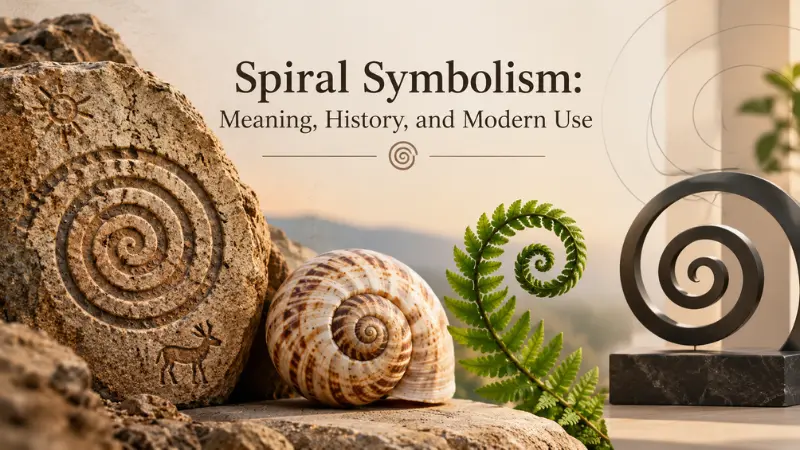
A spiral is a curved line that circles around a central point while gradually moving inward or outward. Spiral symbolism often relates to growth, movement, change, continuity, and the passage from one state to another, which helps explain why the shape appears in art, architecture, jewelry, tattoos, and nature-inspired design.
The form is especially interesting because it does not have one universal meaning. A spiral carved into a prehistoric monument, painted on a modern artwork, or chosen for a tattoo may communicate very different ideas depending on its culture, setting, direction, and surrounding imagery.
In the United States, people commonly associate spirals with personal growth, transformation, creativity, cycles, and connection with nature. At the same time, the shape remains strongly connected to older artistic traditions around the world.
Quick Answer
Spiral symbolism commonly represents growth, change, movement, and life’s ongoing cycles in modern American culture, especially in tattoos, artwork, jewelry, and nature-inspired design. Historically, spiral forms appeared in ancient art across Europe, Asia, the Mediterranean, and other regions, where their meanings varied from natural cycles and movement to religious or cultural ideas.
TL;DR
- Spirals commonly suggest growth, movement, change, and continuity.
- Ancient spiral motifs appear across several independent cultures.
- American interpretations often emphasize personal transformation and creativity.
- Nature provides many familiar spiral forms, from shells to galaxies.
- Māori koru has specific cultural meanings that should not be generalized.
- Modern tattoos and artwork give spirals highly personal meanings.
What a Spiral Looks Like and Why the Shape Matters
A spiral begins around a central point and curves progressively around it. Depending on the design, the line can tighten toward the center, expand outward, or create several connected turns.
This movement distinguishes a spiral from a simple circle. A circle returns to its starting point without showing an obvious direction. A spiral suggests movement between the center and the outside.
That visual quality gives the form much of its symbolic flexibility. An inward-moving spiral can suggest reflection, concentration, retreat, or returning to one’s center. An outward-moving spiral can suggest expansion, discovery, development, or release.
These interpretations are not fixed rules. Artists and cultures can use the same basic shape for very different purposes.
What Spirals Commonly Represent Today
In contemporary American culture, several associations appear repeatedly.
Growth is one of the most common. Because a spiral expands as it turns, people may use it as a visual metaphor for developing through experience rather than remaining unchanged.
Change is another common association. The spiral is always moving while remaining connected to its center, making it useful for representing transitions, life stages, and personal development.
Cycles and continuity also fit the form. The repeated curve can suggest seasons, recurring experiences, generations, or patterns that return without being exactly the same.
Creativity is particularly common in art and design. A spiral can create movement across a flat surface and guide the viewer’s attention toward or away from a focal point.
Some people also interpret spirals as symbols of balance between inner and outer life. In this reading, the center represents an individual or starting point, while the expanding curve represents relationships, experience, and the wider world.
Ancient Roots and Early Spiral Motifs
Spiral designs are extremely old. Archaeological objects and monuments from different parts of the world show that humans used curved, rotating patterns thousands of years ago.
One important example comes from Neolithic Britain and Ireland. Spirals and related geometric designs appear on prehistoric stones and monuments, including the passage tomb complex at Brú na Bóinne in Ireland. Newgrange contains famous triple-spiral imagery.
It is tempting to assign a single meaning to these ancient designs, but archaeologists cannot always determine exactly what their makers intended. Suggestions involving the sun, moon, stars, cycles, or movement remain interpretations rather than universally established facts.
That uncertainty is important. A spiral found on a prehistoric monument tells us that the form mattered to its makers, but it does not automatically reveal the precise idea they wanted to communicate.
Spiral decoration also appeared in ancient Mediterranean societies. Greek, Minoan, and Mycenaean art used curving spiral and scroll patterns as architectural and decorative elements.
In ancient China, spiral designs appeared on Neolithic ceramics. Other examples have been found across the ancient Near East and western Asia.
The widespread appearance of the shape does not necessarily indicate one shared ancient belief. In many cases, separate societies could develop similar motifs because people observed comparable natural forms and found spirals visually useful.
Spirals in Nature and the Human Imagination
Nature provides countless examples of spiral forms, which helps explain the symbol’s recurring appearance.
Snail and seashells provide familiar examples. Fern shoots curl as they develop. Some plants produce spiral arrangements of leaves or seeds. Weather systems can form spiral patterns, while galaxies display enormous rotating structures.
The human eye therefore encounters spiral-like forms at dramatically different scales.
This natural visibility may contribute to the symbolic association between spirals and growth. A tightly curled plant shoot can unfold as it develops, while a shell records growth through successive additions.
However, not every natural spiral follows the same mathematical pattern, and popular discussions sometimes exaggerate connections between natural spirals, the golden ratio, and universal design. A symbolic interpretation should not be confused with a scientific claim about how every spiral in nature is formed.
The important point is simpler: people repeatedly encounter spirals in living organisms, landscapes, weather, and astronomy, making the shape an intuitive way to represent movement and development.
What Spirals Mean in the United States
There is no single official American meaning for the spiral. Instead, contemporary U.S. interpretations tend to depend on context.
In art, a spiral can create motion, guide attention, or suggest an evolving idea. American artists have used spirals in painting, sculpture, photography, installation, and graphic work.
In design, the shape can make a composition feel organic rather than rigid. It appears in logos, textiles, posters, home décor, jewelry, and illustrations.
In personal symbolism, Americans may choose a spiral to represent a new chapter, recovery from a difficult period, creative development, or an ongoing journey.
In education and science, spirals can also represent mathematical patterns, natural processes, galaxies, shells, or systems that develop through repeated movement.
Robert Smithson’s Spiral Jetty, created in Utah in 1970, is a particularly notable American example. The enormous earthwork uses a spiral form within the landscape and has generated interpretations involving land, time, geology, perception, and environmental change.
The work demonstrates why context matters. A spiral does not need to carry one predetermined message; an artist can use its form to create a particular relationship between shape, place, material, and idea.
Spiral Meanings Across Different Cultures
Spiral motifs appear in many cultures, but their meanings should be treated separately rather than combined into one universal tradition.
In ancient Ireland and Britain, spirals appear prominently in Neolithic monumental art. Their exact meanings remain uncertain, although researchers have considered connections with celestial observation, natural cycles, and abstract design.
In Minoan and Mycenaean art, spiral and scroll forms became important decorative motifs, particularly in architectural and painted ornament.
In ancient China, spiral decoration appeared on Neolithic pottery, showing that the form was part of a broader visual vocabulary rather than an exclusively European motif.
Among Māori communities in Aotearoa New Zealand, the koru is a culturally specific spiral-like motif associated with the unfurling young frond of the silver fern. It is commonly connected with ideas such as new life and growth. Māori spiral motifs also occur within traditional art and tā moko, where visual elements can communicate identity and social meaning.
The Māori koru should not simply be treated as another generic “spiral tattoo.” Its cultural context is specific, and copying a culturally meaningful motif without understanding that context can create problems.
These examples show that similar shapes can develop different meanings. A spiral’s appearance alone does not determine its cultural significance.
Inward Spirals vs. Outward Spirals
Direction can influence interpretation, although there is no universal symbolic dictionary governing every design.
An outward spiral can visually suggest expansion. In personal artwork, it might represent learning, exploration, creativity, or moving into a new phase.
An inward spiral naturally draws attention toward the center. Artists may use it to suggest reflection, introspection, concentration, or returning to something fundamental.
A spiral that alternates between inward and outward movement can communicate tension between these two ideas. It may represent the relationship between private and public life, solitude and connection, or reflection and action.
For this reason, someone choosing a spiral for artwork or body art may want to consider not only the shape but also its direction and surrounding elements.
Emotional and Psychological Associations
Spirals can influence how an image feels because curved lines tend to create a different visual experience from straight lines and sharp geometric forms.
A spiral can lead the eye gradually toward a center or outward toward the surrounding space. That visual journey can make an image feel active, flowing, or contemplative.
For some people, this makes the spiral a useful metaphor for self-reflection. The eye moves toward a center, much as someone might turn attention inward when thinking about personal experiences.
An expanding spiral can produce the opposite impression. Its widening path can suggest openness, exploration, and possibility.
These are visual and cultural associations rather than universal psychological laws. A spiral does not automatically produce the same emotional response in every viewer.
Artists often rely on surrounding color, scale, texture, and imagery to determine whether a spiral feels peaceful, energetic, unsettling, playful, or serious.
Spirals in Tattoos and Personal Style
Spiral tattoos are popular partly because the shape can be simple while still allowing substantial personal interpretation.
A small single-line spiral may represent personal growth or a continuing journey. A larger design can incorporate flowers, animals, celestial imagery, geometric shapes, waves, or other symbols.
Some people use spiral imagery to mark a transition between stages of life. Others choose it because they enjoy its appearance or because it reminds them of a natural object such as a shell, wave, fern, or galaxy.
The meaning becomes more specific when another symbol is added. A spiral combined with a flower may emphasize growth, while one incorporated into a celestial design may focus on cycles or the universe.
People should also distinguish between a generic spiral and culturally specific designs. A Māori koru, for example, carries cultural context that goes beyond the general meaning of a curved line.
Spirals in Jewelry, Clothing, and Home Décor
Spiral forms work especially well in objects because they combine movement with symmetry.
Jewelry may use a spiral as a pendant, ring pattern, earring shape, or decorative element. In these settings, it can communicate individuality, natural inspiration, or a preference for flowing forms.
In home décor, spiral patterns can appear in metalwork, wall art, ceramics, textiles, staircases, furniture details, and garden features.
Fashion designers may use spirals to create visual movement or an organic alternative to straight geometric patterns.
The symbolism is often subtle. A person may choose a spiral simply because the shape looks elegant while another person may attach a personal meaning to the same design.
| Context | Common U.S. Interpretation | Typical Associations | Important Note |
|---|---|---|---|
| Tattoo | Personal growth or change | Transformation, journey, identity | Meaning depends on the complete design |
| Jewelry | Individuality and movement | Growth, nature, continuity | Often chosen for visual appeal too |
| Home décor | Organic movement | Nature, creativity, flow | Usually decorative rather than religious |
| Fine art | Change or perception | Time, cycles, movement | Artist’s intent matters most |
| Nature imagery | Development and cycles | Shells, plants, galaxies | Natural spirals have different causes |
Spirals in Modern Art and Popular Culture
Modern artists have repeatedly used spirals because the form can suggest motion without requiring a literal image of movement.
In American art, the spiral has appeared in sculpture, painting, conceptual art, film, crafts, and large-scale environmental works. Its ability to work both as a simple geometric shape and as a metaphor makes it useful across artistic styles.
Digital culture has expanded those possibilities. Spirals appear in animations, visual effects, illustrations, album artwork, games, social-media graphics, and digital backgrounds.
The shape can also create an optical effect. Repeating curves may make the viewer feel as though the image is rotating, expanding, contracting, or drawing attention toward a center.
This helps explain why the spiral remains useful even in highly technological settings. Its basic visual structure is easy to recognize, reproduce, animate, and combine with other forms.
Religious and Spiritual Interpretations
Spirals have appeared in religious and spiritual art, but there is no single religious doctrine that assigns one universal meaning to the shape.
In some traditions, circular movement can relate to cycles, creation, renewal, meditation, or the relationship between an individual and a larger whole. In other contexts, spiral forms may be primarily decorative.
Christian art, Jewish art, Indigenous traditions, Asian religions, and various modern spiritual movements can all contain curved or spiral imagery, but their meanings should not be merged into one category.
This distinction is particularly important online, where lists of “spiritual spiral meanings” sometimes combine symbols from unrelated cultures and present them as though they belonged to one ancient belief system.
A more accurate approach is to ask three questions: Which culture uses the symbol? Where does it appear? What does that particular tradition say about it?
Common Misunderstandings About the Spiral
One common misconception is that every ancient spiral represented the same idea. Archaeological evidence does not support such a simple conclusion.
Another mistake is calling every ancient spiral design “Celtic.” Spirals were used in Europe long before the historical period associated with Celtic cultures. The famous spirals at Newgrange, for example, belong to the Neolithic period.
It is also misleading to claim that every spiral represents the cycle of life. That interpretation may be appropriate for a particular artwork or personal design, but it is not a universal definition.
A further misunderstanding involves the Māori koru. Although it is spiral-shaped, its cultural meaning comes from Māori traditions and visual language. Treating it as a generic decorative spiral removes important context.
Finally, mathematical claims about spirals are sometimes overstated. Not every spiral in nature follows the same formula, and symbolic resemblance does not prove a mathematical relationship.
How Spiral Meanings Have Changed Over Time
The history of spiral imagery is less a single story than a collection of overlapping traditions.
Prehistoric artists used spiral forms in monumental and decorative contexts whose precise meanings are often unknown. Later societies incorporated spirals into pottery, jewelry, architecture, manuscripts, textiles, and other objects.
In modern Western art, the spiral increasingly became a tool for exploring movement, perception, emotion, landscape, and abstraction.
Contemporary American culture has added another layer: personal symbolism. Today, an individual can choose a spiral without belonging to a particular historical tradition and give it a private meaning connected with change, creativity, family, identity, or a major life transition.
The result is a symbol that has remained visually recognizable while its interpretation continues to change.
Positive and Negative Associations
Spirals are usually used in positive or neutral contexts, particularly when they represent growth, creativity, movement, and continuity.
However, the same visual movement can produce less comfortable associations. A tightly wound spiral may suggest pressure, confinement, obsession, confusion, or feeling trapped.
Artists sometimes use spirals deliberately for this reason. The form can communicate both expansion and constriction depending on how tightly it is drawn and how it interacts with the surrounding composition.
There is therefore no requirement for a spiral to represent something positive. Its meaning comes from context, artistic intention, and the viewer’s interpretation.
Why the Spiral Remains Relevant Today
The spiral has survived across very different artistic environments because it can perform several jobs at once.
It is visually recognizable, easy to adapt, and capable of suggesting movement without depicting a person or object in motion. It can look ancient in stone, contemporary in a logo, natural in a botanical illustration, or highly personal as a tattoo.
Modern Americans also encounter spiral forms constantly in science and nature. Images of galaxies, shells, storms, plants, and mathematical patterns reinforce the association between the shape and processes that unfold over time.
At the same time, modern artists continue to challenge older interpretations. A spiral can be used for environmental commentary, personal expression, abstract exploration, or simply visual experimentation.
That flexibility is one reason the form continues to appear in both everyday design and serious art.
FAQs
A spiral can symbolize renewal, cycles, inner reflection, movement, or connection between an individual and a larger whole in some spiritual contexts. Its specific meaning depends on the religious or cultural tradition rather than on the shape alone.
A spiral tattoo often represents personal growth, transformation, a continuing journey, or change. Some people choose one simply because they like the shape, so the tattoo’s meaning ultimately depends on the wearer.
A spiral can represent life, growth, and recurring stages because its form combines movement with repeated curves. However, “symbol of life” is an interpretation rather than a universal definition shared by every culture.
An inward spiral may suggest introspection, concentration, returning to one’s center, or withdrawal. These associations come from the visual movement toward the middle and can change according to the artwork’s context.
An outward spiral can suggest expansion, exploration, development, creativity, or moving into a new stage. It is particularly useful in personal artwork when someone wants to represent growth or opening toward new experiences.
Spirals are strongly associated with some Celtic and Insular artistic traditions, including triskele designs, but the motif is much older than historically Celtic cultures. Neolithic spiral carvings in places such as Newgrange predate the period commonly associated with Celtic societies.
No. The koru is a specific Māori motif based on the unfurling young fern frond and has meanings connected with new life and growth. It should be understood within Māori artistic and cultural traditions rather than treated as a generic spiral decoration.
Conclusion
Spiral symbolism is best understood as a flexible visual language rather than a symbol with one fixed definition. In modern American culture, it frequently suggests growth, change, creativity, continuity, and movement, while individual artworks and personal designs can give it more specific meanings.
Its long history makes the spiral especially interesting. Ancient communities used the form in different artistic settings, later cultures developed their own interpretations, and contemporary artists and individuals continue to adapt it for new purposes.
Whether it appears in prehistoric stonework, a piece of jewelry, a tattoo, a painting, or a modern landscape artwork, the spiral invites attention to movement and change. Its meaning becomes clearest when the shape is considered together with the culture, context, and person who uses it.


