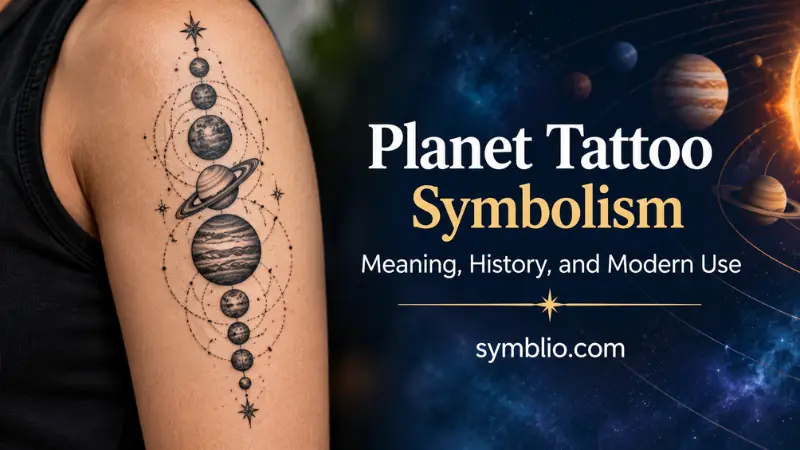
A planet tattoo can symbolize curiosity, personal identity, exploration, change, and a sense of connection to something larger than everyday life. The meaning becomes more specific when the design features a particular planet, orbit, moon, constellation, or solar-system arrangement.
People choose planetary tattoos for many reasons. Some are interested in astronomy, while others connect a planet with a period of personal growth, a favorite science-fiction story, childhood memories, or an interest in astrology. In the United States, the imagery is especially flexible: the same Saturn tattoo can represent astronomy for one person and personal transformation for another.
Unlike symbols with one established definition, a planet tattoo is usually personal. Its meaning comes from the planet shown, the surrounding imagery, the tattoo style, and the story the wearer attaches to it.
Quick Answer
Planet tattoo symbolism commonly represents curiosity, exploration, individuality, and connection to the universe in modern American culture. Historically, planets were also associated with gods, astrology, fate, seasonal cycles, and ideas about human character.
TL;DR
- Planets commonly represent exploration, curiosity, and individuality.
- Ancient cultures connected visible planets with gods and celestial forces.
- American tattoo culture gives planetary imagery highly personal meanings.
- Saturn often suggests cycles, boundaries, patience, or transformation.
- Earth can represent home, nature, belonging, or environmental awareness.
- Planet tattoos may combine astronomy with mythology, astrology, or pop culture.
What a Planet Tattoo Looks Like
A planet tattoo can be extremely simple or highly detailed. The design might show a realistic sphere, a ringed planet, a tiny astronomical symbol, or an entire miniature solar system.
Some designs use fine lines and restrained shading to create an astronomical appearance. Others use bold colors, watercolor effects, geometric shapes, stars, moons, or orbital lines. A planet may also appear inside a larger scene involving astronauts, spacecraft, galaxies, flowers, animals, or constellations.
The design itself can change the impression. A scientifically detailed planet may communicate an interest in astronomy, while a colorful surreal planet can feel more imaginative or artistic.
Small planetary tattoos are also common because planets can be represented with relatively simple circular forms. Larger designs allow room for surface details, rings, moons, orbital paths, and surrounding celestial elements.
What Planets Commonly Symbolize Today
The broadest modern meanings come from the qualities people associate with space itself.
A planet can represent exploration because planets are destinations humans have studied through telescopes, spacecraft, probes, and scientific missions. The image can therefore suggest curiosity and a willingness to look beyond familiar surroundings.
Planets can also symbolize individuality. Each world has its own size, atmosphere, surface, temperature, and orbital characteristics. Someone may use that contrast to express the idea that every person has a distinct identity.
Another common interpretation is perspective. Looking at Earth from space changes the scale at which people think about everyday life. A planet tattoo can therefore represent stepping back, seeing a situation differently, or remembering that personal experiences exist within a much larger world.
For some people, the symbolism is simply emotional: a planet represents wonder, childhood fascination, science, imagination, or the feeling of looking into the night sky.
Ancient Roots of Planetary Symbolism
Planetary symbolism is much older than modern astronomy.
Ancient observers could see several planets without telescopes because Mercury, Venus, Mars, Jupiter, and Saturn are visible to the unaided eye under suitable conditions. Their movement against the background stars made them appear different from ordinary stars.
Mesopotamian cultures carefully observed celestial bodies and connected them with divine figures and earthly events. Later Greek and Roman traditions associated planets with deities whose names became closely connected with the planets used in Western astronomy.
For example, Mars became associated with the Roman god of war, Venus with love and beauty, Jupiter with the chief Roman deity, and Saturn with an older agricultural deity. These associations helped establish symbolic traditions that continued in European art, astrology, literature, and popular culture.
It is important to separate these historical traditions from modern scientific astronomy. A planet’s mythological association does not describe its physical properties. Instead, it shows how earlier societies interpreted celestial objects through their religious and cultural frameworks.
Planet Symbols in Greek and Roman Tradition
Greek and Roman mythology contributed many of the names and associations still used for planets today.
Mercury became connected with speed, travel, communication, trade, and cleverness because of the god Mercury’s role as messenger and traveler.
Venus became associated with beauty, attraction, love, and desire through the Roman goddess Venus.
Mars became linked with courage, conflict, military power, and warfare through the Roman god Mars.
Jupiter traditionally carried associations with authority, leadership, law, protection, and the sky.
Saturn has more complicated associations, including agriculture, time, generational change, and the passage of eras.
These meanings sometimes appear in modern tattoos. Someone choosing Mars might like its astronomical appearance while also appreciating its traditional association with courage. Another person may choose Venus because of its cultural connection with beauty or love.
The important point is that these meanings are layered rather than fixed.
What Different Planets Can Represent
Choosing a specific planet often gives a tattoo a more recognizable theme.
| Planet or World | Common Symbolic Association | Modern Tattoo Interpretation | Design Ideas |
|---|---|---|---|
| Mercury | Communication, movement, adaptability | Curiosity and flexibility | Orbit lines, wings, fine-line style |
| Venus | Beauty, love, attraction | Relationships or self-expression | Flowers, clouds, feminine imagery |
| Earth | Home, belonging, nature | Environmental awareness or connection | Leaves, oceans, hands, animals |
| Mars | Courage, conflict, action | Determination and resilience | Red tones, geometric details |
| Jupiter | Expansion, leadership, abundance | Growth and ambition | Moons, storms, celestial lines |
| Saturn | Time, cycles, boundaries | Patience, maturity, transformation | Rings, clocks, moons |
These interpretations are cultural associations rather than universal definitions. The wearer may give a planet a completely different meaning.
Saturn Tattoos and the Meaning of Rings
Saturn is one of the most recognizable planets in tattoo art because its rings create an immediately identifiable silhouette.
The rings can contribute ideas about cycles, time, boundaries, and continuity. Saturn’s association with the Roman god Saturn also gives the planet a long history of connection with agriculture, time, and changing generations.
In modern American tattoo culture, however, a Saturn tattoo does not automatically mean any particular thing. Someone might choose it because they enjoy astronomy, while another person may connect its rings with a personal period of change.
Saturn is also frequently used in minimalist tattoos. A simple circle with thin rings can communicate the subject without requiring a large or elaborate design.
Earth Tattoos and the Idea of Home
Earth carries a different kind of symbolism because it is the planet humans actually inhabit.
An Earth tattoo may represent home, belonging, environmental responsibility, travel, or appreciation for nature. It can also commemorate a particular relationship with the planet, such as an interest in conservation or geography.
Some people use Earth imagery to mark an important journey. A globe or planet design can represent travel, moving to a new place, or discovering cultures outside one’s familiar environment.
A small blue-and-green Earth can also function as a reminder of perspective. Instead of focusing on one person’s immediate surroundings, the image represents the shared physical home of humanity.
Mars, Venus, Jupiter, and Mercury in Personal Tattoos
Other planets can create more specialized meanings.
A Mars tattoo may appeal to someone interested in mythology, astronomy, science fiction, or the traditional association between Mars and courage. Its reddish appearance also makes it visually distinctive.
A Venus tattoo can combine astronomical and mythological ideas. Because Venus is associated with the Roman goddess of love and beauty, some designs incorporate flowers, mirrors, hearts, or classical imagery. Others focus entirely on the planet’s unusual cloud-covered appearance.
Jupiter often works well for people drawn to large-scale imagery. Its enormous size, colorful atmosphere, and Great Red Spot give artists plenty of visual material. Symbolically, it can be connected with growth, expansion, leadership, or simply fascination with astronomy.
Mercury is particularly interesting because of its speed in Roman mythology and its position as the closest planet to the Sun. A Mercury tattoo can therefore suggest movement, adaptability, communication, or an interest in the planet itself.
Why People Choose Planet Tattoos in the United States
American tattoo culture has changed considerably over time. Tattooing has roots in many Indigenous and global traditions, while commercial tattooing in the United States developed through several different communities and artistic movements. By the modern era, tattoos had increasingly become accepted as forms of personal art and self-expression.
Planet tattoos fit especially well within this environment because they do not require one fixed cultural interpretation. A person can combine scientific imagery with personal memories, mythology, family symbolism, or artistic preferences.
A planetary design can also communicate interests without using words. Someone interested in astronomy may choose a detailed solar-system tattoo. Someone who loves science fiction may incorporate fictional spacecraft or futuristic imagery. Another person may choose a tiny planet simply because they like the visual design.
This flexibility is part of what makes planetary imagery common in contemporary tattoo art.
Planet Tattoos and Astrology
Astronomy and astrology overlap historically but are not the same subject.
Astronomy is the scientific study of celestial objects and phenomena. Astrology is a cultural and divinatory tradition that interprets celestial positions as meaningful in relation to human affairs.
Planet tattoos can draw from either tradition.
Someone might choose a planet because of its astronomical properties. Another person may select it because of its role in an astrological birth chart or zodiac practice. Some designs intentionally combine both, using a realistic planet alongside zodiac signs or astrological glyphs.
When interpreting such a tattoo, it is better not to assume the wearer follows astrology. The image may simply reflect an interest in celestial aesthetics or science.
Emotional and Psychological Meanings
Planet tattoos can express several emotional themes without requiring a religious interpretation.
Curiosity is one of the most straightforward. Space represents unanswered questions, distant worlds, and scientific discovery.
Perspective is another. A planet viewed from a distance can remind someone to consider life beyond immediate problems.
Independence may also appear in planetary imagery. A single planet floating against a large field of space can visually suggest individuality or a separate path.
For others, the symbolism is connected with change. Planets move through orbits, experience different seasons, and exist within systems that are constantly in motion. A person may use that imagery to represent a transition without assigning any supernatural meaning to it.
These interpretations are personal rather than psychological rules. A tattoo does not reveal someone’s personality by itself.
Planet Tattoos, Identity, and Personal Milestones
A planetary tattoo can become a visual record of a particular period in someone’s life.
For example, someone might choose Earth after moving away from home, Saturn after an important life transition, or a favorite planet after developing an interest in astronomy. A multi-planet design may represent several people, stages, places, or interests.
The symbolism can become even more personal when combined with dates, initials, flowers, coordinates, constellations, or other meaningful imagery.
This is one reason planetary tattoos resist simple definitions. The image provides a recognizable cultural vocabulary, but the individual story supplies much of the final meaning.
Planet Tattoos in Fashion, Art, and Digital Culture
Celestial imagery has become common in modern visual culture. Planets appear in clothing graphics, album artwork, posters, jewelry, illustrations, gaming, animation, and social-media aesthetics.
Their visual appeal is partly practical. Circular planets, rings, stars, and orbital paths create recognizable shapes that work well in both minimalist and highly detailed artwork.
Digital culture has also made astronomical imagery easy to combine with fantasy and surrealism. A planet might appear with flowers, an eye, a face, an animal, a house, or a person. These combinations transform a scientific object into a personal visual metaphor.
Because of this, not every planet tattoo should be interpreted through traditional mythology. Contemporary design often creates meanings that did not exist in ancient cultures.
Religious and Cross-Cultural Interpretations
Celestial objects have appeared in religious and cultural traditions around the world, but their meanings differ considerably.
Ancient Mesopotamian cultures developed sophisticated observations of the sky. Greek and Roman traditions incorporated planets into mythology. Other cultures developed their own astronomical systems, calendars, stories, and religious interpretations.
Indigenous North American cultures also have diverse celestial traditions. There is no single Indigenous interpretation of planets or stars because Native nations have distinct histories, languages, beliefs, and artistic traditions.
Modern tattoo interpretation should therefore avoid treating one cultural meaning as universal.
A planetary tattoo may draw inspiration from mythology, astrology, astronomy, religion, or contemporary art. Understanding the specific tradition behind a design matters, especially when someone uses culturally specific imagery rather than a general planet illustration.
Common Misunderstandings About Planet Tattoos
One common misunderstanding is assuming every planet tattoo has an astrological meaning. Many people choose planetary designs because they enjoy astronomy or simply like the imagery.
Another mistake is treating traditional planetary associations as universal. Venus does not automatically mean romance, and Mars does not automatically represent aggression. These associations developed through particular mythological and cultural traditions.
It is also easy to assume that a tattoo has one fixed meaning because a particular design appears frequently online. In reality, tattoo meanings can change substantially from one person to another.
The safest interpretation is to begin with the design and context rather than assigning a single definition.
How Planet Tattoo Meanings Have Changed
The meaning of planetary imagery has shifted alongside changes in knowledge and culture.
Ancient observers understood planets through religious and mythological systems. Later European traditions preserved many of those names and associations while astronomy gradually developed into a mathematical and observational science.
The invention of telescopes transformed how people understood the planets. Space exploration added another layer, turning planets from distant points of light into photographed and measured worlds.
Modern tattoo culture adds yet another layer: personal identity.
Today, a Saturn tattoo might simultaneously evoke Roman mythology, astronomy, a favorite space photograph, a science-fiction story, and someone’s own experience with change. The symbolism is no longer restricted to one tradition.
Planet Tattoos and Tattoo Culture Today
Contemporary tattooing gives people considerable freedom to combine visual traditions. Modern tattoo artists work across styles that include realism, fine line, geometric work, illustrative designs, traditional approaches, and abstract compositions.
Planet imagery adapts easily to these styles.
A fine-line Earth may feel understated. A realistic Jupiter can emphasize scientific detail. A geometric Saturn can focus on shape and symmetry. A colorful solar system can create a more imaginative effect.
The history of tattooing also shows why it is important not to describe tattoos as a purely modern invention. Tattooing has existed in many societies for thousands of years and has served different purposes, including identity, status, cultural belonging, rites of passage, and personal expression.
Planet tattoos are therefore part of a much larger history of using marks on the body to communicate meaning.
FAQs
A planet tattoo commonly represents curiosity, exploration, individuality, perspective, or a connection with the universe. Its exact meaning depends on the planet, surrounding imagery, and personal reason for choosing it.
Saturn can symbolize time, cycles, boundaries, patience, and transformation because of its mythological associations and distinctive rings. In modern tattoo culture, it can also simply represent an interest in astronomy.
No. A planet tattoo can come from astronomy, mythology, science fiction, personal experiences, or visual design. Astrology is only one possible source of meaning.
Earth commonly represents home, belonging, nature, environmental awareness, travel, or humanity’s shared place in the universe. Some people also use it to commemorate a meaningful journey or connection to a particular place.
Mars can represent courage, action, determination, or conflict because of its traditional connection with the Roman god of war. It can also simply reflect an interest in the red planet and space exploration.
They can be, but they do not have to be. Celestial bodies have appeared in many religious and cultural traditions, while modern planet tattoos are often secular and focused on astronomy or personal expression.
Yes. Personal meaning is often the most important part of a tattoo. A planet may represent a person, memory, life transition, interest, place, or private idea that is meaningful only to the wearer.
Conclusion
Planet tattoos bring together several layers of meaning, from ancient mythology and astrology to modern astronomy, science fiction, art, and personal identity. Planet tattoo symbolism commonly centers on exploration, curiosity, individuality, perspective, and connection, but a specific planet can add another layer based on its cultural history or physical characteristics.
For many Americans today, the appeal is not about following one traditional interpretation. A planetary tattoo can represent a scientific interest, a personal milestone, a favorite world, a relationship with nature, or simply the desire to carry a small image of the cosmos. Its meaning ultimately comes from the combination of the symbol, the design, and the story behind choosing it.


