
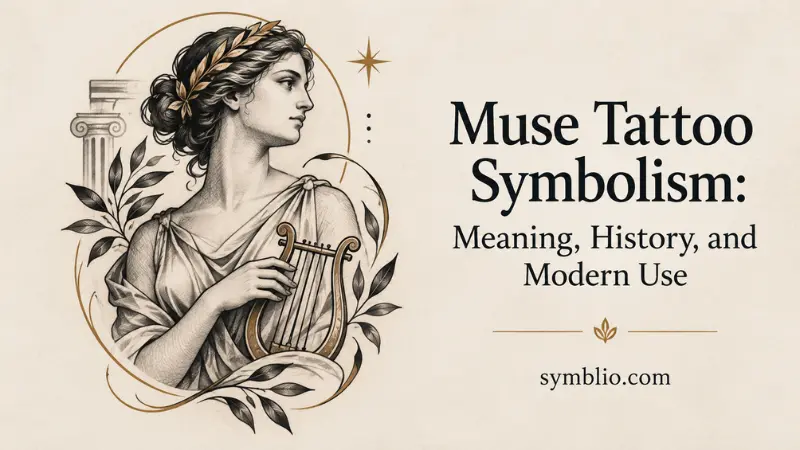
Muse tattoo symbolism centers on inspiration, creativity, admiration, and the person or idea that encourages someone to create. A muse can represent an artist’s source of ideas, a meaningful person, a personal creative identity, or a reminder to keep imagination active.
The word has ancient roots, but its modern tattoo meaning is much broader than its original mythological setting. In contemporary American culture, a muse tattoo may honor a relationship, celebrate artistic ambition, commemorate an influential person, or simply express a love of creativity.
The design can also carry different meanings depending on how it appears. A portrait of a mythological Muse suggests classical art and inspiration, while the single word “muse” may feel more personal and understated. Because tattoos remain with the wearer, many people choose the symbol to represent something they want to remember rather than something they want everyone else to understand.
Quick Answer
Muse tattoo symbolism commonly represents inspiration, creativity, artistic expression, and a person or idea that motivates someone to create. Historically, the concept comes from the Greek Muses, associated with poetry, music, learning, and the arts; today, the tattoo can also represent personal identity, admiration, memory, or an individual creative journey.
TL;DR
- A muse tattoo commonly represents creativity and inspiration.
- Greek mythology provides the symbol’s oldest major cultural foundation.
- Modern Americans may use it to honor a person or artistic identity.
- Portraits, words, and classical imagery create different interpretations.
- The symbol can suggest admiration without necessarily implying romance.
- Contemporary tattoos often make the meaning highly personal.
What a Muse Represents
A muse is traditionally understood as a person, figure, idea, or influence that inspires creative work. The concept is especially connected with artists, writers, musicians, poets, and other creators.
That meaning explains why the symbol works naturally as a tattoo. Someone may choose it as a reminder of the force that encourages them to write, draw, compose, perform, design, or think differently.
The muse does not have to be another person. A place, memory, personal experience, cultural tradition, or even an artistic discipline can serve as an individual’s inspiration.
For this reason, a muse tattoo can communicate several related ideas:
- Creativity
- Artistic ambition
- Inspiration
- Curiosity
- Imagination
- Admiration
- Personal influence
- Self-expression
The most important distinction is that the tattoo represents what inspires creation, rather than simply representing beauty or artistic talent.
Ancient Greek Roots of the Muses
The concept comes from ancient Greek mythology, where the Muses were divine figures associated with artistic and intellectual pursuits. Classical tradition eventually recognized nine Muses, each connected with a particular field.
Their associations included poetry, history, music, dance, astronomy, and other forms of cultural expression. Their presence in mythology helped establish the idea that inspiration could be personified.
The Muses were also connected with Apollo, a major Greek deity associated with music and the arts. Ancient stories and later artistic traditions frequently placed the Muses within an environment of poetry, music, performance, and learning.
This background matters for tattoo symbolism because a modern muse design can deliberately draw from classical imagery. A figure holding a lyre, scroll, book, or other artistic object may immediately suggest the ancient tradition.
At the same time, a modern tattoo does not have to reproduce Greek mythology literally. The word has evolved into a broader description of anything that stimulates creative thought.
How the Meaning Changed Over Time
The original Muses were mythological figures, but “muse” eventually became a common term for a source of artistic inspiration.
Artists in later European traditions frequently described particular people as muses. Sometimes the person served as a model, collaborator, emotional influence, or subject of artistic work. In other cases, the relationship was more complicated and involved admiration, friendship, romance, or intellectual influence.
This history helped transform the muse from a supernatural figure into a human concept.
Today, someone can call a person their muse without believing in mythology at all. The expression usually means that the person inspires ideas, emotions, artwork, writing, music, or another form of creative expression.
That shift gives the tattoo considerable flexibility. It can reference ancient mythology while still expressing a very modern idea.
What It Commonly Means in the United States
In modern American culture, a muse tattoo is most commonly associated with creativity and inspiration.
An artist might use the design as a statement about their creative life. A writer could see it as a reminder of storytelling and imagination. Someone outside the professional arts might choose it simply because a particular person, experience, or period of life encouraged them to think differently.
The symbol can therefore function as an identity marker.
For some Americans, it communicates something like, “Creativity is an important part of who I am.” For others, it means, “Someone or something changed the way I see the world.”
The meaning also fits comfortably within American tattoo culture, where short words and symbolic images are often adapted to personal experiences rather than fixed cultural definitions.
A Muse Can Represent a Person
One of the most personal interpretations is using the muse as a tribute to another person.
That person might be a friend, family member, teacher, partner, artist, mentor, or someone who influenced the wearer during an important period. The tattoo does not necessarily mean that the person is a romantic partner.
This distinction matters because popular culture sometimes portrays the muse as a beautiful romantic figure. Historically and personally, however, inspiration can come from many kinds of relationships.
A person may inspire someone through their ideas, personality, resilience, humor, artistic work, or way of seeing the world.
A tattoo can preserve that influence without explaining the entire story publicly.
When the Muse Represents Yourself
A muse tattoo can also be about the wearer rather than another person.
Someone may interpret the muse as their own imagination, creative discipline, or ability to find ideas in everyday life. In that case, the tattoo becomes a statement of creative independence.
This interpretation can be particularly meaningful for people who have spent years developing an artistic skill. The muse becomes less about waiting for another person to provide inspiration and more about recognizing creativity as an ongoing part of personal identity.
A person who writes, paints, photographs, designs, dances, makes music, or simply enjoys creative experimentation might use the symbol as a reminder to continue making things.
The tattoo can therefore represent both the source of inspiration and the decision to act on it.
Emotional Meaning Behind a Muse Tattoo
Emotionally, a muse tattoo can represent admiration, gratitude, curiosity, affection, or a lasting connection to an experience.
The feeling depends heavily on the story behind the tattoo. Someone honoring a former teacher may associate the symbol with gratitude. Someone remembering a close friend may connect it with affection and shared creativity. An artist may see it as a reminder of discipline and imagination.
The word can also express nostalgia.
If a particular person or period of life changed someone’s creative direction, the tattoo may preserve that influence even after circumstances change. It does not necessarily mean the relationship itself must remain unchanged.
This makes the muse a useful symbol for personal growth. What once inspired someone can become part of their history without determining their future.
Romantic and Non-Romantic Interpretations
A muse tattoo can sometimes have romantic associations, but romance is not an automatic part of its meaning.
In poetry, music, film, and popular culture, muses are often portrayed as people who inspire attraction as well as artistic expression. That association can influence how viewers interpret a tattoo.
However, a muse can just as easily represent a friend, mentor, relative, creative collaborator, or cultural figure.
The distinction depends on the tattoo’s surrounding imagery and the wearer’s story. A portrait paired with romantic imagery may suggest a personal relationship, while a classical figure holding a book or musical instrument may emphasize artistic inspiration.
Because the word has several established meanings, viewers should not assume that every muse tattoo represents romantic devotion.
Muse Tattoos and Artistic Identity
For many tattoo wearers, the strongest meaning is artistic identity.
A person does not have to make art professionally to connect with this interpretation. Creativity can include writing, photography, fashion, architecture, music, illustration, crafts, dance, filmmaking, or other forms of expression.
A muse tattoo may mark a commitment to continuing that creative practice.
It can also represent the belief that inspiration is found through observation. A city, landscape, conversation, book, memory, or everyday object can become the starting point for an idea.
In this sense, the tattoo encourages attentiveness. It represents the habit of noticing things that might otherwise be overlooked.
Common Muse Tattoo Designs
Different visual approaches change the impression of the tattoo.
| Design | Common Meaning in the USA | Associations | Overall Feel |
|---|---|---|---|
| Word “Muse” | Inspiration and creativity | Writing, art, personal identity | Minimalist |
| Greek Muse figure | Classical inspiration | Mythology, literature, arts | Traditional |
| Female portrait | Personal inspiration | Admiration, memory, artistic influence | Personal |
| Lyre or musical imagery | Musical creativity | Poetry, performance, classical culture | Artistic |
| Book or scroll | Knowledge and expression | Writing, history, learning | Intellectual |
| Abstract figure | Individual inspiration | Imagination, self-expression | Contemporary |
A simple word tattoo leaves more room for personal interpretation. A mythological figure makes the historical connection more obvious.
Color and Visual Style
Color can influence how people read a muse tattoo, although there is no universal color code for the symbol.
Black-and-gray designs often emphasize classical artwork, typography, or traditional tattoo aesthetics. Fine-line work can make the design feel delicate and literary, while bold designs may create a stronger graphic statement.
Gold or warm tones can suggest classical art, while blue or purple may give the image a dreamlike artistic appearance. These interpretations come from broader associations with color rather than from a fixed ancient rule about the Muses.
The most important factor is consistency between the visual style and the meaning the wearer wants to communicate.
Muse Symbolism in American Tattoo Culture
American tattoo culture frequently turns words, mythological figures, and artistic references into personal symbols.
A muse fits particularly well because it can operate at several levels. Someone can appreciate the Greek mythology while also attaching a completely individual meaning to the tattoo.
The design may appear on the forearm, shoulder, wrist, back, chest, or another location chosen for personal reasons. Placement itself does not establish a universal meaning.
Minimalist tattoos are particularly suitable for the word “muse” because it is short and visually balanced. Portraits and classical figures allow more room for detail and storytelling.
The choice between these approaches often depends on whether the wearer wants the reference to be immediately recognizable or privately meaningful.
Cross-Cultural and Religious Contexts
The original Muses belong specifically to ancient Greek religious and mythological tradition. They should not be treated as universal religious symbols shared identically across cultures.
Other cultures have their own traditions involving inspiration, artistic patrons, poets, divine knowledge, and creative revelation. Those traditions may resemble the idea of a muse without being historically identical to the Greek Muses.
In modern use, “muse” is usually secular. A person wearing a muse tattoo does not necessarily intend a religious statement.
Someone choosing a classical Muse figure for its mythology may appreciate the historical context, while another person may simply use the figure as a representation of creativity.
Psychological Meaning of Inspiration
From a psychological perspective, the muse can represent the relationship between external experience and creative thought.
People often generate ideas from what they observe, remember, imagine, and feel. A person who inspires an artist may provide a subject, challenge an assumption, introduce a new perspective, or evoke an emotion that becomes part of the creative process.
The muse therefore represents more than sudden inspiration.
It can symbolize attention, curiosity, memory, and the willingness to turn experience into expression. That interpretation makes the tattoo relevant even for people who do not consider themselves artists.
Common Misunderstandings About Muse Tattoos
One common misunderstanding is that a muse tattoo must represent a romantic partner. It does not.
Another misconception is that the muse is always a woman. The historical tradition often portrayed the Muses as female figures, and modern language has frequently continued that pattern, but anyone can serve as a muse.
The symbol also does not mean that the wearer lacks creativity of their own. A muse is traditionally a source or catalyst for creative work, not a replacement for the creator.
Finally, the tattoo does not have one official meaning. Mythological references provide historical context, but the wearer’s personal story determines the tattoo’s specific significance.
How Muse Symbolism Continues to Evolve
The meaning of the muse has moved from divine inspiration toward a broader idea of creative influence.
In earlier mythology, the Muses were supernatural figures associated with particular artistic and intellectual domains. Later artists used the term for people who inspired their work. Today, the concept can include people, memories, places, ideas, experiences, and even an individual’s own creative identity.
Digital culture has expanded this further. Artists, photographers, musicians, designers, and creators can find inspiration through online communities, visual archives, conversations, and global cultural exchange.
The modern muse is therefore less likely to be a single idealized figure. Inspiration can come from many directions, and the tattoo can acknowledge that complexity.
When a Muse Tattoo Has Personal Significance
The strongest muse tattoos usually have a specific story behind them.
Someone might choose the design after discovering a passion for art. Another person may dedicate it to someone who encouraged their creativity. Someone else may use it to mark the beginning of a new creative chapter.
Because the symbol is flexible, the wearer does not have to explain its meaning to everyone who asks.
That privacy can be part of its appeal. A simple word or classical figure can look decorative to an observer while carrying a much more specific memory for the person wearing it.
Is a Muse Tattoo Positive or Negative?
A muse tattoo is generally associated with positive ideas such as creativity, inspiration, admiration, imagination, and personal expression.
It can occasionally carry more complicated emotions. A muse might represent someone who inspired a person during a difficult period, a relationship that ended, or an experience that produced both positive and painful memories.
That does not make the symbol inherently negative. It simply shows how tattoos can preserve complicated personal histories.
The meaning ultimately depends on what the wearer wants the tattoo to remember.
FAQs
A muse tattoo commonly symbolizes inspiration, creativity, artistic expression, and admiration. It may represent a specific person, an artistic passion, or the wearer’s own creative identity.
Not necessarily. Although the word can have romantic associations, a muse can also be a friend, mentor, family member, artist, idea, or experience that inspires creativity.
Yes, the concept has its roots in the nine Muses of ancient Greek mythology. Modern tattoos may reference those figures directly or use the word “muse” in its broader contemporary sense.
Yes. Some people use the muse as a symbol of their own imagination, creativity, or commitment to making art. In this interpretation, the tattoo represents creative identity rather than another person.
A Muse tattoo specifically emphasizes inspiration, artistic or intellectual creativity, and cultural expression. A goddess tattoo can have a much broader meaning involving religion, mythology, femininity, power, protection, or a particular deity.
No. Anyone can use the symbol to represent a person, experience, or idea that encourages creativity or personal growth. The concept can apply to hobbies and everyday forms of expression as well as professional art.
It can. Someone may use it to remember a person, relationship, or period of life that inspired them but has since ended. The symbol itself remains associated with inspiration, while the personal story can add feelings such as nostalgia or loss.
Conclusion
A muse tattoo brings together an ancient mythological idea and a modern understanding of creativity. Its central meaning is inspiration: the person, experience, memory, or inner quality that encourages someone to create, explore, or see life differently.
Muse tattoo symbolism does not require one fixed interpretation. For one person, it may honor a meaningful relationship; for another, it may represent artistic ambition or a commitment to personal creativity. The Greek Muses provide its historical foundation, but contemporary tattoo culture gives the symbol room to become distinctly personal.
The most meaningful interpretation is often the simplest one: something inspired you enough to become part of your story.


