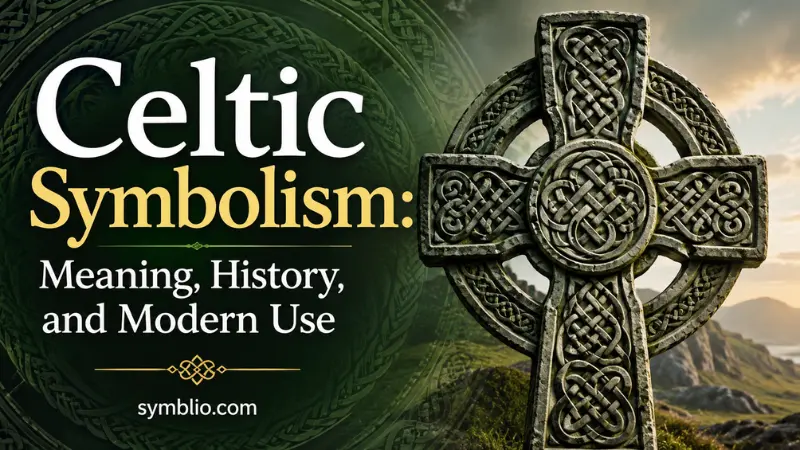
Celtic symbolism refers to the patterns, images, objects, and cultural ideas associated with peoples and traditions historically connected with the Celtic-speaking regions of Europe. In modern American culture, the term often brings to mind interlaced knots, spirals, crosses, the triskele, and imagery associated with Ireland, Scotland, Wales, and other Celtic regions.
The subject is more complicated than a collection of fixed symbols with one official meaning. Ancient Celtic-speaking communities were diverse, and much of what people now call “Celtic symbolism” comes from a mixture of Iron Age art, early medieval traditions, Christian imagery, later Celtic revival movements, and modern reinterpretation.
That history matters in the United States because Celtic imagery has become part of ancestry, jewelry, tattoos, weddings, family identity, holiday decoration, and popular design. For many Americans, these symbols function less as archaeological statements and more as visual expressions of heritage, continuity, family, spirituality, or connection to Celtic culture.
Quick Answer
Celtic symbolism commonly represents heritage, continuity, family connection, spirituality, and an enduring relationship with Celtic cultural traditions in modern American culture. Historically, Celtic art included spirals, animal forms, geometric patterns, and interlace, whose meanings varied by period and community rather than following one universal symbolic system.
TL;DR
- Celtic imagery often represents heritage, continuity, and cultural identity.
- Ancient Celtic art was diverse rather than one unified symbolic language.
- Spirals and triskeles have very old European artistic roots.
- Medieval Christian art transformed earlier motifs into new religious contexts.
- Americans often use Celtic designs to express ancestry and belonging.
- Modern tattoos and jewelry sometimes give symbols meanings they never historically had.
What Counts as Celtic Symbolism?
There is no single ancient catalog of Celtic symbols.
The people described by ancient Greek and Roman writers as Celts lived across a broad area of Europe, and archaeological evidence shows substantial regional variation. Researchers today are cautious about treating “the Celts” as one unified nation or culture. The British Museum describes the ancient Celtic world as a mosaic of communities that shared connections while maintaining distinct local identities.
Celtic symbolism is therefore best understood as a broad category rather than a single system. It can include artistic motifs from Iron Age Europe, early medieval Irish and Scottish art, Christian manuscripts, carved stones, metalwork, and later interpretations of Celtic heritage.
The most recognizable examples today include knotwork, spirals, triskeles, crosses, animals, and circular designs.
Ancient Roots and Early Celtic Art
Some of the oldest visual traditions later associated with Celtic art developed during the European Iron Age. One important style is known as La Tène art, named after an archaeological site in Switzerland.
La Tène designs often use flowing curves, spirals, repeating patterns, and stylized animals. Instead of presenting animals in straightforward naturalistic forms, artists could make bodies, heads, leaves, and abstract lines blend into one another. The British Museum notes that this art could appear almost transformable, with shapes becoming recognizable as different figures depending on how they were viewed.
The Turoe Stone in Ireland is a well-known example. Created during the Iron Age, it combines repeating curves, trumpet-shaped forms, triskeles, and stylized animal imagery.
This helps explain why Celtic-inspired designs can feel visually fluid. Their appeal does not depend on a single symbol carrying a dictionary definition. Much of the visual language comes from movement, repetition, balance, and transformation.
What Spirals Mean in Celtic Traditions
Spirals are among the oldest motifs associated with prehistoric art in Ireland and Scotland. Spiral carvings appear at ancient monuments that predate the historical Celtic period by many centuries.
That distinction is important. A spiral found at a prehistoric monument cannot automatically be described as an “ancient Celtic symbol.” The people who created those monuments lived long before historians could identify Celtic languages and cultures in the later historical sense.
Still, spirals became part of later artistic traditions associated with Celtic regions. They appear in Iron Age artwork and were subsequently reworked in early medieval designs. National Museums Scotland notes that spiral-based elements in early medieval art drew on much older Iron Age artistic traditions.
Today, people often interpret Celtic spirals as symbols of movement, cycles, growth, or interconnectedness. Those interpretations can be meaningful, but they should be treated as modern or generalized readings rather than universal ancient definitions.
The Triskele and the Meaning of Three
The triskele, or triskelion, consists broadly of three curved arms or spiraling forms radiating from a central point. Examples of triskele designs occur in Celtic-period archaeological material, including metalwork from Britain and Ireland.
The number three has acquired several interpretations in Celtic-inspired symbolism. Modern audiences may associate it with cycles, balance, movement, or three interconnected aspects of existence.
In early medieval Christian contexts, groups of three could also be interpreted through the Christian Trinity. National Museums Scotland discusses early medieval spiral designs grouped in threes and notes that they could be reimagined with Christian significance, including associations with Father, Son, and Spirit.
This illustrates an important feature of Celtic symbolism: an older visual form could acquire a new meaning when it entered a different religious or cultural setting.
Celtic Knots and Interlacing Designs
Few images are more strongly associated with modern Celtic identity than the Celtic knot.
These designs consist of lines that weave over and under one another, often forming continuous-looking patterns. Their visual effect naturally encourages modern interpretations involving connection, continuity, eternity, family, and relationships.
But the popular idea that every Celtic knot has a precise ancient meaning is misleading.
Interlace existed in several artistic traditions and was not exclusively Celtic. National Museums Scotland specifically cautions that knotwork is not uniquely Celtic and points to its presence in earlier classical art as well as Anglo-Saxon and early medieval northern European traditions.
The symbolism commonly attached to knots today is therefore partly an interpretation of their visual structure. A continuous line can suggest an unbroken relationship, while repeated crossings can evoke interconnected lives or generations.
That makes the knot especially suitable for modern family jewelry, wedding designs, and tattoos.
Celtic Christianity and the Cross
Christianity became an important part of the cultural history of Ireland, Scotland, and western Britain during the early medieval period. Monastic communities became centers of learning and artistic production, creating manuscripts, metalwork, stone carvings, and religious objects.
Celtic-inspired Christian art frequently combines crosses with interlace, spirals, animals, and geometric patterns. Archaeological evidence from sites such as Dunadd shows how Christian imagery could exist alongside regional artistic traditions.
The Celtic cross is particularly recognizable today. Its circular element is often interpreted in modern culture as a sign of eternity, the sun, or continuity, although individual historical examples do not necessarily carry one universal explanation.
For many Americans, however, the Celtic cross has a straightforward contemporary meaning: Christian faith combined with Irish or Scottish heritage.
Celtic Symbolism in the United States
Celtic imagery gained particular cultural importance in the United States through immigration and the development of Irish American and Scottish American communities.
Irish immigration expanded dramatically during the nineteenth century, especially around and after the Great Famine. Irish Americans brought traditions, music, religious practices, family stories, political identities, and visual symbols with them. During the American Civil War, for example, Irish American military units used Irish imagery as part of ethnic identity, including the harp alongside the American eagle.
Today, Celtic symbolism in the United States is often connected with ancestry rather than a single religious belief.
Someone might wear a knot pendant because their grandparents were Irish. Another person might choose a Celtic cross because Christianity and family heritage are both important. A family may use Celtic-inspired designs at a wedding to emphasize continuity between generations.
In this context, the symbol becomes a way of saying, “This heritage is part of who I am.”
Celtic Symbolism and Family Heritage
Family identity is one of the strongest modern American associations with Celtic imagery.
A knot can appear on a family ring, pendant, wedding invitation, coat of arms-inspired design, or memorial object. The continuous structure lends itself naturally to ideas about family relationships.
This does not mean ancient Celtic communities necessarily used every knot to represent family bonds. Instead, modern people see an understandable connection between an unbroken pattern and the idea of relationships continuing across generations.
The meaning can become particularly personal when the symbol accompanies a surname, birthplace, family story, or photograph. In those cases, the design works almost like a visual shorthand for ancestry.
Celtic Symbolism in Weddings and Relationships
Celtic-inspired designs are common in American wedding culture, particularly among couples with Irish, Scottish, or broader Celtic ancestry.
Interlacing patterns can symbolize two lives becoming connected, while circular forms can suggest continuity. Rings are especially compatible with this imagery because the shape itself has long been associated with an ongoing bond.
A couple might choose a Celtic knot for invitations, jewelry, ceremony decorations, or engraved gifts. The symbolism is usually modern rather than a direct reproduction of one ancient wedding custom.
The important point is that contemporary couples are often adapting historical-looking imagery to express their own understanding of commitment.
Why Celtic Symbols Appear in Tattoos and Jewelry
Celtic designs work especially well as tattoos and jewelry because they are visually adaptable.
Knotwork can be enlarged into a detailed tattoo or simplified into a small pendant. A triskele can fit naturally into a circular design. Crosses can incorporate interlace without becoming excessively complex.
For Americans, these designs often communicate one of four things: ancestry, family, spirituality, personal continuity, or appreciation for Celtic art.
A tattoo may also represent a connection to a particular family member rather than Celtic culture in general. Someone might select a knot after researching their family’s Irish background, while another person may simply appreciate the design’s visual message of connection.
The meaning comes from both the historical tradition and the wearer’s personal story.
Celtic Symbols in Modern American Culture
| Context | Meaning in the USA | Common Associations | Notes |
|---|---|---|---|
| Family jewelry | Heritage and connection | Irish or Scottish ancestry | Often personalized with names or dates |
| Weddings | Continuity and commitment | Knots, rings, crosses | Usually modern interpretation |
| Tattoos | Identity and personal heritage | Knots, triskeles, crosses | Meaning varies by wearer |
| Christian settings | Faith and heritage | Celtic crosses | Combines religious and cultural identity |
| St. Patrick’s Day | Irish identity | Green, harps, shamrocks, Celtic designs | Often broader than historical Celtic culture |
| Home décor | Heritage and aesthetics | Knotwork, crosses, carved designs | Can be cultural or decorative |
Celtic Revival and the Reinvention of Tradition
Many ideas people now consider traditionally Celtic were shaped or popularized during the Celtic revival movements of the eighteenth and nineteenth centuries and afterward.
The word “Celtic” itself changed meaning over time. According to the British Museum, Renaissance scholars revived the term, while later communities in places such as Ireland, Scotland, Wales, Brittany, Cornwall, and the Isle of Man used Celtic identity to emphasize distinctive local histories and cultural traditions.
The nineteenth-century revival helped create a romantic vision of Celtic antiquity. Artists, writers, political movements, and cultural organizations looked to the past when constructing modern identities.
This does not make modern Celtic symbolism “fake.” It means its history is layered. Some elements are ancient, others medieval, and others are products of modern cultural revival.
What Celtic Symbols Communicate Emotionally
Celtic-inspired imagery often communicates belonging.
A knot can suggest that a person sees relationships as interconnected. A cross can express both Christian faith and ancestral identity. A spiral can evoke change or movement. A triskele can represent balance or a three-part personal philosophy.
These meanings are psychological and personal rather than universal rules.
For someone reconnecting with family history, a Celtic symbol may provide a visible link to ancestors. For another person, the same design may simply represent endurance, connection, or appreciation for Celtic art.
That flexibility helps explain why Celtic imagery remains useful in contemporary personal expression.
Common Misunderstandings About Celtic Symbols
One of the biggest misconceptions is that every Celtic design has one documented ancient meaning.
Historical evidence rarely supports such certainty. Many symbols survive only through archaeological objects, while ancient Celtic communities left limited written explanations of their own visual traditions. Modern researchers therefore have to interpret designs through archaeology, comparisons, historical context, and later evidence.
Another misconception is that all Celtic symbols belong equally to Ireland, Scotland, Wales, and other Celtic regions. These cultures share linguistic and historical connections, but they also have distinct traditions.
It is also inaccurate to assume that every knot is ancient. Contemporary designers have created many patterns that look Celtic but have no known archaeological counterpart.
Understanding these distinctions does not diminish the symbolism. It makes the interpretation more honest.
Controversial Uses and Misappropriation
Celtic imagery can sometimes be separated from its cultural context and turned into a vague fantasy version of an ancient Celtic past.
This happens when modern designs claim precise meanings without historical evidence or treat all Celtic peoples as though they belonged to one uniform civilization.
There have also been cases in which Celtic-looking imagery has appeared alongside extremist or exclusionary identities. That association should not be generalized to Celtic symbols as a whole. A knot, cross, spiral, or triskele can have many legitimate cultural, religious, artistic, and personal uses.
The responsible approach is to distinguish the symbol itself from the ideology of a particular person or group using it.
How Celtic Symbolism Has Changed Over Time
The history of Celtic symbolism is less a straight line than a series of reinterpretations.
Iron Age artists developed distinctive visual traditions involving curves, spirals, animals, and complex compositions. Early medieval communities adapted some older artistic forms into new styles. Christian artists incorporated interlace and other regional motifs into religious objects and manuscripts. Later cultural movements revived the idea of a shared Celtic heritage.
Modern Americans have added another layer by connecting these designs with immigration, ancestry, family, weddings, tattoos, fashion, and personal identity.
That is why a Celtic knot purchased in an American jewelry store today cannot be understood solely through Iron Age archaeology. Its modern meaning comes from centuries of cultural development.
Celtic Symbolism Beyond Ireland
Celtic heritage extends beyond Ireland, even though Ireland is often the strongest association in American popular culture.
Scotland, Wales, Cornwall, Brittany, the Isle of Man, and other regions have their own relationships with Celtic languages and histories. The British Museum describes modern Celtic identity as connected with the local histories, traditions, languages, and cultures of these regions.
This broader perspective matters when interpreting Celtic imagery. A design marketed simply as “Celtic” may draw from Irish, Scottish, Welsh, medieval Christian, or generalized revival traditions.
For American audiences, the word has therefore become both a cultural label and a flexible design category.
How to Interpret a Celtic Symbol Today
The most useful question is not simply, “What does this Celtic symbol mean?”
Ask instead:
Where did the design come from? What period does it belong to? What culture used it? How is it being used now?
That approach prevents modern interpretations from being mistaken for ancient facts.
If a knot represents family to someone today, that is a valid personal meaning. If a Celtic cross represents Christian faith and Irish ancestry, that meaning can be culturally meaningful even if a particular historical cross had a different purpose.
Symbols evolve because people reuse them. Celtic imagery is a particularly clear example of how historical art can acquire new meanings without losing its connection to the past.
FAQs
In modern American culture, Celtic symbolism commonly represents heritage, family connection, continuity, spirituality, and cultural identity. The exact meaning depends on the particular design and the person using it.
Today, Celtic knots are often interpreted as symbols of connection, continuity, family, and relationships. However, historians cannot assign one universal ancient meaning to every knot pattern.
Some Celtic symbols became closely associated with Christianity, particularly in early medieval Ireland and Scotland. Other Celtic-inspired designs are secular and are used mainly for heritage, art, jewelry, or personal identity.
In contemporary American culture, a Celtic cross often combines Christian faith with Irish or Scottish heritage. Interpretations of the circle and other decorative elements vary, so it is better not to assume one explanation applies to every historical example.
Triskele designs are found in Celtic-period archaeological material, including Iron Age and later objects. Their exact meaning in ancient contexts is not always known, while modern interpretations often connect the three-part design with cycles, balance, or interconnectedness.
Celtic designs provide visually distinctive ways to express ancestry, family, spirituality, or personal identity. Their flowing patterns also adapt well to different tattoo sizes and styles.
No. Some motifs have ancient archaeological roots, while others were developed or popularized during medieval periods and later Celtic revival movements. Many contemporary designs are modern creations inspired by older Celtic art.
Conclusion
Celtic symbolism is best understood as a changing visual tradition rather than a fixed dictionary of ancient meanings. Its imagery developed through Iron Age art, early medieval culture, Christianity, cultural revival movements, immigration, and modern personal expression.
In the United States, Celtic designs most often function as reminders of heritage, family, faith, continuity, or cultural belonging. Their meanings become more accurate—not less meaningful—when historical evidence and modern interpretation are kept distinct.
A Celtic knot on a wedding ring, a cross passed through a family, or a spiral chosen for a tattoo can all carry personal significance. What connects them is the human habit of giving inherited images new meaning while keeping a visible link to the past.