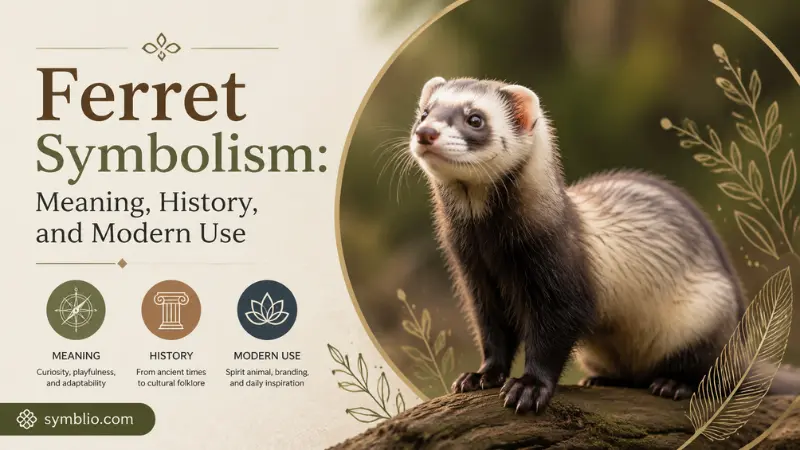
Ferrets are small, long-bodied members of the weasel family, known for their curiosity, agility, playfulness, and habit of investigating places other animals cannot easily reach. Ferret symbolism often grows from these observable traits rather than from a single ancient religious tradition.
In modern American culture, the ferret occupies an unusual place. It is both a working animal with a long history of hunting and pest control and a companion animal valued for its energetic personality. That combination gives the ferret several symbolic associations: curiosity, cleverness, adaptability, independence, mischief, and persistence.
The animal’s history also matters. Domestic ferrets have been associated with humans for more than two thousand years, particularly as animals used to pursue rabbits and rodents from burrows. Their relationship with people helps explain why the ferret can symbolize practical intelligence rather than simply wildness.
Quick Answer
Ferret symbolism commonly represents curiosity, cleverness, playfulness, adaptability, and resourcefulness in modern American culture, especially when the animal is used to express an inquisitive or mischievous personality. Historically, the ferret has also been associated with hunting, pest control, persistence, and the ability to uncover what is hidden.
TL;DR
- Ferrets commonly symbolize curiosity, cleverness, and playful independence.
- Their historical role connects them with hunting and practical problem-solving.
- American pet culture emphasizes their mischievous and social personalities.
- Their ability to enter tight spaces suggests persistence and investigation.
- The black-footed ferret adds themes of conservation and recovery.
- Negative meanings usually come from confusion with weasels or polecats.
What a Ferret Represents at a Glance
The easiest way to understand the ferret as a symbol is to look at the animal’s actual behavior.
Ferrets are naturally inquisitive. They explore holes, tunnels, objects, rooms, and anything else that catches their attention. They are also capable of moving through narrow spaces and following prey into burrows. These characteristics make curiosity one of the most natural symbolic meanings associated with the animal.
Their playful behavior adds another layer. A ferret can be energetic, social, mischievous, and surprisingly persistent. In symbolic language, that makes it a useful representation of someone who approaches life with curiosity instead of hesitation.
| Context | Meaning in the United States | Common Associations | Notes |
|---|---|---|---|
| Pet ownership | Playfulness and individuality | Curiosity, companionship | Often reflects personality more than tradition |
| Historical work | Resourcefulness | Hunting, persistence, usefulness | Connected to rabbit and rodent control |
| Tattoos and art | Clever independence | Mischief, exploration | Usually highly personal |
| Conservation | Survival and recovery | Resilience, protection | Especially relevant to the black-footed ferret |
| Personality symbolism | Inquisitiveness | Intelligence, unconventionality | Often chosen for distinctive character |
Curiosity and the Desire to Explore
Curiosity is probably the clearest symbolic quality associated with the ferret.
The animal’s physical behavior makes this association easy to understand. Ferrets investigate their surroundings with enthusiasm, often squeezing into small spaces and examining objects that seem unimportant to humans.
Symbolically, this can represent a person who wants to know how things work rather than accepting appearances at face value.
A ferret image may therefore suggest:
- asking questions
- exploring unfamiliar situations
- investigating hidden details
- intellectual curiosity
- willingness to experiment
- refusing to remain passive
This interpretation is especially fitting in modern culture, where animals are often used as shorthand for personality traits.
Cleverness, Resourcefulness, and Problem-Solving
Ferrets were not originally domesticated simply because people found them entertaining. Their practical value was important.
Historical evidence indicates that humans used ferrets to pursue rabbits and control rodents. Their narrow bodies and hunting behavior allowed them to enter burrows and force prey into the open. The English expression “ferret out” reflects this practical association with searching for something hidden.
That history gives the ferret a useful symbolic connection with resourcefulness.
Unlike symbols that represent intelligence through wisdom or scholarship, the ferret represents a more practical form of intelligence. It suggests figuring something out with the tools available, finding another route, and continuing when the obvious approach does not work.
For this reason, a ferret can symbolize someone who is inventive rather than conventional.
Mischief Without Necessarily Meaning Harm
Ferrets are frequently described as mischievous because of their playful behavior and tendency to investigate or carry away objects.
Even the animal’s name is connected to this reputation. The word “ferret” derives from the Latin furittus, generally interpreted as “little thief,” a reference likely connected to the animal’s habit of secreting small objects.
This creates an important distinction between mischief and wrongdoing.
In contemporary American pet culture, calling a ferret mischievous usually suggests humor, curiosity, and unpredictable behavior rather than criminality. A person might use a ferret image to communicate, “I’m playful and a little unconventional,” rather than “I’m dishonest.”
That difference matters when interpreting ferret imagery. The symbolism is often affectionate.
The Historical Roots of Ferret Symbolism
The historical record surrounding ferrets is older than the modern pet trade.
Researchers generally place ferret domestication more than 2,000 years ago, although the exact details are complicated because ancient writers did not always distinguish clearly among ferrets, polecats, and other mustelids. The domestic ferret is generally considered closely related to the European polecat.
Ancient writers including Aristotle and Strabo described animals resembling ferrets, with later evidence documenting their use in hunting. By the Roman period, ferrets were associated with driving rabbits from burrows.
This history helps explain why the animal’s symbolic meaning is strongly connected with searching, pursuit, usefulness, and persistence.
It is important, however, not to turn these historical facts into claims about a universal ancient “ferret meaning.” There is no single worldwide symbolic system in which the ferret has always represented one fixed idea.
Ferrets in Medieval and European Life
As ferreting developed in Europe, the animal became increasingly associated with rabbit hunting and practical rural life.
Historical illustrations show people using ferrets to drive rabbits from underground burrows. Their role was functional: the ferret entered the tunnel, while people or other animals waited outside to capture the rabbit.
This is significant symbolically because it adds an idea of working behind the scenes.
The ferret does not necessarily accomplish the entire task itself. Instead, it enters a difficult environment and changes what happens there. That makes it a useful metaphor for investigation, preparation, and finding solutions that are not immediately visible.
In symbolic art, this can translate into the idea of someone who works quietly but effectively.
What Ferrets Mean in Modern American Culture
The American interpretation of the ferret is different from its older European working-animal identity.
Ferrets became increasingly popular as companion animals in the United States during the late 20th century, especially from the 1980s and 1990s. That shift changed the animal’s cultural image from primarily practical hunter to playful household companion.
Today, Americans who keep ferrets often emphasize qualities such as:
- affection
- playfulness
- intelligence
- curiosity
- individuality
- social behavior
- energetic personality
Consequently, modern ferret imagery is more likely to communicate personality than hunting.
A ferret on a shirt, sticker, social-media profile, or piece of artwork may simply signal that the person identifies with being curious, unconventional, or playful.
Ferret Symbolism and Personal Identity
Animals can function as identity symbols because people recognize familiar personality traits in them.
Someone who identifies with the ferret may see themselves as curious but independent, social but unconventional, or playful without being careless.
The animal is particularly suited to people who do not want a traditional symbol such as an eagle, lion, wolf, or butterfly.
A ferret communicates something more specific: “I explore, I investigate, and I do things my own way.”
That makes it attractive for personal artwork and character design. It can represent individuality without requiring an elaborate mythology.
Ferrets in Tattoos, Art, and Personal Style
Ferret tattoos and artwork generally have personal rather than standardized meanings.
A person may choose a ferret because they own one, grew up with one, admire its personality, or associate it with a particular period of life. In those situations, the emotional meaning comes from the person’s experience rather than from a universal symbolic dictionary.
When symbolism is intentional, common interpretations include:
A playful ferret: humor, curiosity, energetic personality.
A ferret exploring: discovery, independence, investigation.
A ferret emerging from a tunnel: persistence or finding a way forward.
A pair of ferrets: companionship, social connection, or shared mischief.
A black-footed ferret: conservation, survival, and recovery.
The surrounding imagery usually matters more than the animal alone.
The Black-Footed Ferret and American Conservation
One important distinction is between the domestic ferret and the black-footed ferret, a native North American species.
The black-footed ferret is not simply another version of the common household ferret. It is a separate wild species historically associated with the Great Plains and closely connected ecologically with prairie dog colonies.
Its conservation history gives it a different symbolic meaning in the United States.
Black-footed ferrets were once believed to be extinct until a population was discovered in Wyoming in 1981. Conservation programs subsequently worked to breed and reintroduce them.
Because of this history, the black-footed ferret can symbolize:
- recovery after severe decline
- conservation
- protection of ecosystems
- persistence
- survival
- restoration
This symbolism is particularly appropriate in environmental education and wildlife conservation.
Emotional and Psychological Associations
Ferret symbolism often works at the level of personality rather than emotion.
The animal can suggest curiosity when someone feels motivated to explore. It can represent playfulness when the emphasis is on joy and activity. It can suggest independence when the animal is portrayed investigating its environment alone.
There is also an interesting psychological contrast between its small size and determined behavior.
A ferret does not look physically imposing. Yet its history shows an animal capable of entering spaces that larger animals cannot easily access. Symbolically, that can communicate the idea that effectiveness does not depend on size or appearance.
This makes the ferret a useful symbol for unconventional problem-solving: finding an approach that others overlook.
What Ferret Symbolism Means in Dreams
Dream symbolism is personal, so a ferret appearing in a dream does not have one scientifically established interpretation.
Still, traditional symbolic reading can use the animal’s recognizable characteristics as prompts for reflection.
A curious ferret might represent a desire to investigate something in waking life. A hidden or burrowing ferret could suggest attention toward something overlooked. A playful ferret might reflect spontaneity, while a difficult-to-catch ferret could symbolize an idea, goal, or situation that keeps demanding attention.
The important question is not simply, “What does a ferret mean?” but “What did the ferret represent to me?”
Someone who owns ferrets may naturally have a very different dream association from someone who has never encountered one.
Religious and Spiritual Interpretations
There is no widely recognized major religious tradition in which the ferret has a fixed, universally accepted sacred meaning.
That distinction is important because modern animal-symbolism websites sometimes assign spiritual meanings to animals as though those interpretations were ancient religious teachings. Such claims should be treated carefully.
A person can certainly use the ferret spiritually or personally to represent curiosity, adaptability, persistence, or attention to hidden things. But that is different from saying that a particular religion officially teaches that the ferret symbolizes those qualities.
In a personal spiritual context, the ferret may function as a reminder to investigate rather than assume, remain adaptable, and approach uncertainty with curiosity.
Positive and Negative Interpretations
Ferret symbolism is mostly positive in contemporary American pet culture, but the animal can carry less flattering associations as well.
The “little thief” meaning associated with the name can contribute to ideas of stealing or mischief. Historically, polecats and related animals were sometimes viewed negatively because of their scent, predatory behavior, or competition with humans. The distinction between ferrets, polecats, and weasels has also caused confusion in historical descriptions.
Modern audiences generally interpret these associations less harshly.
A mischievous ferret usually suggests a troublemaker with personality, not an immoral person. A ferret searching through a hidden place suggests curiosity rather than deception.
Context determines whether the symbolism feels playful or suspicious.
How Ferret Meaning Has Changed Over Time
The evolution of the ferret’s image can be summarized as a movement from utility to personality.
In earlier societies, its value came largely from what it could do. It hunted rabbits, controlled rodents, and worked alongside people. Its symbolic associations consequently centered on usefulness, pursuit, and practical intelligence.
In modern America, the household ferret is more often encountered as a companion animal. Its behavior becomes the main source of symbolism: playful, inquisitive, social, energetic, and slightly mischievous.
The black-footed ferret adds another modern layer, turning the animal into a symbol of conservation and ecological recovery.
The result is not one meaning but a collection of related meanings shaped by different relationships with the animal.
Common Misunderstandings About Ferret Symbolism
One common mistake is assuming that every animal has an ancient symbolic code shared across cultures.
Ferrets do not have one universal meaning. Their symbolism is largely derived from their behavior, history, language, and modern cultural associations.
Another mistake is confusing domestic ferrets with black-footed ferrets. The domestic animal has a long history of human use, while the black-footed ferret is a native North American wild species with a major conservation story.
Finally, ferret symbolism should not automatically be interpreted as deception because of the “little thief” association. In modern American culture, playful curiosity is usually a more appropriate interpretation.
FAQs
A ferret can be used in personal spiritual symbolism to represent curiosity, adaptability, persistence, and investigation. However, there is no single universally recognized religious doctrine assigning the ferret one fixed spiritual meaning.
A ferret tattoo often represents individuality, playfulness, curiosity, or a personal connection with the animal. Its meaning can become more specific through surrounding imagery, such as tunnels, flowers, books, or other animals.
There is no widely established American tradition that treats the ferret as a standard good-luck symbol. Some individuals may associate its resourcefulness and adaptability with positive outcomes, but that is a personal interpretation rather than a universal belief.
Not necessarily. The association comes partly from the Latin origin of the animal’s name, linked with the idea of a “little thief,” but modern American ferret imagery usually emphasizes mischief and curiosity rather than dishonesty.
In the United States, the black-footed ferret can symbolize conservation, survival, restoration, and ecological recovery. Its history of being considered extinct and later rediscovered makes it particularly meaningful in wildlife-protection contexts.
Yes. Ancient Greek and Roman-era writings contain descriptions believed by researchers to refer to ferrets or closely related animals, although identification can be uncertain because ancient terminology was not always precise. Clearer historical evidence connects ferrets with rabbit hunting and vermin control.
Conclusion
The most useful way to understand ferret symbolism is to connect the animal’s meaning to its actual history and behavior. Curiosity, cleverness, adaptability, playfulness, and persistence are natural interpretations because ferrets have long been valued for investigating difficult spaces and working closely with people.
In modern American culture, the ferret has moved beyond its traditional role as a hunting and pest-control animal. It is now also associated with companionship, individuality, humor, and unconventional personality, while the black-footed ferret carries an additional message of conservation and recovery.
The ferret ultimately symbolizes a particular kind of intelligence: the willingness to explore what others overlook and find a way through spaces that seem difficult to enter.