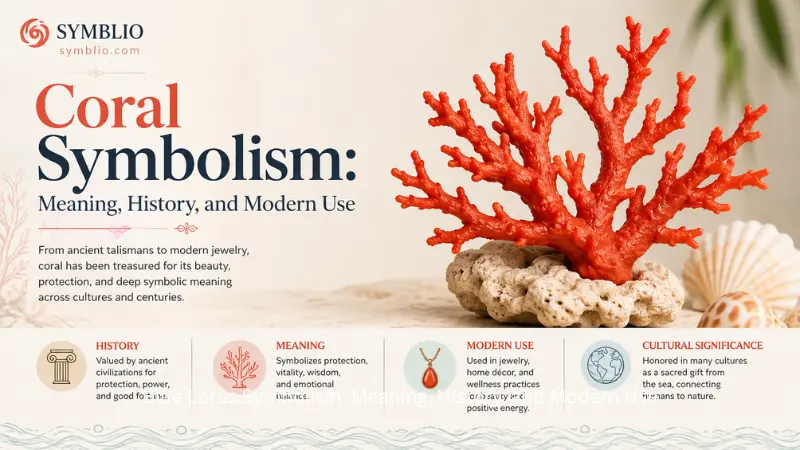
Coral is one of the ocean’s most recognizable natural forms, appearing as branching structures, rounded colonies, fans, and intricate reef formations. Coral symbolism commonly centers on protection, vitality, community, endurance, and connection to the sea. Its unusual appearance and vivid colors have also inspired associations with blood, family, growth, wealth, and transformation.
These meanings come from many different traditions rather than one universal belief. Red coral became a protective material in parts of the ancient Mediterranean world, while later societies used it in religious objects, royal regalia, jewelry, and personal adornment.
In modern American culture, coral appears in tattoos, coastal decor, fashion, jewelry, wedding colors, and environmental imagery. Its meaning has also changed as people have become more aware of coral reefs as living ecosystems that can be damaged by warming waters and other environmental pressures.
Quick Answer
Coral symbolism commonly represents protection, vitality, community, resilience, and connection to the ocean in modern American culture. Historically, coral has also been associated with protective amulets, blood and life, social status, spiritual beliefs, and valuable trade materials.
TL;DR
- Coral commonly symbolizes protection, vitality, community, and ocean connection.
- Red coral historically served as a protective material in Mediterranean cultures.
- Its branching form can suggest family, growth, and interconnected relationships.
- Coral jewelry has represented prestige in several distinct cultural traditions.
- Tattoos often express endurance, ocean identity, or environmental awareness.
- Modern coral imagery can also represent ecological vulnerability.
What Coral Is and Why Its Appearance Influences Its Meaning
Coral may resemble a colorful underwater plant or mineral, but living corals are animals. Tiny organisms called polyps often live together in colonies, and some species gradually produce the hard structures that help form coral reefs.
That natural structure strongly influences modern interpretations.
A reef develops from countless small organisms living together. Because of this, coral can work as a visual metaphor for community, cooperation, family, and collective strength. One small organism may seem insignificant, yet together coral colonies can create complex habitats that support many other forms of marine life.
Its branching shape also resembles roots, trees, antlers, veins, and family diagrams. In personal symbolism, this can suggest ancestry, expanding relationships, generations, or different paths growing from a shared beginning.
These interpretations do not all come from ancient traditions. Many developed from modern observations of coral’s natural form and ecological role.
What Coral Commonly Symbolizes Today
Coral has several meanings in modern American culture, depending on where and how it appears.
| Context | Common Meaning | Typical Associations | Notes |
|---|---|---|---|
| Jewelry | Protection and vitality | Red, warmth, strength | Often influenced by older traditions |
| Tattoos | Connection and endurance | Ocean, family, survival | Highly personal meaning |
| Coastal decor | Sea and relaxation | Beaches, reefs, summer | Usually decorative |
| Environmental imagery | Vulnerability and conservation | Bleaching, reefs, biodiversity | Common in modern awareness campaigns |
| Branching coral | Community and connection | Family, ancestry, growth | Often a modern metaphor |
| Coral color | Warmth and friendliness | Pink, orange, energy | Different from natural coral symbolism |
Protection has some of the strongest historical roots. Community, resilience, and interconnectedness are more closely tied to contemporary interpretations of reef biology.
Ancient Mediterranean Associations With Blood and Transformation
Red coral attracted attention in the Mediterranean world because its color and branching form made it unlike ordinary stone, shell, or plant material.
Classical mythology offered imaginative explanations for its appearance. One famous story connected the creation of red coral with Perseus and Medusa. In the tale, sea vegetation hardened and turned red after contact with Medusa’s blood.
The story helped connect coral with blood, transformation, danger, and protective force.
Its appearance may also have contributed to these associations. Bright red coral can resemble blood vessels or branching veins, making connections with life and physical vitality easy to understand.
However, mythological explanations should not be confused with scientific descriptions of coral formation. Their importance lies in showing how earlier cultures interpreted an unusual natural material.
Why Red Coral Became Associated With Protection
Protection is one of coral’s oldest and most persistent symbolic meanings.
In parts of the ancient Mediterranean world, coral was worn or carried as an amulet. Adults sometimes placed coral ornaments on children because they believed the material could help guard against misfortune, illness, or harmful supernatural influences.
Red may have strengthened this reputation. Across many cultures, the color has been connected with blood, life, danger, strength, and vitality. Coral combined that striking color with an unusual organic shape and an origin beneath the sea.
Over time, a coral branch could therefore function as more than decoration. It could communicate wishes for safety and well-being.
Modern people do not need to share older supernatural beliefs to use the same symbolic idea. A coral necklace passed from a parent to a child, for example, may represent care, protection, or family continuity.
Coral in Christian Art and European Childhood Traditions
Older protective meanings continued to influence European culture after Christianity became dominant.
Coral occasionally appeared in religious art, particularly in images involving the Christ Child. Red coral could retain its familiar protective association while also taking on Christian interpretations connected with blood, sacrifice, and the future Passion of Christ.
Children also continued to wear coral ornaments in parts of Europe.
This illustrates an important feature of symbolism: meanings often accumulate instead of replacing one another completely.
A single object may retain an older folk belief while receiving a newer religious interpretation. Coral therefore moved between domestic protection, religious imagery, personal jewelry, and decorative use without developing one fixed meaning everywhere.
Coral as a Symbol of Status and Authority in Benin
Coral has also carried strong associations with wealth, authority, and social rank.
In the historic Kingdom of Benin, located in present-day Nigeria, coral beads became especially important within royal culture. Rulers and high-ranking members of the court wore elaborate coral bead regalia as visible markers of prestige and authority.
The material’s value was linked partly to trade and scarcity. Possessing large quantities of coral could communicate access to important commercial networks and elite resources.
Within Benin culture, coral also became connected with the sea and religious ideas surrounding prosperity and spiritual authority.
This symbolism should not be generalized as a single “African meaning.” Africa includes a vast range of peoples and traditions. Coral’s association with royal authority is especially significant in the specific historical context of Benin court culture.
Coral in Asian Jewelry and Spiritual Traditions
Coral appears in several Asian traditions as well, although its meaning varies considerably.
In Tibetan and Himalayan jewelry, coral has often appeared alongside turquoise, metalwork, pearls, and other valued materials. In some settings, people associated these materials with protection, health, prosperity, spiritual practice, or cultural identity.
Coral also appears in religious ornaments and ceremonial objects from Himalayan regions.
In some South Asian astrological systems, red coral is associated with the planet Mars. People who follow these traditions may wear it according to particular astrological beliefs concerning courage, energy, confidence, or personal circumstances.
These examples should remain culturally separate. There is no single universal “Asian coral meaning.” Different communities gave coral meanings based on their own religious practices, trade systems, aesthetics, and local traditions.
What Coral Commonly Means in the United States
For many Americans today, coral first symbolizes the ocean and coastal life.
Divers, sailors, surfers, marine scientists, aquarium enthusiasts, and coastal residents may use coral imagery because it represents a personal connection with the sea.
Others associate it with tropical travel, beaches, warm climates, or memories of coastal places.
Protection remains another possible meaning, especially in families that maintain Mediterranean, European, or other cultural jewelry traditions. An inherited piece of red coral may represent family continuity even when the wearer does not believe it has supernatural powers.
Coral also increasingly symbolizes community. A reef composed of many interconnected organisms provides an intuitive metaphor for people working together, supporting one another, or belonging to a larger family or social network.
Environmental awareness has added yet another layer. Healthy coral can represent biodiversity and ecological balance, while damaged or bleached coral can represent environmental stress and loss.
Coral in Native American and Southwestern Jewelry
Coral has also become part of important jewelry traditions in the American Southwest.
Some Diné, or Navajo, jewelers and other Native artists have incorporated coral into silverwork alongside turquoise, shell, lapis, and other materials.
Red coral creates a striking contrast with turquoise, particularly when combined with silver. Depending on the artist and piece, it may contribute color, personal significance, cultural continuity, artistic experimentation, or the value associated with imported materials.
However, it would be inaccurate to claim that coral has one universal “Native American meaning.”
Native nations have distinct histories, beliefs, and artistic traditions. Even within one community, individual artists may use coral differently.
The safest interpretation comes from the specific object, artist, community, and context rather than a generalized symbolism chart.
Emotional and Psychological Meaning of Coral
Coral combines two qualities that seem contradictory: strength and sensitivity.
Large reefs can appear permanent and solid, yet the living organisms responsible for them depend on specific environmental conditions. When those conditions change significantly, coral communities can suffer.
That contrast gives coral a useful modern psychological meaning: strength that still requires care.
The idea can apply to relationships, families, communities, or individuals. Something can be resilient without being indestructible.
Coral’s branching form can also communicate memory and ancestry. A central structure dividing into many connected branches resembles the way families and relationships expand through generations.
For someone choosing coral as a personal symbol, it may therefore represent growing outward while remaining connected to a shared origin.
What Coral Tattoos Can Symbolize
Coral tattoos usually have personal rather than standardized meanings.
A realistic reef tattoo may express a strong relationship with marine life. Someone who dives, studies the ocean, grew up near the coast, or feels attached to a particular island or shoreline may use coral as a permanent reminder of that connection.
Branching coral can represent family, friendships, or interconnected lives.
Some people may choose damaged coral beside healthy new growth to represent recovery after hardship. Others combine coral with fish, turtles, shells, waves, or sea plants to symbolize an entire marine ecosystem.
Red coral designs may also borrow from older protective traditions, giving the tattoo the symbolic role of an amulet.
Environmental themes are increasingly relevant as well. A tattoo showing healthy and bleached coral together may express concern about changing ocean conditions rather than personal protection or family identity.
Coral in Jewelry, Fashion, Weddings, and Decor
Not every modern use of coral carries spiritual or historical meaning.
Coral-shaped earrings, necklaces, prints, sculptures, fabrics, and household objects often simply create a coastal aesthetic. In beach houses and resort-inspired interiors, branching coral immediately suggests the sea.
The coral color has also developed symbolism independent of the marine organism.
Usually described as a warm blend of pink and orange, coral can suggest friendliness, warmth, summer, optimism, sociability, and playful elegance.
Because of those qualities, coral tones often appear in fashion, cosmetics, branding, wedding palettes, floral arrangements, and interior design.
A coral-colored wedding invitation does not necessarily carry the protective symbolism of historical red coral jewelry. The color and the natural material overlap visually, but their meanings should not automatically be treated as identical.
Coral as a Modern Environmental Symbol
One of the biggest changes in coral symbolism has come from modern environmental awareness.
Earlier societies often valued coral mainly as an unusual and attractive material taken from the sea. Today, many Americans first encounter coral through documentaries, science education, reef conservation campaigns, aquariums, and discussions about ocean health.
This has transformed its symbolic role.
A colorful living reef can represent biodiversity, balance, cooperation, and natural abundance. A pale or damaged reef can communicate ecological stress, habitat loss, or environmental vulnerability.
That difference has made coral especially effective in environmental imagery.
The symbol has therefore shifted in an interesting way. Historically, people often sought protection from coral or believed coral offered protection. Modern environmental culture increasingly emphasizes the need to protect coral itself.
Common Misunderstandings About Coral Symbolism
One mistake is treating every traditional belief about coral as scientifically established.
Historical communities genuinely used coral for protection, health, luck, and spiritual purposes. Those practices are important parts of cultural history, but they do not prove that coral can medically protect or heal someone.
Another mistake is combining unrelated cultures.
A Roman child’s amulet, Benin royal beadwork, Himalayan jewelry, and contemporary Southwestern silverwork do not carry identical meanings simply because they contain coral.
Responsible interpretation requires context.
There are environmental concerns as well. Natural coral comes from marine ecosystems, and the collection and trade of some species are regulated or restricted. Vintage, antique, imitation, reconstructed, or coral-inspired materials may therefore be preferable choices for people who want the appearance or symbolism without encouraging harmful harvesting.
How Coral Symbolism Has Evolved
Coral’s symbolism changed as people encountered it through different cultural circumstances.
In the ancient Mediterranean, its striking red color, marine origin, and unusual form encouraged myths and protective beliefs. Later European societies incorporated similar ideas into childhood jewelry and Christian imagery.
Elsewhere, coral entered trade networks and acquired new meanings. In Benin, it became closely associated with royal prestige and authority. In Himalayan regions, it appeared in jewelry and religious objects. In the American Southwest, artists incorporated it into distinctive jewelry traditions.
Modern environmental awareness has introduced one of the newest interpretations.
Coral is increasingly viewed not simply as a valuable object from the ocean but as part of a living ecosystem.
That change has expanded its meaning from personal protection and status to community, ecological responsibility, vulnerability, and conservation.
FAQs
Coral has historically been treated as a protective or luck-associated material in several cultures, especially around the Mediterranean. Today, people may wear it for traditional, sentimental, or decorative reasons without believing it literally changes their luck.
Red coral commonly represents vitality, protection, courage, blood, and life. In particular traditions, it can also communicate wealth, authority, religious identity, or social status.
A coral tattoo may represent ocean connection, community, family, endurance, personal growth, or environmental awareness. Its exact meaning depends on the wearer, design, color, placement, and accompanying marine imagery.
Coral is not a universal symbol of one religion. It has appeared in Christian artwork, Himalayan religious objects, South Asian astrological traditions, and other cultural settings with different meanings.
Yes. Protection is one of coral’s strongest historically documented symbolic associations, particularly with red coral in Mediterranean traditions. Modern jewelry may preserve that meaning in a personal or sentimental way.
Coral itself is usually associated with positive or neutral ideas. However, bleached or damaged coral can symbolize ecological decline, environmental stress, vulnerability, and loss.
Naturally pale or white coral may suggest calmness, simplicity, purity, or the sea in modern decorative use. When whiteness represents coral bleaching, however, it communicates ecological stress rather than purity.
Conclusion
Coral has accumulated meaning because people have encountered it in many different ways: as a marine organism, a valuable material, a protective amulet, an artistic resource, a marker of status, and part of a complex ecosystem. Protection has especially strong historical roots, while community, ancestry, ocean connection, resilience, and conservation have become important modern interpretations.
In the United States today, coral symbolism brings these older associations together with contemporary experiences. A coral branch may represent family in a tattoo, protection in inherited jewelry, coastal life in home decor, or environmental vulnerability when shown as part of a damaged reef.
Its meaning ultimately reflects the nature of coral itself: countless small lives can create something strong and interconnected, but that strength still depends on the conditions that allow the community to survive.