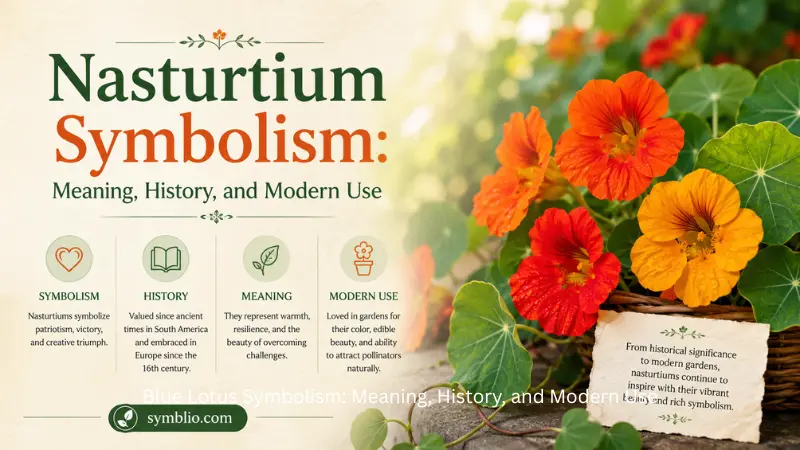
Nasturtiums are easy to recognize by their rounded leaves, trailing or climbing stems, and vivid flowers in shades of orange, red, yellow, cream, and peach. Nasturtium symbolism traditionally centers on patriotism, victory, courage, and determination, while modern interpretations often add resilience, individuality, creativity, and cheerful confidence.
The flower’s symbolic history is unusual because several of its best-known meanings developed after the South American plant reached European gardens. Its shield-like leaves and helmet-shaped flowers inspired comparisons with trophies and equipment associated with battle.
During the nineteenth century, flower-language traditions strengthened these associations and gave nasturtiums a particularly clear connection with patriotism. Today, Americans are more likely to encounter the flowers in gardens, botanical art, tattoos, edible dishes, and decorative designs, allowing older meanings to mix with more personal ones.
Quick Answer
Nasturtium symbolism commonly represents patriotism, victory, courage, determination, and confident individuality. Historically, the flower became associated with battle trophies and patriotism, while modern interpretations also connect it with resilience, creativity, and overcoming challenges.
TL;DR
- Traditional flower language connects nasturtiums with patriotism.
- Their botanical name helped create associations with victory.
- Shield-shaped leaves contributed to their martial imagery.
- Modern meanings include resilience, confidence, and individuality.
- Tattoos often symbolize personal victory or overcoming hardship.
- Bright colors give the flower an energetic, optimistic character.
What Nasturtiums Look Like and Why Their Shape Matters
Garden nasturtiums usually have nearly circular leaves attached to long stalks. Their flowers have five petals and a noticeable spur, and varieties can produce red, orange, yellow, cream, peach, or mixed-color blooms.
Some plants stay compact, while others trail over containers, climb supports, or spread across garden beds.
Their appearance played an important role in the development of their symbolism. The broad round leaves reminded early observers of shields. The unusual flowers could be imagined as helmets.
When red and orange blossoms appeared among those shield-like leaves, the plant lent itself naturally to military comparisons.
That resemblance helped connect nasturtiums with battle trophies, triumph, courage, and victory.
Their physical character also supports more recent interpretations. Nasturtiums tend to look lively rather than formal. They spill over garden edges, spread through beds, and produce bright flowers that stand out without appearing delicate or restrained.
For modern gardeners, those qualities can suggest independence, enthusiasm, and an ability to flourish without excessive fuss.
What Nasturtiums Commonly Symbolize
No flower has one definition that applies to every culture, period, or person. Nasturtiums are no exception.
Their strongest traditional meaning is patriotism, but several related interpretations have developed from the plant’s name, appearance, color, and growth habits.
| Context | Common Meaning | Why It Fits | Notes |
|---|---|---|---|
| Traditional flower language | Patriotism | Established nineteenth-century association | Strongest historical meaning |
| Battle imagery | Victory and courage | Leaves resemble shields | Connected with botanical naming |
| Modern personal symbolism | Resilience | Vigorous, adaptable growth | Contemporary interpretation |
| Bright floral colors | Confidence and enthusiasm | Warm colors feel energetic | Based largely on modern color symbolism |
| Tattoos | Overcoming challenges | Victory becomes personal achievement | Meaning varies by wearer |
| Garden and food culture | Vitality and creativity | Decorative and edible plant | Mostly modern association |
The distinction between historical and modern meanings matters.
Patriotism has a clear basis in older flower-language traditions. Victory and courage developed through the plant’s association with trophy imagery.
Resilience, creativity, independence, and optimism are better understood as contemporary interpretations rather than ancient definitions.
Why Nasturtiums Became Symbols of Victory
One of the most interesting parts of the flower’s meaning comes from its botanical name, Tropaeolum.
The name is connected with the Latin idea of a trophy. In the ancient world, a trophy could refer to captured weapons or armor displayed after victory.
When the plant was formally named, its appearance encouraged this comparison. Its rounded leaves resembled shields, while its flowers were compared with helmets.
This does not mean ancient Romans used nasturtiums themselves as victory flowers. Garden nasturtiums originated in the Americas, so the connection was created later through botanical naming and visual comparison.
That difference is important because modern symbolism articles sometimes blur the two ideas.
Nasturtiums were not necessarily ancient Roman ceremonial flowers. Instead, people looking at the plant centuries later saw imagery that reminded them of classical battle trophies.
From there, victory became a natural symbolic interpretation.
Today, the meaning does not need to involve warfare. A nasturtium can represent finishing a difficult degree, recovering from a setback, surviving a difficult period, succeeding in a career, or accomplishing a demanding personal goal.
Victorian Flower Language and Patriotism
The nineteenth century gave flowers unusually specific social meanings.
Flower dictionaries and gift traditions allowed people to associate certain plants with qualities, feelings, and messages. Within this system, nasturtiums became strongly associated with patriotism.
Older sources sometimes referred to the plant as Indian cress, reflecting historical European naming practices rather than its actual relationship to India.
The flower’s patriotic meaning likely worked well because it already carried visual associations with shields, helmets, trophies, and victory.
In Victorian-style flower language, patriotism did not necessarily imply modern political partisanship. It could simply represent devotion to one’s country, loyalty to home, or pride in national identity.
That distinction still matters today.
Someone interested in historical floriography may choose nasturtiums specifically because of this patriotic message. Someone unfamiliar with flower dictionaries, however, may see the same bloom simply as cheerful, bold, or energetic.
Nasturtiums in Modern American Culture
Most Americans today are more likely to encounter nasturtiums in gardens than in flower dictionaries.
They are commonly grown in containers, garden borders, raised beds, herb gardens, edible landscapes, and cottage-style plantings. Their flowers and leaves are edible and have a noticeable peppery flavor.
That everyday use has changed how the plant feels symbolically.
Rather than appearing formal or ceremonial, nasturtiums often suggest home gardens, summer color, practical beauty, experimentation, and abundance.
Their older meanings have not disappeared. A person who studies flower symbolism may still associate them with patriotism or victory.
Modern settings simply create additional interpretations.
A gardener may see resilience.
An artist may see color and individuality.
A cook may associate the flower with creativity and freshness.
Someone choosing a tattoo may use it to represent triumph over a difficult experience.
Modern American meaning therefore depends strongly on context.
Why Nasturtiums Can Represent Resilience
Resilience is not the most historically documented nasturtium meaning, but it fits the plant’s behavior well enough to have become a natural modern interpretation.
Nasturtiums are known as relatively approachable garden plants. They can grow in containers or beds, and many varieties trail or spread freely.
They also tend to perform well without the heavily managed conditions required by some ornamental flowers.
That makes them easy to interpret symbolically as plants that make the most of what they have.
In personal symbolism, this can represent several qualities.
Adaptability means continuing to function when circumstances change.
Persistence suggests refusing to stop after difficulty.
Self-reliance can reflect confidence without constant external support.
Resourcefulness fits a plant that provides both visual beauty and edible leaves and flowers.
A person choosing the flower after a difficult period may therefore use it as a reminder that survival does not have to look solemn. Resilience can also be colorful, active, and expressive.
Nasturtium Color Meanings
Color can change the emotional impression of a nasturtium, although elaborate color charts should not be mistaken for ancient or universal flower-language rules.
Many modern interpretations rely on broader color symbolism.
Red Nasturtium
Red can emphasize courage, determination, passionate commitment, and strong motivation.
Because nasturtiums already carry associations with victory, red can make that meaning feel especially decisive.
A red bloom may suit someone who sees the flower as a symbol of persistence through conflict or challenge.
Orange Nasturtium
Orange often communicates enthusiasm, confidence, warmth, and creative energy.
An orange nasturtium can work particularly well as a symbol of joyful achievement rather than serious triumph.
It may also suggest a person who enjoys standing out rather than blending in.
Yellow Nasturtium
Yellow gives the flower a lighter emotional tone.
It commonly suggests optimism, friendship, sociability, cheerfulness, and summer warmth.
When given as a gift, yellow nasturtiums can feel encouraging rather than romantic.
Peach and Cream Nasturtiums
Softer shades such as peach and cream can suggest appreciation, friendliness, gentle encouragement, and understated warmth.
They soften the plant’s stronger associations with battle and victory.
Burgundy and Dark Red Nasturtiums
Darker flowers create a more mature or serious impression.
They may represent resolve, endurance, conviction, or achievement gained through sustained effort.
These interpretations are useful for modern design and personal symbolism, but they should remain flexible rather than being treated as fixed historical rules.
South American Origins of the Nasturtium
Garden nasturtiums come from South America, and the larger Tropaeolum group is native to parts of Central and South America.
European observers encountered and described these plants during the period of exploration and exchange between the Americas and Europe.
They later became established as ornamental and edible plants in European gardens.
Historical English names included Indian cress, a label reflecting the older European habit of referring broadly to American plants through terms connected with the “Indies.”
The plant’s peppery taste also contributed to comparisons with cress.
Its journey from an American plant to a European garden favorite eventually created the conditions for its later symbolic meanings.
This sequence is important because the plant’s biological origin and its Victorian symbolic meanings come from different historical contexts.
Andean Origins Should Not Be Turned Into Invented Spiritual Claims
A South American origin does not automatically prove that a plant carried one universal ancient spiritual meaning.
Indigenous societies across South America developed diverse relationships with plants through food, medicine, cultivation, ceremony, ecology, and everyday life. Those traditions cannot responsibly be reduced to one convenient symbolic definition without specific evidence.
Modern symbolism sometimes combines several unrelated layers.
The plant’s South American origin may be placed beside European battle imagery, Victorian flower language, modern spirituality, and contemporary color psychology as though every meaning developed together.
They did not.
A more accurate interpretation keeps the layers separate.
The plant’s American origins belong to its botanical and cultural history.
The plant’s trophy symbolism developed through European scientific naming.
During the nineteenth century, its patriotic associations became especially visible through the language of flowers.
More recently, resilience, creativity, and personal transformation have emerged as modern symbolic interpretations.
This separation prevents attractive stories from being mistaken for established history.
Nasturtiums as Symbols of Practical Beauty
One reason nasturtiums feel different from many ornamental flowers is that they are also edible.
Both their leaves and flowers can be used in food, where they contribute a peppery flavor. They may appear in salads, garnishes, herb dishes, and other culinary presentations.
Young seed pods have also been used in preparations resembling capers.
That combination of beauty and usefulness gives the flower another modern symbolic layer.
A nasturtium does not have to choose between being decorative and practical.
For some people, that makes it an appealing symbol of resourcefulness.
It can also represent creativity that has a purpose, beauty that contributes something useful, or a personality that is expressive without being impractical.
This interpretation works especially well in kitchen gardens, homesteading imagery, botanical illustration, and designs celebrating homegrown food.
Nasturtium Tattoo Meaning
A nasturtium tattoo can adapt the flower’s older meanings to a person’s private history.
Someone may choose it after completing something difficult, recovering from adversity, leaving an unhealthy situation, rebuilding a career, or becoming more confident.
In that context, victory does not mean defeating another person. It means refusing to remain defeated by circumstances.
A nasturtium tattoo may therefore symbolize:
- personal victory
- courage during change
- resilience after hardship
- loyalty to home or heritage
- independent personality
- creative confidence
- determination to keep growing
The flower can also have entirely personal significance.
Someone may remember nasturtiums from a grandparent’s garden, a childhood home, a wedding, a favorite place, or another meaningful period.
Historical symbolism can enrich a tattoo’s meaning, but it does not control it.
The wearer’s own association remains the most important interpretation.
Nasturtiums in Art and Decor
Nasturtiums have long appealed to artists because their form is visually distinctive.
Their nearly circular leaves create repetition and rhythm, while bright flowers provide sharp points of color among the green foliage.
That visual combination works naturally in botanical paintings, textile patterns, stationery, wallpaper, kitchen decor, garden photography, and contemporary floral illustration.
In decorative settings, the plant’s military symbolism is usually much less obvious.
Instead, it often communicates warmth, informality, creative energy, and summer abundance.
An orange nasturtium print may make a room feel lively.
A vintage botanical illustration can suggest nostalgia or appreciation for gardening.
A modern tattoo design may emphasize the contrast between delicate petals and confident growth.
This ability to shift meaning according to context explains why the plant can feel traditional and contemporary at the same time.
Spiritual Meaning of Nasturtiums
Nasturtiums do not have one widely established religious meaning comparable with flowers such as the lotus or lily.
Modern spiritual interpretations sometimes associate them with motivation, renewal, courage, protection, personal strength, or emotional growth.
Those meanings are better understood as personal metaphors than as teachings belonging to a major religious tradition.
The flower nevertheless offers several useful symbolic qualities.
Its spreading growth can represent continued progress.
The vivid color may suggest renewed enthusiasm, while the plant’s historical connection with victory can become a metaphor for overcoming fear or self-doubt.
Because it is also edible, the plant can symbolize a union of beauty and nourishment.
For someone using flowers in personal reflection, these interpretations can be meaningful without needing to be presented as ancient spiritual facts.
Common Misunderstandings About Nasturtium Symbolism
One common misunderstanding concerns the plant’s name.
Garden nasturtiums belong to the genus Tropaeolum. Watercress, which has the botanical name Nasturtium officinale, belongs to a different botanical group.
The shared terminology can be confusing because both plants are associated with a peppery taste.
Another misconception is that nasturtiums were literal ancient Roman victory flowers.
Their association with classical trophies came later through the name Tropaeolum and the resemblance of their leaves and flowers to shields and helmets.
It is also misleading to treat every modern color meaning as established Victorian flower language.
Red, orange, yellow, peach, and burgundy interpretations often draw from modern color associations rather than documented nineteenth-century rules.
Finally, the flower’s historical association with patriotism should not automatically be interpreted as aggressive nationalism or support for a particular political movement.
Traditional flower language used patriotism more broadly as devotion to one’s country or homeland.
How Nasturtium Meaning Changed Over Time
The symbolic history of nasturtiums developed in stages.
The plant first existed within the landscapes and human cultures of the Americas, where it had practical botanical importance long before European flower dictionaries appeared.
After reaching Europe, its unusual form attracted attention.
Scientific naming introduced classical trophy imagery by comparing its leaves and flowers with shields, helmets, and the equipment displayed after victory.
Nineteenth-century flower language then gave the plant an especially recognizable meaning: patriotism.
Modern culture widened the symbolism again.
Gardeners began seeing adaptability and abundance.
Food culture emphasized practicality and vitality.
Artists focused on vivid color and expressive form.
Tattoo culture translated victory into survival, transformation, and personal accomplishment.
Today’s nasturtium therefore carries several historical layers rather than one fixed definition.
When Nasturtiums Make a Meaningful Gift
Nasturtiums are less conventional gift flowers than roses, lilies, or carnations.
That can make them especially suitable for someone who appreciates gardening, unusual plants, or symbolic gifts.
They can be appropriate after an achievement because their victory association fits graduations, completed projects, career milestones, competitions, or difficult personal accomplishments.
A potted nasturtium may also suit a new beginning.
It can mark moving into a home, starting a garden, beginning a creative project, or entering a new stage of life.
For someone interested in traditional flower language, the plant can communicate patriotism or attachment to home.
The message becomes clearest when the giver explains why the flower was chosen.
Symbolism works best as an extra layer of meaning rather than as a secret message the recipient is expected to recognize automatically.
FAQs
What does nasturtium symbolize?
Nasturtium symbolism commonly represents courage, strength, victory, patriotism, and determination. Its bold colors and hardy growth also make it a symbol of resilience and energetic living.
Why is nasturtium associated with courage?
The plant’s shield-shaped leaves and vivid flowers have historically encouraged comparisons with armor and battle imagery. Because of these visual associations, nasturtiums became connected with bravery, courage, and victory.
What does a red nasturtium symbolize?
Red nasturtiums are often associated with passion, courage, strength, and intense emotion. Their bright color can make them especially meaningful when expressing boldness or determination.
What does an orange nasturtium symbolize?
Orange nasturtiums commonly represent enthusiasm, energy, warmth, confidence, and optimism. They can symbolize an adventurous and lively approach to life.
What does a yellow nasturtium symbolize?
Yellow nasturtiums can symbolize happiness, friendship, positivity, and cheerful energy. Their sunny appearance makes them particularly suitable for messages of encouragement and joy.
What does nasturtium mean spiritually?
In modern spiritual interpretations, nasturtium can represent inner strength, personal growth, confidence, and perseverance. These meanings are symbolic interpretations rather than universal religious teachings.
Is nasturtium a good gift?
Yes. Nasturtiums can be a thoughtful symbolic gift for someone beginning a new challenge, celebrating an achievement, or showing resilience because the flower is associated with courage, success, and determination.
Conclusion
Nasturtiums combine several distinct layers of meaning. Traditional flower language connects them most clearly with patriotism, while their botanical naming introduced associations with trophies, courage, and victory. Modern gardening, art, tattoos, and food culture have added ideas such as resilience, individuality, creativity, and practical beauty.
In modern American culture, nasturtium symbolism works especially well for people who want a flower representing determined growth and achievement without excessive formality. Its history gives it the language of victory, while its bright appearance and adaptable nature allow that victory to feel energetic, personal, and alive.