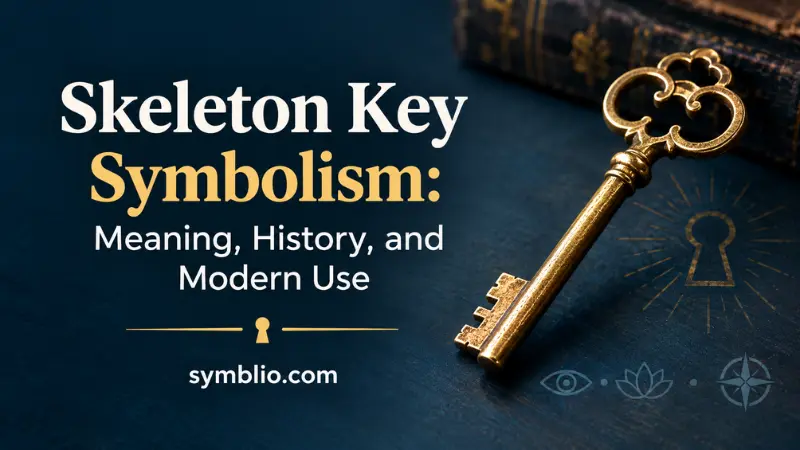
A skeleton key is an old-fashioned key associated with locks, hidden rooms, forgotten houses, and access to places that are normally closed. In modern American culture, skeleton key symbolism commonly centers on access, discovery, freedom, opportunity, and the ability to unlock something previously unavailable.
The physical object also has a distinctive appearance. Traditional skeleton keys have a relatively simple shaft and a reduced bit, reflecting their historical use with warded locks. The term refers to keys designed to bypass some of the internal wards found in certain older locks, although many antique keys casually called “skeleton keys” are actually other types of historical keys.
That practical history helps explain why the skeleton key became such an effective metaphor. A key does not merely open a door; it represents having access to something. In stories, jewelry, tattoos, interior design, and popular culture, that basic idea can expand into themes of opportunity, secrets, independence, knowledge, and personal transformation.
Quick Answer
Skeleton key symbolism commonly represents access, freedom, discovery, and the ability to unlock opportunities or hidden possibilities in modern American culture. Historically, its association with old locks and multiple doors also connects it with authority, privacy, secrets, and control over entry.
TL;DR
- Skeleton keys commonly symbolize access, opportunity, freedom, and discovery.
- Their historical function connects them with old locks and multiple doors.
- Keys have longstanding associations with authority and spiritual access.
- American culture often uses them to represent secrets and personal independence.
- Jewelry and tattoos can turn the key into a personal metaphor.
- Modern interpretations depend heavily on surrounding imagery and context.
What Is a Skeleton Key?
A skeleton key is a simplified key associated primarily with older warded locking systems. Its bit—the portion that interacts with the lock—can be reduced so that it clears certain internal obstructions and operates more than one compatible lock.
The name comes from the stripped-down appearance of the key. Rather than containing a complicated profile designed for one particular lock, the key may appear unusually thin or skeletal.
Historical examples can be surprisingly varied. A London Museum object dating from roughly 1600–1800 is described as a skeleton or lock-pick key with an iron construction and an elongated, simplified form.
Today, people also use “skeleton key” loosely for almost any antique-looking key. That distinction matters because an old key is not automatically a genuine skeleton key.
Why the Key Became a Symbol of Access
The symbolism begins with the most basic function of a key: it allows someone to pass through a barrier.
A locked door separates what is accessible from what is restricted. Possessing the appropriate key changes that situation immediately. The person holding it has permission, ability, or authority to cross the boundary.
That makes the key a natural symbol for:
- access
- opportunity
- permission
- freedom
- knowledge
- discovery
- control
- transition
The skeleton key adds another layer because it is associated with multiple locks rather than one narrowly defined entrance. Symbolically, that can suggest versatility—the idea that one person, skill, decision, or opportunity can open several paths.
What It Commonly Means in the United States
In contemporary American culture, an antique or skeleton-style key is often interpreted through familiar ideas about doors and possibilities.
A key may represent a new opportunity, such as beginning a new stage of life or entering an unfamiliar environment. Someone might give a key as a housewarming gift because it naturally relates to having a home and access to one’s own space.
It can also represent independence. Receiving the keys to a first apartment or home is a recognizable milestone in American life. The object becomes connected with responsibility as well as freedom.
Another common interpretation is discovery. Fiction frequently uses old keys to introduce locked rooms, family secrets, abandoned buildings, treasure, or forgotten histories. Consequently, a skeleton key can suggest curiosity even when no literal lock is involved.
Ancient and Historical Roots of Key Symbolism
The symbolic importance of keys predates the modern skeleton key itself. Across different traditions, the key became associated with controlling entrances, boundaries, and restricted spaces.
One particularly important example comes from Christian art. The Gospel of Matthew describes Jesus giving Peter the “keys of the kingdom of heaven,” and Christian artists subsequently developed the key as one of Saint Peter’s identifying attributes. The National Gallery notes that keys represent the keys of Heaven given to Peter.
The association became especially important in Catholic visual culture. Saint Peter’s Basilica explains that the keys symbolize the authority given to Peter to “bind and loose,” and the crossed keys became associated with papal authority.
This history demonstrates why keys can symbolize more than physical entry. They can represent entrusted authority—the responsibility to determine who or what may pass through a boundary.
Skeleton Keys and the Symbolism of Secrets
An old skeleton key often evokes secrecy because its appearance immediately raises questions.
What did it open?
Who possessed it?
Why was the door locked?
What might still be behind it?
These questions are partly cultural associations rather than properties of the object itself. The key becomes a visual shorthand for something hidden.
This is particularly common in American Gothic stories, mystery fiction, horror imagery, historical dramas, and photographs of abandoned buildings. An antique key placed beside an old diary, locked chest, or weathered door can suggest that something from the past remains inaccessible.
The symbolism therefore works through implied information. The key tells the viewer that there is something to discover without revealing what that thing is.
Freedom, Independence, and Personal Control
A key can symbolize freedom because possessing it gives someone the ability to enter or leave a protected space.
That interpretation becomes especially understandable in American culture, where personal independence is often associated with having one’s own home, room, vehicle, office, or private space.
A skeleton key used as jewelry might therefore represent a personal transition:
- leaving home
- starting a new chapter
- gaining independence
- creating personal boundaries
- taking responsibility
- entering a new environment
The important distinction is that the symbol does not automatically mean freedom in every situation. A key can also represent restriction because it exists precisely where something has been locked away.
Knowledge and Unlocking Understanding
Keys are frequently used as metaphors for knowledge.
People talk about finding the “key” to a problem, discovering the key to understanding something, or having information that unlocks a difficult question. The metaphor works because knowledge can remove an obstacle in much the same way a physical key removes a barrier.
A skeleton key can intensify that idea because its unusual appearance suggests access to more than one place.
In this context, it may symbolize:
curiosity → discovery → understanding → new possibilities
That makes the skeleton key particularly suitable for educational, literary, and intellectual imagery.
Religious Interpretations of Keys
The strongest religious association involving keys in Western Christianity is Saint Peter.
Christian artwork commonly portrays Peter carrying one or two keys. The National Gallery identifies keys as his attribute because of the traditional association with the keys of Heaven.
The National Gallery of Art also holds a painting of Saint Peter carrying two large keys, demonstrating how established the imagery became in European Christian art.
For this reason, a key can carry religious associations involving:
- spiritual authority
- entry into Heaven
- responsibility
- stewardship
- judgment
- access to the sacred
However, an ordinary skeleton key should not automatically be interpreted as a Christian symbol. Context matters. A key-shaped necklace worn for fashion may have no religious intention at all.
The Symbolism of Doors, Locks, and Boundaries
Skeleton key symbolism becomes clearer when the key is considered together with the lock.
The lock represents something protected, private, restricted, or unavailable.
The key represents the means of access.
The door represents the boundary between one state and another.
Together, these objects create a simple symbolic vocabulary for change.
| Context | Meaning in the USA | Common Association | Notes |
|---|---|---|---|
| Skeleton key alone | Access and possibility | Opportunity | Often interpreted broadly |
| Key with a lock | Access to something restricted | Secrets | Stronger mystery association |
| Key with a door | Transition | New beginnings | Common in decorative imagery |
| Antique key | Past or hidden history | Nostalgia | Often used in vintage design |
| Key necklace or tattoo | Personal meaning | Independence | Interpretation depends on the wearer |
This is why a skeleton key can feel different depending on the surrounding imagery. A key beside a heart may suggest emotional access, while one beside a locked door may emphasize secrecy.
Emotional and Psychological Associations
People can attach personal meaning to objects that represent important experiences. A key may become emotionally significant when it is connected to a first home, a family property, a childhood memory, or an important transition.
A skeleton key can therefore suggest belonging as well as independence.
For one person, it might represent finally having a place of their own. For another, it might represent an inherited house or a family history. Someone else may simply appreciate the vintage appearance.
The psychological symbolism is consequently personal rather than universal. The same antique key can communicate nostalgia to one person and adventure to another.
Skeleton Keys in Tattoos and Personal Style
Skeleton key tattoos often work because the design is simple enough to carry several interpretations.
Someone might choose one to represent:
- opening a new chapter
- overcoming an obstacle
- personal freedom
- curiosity
- hidden knowledge
- a meaningful relationship
- connection to family history
- leaving the past behind
The surrounding design can change the message. A key combined with a flower can create a softer interpretation, while a key with a clock may emphasize time, change, or an important life transition.
An ornate antique key can also appeal to people interested in vintage aesthetics, Gothic design, historical objects, or fantasy imagery.
Jewelry, Gifts, and Home Decor
Key-shaped jewelry has a long history as a decorative motif, but its meaning in modern use is often straightforward.
A key necklace can represent access to someone’s heart, independence, or a personal milestone. A decorative antique key displayed in a home can evoke history, nostalgia, craftsmanship, or mystery.
Keys can also work as symbolic gifts. Giving someone a key may communicate trust or welcome, particularly when the key is connected to a real home or meaningful place.
In purely decorative settings, however, the object may simply be attractive. Not every key motif carries an intentional symbolic message.
Skeleton Keys in American Popular Culture
American movies, television, books, games, and visual art frequently use old keys as storytelling devices.
An antique key immediately raises narrative possibilities. It may open a forgotten room, reveal a family secret, provide access to an old estate, or connect the present with an earlier generation.
This makes the skeleton key particularly useful in mystery and Gothic storytelling. Its visual age creates a sense of history without requiring much explanation.
The symbolism also works in fantasy. A character holding a special key may be given access to a hidden world or forbidden location. Here, the key becomes an object of narrative agency: the character possesses something that can change what is possible.
Common Misunderstandings About Skeleton Keys
One of the biggest misconceptions is that every antique key is a skeleton key.
The Smithsonian-affiliated preservation record for an archaeological key found in Washington, D.C., illustrates this problem. Although the object was popularly called a skeleton key, the museum description identifies it as a bit or barrel key intended for a single lock.
Another misunderstanding is that a skeleton key can open virtually any modern lock. Traditional skeleton keys were designed around particular types of older locking mechanisms, especially warded locks. Modern pin-tumbler locks work differently and generally require a properly matched key or other specialized equipment.
Symbolically, this distinction is useful too: the popular image of a “universal key” is more powerful than the object’s actual mechanical capabilities.
When Skeleton Key Symbolism Takes on a Negative Meaning
Keys can have negative associations when they are connected with unwanted access, secrecy, surveillance, trespassing, or control.
A skeleton key’s historical association with bypassing certain locks can contribute to this darker interpretation. In fiction, an old key may therefore represent intrusion rather than freedom.
The meaning depends heavily on context.
A key given with a new home may communicate welcome. The same key appearing beside a locked door in a mystery story may suggest something concealed. A key in a historical religious artwork can represent authority rather than secrecy.
There is no single positive or negative meaning attached to the object itself.
How Skeleton Key Meaning Has Evolved
The physical function of old keys has changed as locking technology has developed. Skeleton keys are now more likely to be encountered as antiques, reproductions, decorative objects, restoration hardware, or collectibles than as everyday household tools.
Their symbolic life has changed along with that practical decline.
When keys were essential household objects, their significance was closely tied to ownership, security, access, and responsibility. Today, an antique key can additionally evoke nostalgia, mystery, historical memory, or fictional adventure.
That shift explains why skeleton keys appear so frequently in modern design even among people who have never used one with an antique lock.
Why the Skeleton Key Remains a Strong Symbol Today
The skeleton key continues to work as a symbol because its basic message is easy to understand.
Something is closed.
Something is inaccessible.
Then a key appears.
The possibility of opening that barrier creates an immediate story. It can mean finding an opportunity, gaining independence, discovering information, entering a new phase, or reconnecting with the past.
Its old-fashioned appearance adds another layer of meaning. Unlike a modern car key or electronic access card, an antique key visibly suggests craftsmanship and history.
That combination of function, age, and mystery gives the skeleton key unusual flexibility in modern American visual culture.
FAQs
A skeleton key commonly symbolizes access, freedom, opportunity, discovery, and the ability to overcome a barrier. Depending on its context, it can also represent secrecy, authority, independence, or connection with the past.
A skeleton key tattoo can represent opening a new chapter, personal freedom, overcoming obstacles, or discovering something previously hidden. Its meaning becomes more specific when combined with other images such as flowers, locks, doors, or clocks.
It can be. Antique keys frequently appear in mystery and Gothic imagery because they imply that something locked away remains to be discovered.
In Christian art, keys are strongly associated with Saint Peter and the keys of Heaven. The imagery represents the authority associated with Peter’s role and the biblical passage concerning the “keys of the kingdom.”
It can symbolize freedom because a key provides access and allows someone to cross a locked boundary. In personal symbolism, it may represent independence, a new home, or moving into a new stage of life.
No. Many antique keys are simply old bit, barrel, or other historical keys. A genuine skeleton key has a particular relationship to the lock mechanism and is not merely any old-fashioned-looking key.
In modern American culture, skeleton key symbolism often centers on opportunity, access, independence, discovery, and hidden possibilities. Its historical associations with locks and restricted spaces also make it useful for expressing mystery, privacy, and control.
Conclusion
A skeleton key is more than an antique piece of hardware when it is used symbolically. Its basic function—opening what has been closed—naturally connects it with opportunity, freedom, discovery, knowledge, and transition.
Its history also gives the image additional associations with authority and restricted access, while Christian art established the key as an important religious emblem through the symbolism of Saint Peter.
Ultimately, skeleton key symbolism depends on context. On a necklace it may represent independence; in a tattoo it may mark a personal transition; in a novel it may signal a secret; and in historical artwork it may represent authority. The enduring appeal comes from one simple idea: a key represents the possibility of opening a door that was previously closed.