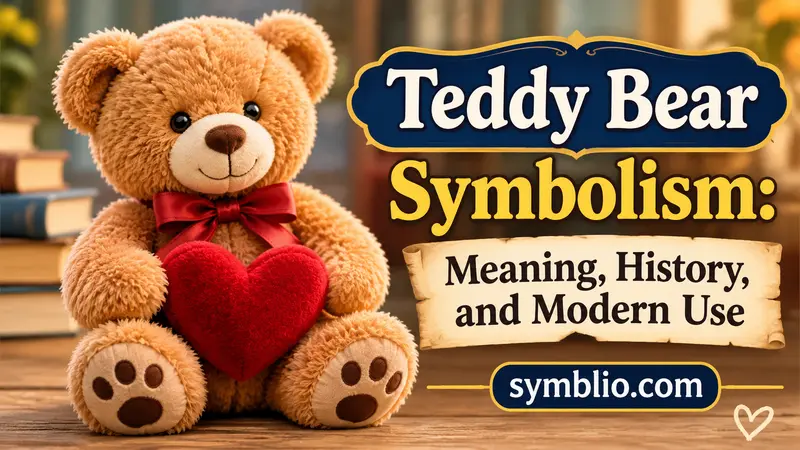
A teddy bear is more than a soft toy. For many people, it represents childhood, comfort, affection, security, and the reassuring presence of someone who cares. Its familiar shape, soft texture, and gentle expression make it one of the most recognizable symbols of emotional warmth. Teddy bear symbolism often connects these qualities with memories, relationships, and the human need for reassurance.
In the United States, teddy bears hold a special place in family life and popular culture. Children receive them as birthday and holiday gifts, parents give them as comforting companions, and adults sometimes keep them long after childhood. A teddy bear may sit on a bedroom shelf, appear in a Valentine’s Day gift, or become a treasured reminder of someone who is no longer nearby.
Its meaning also has an interesting historical background. The teddy bear emerged in the early twentieth century, drawing inspiration from an American presidential story and the growing popularity of manufactured stuffed animals. Over time, it developed associations that reach beyond playthings, becoming a familiar emblem of kindness, innocence, emotional attachment, and care.
Quick Answer
Teddy bear symbolism commonly represents comfort, childhood innocence, affection, emotional security, and unconditional love in modern American culture. Historically connected to early twentieth-century American popular culture, the teddy bear has also become a symbol of friendship, nostalgia, protection, and reassurance during difficult times.
TL;DR
- Teddy bears commonly represent comfort, affection, and emotional security.
- Their name originated from a story involving President Theodore Roosevelt.
- In American culture, they are closely associated with childhood and family memories.
- Giving a teddy bear often communicates love, friendship, and care.
- Some teddy bears represent remembrance, grief, or emotional support.
- Modern designs extend their meaning into fashion, art, and popular culture.
What a Teddy Bear Looks Like and Why Its Appearance Matters
A traditional teddy bear is a stuffed animal with a rounded head, small ears, soft body, short limbs, and a friendly facial expression. Most have plush fabric, button-like or embroidered eyes, and a nose that gives the face a gentle appearance. Some are designed to look realistic, while others have exaggerated features that make them especially appealing to young children.
These physical qualities contribute to its symbolism. Softness suggests gentleness, warmth, and care. Rounded shapes often make an object appear approachable rather than threatening, while a familiar face gives the impression of companionship.
Teddy bears also have a distinctive quality: they do not demand anything from their owners. They can be held, carried, placed beside a pillow, or kept on a shelf. Their quiet presence allows people to associate them with safety and familiarity.
Not every teddy bear looks alike, however. An old-fashioned brown bear may suggest nostalgia, while a pink or white bear might communicate tenderness or affection. A worn childhood teddy bear can carry more emotional meaning than a new, expensive one because its value comes from the experiences attached to it.
The Core Symbolic Meanings of Teddy Bears
Teddy bears carry several related meanings, but some associations appear more consistently than others.
Comfort and security are among their most familiar meanings. A teddy bear can represent a reassuring presence during unfamiliar experiences, such as starting school, traveling, or sleeping in a new environment.
Childhood innocence is another major association. Because teddy bears are strongly connected with children’s play, they often represent an early stage of life characterized by imagination, discovery, and dependence on caregivers.
Love and affection also feature prominently. Giving someone a teddy bear can communicate tenderness without requiring an elaborate explanation. The gift says that the recipient is valued and deserves kindness.
Other common associations include:
- Friendship and companionship
- Protection and reassurance
- Nostalgia and family memories
- Gentleness and emotional openness
- Loyalty and lasting attachment
- Kindness toward vulnerable people
These meanings overlap, but the context changes which one becomes most important. A teddy bear given to a young child may represent security, while one exchanged between friends may express affection and loyalty.
How the Teddy Bear Originated in the Early 1900s
The teddy bear has an unusually well-documented connection to American history. Its name comes from President Theodore Roosevelt, whose nickname was Teddy.
In November 1902, Roosevelt participated in a bear hunt in Mississippi. During the expedition, hunting companions captured and tied a black bear to a tree. Roosevelt refused to shoot the defenseless animal, considering it unsportsmanlike. The incident attracted newspaper attention and inspired political cartoonist Clifford Berryman to illustrate the president’s decision.
The cartoon helped turn the bear into a recognizable public image. Brooklyn shopkeepers Morris and Rose Michtom saw an opportunity to create a stuffed bear inspired by the story. Rose made the toy, and Morris displayed it as “Teddy’s Bear.” The product became popular, eventually contributing to the development of the Ideal Toy Company. National Museum of American History+2
An important detail is that Roosevelt did not invent the stuffed bear. In Germany, Richard Steiff had independently designed a jointed plush bear in 1902 for his aunt Margarete Steiff’s toy business. The bear was presented at the Leipzig Toy Fair in 1903 and attracted a substantial order from an American buyer. Margarete Steiff GmbH+1
These two developments helped establish the teddy bear as an international toy. Its American name came from a presidential story, while its early manufacturing history also involved German craftsmanship.
The original story introduced associations with sportsmanship and compassion. However, the toy’s lasting cultural importance developed through its role in children’s lives rather than through its political origins.
What Teddy Bears Symbolize in American Culture
In the United States, teddy bears are closely associated with family life, childhood celebrations, and expressions of affection. They appear in nurseries, bedrooms, toy collections, gift shops, and holiday displays.
One reason for their popularity is their versatility. A teddy bear can be an ordinary plaything, a birthday present, a keepsake, or a decorative object. Its meaning changes depending on the relationship between the giver and recipient.
American parents and relatives often give teddy bears to celebrate a new baby’s arrival. In this setting, the toy represents warmth, protection, and the hope that the child will feel loved and secure.
They also appear during Valentine’s Day, Christmas, birthdays, and other celebrations. A heart-shaped accessory or a message attached to a teddy bear can turn it into an expression of romantic or family affection.
Teddy bears also appear in American charitable activities. Plush animals are sometimes donated to children experiencing stressful circumstances, including hospital visits and emergencies. In these situations, the bear represents kindness and reassurance rather than simply entertainment.
The American interpretation therefore extends beyond childhood. Adults may continue to associate teddy bears with people, places, and experiences that shaped their lives.
Teddy Bears and the Symbolism of Childhood Innocence
A teddy bear often represents childhood because it belongs to a familiar world of imaginative play and early emotional development.
Children may give their bears names, personalities, and imaginary histories. One bear might become a brave explorer, while another becomes a trusted companion who accompanies its owner through ordinary daily activities.
This imaginative relationship makes the toy more than an object. It becomes part of a child’s personal world, where pretend conversations and invented adventures provide opportunities for creativity.
For adults, seeing a teddy bear can bring back memories of childhood bedrooms, family holidays, bedtime routines, or gifts received from grandparents. The object becomes a reminder of a particular period rather than a symbol of childhood in the abstract.
Its connection with innocence does not mean that children are always happy or carefree. Instead, it represents the vulnerability, imagination, and need for care that often characterize early life.
Emotional Comfort, Attachment, and a Sense of Security
Teddy bears are frequently associated with emotional reassurance because they provide a familiar object that can be held during uncertain moments.
In child development, a familiar blanket, stuffed animal, or similar possession may function as a transitional object. Such objects can help children manage separation from caregivers and become more comfortable in unfamiliar situations.
A teddy bear may accompany a child to daycare, a relative’s home, or an overnight stay. Its familiar appearance and texture can make a new environment feel less unfamiliar.
Adults can also attach emotional importance to stuffed animals. Someone might keep a childhood teddy bear because it reminds them of a parent, grandparent, sibling, or meaningful period in life.
This attachment does not mean the person believes the toy is alive. Rather, the object carries memories and associations that make it personally valuable.
The emotional symbolism is particularly noticeable when someone experiences change. During a move, family transition, or period of uncertainty, a familiar keepsake can provide continuity with earlier experiences.
Teddy Bear Colors and Their Symbolic Associations
Color can influence how people interpret a teddy bear, particularly when it is given as a gift or used in decoration. These associations are not universal rules, but they are familiar in contemporary American design.
| Teddy Bear Color | Common Symbolic Association | Typical Context |
|---|---|---|
| Brown | Warmth, familiarity, nostalgia | Traditional childhood toys |
| White | Innocence, peace, tenderness | Baby gifts and keepsakes |
| Pink | Affection, sweetness, gentleness | Valentine’s Day and celebrations |
| Red | Love, romance, strong affection | Romantic gifts |
| Blue | Calmness, trust, reassurance | Nursery decorations and gifts |
| Black | Elegance, remembrance, individuality | Collectible and decorative designs |
A color’s meaning also depends on the person’s experience. A blue teddy bear might remind someone of a childhood birthday, while a white one might be connected with a family celebration.
It is therefore better to understand color symbolism as an additional layer of meaning rather than a fixed explanation of what every teddy bear represents.
Why Giving Someone a Teddy Bear Is a Meaningful Gesture
A teddy bear is a popular gift because it communicates affection in a simple, recognizable way. Unlike many presents that serve a practical purpose, a stuffed bear often carries an emotional message.
When someone gives a teddy bear, the gesture may mean:
- I care about you: The gift communicates warmth and personal attention.
- You are important to me: It can serve as a lasting reminder of a relationship.
- I want you to feel comfortable: Its familiar softness suggests reassurance.
- I am thinking about you: A teddy bear can represent affection even when the giver is far away.
- Our memories matter: A special bear can preserve the emotional connection between two people.
The relationship determines how the gift should be interpreted. A parent giving a bear to a child expresses protective affection. Friends may exchange them as playful reminders of their friendship. Partners may use them to communicate tenderness, especially when they cannot spend time together.
A teddy bear does not automatically indicate romantic interest. Its meaning depends on the circumstances, the relationship, and the intentions behind the gift.
Teddy Bears in American Holidays and Celebrations
American celebrations have helped maintain the teddy bear’s association with affection and family traditions.
Valentine’s Day is one of the clearest examples. Teddy bears decorated with hearts, ribbons, or affectionate messages are common gifts. They represent tenderness and the desire to make someone feel appreciated.
Christmas gives the bear another familiar role. Plush bears placed under Christmas trees often become childhood keepsakes. Some families preserve them and bring them out year after year, connecting the toy with shared holiday memories.
Baby showers and newborn celebrations also frequently feature teddy bears. They appear on greeting cards, blankets, nursery decorations, and gift arrangements. Their gentle appearance makes them suitable symbols of welcome, care, and protection.
Birthdays and graduations offer different interpretations. A teddy bear may commemorate a childhood milestone or serve as a reminder that someone remains supported during a new stage of life.
These traditions show how an ordinary toy can become part of a family’s emotional history. Its value often comes from the occasion and the person who gave it.
Cross-Cultural Interpretations of the Teddy Bear
Although the name has American roots, teddy bears became popular internationally. Their symbolic associations are not limited to the United States.
In Germany, the toy’s early manufacturing history is closely connected with the Steiff company and its tradition of plush animal craftsmanship. The teddy bear became an important example of the country’s early twentieth-century toy industry.
In the United Kingdom, teddy bears became familiar childhood companions and collectible objects. British expressions such as a child’s “teddy” reflect how naturally the toy entered everyday family language.
In Japan, teddy bears are part of a broader culture of cute character design and collectible plush toys. Their appearance in shops, gifts, and personal collections often connects them with affection, comfort, and decorative expression.
Across these settings, the bear generally communicates gentleness and companionship. However, its precise associations differ according to local traditions, popular characters, and individual experiences.
It is important not to treat the teddy bear as an ancient religious or universal spiritual symbol. Its recognizable history is relatively recent, and most of its familiar meanings developed through modern family life and popular culture.
Teddy Bears in Memorials, Remembrance, and Difficult Times
A teddy bear can also represent remembrance when it is connected with someone who has died or with a difficult event.
Families sometimes preserve a stuffed animal because it belonged to a loved one. The bear becomes a personal keepsake that helps maintain a connection with shared memories.
Teddy bears also appear in public memorial settings, including tributes to children and communities affected by tragedies. People may leave plush animals alongside flowers, cards, and other expressions of sympathy.
In these circumstances, the bear communicates tenderness toward people who have experienced loss. Its familiar appearance can express care without requiring elaborate words.
A memorial teddy bear should not be confused with a universal symbol of grief. Its significance comes from the people, circumstances, and memories associated with it.
There is also a difference between remembrance and commercialization. A bear placed at a memorial may carry profound personal meaning, while a mass-produced bear sold with a generic message may have no particular connection to mourning.
Teddy Bears in Tattoos, Jewelry, and Personal Style
Teddy bear imagery has gradually moved beyond toys and into personal expression. People sometimes choose bear designs because they connect the image with a particular memory, relationship, or period of life.
A teddy bear tattoo can represent:
- Childhood memories and nostalgia
- A connection with a parent or grandparent
- Innocence and a playful personality
- Affection and emotional openness
- A personal reminder of comfort and security
- A childhood companion that remains meaningful in adulthood
Some people choose a teddy bear tattoo to commemorate a loved one. Others select the image because they enjoy its friendly appearance or associate it with a favorite childhood character.
Jewelry offers another way to use the symbol. Teddy bear pendants, charms, and bracelets often appear in gifts for children, family members, or people who appreciate sentimental accessories.
In fashion, teddy bear graphics can communicate playfulness and nostalgia. Plush-inspired clothing and accessories also borrow the bear’s association with softness and warmth.
The design itself affects the interpretation. A small, traditional bear may suggest childhood memories, while a customized bear with a name, date, or personal detail can represent a specific relationship.
Teddy Bears in Literature, Film, and Popular Culture
Teddy bears have become recognizable characters in American entertainment. Their familiar appearance makes them suitable for stories about friendship, imagination, childhood, and emotional growth.
One well-known example is Winnie-the-Pooh. Created by A. A. Milne, the character helped establish the image of a bear as a gentle companion associated with friendship, curiosity, and simple pleasures.
Another example is Paddington Bear. Although Paddington is not technically a teddy bear, his familiar bear appearance and polite personality connect him with kindness, belonging, and the experience of finding a welcoming home.
In American popular culture, Ted offers a contrasting interpretation. The character uses the appearance of a childhood stuffed animal in an adult comedy, creating humor through the difference between an innocent-looking toy and adult behavior.
These examples demonstrate that the bear’s meaning is not limited to sweetness. Writers and filmmakers can use its familiar appearance to explore friendship, loneliness, nostalgia, humor, and the transition from childhood to adulthood.
Common Misunderstandings About Teddy Bear Symbolism
Although teddy bears generally carry positive associations, several assumptions can lead to inaccurate interpretations.
A teddy bear does not always represent romance. People give them to children, friends, relatives, and partners. Affection is a common meaning, but it does not automatically indicate romantic feelings.
A teddy bear is not necessarily a sign of immaturity. Adults may keep stuffed animals because of sentimental value, collecting interests, or personal memories. Emotional attachment to a keepsake is not limited to children.
Not every teddy bear represents protection. Some are simply decorative objects, collectible toys, or playful gifts. Their meaning depends on how people use and interpret them.
The teddy bear is not an ancient religious emblem. Its modern history began around 1902. Although bears have appeared in folklore and mythology for much longer, those older traditions should not be confused with the origins of the teddy bear.
The original Roosevelt story is more complicated than the popular version suggests. The president refused to shoot a restrained bear, but the injured animal was subsequently killed to end its suffering. The toy’s association with compassion developed partly through the way newspapers and cartoons presented the incident. National Park Service+2
Understanding these distinctions helps separate the teddy bear’s established cultural history from meanings people assign to individual toys.
How Teddy Bear Symbolism Has Changed Over Time
The teddy bear’s earliest popularity came from a combination of presidential publicity, toy manufacturing, and changing attitudes toward childhood.
In the early twentieth century, it became a fashionable plaything and a recognizable part of family life. Its growing popularity helped establish the idea that stuffed animals could be more than decorative objects.
As manufacturing improved, teddy bears became available in different sizes, materials, colors, and styles. Their appearance evolved, but their connection with childhood remained strong.
During the twentieth century, teddy bears increasingly appeared in children’s books, advertising, television, and film. These appearances reinforced their image as friendly companions.
By the twenty-first century, the bear had become both a childhood object and an adult keepsake. Collectors seek historical examples, families preserve well-loved toys, and designers incorporate bear imagery into modern products.
In 2025–2026, teddy bears continue to appear in gift culture, nursery design, collectible markets, and online expressions of affection. Their symbolism has expanded without losing its original connection to comfort and companionship.
The most important change is that people now use teddy bears to express a wider range of personal experiences. What began as a popular stuffed toy has become an object through which people communicate memories, relationships, and emotional connections.
Why People Keep Their Childhood Teddy Bears as Adults
Many adults retain childhood teddy bears because the objects hold personal memories that cannot be replaced by purchasing another toy.
An old bear may remind someone of a grandparent who gave it to them, a childhood home, or a family tradition. Its worn fabric and faded appearance can make it more meaningful because they reflect years of use.
For some people, keeping a teddy bear is also a way of maintaining a connection with an earlier stage of life. The object offers a tangible reminder of experiences that might otherwise exist only in memory.
Others collect teddy bears because they appreciate their craftsmanship, historical value, or artistic designs. Antique examples may interest collectors for reasons that have little to do with childhood.
There is no single reason adults keep these objects. Their significance may be sentimental, historical, decorative, or simply personal.
A teddy bear’s value is therefore not determined by its age, price, or condition. Sometimes the most meaningful bear is the one that has been part of a person’s life for decades.
FAQs
A teddy bear is commonly associated with comfort, kindness, emotional security, and innocence. Although it does not have one established religious meaning, individuals may connect it with personal ideas about love, protection, and peaceful memories.
Giving someone a teddy bear usually expresses affection, thoughtfulness, and appreciation. Depending on the relationship, it can represent friendship, family love, romantic interest, or a simple desire to make someone feel special.
A teddy bear in a dream may reflect childhood memories, a desire for reassurance, emotional comfort, or feelings of nostalgia. Dream interpretations are subjective, so the meaning depends on the dreamer’s personal experiences and the surrounding circumstances.
Teddy bears became popular children’s toys in the early twentieth century and developed strong connections with play, bedtime routines, and family traditions. Their soft appearance and familiar presence helped establish them as recognizable symbols of childhood.
A teddy bear tattoo can represent childhood innocence, family memories, affection, friendship, or a connection with someone important. Some people choose the design to remember a loved one or preserve a meaningful childhood experience.
A white teddy bear commonly represents innocence, peace, tenderness, and gentleness. It is frequently chosen for baby gifts, special occasions, and sentimental decorations, although personal associations can give it additional meaning.
Yes, teddy bears generally have positive associations with love, comfort, friendship, and emotional security. However, they can also represent sadness or remembrance when connected with personal loss or difficult memories.
Conclusion
A teddy bear represents much more than a childhood toy. Its familiar appearance and long association with family life have made it a symbol of comfort, affection, innocence, friendship, and emotional security. From its beginnings in early twentieth-century America to its place in modern popular culture, it has remained a recognizable expression of gentleness and care.
The meaning of teddy bear symbolism ultimately depends on the person and the memories attached to the object. For a child, it may be a trusted companion; for an adult, it may preserve a connection with someone they love or a time they remember fondly.
Sometimes, an ordinary stuffed bear becomes meaningful simply because of who gave it, who kept it, and the memories it carries.