
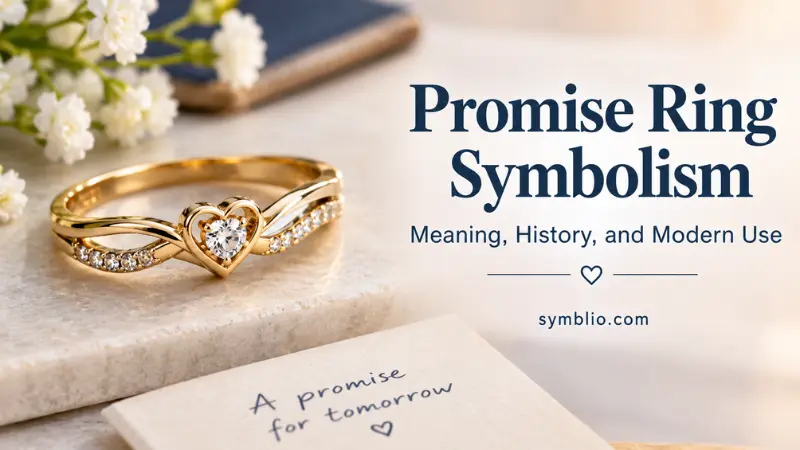
A ring can mark a major commitment, but it does not always mean engagement or marriage. Promise ring symbolism centers on the idea of turning a personal commitment into a visible, wearable reminder. In modern American culture, the ring is most often associated with romantic commitment, loyalty, or a relationship that matters to both people.
Unlike an engagement ring, a promise ring has no single universally recognized definition. One person may give one to express devotion and exclusivity, while another may use it to represent a future intention, a long-distance relationship, or a personal pledge. The meaning depends heavily on the promise being made.
That flexibility helps explain why promise rings have remained relevant. They occupy a space between an ordinary piece of jewelry and a formal relationship milestone, allowing people to mark commitment without necessarily making a promise of marriage.
Quick Answer
Promise ring symbolism commonly represents romantic commitment, loyalty, and devotion in modern American culture, especially when two people want to mark a serious relationship without becoming engaged. Historically, related ring traditions expressed love, fidelity, courtship, religious devotion, and promises between individuals.
TL;DR
- Promise rings commonly symbolize commitment and romantic devotion.
- Medieval posy rings helped establish the tradition of message-bearing commitment jewelry.
- Modern Americans use promise rings for several different kinds of personal commitments.
- A promise ring does not automatically mean an engagement is coming.
- Purity rings and promise rings can have different meanings.
- The inscription, design, and circumstances often reveal the intended message.
What a Promise Ring Actually Represents
A promise ring is a piece of jewelry given or exchanged to represent a commitment. The commitment can be romantic, personal, religious, or occasionally connected with friendship or family.
In the United States today, the romantic meaning is the most familiar. A couple may use a promise ring to acknowledge that their relationship is serious while deliberately keeping the commitment different from an engagement.
The important distinction is that there is no official promise-ring formula. The ring itself does not establish exactly what has been promised. The people exchanging it determine that meaning.
For example, a ring might represent:
- Commitment to an exclusive relationship
- Loyalty and faithfulness
- Intention to remain together
- A future possibility of engagement
- A commitment during a period of distance
- A personal or religious pledge
- A meaningful anniversary or relationship milestone
Because the meaning is flexible, discussing the intended promise can be more important than the ring’s style.
The Medieval Roots of Message-Bearing Rings
The modern promise ring does not have one clearly documented starting point. Instead, it developed from several older traditions in which rings represented affection, loyalty, courtship, or a pledge.
One important predecessor was the posy ring, popular in England and parts of Europe during the late medieval and early modern periods. These rings commonly carried short inscriptions expressing love, friendship, loyalty, or devotion. The word “posy” is connected with poetry, reflecting the short poetic messages engraved on the jewelry.
Some historical rings contained messages on the inside of the band. That placement made the inscription especially personal because the words were close to the wearer’s skin rather than displayed publicly.
Other examples featured religious phrases alongside romantic messages. This reflects an important feature of historical jewelry: emotional, religious, and social meanings were not always separated as neatly as they are today.
These older traditions do not prove that today’s promise ring is simply a medieval practice continued unchanged. Instead, they show that using a ring to carry a personal pledge has a long history.
From Posy Rings to Acrostic Rings
Another interesting development appeared during the Georgian and Victorian eras. Acrostic rings used gemstones whose first letters spelled a hidden message.
For example, particular combinations of gemstones could spell words associated with affection or devotion. The message therefore existed not only in an inscription but also in the arrangement of the stones.
This tradition illustrates an enduring feature of commitment jewelry: people have repeatedly found ways to make a small ring communicate a larger personal message.
The modern promise ring usually does not rely on such elaborate codes. Instead, contemporary designs tend to communicate through the ring’s shape, engraving, birthstones, initials, or the circumstances in which it is given.
What Promise Rings Mean in the United States
In contemporary American culture, promise rings are primarily understood through relationships. They can represent a serious commitment without carrying the specific social expectation attached to an engagement ring.
For some couples, the ring functions as a pre-engagement symbol. They may care about each other deeply but feel that engagement is not appropriate yet because of age, education, finances, distance, or other circumstances.
For others, marriage is not necessarily the goal. The ring can simply mark the importance of the relationship and a commitment to remain devoted to one another. Jewelry-industry guides and wedding publications commonly distinguish this meaning from the more specific marriage intention associated with an engagement ring.
American culture also allows the tradition to be adapted. Promise rings may be exchanged rather than given by one person to another, and modern couples are not restricted to traditional gender roles when deciding who gives or wears one.
Promise Ring vs. Engagement Ring
The difference between the two is mainly the commitment being communicated.
An engagement ring generally communicates an intention to marry. A promise ring communicates another commitment, which may include the hope of marriage but does not inherently establish it.
| Context | Common U.S. Meaning | Typical Association | Important Note |
|---|---|---|---|
| Promise ring | Commitment or devotion | Serious relationship | Meaning varies by couple |
| Pre-engagement promise ring | Relationship moving toward a future commitment | Future engagement | Does not itself constitute an engagement |
| Engagement ring | Intention to marry | Formal engagement | Usually carries a more established social meaning |
| Purity ring | Personal or religious commitment concerning sexual behavior | Faith and abstinence | Not synonymous with every promise ring |
| Friendship or personal ring | Loyalty or a personal pledge | Friendship or self-commitment | Less common than romantic use |
A common misunderstanding occurs when people assume that every promise ring is a hidden engagement announcement. It is not. The person giving or wearing the ring should define what it represents rather than relying on assumptions.
The Emotional Meaning Behind the Ring
The emotional symbolism of a promise ring comes partly from its permanence as an object.
A spoken promise can be remembered, but a ring remains physically present. Wearing it can serve as a reminder of a decision or commitment made at a particular point in life.
That gives the ring several emotional associations:
Loyalty: The wearer may see the ring as a reminder to remain faithful to an important relationship.
Continuity: A ring has no obvious beginning or ending, which makes the circular form easy to associate with an ongoing bond.
Recognition: Giving someone a ring can acknowledge that a relationship has reached an important stage.
Reassurance: For couples separated by distance or circumstances, the ring can function as a physical reminder of the relationship.
Personal identity: The jewelry can become part of how someone privately understands an important commitment.
These meanings are symbolic rather than automatic. A circle does not guarantee loyalty, and wearing a ring does not by itself determine the quality of a relationship. The significance comes from the intention attached to it.
Why the Circular Shape Matters
The shape of a ring contributes to its symbolism.
A circular band has no obvious endpoint, making it an intuitive visual representation of continuity. This is one reason circular jewelry has repeatedly appeared in traditions involving marriage, loyalty, and lasting relationships.
However, the meaning should not be overstated. The circular shape is one element of the symbolism, while the actual promise comes from the people involved.
An engraved sentence, initials, birthstone, or particular design can give the ring a more specific meaning than the basic circular form alone.
Common Promise Ring Designs and Their Symbolism
Modern promise rings come in many styles, and design choices can add another layer of meaning.
Simple Bands
A plain band can emphasize the promise itself rather than decoration. This style may appeal to someone who wants the ring to feel understated and personal.
Engraved Rings
Words, initials, dates, or short messages can make the ring highly specific. An engraving can refer to an anniversary, shared phrase, important date, or commitment.
Heart Designs
Heart-shaped details usually communicate affection and romantic attachment. Their meaning is relatively direct and easily understood.
Infinity Designs
Infinity symbols commonly suggest continuity or an enduring connection. Their popularity comes from the visual association between an unbroken line and an ongoing relationship.
Birthstones
Birthstones can connect the ring to a person’s identity or birth month. In a couple’s ring, they may represent the two individuals rather than the relationship alone.
Claddagh-Inspired Designs
Claddagh rings use recognizable motifs associated with a heart, hands, and crown. They have a distinct Irish cultural history and should not automatically be treated as generic promise rings.
Promise Rings and Religious Commitments
Promise rings can have religious meanings, but the traditions are not identical across all faiths.
In some Christian communities in the United States, rings have been used as visible reminders of religious or moral commitments. During the late 20th century, purity-ring movements particularly connected rings with pledges concerning abstinence before marriage.
That history matters because the phrase “promise ring” can refer to more than romantic commitment. A ring may represent a religious promise, while another ring worn by a different person may represent romantic devotion.
It is therefore inaccurate to assume that every promise ring represents the same type of pledge.
Promise Rings and Purity Rings Are Not Always the Same
The terms are sometimes used interchangeably, but they can describe different traditions.
A promise ring generally refers to a ring representing a personal commitment, most commonly within a romantic relationship.
A purity ring is specifically associated with a commitment concerning sexual abstinence, often within a religious context. In the United States, purity-ring movements became particularly visible during the 1990s and early 2000s.
Some people may call a purity ring a promise ring, but that does not mean every promise ring carries a purity-related meaning.
Understanding the distinction prevents assumptions about the person wearing the jewelry.
How Promise Rings Are Worn Today
There is no universal rule governing which finger should hold a promise ring.
People may wear one on different fingers of either hand, depending on personal preference and whether they want to distinguish it from an engagement or wedding ring. Some people wear promise rings on a chain instead of a finger.
This flexibility reflects the broader meaning of the tradition. Since a promise ring is not legally or socially standardized in the way an engagement or wedding ring is, the wearer has considerable freedom.
If someone later becomes engaged, the promise ring can be moved to another finger, worn separately, or kept as a sentimental piece.
Promise Rings in Modern Fashion and Social Media
Promise rings have also become part of contemporary personal style.
Jewelry is increasingly used to communicate identity through small details rather than formal ceremonies. An engraved ring can carry a private message, while a recognizable symbol can make the commitment more visible.
Social media can add another layer. A person may post a photograph of a new ring, prompting others to interpret it as an engagement. This can create confusion because promise rings do not have one standardized appearance.
A simple band, gemstone ring, or matching set could all function as a promise ring. The visual appearance alone usually cannot establish what the ring means.
Why People Give Promise Rings Before Engagement
A promise ring can fill a social space that an engagement ring does not.
Someone may want to recognize a serious relationship without making a marriage proposal. Circumstances can matter: a couple might be too young for marriage, living in different places, concentrating on education, or simply not ready for an engagement.
In such situations, the ring can acknowledge commitment without claiming that a wedding is being planned.
This is one reason the modern tradition is more flexible than the older idea of betrothal jewelry. A contemporary promise does not have to follow a fixed sequence toward marriage. Some couples eventually become engaged, while others never do.
Cross-Cultural and Historical Connections
The broader idea of using rings to represent loyalty is not uniquely American.
European history contains numerous examples of rings connected with courtship, fidelity, betrothal, and marriage. Medieval posy rings are particularly useful for understanding how jewelry could carry a private message between two people.
Gimmel rings provide another historical example. These consisted of interlocking bands and could include clasped-hand imagery associated with fidelity and marriage agreements in early modern Europe.
Roman jewelry traditions are also frequently discussed in histories of engagement and commitment rings, although claims that modern promise rings directly originated in ancient Rome can oversimplify a much longer and more complicated history.
The safest interpretation is that modern promise rings belong to a broad historical family of jewelry used to express promises and relationships.
Common Misunderstandings About Promise Rings
One of the biggest misconceptions is that a promise ring always means “engagement is coming soon.” Sometimes it does, but the ring can also represent commitment without any intention of marriage.
Another misconception is that there is a required finger. There is not.
People may also assume that the more expensive the ring, the more serious the promise. Historically and symbolically, that does not follow. A simple engraved band can carry more personal meaning than an expensive ring chosen without a specific intention.
Finally, not every ring associated with commitment is a promise ring. Engagement rings, wedding rings, purity rings, friendship rings, and memorial jewelry can overlap visually while representing very different ideas.
How Promise Ring Symbolism Has Changed
The basic concept has remained surprisingly consistent: a physical object can preserve a personal promise.
What changed is what people are free to promise.
Earlier European rings were often connected with courtship, betrothal, marriage, faith, or loyalty. Modern Americans can use similar jewelry in relationships that do not follow traditional marriage timelines.
The language has changed too. Historical rings might carry a short poetic inscription, while contemporary rings may use initials, dates, coordinates, symbols, birthstones, or personalized messages.
The ring therefore represents continuity without requiring identical customs. The object remains familiar while the meaning adapts to changing ideas about relationships.
What Makes a Promise Ring Meaningful?
The most meaningful promise ring is not necessarily the most elaborate one. Its significance usually comes from whether the design accurately reflects the commitment it represents.
A thoughtful choice considers three things:
The promise: What exactly is being represented?
The recipient: What symbols, materials, or details have personal significance?
The context: Is the ring marking an anniversary, a relationship milestone, a personal commitment, or another occasion?
Clear communication matters particularly because promise rings do not have a standardized definition. If two people understand the commitment differently, the jewelry can create confusion rather than clarity.
FAQs
A promise ring most commonly symbolizes commitment, loyalty, and romantic devotion. Depending on the person and context, it can also represent a future intention, religious commitment, friendship, or another personal pledge.
No. A promise ring does not automatically indicate an engagement or a plan to marry. Some couples view it as a step before engagement, while others use it to express commitment without intending marriage.
There is no universally required finger for a promise ring. People may wear one on different fingers of either hand or place it on a necklace, depending on personal preference and the meaning they want to communicate.
Not necessarily. Promise rings can represent many kinds of commitments, while purity rings specifically became associated with commitments concerning abstinence, particularly within some U.S. Christian communities.
An engraving makes the commitment more personal by attaching a specific word, date, initials, or message to the jewelry. Historically, inscribed rings such as posy rings used short messages to express love, loyalty, friendship, or devotion.
Yes. Although romantic commitment is the most common modern meaning, rings can represent friendship, family bonds, religious commitments, or personal promises. The intended meaning depends on the giver and wearer.
Not necessarily. Some people use promise rings as pre-engagement jewelry, but others give them simply to recognize a serious commitment without making marriage part of the promise.
Conclusion
A promise ring is best understood as a physical representation of a commitment whose exact meaning depends on the people involved. In the United States, it most often communicates romantic devotion, loyalty, or a serious relationship, while related historical traditions show that rings have long been used to carry messages of fidelity, affection, and personal promises.
Modern promise ring symbolism is flexible rather than fixed. A simple band, engraved message, gemstone, or symbolic design can represent different commitments depending on the circumstances. What gives the ring meaning is not its price or appearance, but the promise that the wearer and giver understand it to represent.
That flexibility is what allows an old form of relationship jewelry to remain relevant in modern life: the ring stays recognizable, while the promise can belong entirely to the people who exchange it.


