
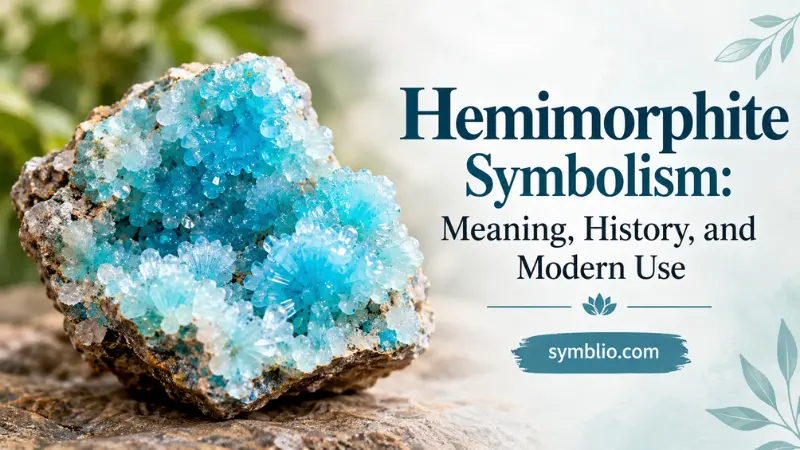
Hemimorphite is a zinc silicate mineral best known for its pale blue, blue-green, white, and sometimes colorless appearance. Hemimorphite symbolism is largely modern rather than rooted in a major ancient religious or ceremonial tradition, with its meanings often shaped by its unusual color, natural formation, and growing popularity in mineral collecting and jewelry.
Unlike gemstones such as sapphire, ruby, or emerald, hemimorphite does not have a long-established symbolic system shared across major cultures. Its appeal today comes partly from its distinctive appearance and partly from the personal meanings people attach to uncommon natural stones.
Understanding hemimorphite therefore requires separating documented mineral history from modern gemstone folklore. Its geological story is well established, while associations such as calmness, clarity, communication, and individuality belong mainly to contemporary symbolic and crystal traditions.
Quick Answer
Hemimorphite symbolism commonly represents calmness, clarity, emotional openness, and individuality in modern American gemstone culture, especially because of its blue and blue-green colors. Historically, however, hemimorphite was more important as a zinc-bearing mineral and collector specimen than as a formal religious or ceremonial symbol.
TL;DR
- Hemimorphite is a zinc silicate mineral with distinctive blue-green varieties.
- Its name refers to crystals with differently shaped ends.
- Modern symbolism comes largely from color and personal interpretation.
- Blue hemimorphite is associated with calmness and clear expression.
- Collectors value its unusual crystal forms and geological history.
- It has no widely recognized ancient religious symbolism.
What Is Hemimorphite?
Hemimorphite is a secondary zinc mineral that commonly forms in the weathered or oxidized portions of zinc deposits. Its chemical formula is Zn₄Si₂O₇(OH)₂·H₂O, and it belongs to the silicate mineral group.
The mineral can appear in several forms. Some specimens consist of tiny crystals, while others form rounded, bubbly-looking masses known as botryoidal aggregates. It can also occur as crusts, radiating clusters, or more clearly developed crystals.
Color is one of its most recognizable features. Hemimorphite may be colorless, white, gray, brown, pale green, or blue. Attractive blue and blue-green specimens are particularly sought after by mineral collectors and jewelry enthusiasts.
Its relatively modest hardness, around 4.5 to 5 on the Mohs scale, also distinguishes it from harder jewelry stones such as quartz or sapphire. For that reason, hemimorphite is often appreciated as a collector’s mineral or used in carefully designed jewelry rather than treated as an everyday hard-wearing gemstone.
What Does Hemimorphite Commonly Symbolize?
Modern interpretations of hemimorphite tend to focus on calmness, clarity, openness, individuality, and emotional balance.
These associations are not fixed rules. They largely come from the stone’s appearance and from contemporary gemstone culture.
Blue hemimorphite naturally invites associations with water, sky, stillness, and clear communication. Blue has also acquired broad cultural associations with calmness and reliability in American visual culture. When those ideas are applied to hemimorphite, the mineral can become a personal symbol of composure or thoughtful expression.
Its relative rarity in everyday jewelry adds another layer. Someone who chooses hemimorphite instead of a familiar blue gemstone may be signaling an appreciation for unusual materials, natural variation, or individuality.
| Context | Meaning in the United States | Common Associations | Notes |
|---|---|---|---|
| Blue color | Calmness and clarity | Sky, water, openness | Primarily a modern visual association |
| Jewelry | Individuality | Uncommon beauty, personal style | Meaning depends on the wearer |
| Mineral collecting | Curiosity and discovery | Geology, natural history | Closely connected to its scientific identity |
| Crystal culture | Emotional openness | Communication, peaceful expression | Contemporary belief rather than established history |
| Home display | Natural beauty | Serenity, color, earth science | Often chosen for appearance |
Why the Name Hemimorphite Matters
The name itself comes from the mineral’s unusual crystal structure.
The term refers to hemimorphism, a crystallographic condition in which corresponding ends of a crystal have different forms. Adolph Kenngott introduced the name hemimorphite in 1853 to reflect this characteristic.
The name comes from Greek roots associated with “half” and “form.” It therefore describes a physical feature of the mineral rather than an ancient symbolic meaning.
That distinction is important. People sometimes interpret unusual mineral names as if they carry hidden spiritual messages. In this case, the name has a straightforward mineralogical origin.
The physical structure is nevertheless interesting symbolically. Modern writers and collectors sometimes interpret hemimorphite’s two differently shaped ends as a reminder of contrast, individuality, or change. Those interpretations can be meaningful on a personal level, but they should not be presented as the historical reason the mineral was named.
Ancient Roots and the History of Hemimorphite
Hemimorphite has a long geological and mining history, but its documented symbolic history is much less extensive.
For centuries, miners used the name calamine for zinc-bearing materials that could look similar in hand specimens. The problem was that what was called calamine could include different minerals. Hemimorphite and smithsonite were particularly easy to confuse before mineralogical testing became more precise.
The distinction became clearer during the development of modern mineralogy. James Smithson’s work on calamine in the early nineteenth century helped establish that apparently similar material could represent chemically different substances. Later mineralogical classification separated the minerals more clearly.
Kenngott’s 1853 naming of hemimorphite gave the zinc silicate its modern mineralogical identity. In 1962, the International Mineralogical Association adopted hemimorphite as the accepted mineral name rather than continuing to use calamine for the species.
This history shows that hemimorphite’s strongest traditional identity is connected with mineralogy, mining, zinc deposits, and scientific classification, rather than mythology or ritual.
Hemimorphite and Zinc Mining
One of the least discussed parts of hemimorphite’s story is its connection to zinc.
Hemimorphite commonly develops as a secondary mineral around zinc deposits. It can form when earlier zinc-bearing minerals undergo weathering and chemical alteration near Earth’s surface.
Historically, zinc ores were economically important because zinc became essential for producing brass and other useful materials. Hemimorphite can serve as a minor source of zinc, although its importance varies depending on the deposit.
This industrial history gives the mineral a different kind of symbolism. Rather than representing an ancient deity or ceremonial tradition, hemimorphite can be viewed as a reminder of the relationship between geology, mining, technology, and everyday materials.
Its story connects a visually delicate mineral with an industrial metal that has played an important role in human manufacturing.
Why Blue Hemimorphite Has a Different Symbolic Feel
Color has a major influence on modern interpretations of hemimorphite.
The most recognizable collector specimens are often blue or blue-green. These shades can resemble turquoise, aquamarine, or other blue minerals, although their mineral identities are different.
In American visual culture, blue commonly appears in settings associated with calmness, trust, openness, and stability. Blue-green shades can add associations with water, vegetation, freshness, and nature.
As a result, blue hemimorphite may be chosen symbolically for reasons that have little to do with historical folklore. A person might simply see the color as peaceful or refreshing and use the stone as a reminder of those qualities.
This is an example of color-based symbolism rather than inherited religious symbolism. The distinction helps explain why different people can give the same specimen different meanings.
Hemimorphite Symbolism in the United States
In the United States, hemimorphite does not have a major established role in national holidays, mainstream religious ceremonies, wedding customs, or traditional mourning practices.
Instead, its modern American identity is concentrated in several smaller communities: mineral collecting, lapidary arts, jewelry, alternative spirituality, and decorative stone collecting.
Mineral enthusiasts may appreciate hemimorphite primarily as a geological specimen. Its crystal habits and unusual botryoidal formations can make it interesting even when symbolism is not part of the discussion.
Jewelry wearers may approach it differently. A blue hemimorphite pendant or cabochon can function as a personal style choice, particularly for someone who prefers less conventional stones.
Within contemporary crystal culture, hemimorphite is sometimes assigned meanings involving communication, emotional openness, calmness, and personal growth. These ideas are part of modern belief systems rather than established scientific properties or ancient American traditions.
Emotional and Psychological Associations
Symbolic objects often become meaningful because people connect them with a particular feeling, memory, or intention.
Hemimorphite’s cool colors can encourage associations with quietness and composure. Someone might keep a specimen on a desk because its appearance creates a visually peaceful environment, or wear a piece of jewelry because it reminds them to communicate thoughtfully.
Its unusual identity can also support a sense of individuality. Hemimorphite is not among the first stones most Americans encounter when they think about gemstones. Choosing it can therefore express an interest in uncommon natural materials.
These psychological associations should be understood as personal symbolism, not medical effects. There is no established scientific basis for claims that hemimorphite treats emotional or physical conditions.
Hemimorphite in Jewelry and Personal Style
Hemimorphite is used in necklaces, pendants, earrings, bracelets, beads, and cabochons. Its blue coloration can make it attractive for jewelry designs that emphasize natural color rather than intense sparkle.
Cabochon cuts are particularly suitable for material where color and surface appearance are more important than brilliant faceting. Some specimens are also kept in their natural form so that their crystal structure remains visible.
For American jewelry buyers, the stone can communicate several things at once:
- appreciation for natural materials
- preference for uncommon gemstones
- interest in mineral collecting
- attraction to blue or blue-green color
- personal rather than traditional symbolism
It can therefore function as both jewelry and a conversation piece.
Hemimorphite in Crystal and Spiritual Culture
Contemporary crystal communities have developed symbolic meanings for many minerals, including hemimorphite.
In these settings, the stone is sometimes associated with communication, emotional honesty, peaceful expression, and personal transformation. Some practitioners also connect it with particular energy centers or spiritual practices.
Those claims belong to modern metaphysical traditions, not established mineral science. Hemimorphite’s chemical composition, crystal structure, and geological formation can be studied scientifically, but proposed spiritual effects are matters of belief rather than demonstrated physical properties.
For a symbolism article, keeping those categories separate matters. Someone can appreciate a crystal tradition as a personal practice without treating its claims as scientific facts.
Hemimorphite in Home Decor and Collecting
Natural mineral specimens have become popular decorative objects in American homes, offices, studios, and collections.
Hemimorphite works particularly well as a display mineral because its appearance can vary significantly from one specimen to another. A blue botryoidal piece may look completely different from a white crystalline specimen.
In home decor, its symbolism tends to be understated. Rather than representing a specific holiday or religious event, it can represent an appreciation for nature, geological history, craftsmanship, or personal discovery.
A specimen displayed on a shelf may therefore have two meanings at once: scientific interest for the collector and aesthetic value for everyone else who sees it.
Hemimorphite in Tattoos and Personal Symbolism
Hemimorphite is not a major traditional tattoo symbol in the way that roses, snakes, birds, or certain religious symbols are.
When it appears in contemporary tattoo concepts, its meaning is more likely to be personal. Someone might choose a blue mineral design to represent calmness, individuality, curiosity, or an interest in geology.
A hemimorphite-inspired tattoo can also symbolize an appreciation for something less familiar. The choice itself may matter as much as the mineral’s assigned meaning.
Because there is no universally accepted hemimorphite tattoo symbolism, the intended message is best understood through the person’s own explanation.
Cross-Cultural Perspectives
Hemimorphite does not have a single major symbolic tradition shared across world religions or cultures.
Its history is more closely tied to European mineralogy, mining regions, and later international mineral collecting. Important specimens have been found in places including Mexico, Romania, Europe, China, and other zinc-bearing regions.
Modern gemstone interpretations can cross cultural boundaries because blue stones are broadly associated with ideas such as water, sky, tranquility, and natural beauty. However, those general color associations should not be mistaken for an ancient hemimorphite-specific tradition.
This makes hemimorphite different from stones whose meanings are strongly documented in religious art, royal traditions, or long-standing ceremonial practices.
Common Misunderstandings About Hemimorphite
One common misunderstanding is that hemimorphite has always been recognized as a distinct gemstone with a fixed spiritual meaning. Historically, its identity was complicated by the broad use of the name calamine for different zinc minerals.
Another misconception comes from treating modern crystal descriptions as ancient traditions. Associations with communication, emotional healing, or spiritual development are relatively modern interpretations and should not be presented as established historical facts.
Hemimorphite can also be confused with visually similar minerals, particularly smithsonite. Their similar colors and botryoidal forms contributed to their historical confusion.
Finally, a vivid blue specimen should not automatically be assumed to be hemimorphite simply because the color looks familiar. Mineral identification depends on physical and chemical characteristics, not color alone.
How Hemimorphite Symbolism Has Evolved
Hemimorphite’s symbolic identity has changed because the mineral itself has moved through different cultural contexts.
During its mining history, it was primarily understood as part of zinc-bearing geological deposits. Mineralogists later became interested in its unusual crystal structure and established it as a distinct mineral species.
Collectors then gave attractive specimens a new cultural setting. As mineral collecting and gemstone jewelry expanded, blue and blue-green hemimorphite became valued for appearance as well as scientific interest.
Contemporary crystal culture added another layer by assigning emotional and spiritual associations to the stone.
The result is a modern symbolism built from several influences: geology, color, collecting, jewelry, personal identity, and contemporary gemstone belief. It is not the product of one ancient symbolic tradition.
Hemimorphite as a Symbol of Individuality
Of all the modern interpretations attached to hemimorphite, individuality may be one of the easiest to understand.
Common gemstones often come with familiar cultural associations. Hemimorphite is less widely recognized, which means someone choosing it may be intentionally moving away from conventional gemstone choices.
Its natural variations reinforce that idea. One specimen may be pale blue and translucent, while another may be white, greenish, or formed as a rounded mineral crust.
That variability makes hemimorphite a useful personal symbol for people who value uniqueness without needing a traditional emblem to explain their identity.
FAQs
Hemimorphite is commonly associated in modern gemstone culture with calmness, clarity, communication, openness, and individuality. These meanings come primarily from its color and contemporary interpretations rather than an ancient symbolic tradition.
Hemimorphite has a long geological and mining history, but there is limited evidence for a major ancient spiritual tradition specifically centered on the mineral. Most of its spiritual symbolism developed through modern gemstone and crystal practices.
Blue hemimorphite is often associated with calmness, clear communication, openness, and peaceful expression. These associations are largely influenced by the cultural symbolism of blue rather than by a historical hemimorphite-specific tradition.
Hemimorphite is not a traditional birthstone recognized alongside widely established stones such as diamond, ruby, sapphire, or emerald. Someone may still choose it as a personal gemstone based on its color or individual meaning.
Modern crystal practitioners sometimes associate hemimorphite with emotional openness, communication, and personal growth. These are spiritual or symbolic beliefs, not scientifically established effects, so they should not be confused with medical treatment.
Collectors value hemimorphite for its unusual crystal habits, blue and blue-green colors, botryoidal formations, and geological associations with zinc deposits. Attractive specimens can also show distinctive textures and crystal growth patterns.
No. Hemimorphite and smithsonite are different minerals with different chemical compositions and crystal structures. They were historically confused because both can occur in weathered zinc deposits and can develop similar-looking forms.
Conclusion
Hemimorphite does not have a single ancient symbolic meaning comparable to gemstones with long ceremonial traditions. Its modern associations with calmness, clarity, communication, openness, and individuality largely arise from its blue-green appearance, its unusual identity, and contemporary gemstone culture.
Hemimorphite symbolism is therefore best understood as a modern, flexible form of meaning rather than a fixed historical code. Its story begins with zinc deposits and mineral classification, continues through collecting and jewelry, and now includes personal and spiritual interpretations.
That combination makes hemimorphite interesting: its meaning is shaped not only by what people believe about it, but also by the mineral’s real geological history and distinctive natural form.


