The juniper tree has long been associated with protection, endurance, purification, and the ability to survive difficult conditions. Its evergreen foliage, aromatic branches, and distinctive blue berry-like cones give it a recognizable appearance, while its presence in traditional stories and cultural practices has added to its symbolic importance. Juniper tree symbolism often reflects the qualities people associate with this hardy plant: strength, renewal, and protection.
Across the United States, junipers appear in residential landscapes, public gardens, natural woodlands, and traditional crafts. Some varieties grow as spreading ground covers, while others develop into substantial trees. Their ability to remain green through winter makes them especially meaningful in places where seasonal changes are pronounced.
The tree also has connections to older European folklore, biblical interpretation, and Indigenous plant traditions. These associations developed in different places for different reasons, so juniper does not carry one universal meaning. Understanding its history helps explain why it continues to represent resilience and protection in contemporary culture.
Quick Answer
Juniper tree symbolism commonly represents protection, resilience, purification, and longevity in modern American interpretations. Historically, juniper was associated with household protection, spiritual cleansing, shelter, and survival in several European and Indigenous traditions.
TL;DR
- Juniper represents endurance because its evergreen foliage survives changing seasons.
- European folklore associated juniper branches with household protection.
- Aromatic smoke traditionally represented cleansing and spiritual renewal.
- Indigenous communities developed distinct practical and ceremonial relationships with juniper.
- American landscaping connects juniper with permanence, adaptability, and natural beauty.
- Modern tattoos and artwork use juniper to express strength and personal renewal.
What the Juniper Tree Looks Like
Juniper belongs to the cypress family (Cupressaceae) and includes numerous species that grow in different climates. Depending on the variety, it may appear as a low, spreading shrub, a rounded bush, or an upright evergreen tree.
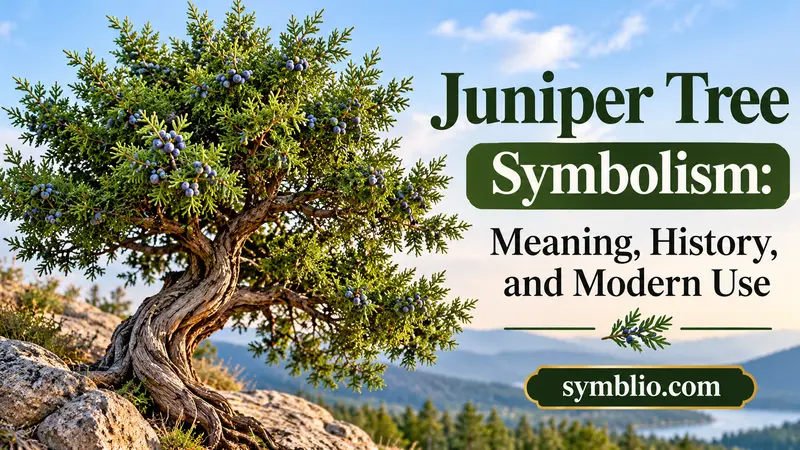
Its foliage consists of small, scale-like leaves or sharp, needle-like leaves. Many varieties produce rounded, blue, purple, or reddish-brown structures commonly called juniper berries. Botanically, these are fleshy seed cones rather than true berries.
In the American West, Utah juniper and Rocky Mountain juniper are familiar features of dry, rocky landscapes. Eastern redcedar, which is actually a juniper rather than a true cedar, grows across much of the eastern and central United States.
Several physical characteristics contribute to the tree’s symbolism:
- Evergreen foliage: Represents continuity and the ability to remain steady through changing seasons.
- Strong root systems: Suggest stability, persistence, and connection to the earth.
- Aromatic branches: Reflect cleansing, freshness, and renewal in traditions that used juniper for its scent.
- Long-lasting wood: Represents durability, reliability, and endurance.
- Berry-like cones: Suggest natural abundance, nourishment, and the continuation of life.
These features help explain why juniper has become associated with qualities that extend beyond its appearance.s, while eastern redcedar appears throughout much of the eastern and central United States. Although these species differ in appearance and habitat, both contribute to the broader cultural recognition of juniper.
Protection and Spiritual Safety
Protection is one of the best-known themes in traditional juniper folklore. Several European communities believed that juniper branches could help protect households against harmful influences.
As a result, families sometimes placed branches above doors or near entrances. These customs reflected a desire to create a protective boundary around the home.
In Scottish Highland traditions, people burned juniper branches during certain household blessing ceremonies. They associated the aromatic smoke with protecting families, homes, and livestock.
Similarly, some central and northern European communities used juniper in seasonal customs intended to discourage misfortune.
Today, these traditions influence the way people interpret juniper as a symbol. For example, someone may associate a juniper branch with:
- Personal boundaries and emotional security.
- A peaceful and welcoming home.
- Protection during difficult transitions.
- Strength when facing uncertainty.
- The preservation of family traditions.
Nevertheless, these associations come from cultural beliefs rather than scientifically established protective properties. The tree represents the protection people historically hoped to receive.
Resilience and Survival in Difficult Conditions
Juniper offers a natural example of resilience because many species grow in environments that challenge other plants.
For instance, Utah juniper thrives in dry regions with rocky soil, limited water, and considerable temperature changes. Its extensive root system helps it access available moisture, while its evergreen foliage maintains its appearance throughout the year.
Some juniper species also live for several centuries. Their longevity strengthens their association with patience, persistence, and endurance.
Consider a mature juniper growing on an exposed hillside. It may face strong winds, dry conditions, and seasonal temperature changes, yet it continues to grow. This ability makes the tree a natural representation of persistence.
People often connect this quality with personal experiences. Someone recovering from a difficult period may see juniper as a reminder to remain patient and continue moving forward.
Its symbolism does not suggest that challenges disappear. Instead, it highlights the importance of adapting to difficult circumstances without abandoning personal values.
Purification and Renewal
Juniper has a long association with purification practices, particularly in European folklore and certain Indigenous traditions.
Historically, people in some European communities burned its aromatic branches during household blessings. The fragrance and smoke represented a transition toward a cleaner or more peaceful environment.
For example, Scottish traditions included the use of juniper smoke during ceremonies intended to bless homes and livestock. These customs connected the plant with protection, freshness, and seasonal renewal.
However, different communities developed their own practices. Therefore, it would be inaccurate to describe every traditional use of juniper as part of the same cleansing ritual.
In modern symbolism, purification can also represent personal change rather than a religious ceremony.
A person might associate juniper with:
- Starting again after a difficult experience.
- Leaving unhelpful habits behind.
- Restoring emotional balance.
- Developing a clearer sense of purpose.
- Creating a more peaceful living environment.
Consequently, juniper provides a useful natural image for people who connect renewal with gradual personal improvement.
Ancient Roots and Early Historical Associations
People have used juniper for thousands of years, although its early importance came largely from practical applications.
Ancient Mediterranean communities valued its aromatic properties and used different parts of the plant in traditional preparations. Historical accounts also connect juniper with ancient Egyptian practices and Roman household life.
The Romans recognized its usefulness as a fragrant plant and valued its wood and cones for various purposes. Meanwhile, European communities gradually developed additional folklore around its protective qualities.
During the medieval period, juniper appeared in household customs associated with cleansing and protection. Its distinctive fragrance helped establish its place in traditional ceremonies.
Furthermore, people valued juniper because it provided several useful resources:
- Wood for fuel and practical objects.
- Cones for seasoning and traditional food preparations.
- Aromatic branches for household customs.
- Materials for certain crafts.
- Useful plant resources in dry environments.
These everyday experiences help explain the development of juniper’s symbolism. People did not simply admire its appearance; they also depended on its practical qualities.
Juniper Tree Symbolism in the Bible and Christianity
Juniper has an interesting connection with biblical interpretation, particularly through the story of the prophet Elijah.
In 1 Kings 19:4, Elijah rests beneath a plant in the wilderness while experiencing exhaustion and discouragement. Some older English Bible translations identify this plant as a juniper tree. However, several modern translations use the term broom tree because scholars question the original botanical identification.
This distinction is important because the passage does not establish that the plant was definitely a modern botanical juniper.
Nevertheless, traditional interpretations connect the story with several Christian themes.
Shelter during hardship: Elijah finds a temporary place to rest during a difficult journey.
Divine care: The broader passage describes how Elijah receives support when he feels overwhelmed.
Rest and recovery: His experience highlights the importance of physical rest and renewed strength.
Hope after difficulty: The story continues beyond his period of discouragement.
European Christian folklore developed another connection through a traditional story about juniper sheltering the infant Jesus and his parents during their escape from King Herod.
Although this story does not appear in the Bible, it contributed to juniper’s association with sanctuary and family protection.
Indigenous American Traditions and Cultural Connections
Juniper has particularly important cultural and practical connections with Indigenous communities across the American West.
Different Indigenous nations developed relationships with the juniper species native to their environments. These relationships included food, medicine, construction, tools, crafts, and ceremonial practices.
For example, historical accounts document several distinct uses:
- Navajo (Diné): Juniper has longstanding connections with traditional medicine and everyday cultural practices.
- Cheyenne: Rocky Mountain juniper wood served in the construction of objects such as flutes, bows, and lance shafts.
- Hopi: Juniper formed part of traditional plant knowledge and certain ceremonial practices.
- Shoshone: Juniper bark supplied materials for practical purposes, including rope and clothing-related items.
- Ancestral Pueblo communities: Juniper cones provided food, while its wood and bark supported construction and household activities.
These examples demonstrate the importance of juniper beyond general spiritual symbolism.
However, Indigenous nations have distinct languages, customs, histories, and relationships with the natural world. Their practices should not be combined into one universal belief system.
For some communities, juniper represents cultural continuity, knowledge passed between generations, and a longstanding relationship with the land.
What Juniper Means in American Culture Today
In contemporary American culture, juniper combines practical usefulness with natural beauty.
Across the western United States, people recognize juniper as part of desert landscapes, mountain slopes, and open woodlands. Meanwhile, eastern redcedar appears in rural properties, windbreaks, and residential gardens.
Not everyone who encounters a juniper tree thinks about its historical symbolism. Many Americans simply appreciate its evergreen appearance and ability to grow in different environments.
Nevertheless, its physical qualities encourage several modern interpretations.
Permanence: Evergreen foliage represents continuity through seasonal changes.
Independence: Its ability to grow in exposed environments suggests self-reliance.
Connection with nature: Its presence in traditional landscapes reflects an appreciation for the natural environment.
Reliability: Durable wood represents practical strength and usefulness.
Environmental adaptability: Its ability to survive in certain dry environments suggests persistence and adjustment.
Additionally, gardeners appreciate juniper because different varieties offer attractive shapes and textures. Some work well as ground covers, while others provide screening and structure.
Consequently, the tree’s modern importance comes from both its cultural associations and its practical place in American landscapes.
Longevity, Wisdom, and the Passage of Time
Some juniper species live for hundreds of years. This characteristic makes longevity one of the tree’s most natural symbolic associations.
Older junipers often develop twisted trunks, irregular branches, and weathered bark. Rather than maintaining a perfectly symmetrical appearance, they display the effects of environmental changes over many years.
This appearance encourages connections with wisdom and experience.
For example, an old juniper growing on a rocky hillside may remind someone that age brings character. Its unusual shape reflects the conditions it has endured and the gradual changes that have influenced its growth.
In personal symbolism, the tree can represent:
- Wisdom gained through experience.
- Respect for older generations.
- Patience during challenging periods.
- Family history and lasting relationships.
- Memories that remain important over time.
Furthermore, a mature juniper growing on family property may remind people of relatives who planted it or experiences shared around it.
Its long life makes it a meaningful representation of continuity between generations.
Emotional and Psychological Meaning of Juniper
The emotional symbolism of juniper comes largely from its appearance, fragrance, and natural environment.
Evergreen plants often suggest stability because they retain their foliage while surrounding vegetation changes with the seasons. Juniper makes this association especially noticeable during winter.
Its different growth patterns also influence how people interpret it. A compact shrub may suggest order and simplicity, while an older tree with irregular branches can communicate independence and individuality.
Several emotional associations commonly appear in modern interpretations.
Inner strength: Juniper represents the ability to maintain personal values during difficult circumstances.
Emotional stability: Its evergreen appearance suggests consistency and dependability.
Personal renewal: Its traditional association with cleansing can represent a fresh perspective.
Independence: Its ability to grow in exposed landscapes reflects self-reliance.
Security: Its protective folklore makes it a natural representation of safety and belonging.
However, these interpretations are not universal psychological rules. A person’s response to juniper may depend on childhood memories, family traditions, regional landscapes, and personal experiences.
For someone who grew up around juniper-covered hills, the tree may represent home. Another person may associate it with winter greenery or the fragrance of the outdoors.
Juniper in European Folklore and Other Cultural Traditions
Juniper appears in several European folklore traditions, particularly those involving household protection and seasonal cleansing.
In Scotland, people traditionally burned juniper branches during Hogmanay, the Scottish New Year celebration. The practice reflected a desire to bless homes and livestock while welcoming the new year.
Similarly, communities in parts of northern and central Europe sometimes hung juniper branches near entrances or burned them during seasonal observances.
Some traditions also connected the plant with protection against witches and harmful spiritual influences.
Irish historical plant traditions record juniper’s practical and medicinal importance. People valued its cones and wood, although its cultural status differed from that of more prominent native woodland trees.
Juniper also appears in certain Tibetan religious and ceremonial practices. Communities have used its aromatic branches as offerings, connecting the fragrance with devotion and purification.
These examples demonstrate how different cultures developed their own relationships with the same plant.
However, European household folklore, Irish plant traditions, and Tibetan religious practices should remain distinct. Each developed within a particular cultural and historical setting.
Juniper Tree Symbolism in Different Colors
Juniper is best recognized for its green foliage and blue-toned or reddish-brown cones. These natural colors contribute additional symbolic associations.
Green Juniper
Green juniper commonly represents renewal, endurance, growth, and continuity. Because its foliage remains green throughout the year, it provides a natural image of persistence.
Blue Juniper Cones
The blue-gray appearance of many juniper cones suggests calmness, reflection, and a connection with natural landscapes. These meanings represent modern visual interpretations rather than established beliefs shared by every culture.
Reddish-Brown Juniper
Reddish-brown bark can suggest age, stability, warmth, and connection with the earth. Its weathered appearance also makes it suitable for artwork representing experience and permanence.
Color interpretations depend on artistic and cultural context. Therefore, people should not treat these associations as fixed historical meanings.
Juniper in Tattoos, Jewelry, and Personal Design
Juniper has become an appealing subject for nature-inspired artwork because its branches, foliage, and cones offer recognizable botanical details.
People who choose juniper imagery may connect it with personal experiences, family history, or qualities they want their designs to represent.
Common interpretations include:
- Resilience tattoos: Representing the ability to continue through difficult periods.
- Protection designs: Reflecting traditional European folklore.
- Family-inspired artwork: Representing continuity and lasting connections.
- Nature tattoos: Expressing appreciation for mountains, forests, and wilderness.
- Renewal designs: Representing a fresh beginning or personal change.
A small juniper branch can create a subtle botanical design. Meanwhile, a larger composition might include mountains, rocks, or other native plants.
In jewelry and decorative artwork, juniper branches can communicate simplicity, natural beauty, and appreciation for traditional plant imagery.
Unlike symbols with standardized religious meanings, juniper tattoos do not have one universally accepted interpretation. Ultimately, the person choosing the design gives it much of its personal meaning.
Juniper in Home Decor, Gardens, and Seasonal Celebrations
Juniper has an established place in American home design because it combines evergreen color with a distinctive botanical appearance.
In residential landscaping, gardeners use different juniper varieties for hedges, ground covers, privacy screens, and decorative plantings. Additionally, some varieties tolerate relatively dry conditions, making them useful in water-conscious landscapes.
The tree’s traditional associations also contribute to its decorative appeal.
Winter decorations: Evergreen branches represent continuity and life during colder months.
Natural wreaths: Juniper foliage contributes to seasonal decorations associated with welcome and renewal.
Garden design: A mature juniper can represent permanence and a lasting connection with nature.
Entryway landscaping: Its historical association with household protection appeals to people who appreciate traditional plant folklore.
In some European Christian traditions, juniper also appeared in stories about the Holy Family seeking shelter. This connection helped establish its place in certain seasonal customs.
However, modern American households generally appreciate juniper more for its appearance and landscaping qualities than for any particular religious meaning.
Common Misunderstandings About Juniper Symbolism
Juniper’s long history has produced several interpretations that deserve careful explanation.
Juniper always means protection.
Protection is an important theme in European folklore. However, it is not a universal meaning because different cultures developed their own relationships with the plant.
All juniper trees have the same appearance.
Juniper includes numerous species with different shapes, sizes, foliage, and growing habits. Some remain small shrubs, while others become substantial trees.
Juniper berries are true berries.
The familiar blue or purple structures are fleshy seed cones. Although they resemble berries, their botanical structure is different.
Every Indigenous community shares the same beliefs about juniper.
Indigenous nations have distinct cultural traditions. Historical records document different uses among individual communities, so their practices should not become one generalized spiritual interpretation.
The biblical juniper reference is botanically certain.
The plant in Elijah’s wilderness story receives different identifications in Bible translations. Therefore, the connection with botanical juniper remains uncertain.
There is also a difference between symbolism and ecological value. In some western American landscapes, juniper expansion can affect native grassland and shrubland communities. Its ecological role depends on the species, location, and environmental conditions.
Understanding these distinctions makes juniper’s history easier to appreciate without exaggerating its cultural meaning.
How Juniper Symbolism Has Changed Over Time
Juniper’s symbolic identity has developed through practical experience, traditional beliefs, and modern appreciation for nature.
In ancient communities, people valued its wood, cones, and aromatic branches. These materials supported everyday activities, including food preparation, household practices, and traditional crafts.
Later, European folklore strengthened its association with protection and spiritual cleansing. Household customs and religious stories gave the plant meanings that extended beyond its practical value.
Meanwhile, Indigenous communities across North America continued their relationships with native juniper species through traditional knowledge, food practices, crafts, and ceremonies.
Today, the tree carries more individual interpretations. Some people appreciate its historical connection with protection, while others associate it with resilience, environmental awareness, family memories, or natural beauty.
Despite these changes, one central idea remains consistent: juniper represents a plant that provides useful resources, adapts to environmental challenges, and maintains its presence through changing conditions.
Juniper Symbolism at a Glance
| Context | Symbolic Meaning | Common Association |
|---|---|---|
| Evergreen foliage | Endurance and continuity | Remaining steady through change |
| European folklore | Protection | Traditional household customs |
| Aromatic branches | Purification and renewal | Historical cleansing practices |
| Long-lived trees | Wisdom and longevity | Experience and family history |
| Indigenous traditions | Cultural continuity | Relationships with native plants |
| Modern artwork | Resilience and identity | Tattoos and botanical designs |
FAQs
Juniper traditionally represents protection, purification, endurance, and renewal. Different cultural traditions have used its branches and aromatic smoke in practices intended to bless homes and create a sense of spiritual cleanliness.
Yes. Protection is one of its best-known historical associations, particularly in European folklore. People traditionally placed juniper branches near entrances or used them in household blessing ceremonies.
Juniper is traditionally connected with the story of Elijah resting in the wilderness in 1 Kings 19:4. However, some Bible translations identify the plant as a broom tree rather than a juniper, making its exact botanical identity uncertain.
A juniper tattoo can represent resilience, personal protection, renewal, and a connection with nature. Some people also choose it to honor family traditions or express appreciation for landscapes where juniper grows.
Juniper generally carries positive associations because of its connections with endurance, protection, and renewal. Nevertheless, its interpretation depends on cultural context, personal experience, and the particular tradition.
Certain historical communities burned aromatic juniper branches during household and ceremonial practices. The fragrance and smoke became associated with cleansing, blessing, and preparing a space for a fresh beginning.
An evergreen juniper commonly represents continuity, longevity, and stability. Because it retains its foliage throughout the year, it provides a natural image of persistence through changing seasons.
Conclusion
Juniper represents protection, resilience, purification, and longevity through its physical characteristics and cultural history. Its evergreen foliage reflects continuity, its ability to grow in challenging environments suggests endurance, and its traditional household uses explain its association with safety and renewal.
Across American landscapes, Indigenous traditions, European folklore, and modern botanical design, the tree carries different meanings shaped by local experiences. Understanding juniper tree symbolism means recognizing both its historical associations and its continuing value as part of the natural environment.
Ultimately, the juniper tree offers a simple reminder that strength is not always about resisting change. Sometimes, it means adapting to changing conditions while maintaining what makes life meaningful.