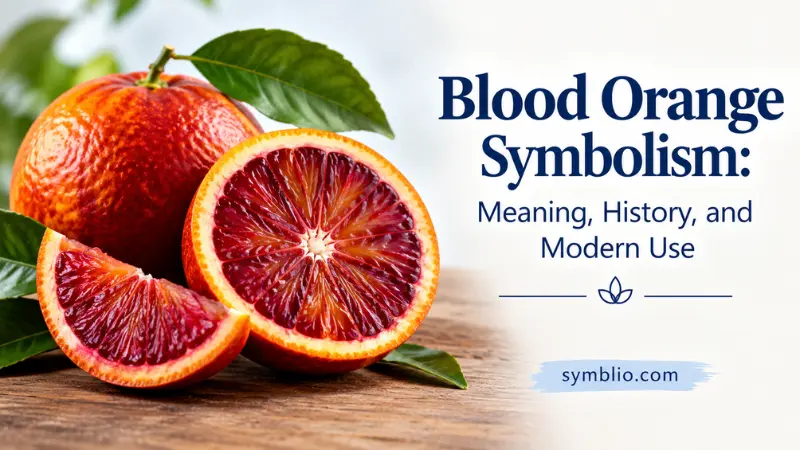
A blood orange is an ordinary citrus fruit with an extraordinary appearance: its flesh can range from orange streaked with ruby red to a much darker crimson. That unusual color gives blood orange symbolism a natural connection to vitality, passion, transformation, contrast, and the relationship between sweetness and intensity. The fruit is especially associated with Mediterranean regions, but its visual appeal has also made it recognizable in contemporary American food, design, and lifestyle culture.
Unlike symbols whose meanings come from a single religious story or established tradition, the blood orange has developed its associations from several sources. Its unusual appearance, seasonal growth, Mediterranean history, and resemblance to blood all contribute to the ways people interpret it.
Today, Americans are more likely to encounter blood oranges at grocery stores, restaurants, farmers markets, specialty food shops, cocktails, desserts, photography, and seasonal design than in formal symbolic traditions. Its meaning therefore tends to be personal and visual rather than fixed.
Quick Answer
In modern American culture, blood orange symbolism commonly suggests vitality, passion, individuality, transformation, and the contrast between sweetness and intensity. Historically, the fruit’s distinctive red pigmentation became associated with Mediterranean cultivation, especially Sicily, while its unusual appearance encouraged later symbolic interpretations involving life, warmth, and emotional intensity.
TL;DR
- Blood oranges commonly symbolize vitality, passion, contrast, and individuality.
- Their red flesh comes from naturally occurring anthocyanin pigments.
- Sicily became strongly associated with blood-orange cultivation and identity.
- Americans often connect the fruit with winter freshness and culinary creativity.
- Its symbolism is usually visual and cultural rather than religiously fixed.
- Modern uses include food styling, design, gifts, photography, and personal expression.
What Does a Blood Orange Look Like?
A blood orange is a type of sweet orange whose flesh contains varying amounts of red or crimson pigmentation. Depending on the cultivar and growing conditions, the interior may have a few reddish streaks or appear dramatically dark red.
The three best-known blood-orange varieties are Tarocco, Moro, and Sanguinello. Tarocco often has orange flesh marked with red, Moro can develop especially dark crimson flesh, and Sanguinello generally shows noticeable red pigmentation.
The red color is not actually blood. It comes primarily from anthocyanins, a group of plant pigments also responsible for red, purple, and blue coloration in many fruits and flowers. In blood oranges, temperature conditions—particularly cooler nights—help encourage anthocyanin development.
That biological explanation matters symbolically. The fruit looks dramatic without being unnatural, making it a useful example of how an ordinary object can acquire meaning simply because it looks different from what people expect.
The Main Symbolic Meanings of Blood Orange
Several ideas naturally cluster around the blood orange.
Vitality comes from its bright orange exterior and vivid interior. Orange is commonly associated with warmth, energy, creativity, and enthusiasm, while the red pigmentation adds a stronger emotional quality.
Passion comes largely from the fruit’s red coloring. Red is frequently associated with love, desire, courage, intensity, and strong emotion. A blood orange combines those associations with the freshness of citrus.
Transformation is another fitting interpretation. From the outside, a blood orange may resemble an ordinary orange. Cut it open, however, and an unexpected interior appears. That contrast makes it a natural metaphor for hidden qualities, change, and discovering something different beneath an ordinary surface.
Individuality also fits the fruit. Blood oranges vary considerably in pigmentation, so no two may look exactly alike. In contemporary design and lifestyle contexts, that unusual appearance can suggest originality rather than conformity.
Finally, the fruit can represent contrast: sweetness alongside acidity, orange alongside red, familiar appearance alongside unexpected interior, and warmth alongside the cool-season conditions that help develop its pigmentation.
Why Red Changes the Meaning of an Orange
Much of the symbolism comes from the meeting of two colors.
Orange generally carries associations with warmth, enthusiasm, creativity, playfulness, sociability, and seasonal abundance. Red introduces a different emotional register, often suggesting passion, urgency, strength, love, or intensity.
When the two appear together inside a single fruit, the result feels more dramatic than an ordinary orange. The symbolism can therefore be understood as a combination rather than a completely separate tradition.
This distinction is important. There is no universal symbolic dictionary that officially defines a blood orange as meaning one particular thing. Instead, people interpret its appearance through familiar cultural associations with citrus, orange, red, food, sunlight, and nature.
The fruit’s symbolism is consequently flexible. In one setting it may communicate romance and passion; in another, creativity or seasonal freshness.
Ancient Roots and the Mediterranean Story
The broader history of citrus reaches far beyond the modern blood orange. Citrus fruits originated in Asia and gradually spread through trade, cultivation, and human migration. Sweet oranges eventually became established in Mediterranean regions, where distinctive varieties developed.
The specific history of blood oranges is more complicated than a simple origin story. Researchers have proposed multiple Mediterranean lines of development, including Italian or Sicilian, Spanish, and other possible ancestral lines. Historical evidence also shows that unusual red-fleshed oranges were known in Italy centuries ago.
This uncertainty is worth acknowledging because blood oranges are sometimes presented as though they originated from one clearly documented event. Their history appears to involve multiple cultivars and mutations rather than one universally accepted starting point.
Sicily nevertheless became particularly important to the identity of the fruit. The island’s blood-orange production is closely connected with the areas surrounding Mount Etna and eastern Sicily.
Sicily, Mount Etna, and Symbolism of Contrast
Sicilian blood oranges provide one of the strongest cultural settings for interpreting the fruit.
The region around Mount Etna combines volcanic landscapes, Mediterranean sunlight, agricultural traditions, and substantial temperature changes between day and night. Those conditions can encourage the anthocyanin pigmentation that gives blood oranges their distinctive appearance.
Symbolically, this creates an appealing contrast: fire and cold, volcanic earth and fruit, sunlight and winter nights.
It is important not to turn that contrast into a claim that Sicilian culture universally treats blood oranges as a formal symbol of transformation or passion. The stronger historical point is that the fruit has become closely identified with Sicily’s agricultural and culinary character.
The symbolism develops from that cultural identity rather than from one ancient doctrine.
Blood Orange Symbolism in the United States
In the United States, blood oranges are usually encountered through food culture rather than formal symbolism.
They appear in winter produce sections, specialty grocery stores, farmers markets, restaurants, desserts, beverages, salads, preserves, and food photography. Their limited seasonal availability can also make them feel like a special winter ingredient rather than an everyday orange.
For American consumers, the fruit often communicates novelty and culinary sophistication. A familiar citrus fruit suddenly reveals red flesh when sliced, making it visually useful for chefs, photographers, designers, and food creators.
Its color also fits contemporary American preferences for visually distinctive foods. A blood-orange slice can add contrast to a dish without artificial coloring, which helps explain why it appears frequently in presentation-focused recipes and food imagery.
In this context, its symbolism is less about ancient ritual and more about natural individuality, seasonal freshness, and creative presentation.
What Blood Oranges Can Represent Emotionally
The emotional interpretation of a blood orange depends heavily on context.
Its orange tones can suggest optimism, warmth, friendliness, and enthusiasm. The red interior can add associations with affection, courage, passion, or emotional intensity.
The fruit’s unexpected interior can also work as a metaphor for personal complexity. Someone might use it symbolically to express the idea that an ordinary exterior does not reveal everything about a person.
That interpretation is especially suitable for artwork, writing, photography, or personal gifts. It should be understood as a modern metaphor rather than a universally established cultural meaning.
The fruit can also suggest balance. Its taste combines sweetness and acidity, while its appearance combines orange and red. Those contrasts make it suitable for representing experiences that contain more than one emotional quality at once.
Blood Orange Symbolism in Food and Hospitality
Food is probably the most important modern setting for the fruit.
Restaurants and home cooks use blood oranges for salads, sauces, desserts, marmalade, garnishes, juices, and other preparations. Their color makes even a simple dish visually distinctive.
That creates several symbolic possibilities.
At a dinner table, blood orange can suggest hospitality, abundance, freshness, and creativity. In a dessert, it may communicate indulgence balanced with tartness. In a winter dish, it can introduce a bright Mediterranean note during a season often associated with darker colors and heavier foods.
The fruit’s appearance also makes it suitable for celebrations where presentation matters. A few crimson citrus slices can change the visual character of a table without requiring elaborate decoration.
Blood Orange Meaning in Art, Photography, and Design
The fruit is particularly effective as a visual subject because its symbolism is visible immediately.
A whole blood orange looks relatively familiar. Once sliced, it reveals a surprising pattern of red, orange, pink, and sometimes dark crimson. That transformation creates a natural visual narrative.
Artists and photographers can therefore use it to suggest:
- hidden identity
- contrast
- change
- natural beauty
- seasonal transition
- vitality
- emotional intensity
In interior and graphic design, blood-orange tones can also function as accent colors. The combination of orange and red tends to feel warmer and more energetic than neutral citrus imagery.
The symbolism works best when the visual context supports it. A blood orange used in a quiet still life may suggest seasonal beauty, while the same fruit placed against dramatic red or black imagery may emphasize intensity.
Blood Orange Symbolism in Gifts and Personal Expression
Giving fruit as a gift can communicate hospitality, generosity, appreciation, or a desire to share something enjoyable. A blood orange adds an element of surprise because its appearance is more unusual than that of a standard orange.
As a personal gift, it can therefore suggest “there is more here than meets the eye.”
That makes it particularly suitable for someone who enjoys cooking, gardening, photography, food culture, or unusual natural objects.
It can also represent freshness or a new experience. Because blood oranges are seasonal, offering them can feel connected to a particular moment of the year rather than being a generic gift.
Blood Orange Symbolism in Tattoos and Personal Style
Blood-orange imagery is less standardized in tattoo culture than symbols such as roses, snakes, butterflies, or traditional citrus motifs. If someone chooses it for a tattoo, the meaning is usually personal.
Possible interpretations include transformation, individuality, vitality, passion, creativity, or an appreciation for nature.
A sliced fruit could emphasize the contrast between appearance and inner identity. A whole fruit might focus more on abundance, natural beauty, or connection to food and place.
The color choice can also change the message. Bright orange may produce a cheerful, energetic effect, while darker crimson tones can make the image feel more dramatic.
There is no single established tattoo definition, so the wearer’s intended meaning matters more than a supposed universal interpretation.
Religious and Cross-Cultural Associations
Blood oranges do not have one widely recognized religious symbolism comparable to objects such as bread, wine, olive branches, or certain flowers.
Citrus fruits themselves have appeared in various cultural and literary traditions. Citrus trees and fruit have been associated with gardens, fragrance, beauty, abundance, and cultivated landscapes in Mediterranean, European, and Islamic cultural settings. Historical literature from the broader Mediterranean and Islamic world contains references to orange trees and their aesthetic qualities.
Some modern sources also describe historical beliefs in medicinal or protective qualities surrounding blood oranges. Such claims belong to folklore and historical belief rather than established scientific evidence.
For that reason, it is better to distinguish cultural symbolism from religious doctrine. A blood orange can appear in culturally meaningful settings without having a universally prescribed religious meaning.
Blood Orange Meaning Across Different Contexts
| Context | Meaning in the USA | Common Associations | Notes |
|---|---|---|---|
| Food | Freshness and creativity | Flavor, color, seasonal produce | Most common modern setting |
| Art | Contrast and transformation | Red, orange, nature | Meaning depends on composition |
| Gifts | Appreciation and individuality | Sharing, novelty | Usually personal rather than traditional |
| Tattoos | Personal transformation or vitality | Passion, identity, change | No fixed universal definition |
| Home decor | Warmth and energy | Citrus colors, winter brightness | Often color-driven symbolism |
Why Blood Orange Symbolism Feels Different From Ordinary Orange Symbolism
An ordinary orange tends to communicate familiar ideas: sunshine, freshness, sweetness, health, and everyday abundance.
The blood orange adds uncertainty and surprise.
Its name immediately draws attention to the red interior, while its appearance challenges expectations about what an orange should look like. That makes its symbolism more dramatic without requiring supernatural explanations.
The fruit can therefore stand for the unexpected within the familiar.
That idea has particular relevance in modern culture, where individuality and originality are frequently expressed through food, fashion, photography, and design. The blood orange offers a naturally occurring visual difference rather than an artificially manufactured one.
Common Misunderstandings About Blood Orange Symbolism
One common mistake is assuming that the fruit’s name means it literally represents death, violence, or something negative. The word “blood” describes the fruit’s reddish appearance; the flesh gets its color from plant pigments, not blood.
Another mistake is treating blood-orange symbolism as an ancient universal tradition. Much of the symbolism commonly assigned to the fruit today is interpretive and modern rather than part of a single historical belief system.
It is also misleading to claim that every red-orange fruit has the same symbolism. Cultivar, cultural context, artistic presentation, and personal experience can all affect interpretation.
Finally, blood oranges should not be confused with Cara Cara oranges simply because both can have pink or reddish flesh. Their pigmentation comes from different compounds and their botanical histories differ.
How the Meaning Has Evolved
The blood orange’s symbolic story has changed alongside its cultural visibility.
Its earliest significance was primarily practical: it was a cultivated citrus fruit valued for its taste and distinctive characteristics. As blood-orange varieties became established in Mediterranean agriculture, particular regions—especially Sicily—became strongly associated with the fruit.
Modern food culture has added another layer. The fruit is now appreciated not only for flavor but also for visual presentation. Photography, restaurant plating, packaging, design, and social media have made unusual natural colors more culturally noticeable.
As a result, contemporary symbolism tends to emphasize individuality, visual contrast, creativity, and seasonal experience.
The historical connection to Mediterranean agriculture remains important, but the modern interpretation is broader.
The Positive and Negative Sides of the Symbol
Blood-orange symbolism is generally positive, but the red coloration can produce different emotional readings.
On the positive side, it can represent:
- vitality
- passion
- courage
- creativity
- warmth
- transformation
- individuality
- abundance
A darker interpretation may associate the red coloring with intensity, danger, blood, or emotional conflict. Those associations are possible because red has multiple meanings across cultures and contexts.
Neither interpretation is automatically correct. The surrounding imagery determines how the fruit is likely to be understood.
A blood orange in a bright kitchen communicates something very different from a solitary blood orange photographed against a dark background.
FAQs
A blood orange commonly symbolizes vitality, passion, individuality, transformation, and contrast. Its meaning comes largely from the combination of its bright citrus character and naturally red interior.
It can be associated with love or passion because its red pigmentation resembles other symbols commonly connected with strong emotion. However, blood orange is not a universally established symbol of romantic love.
A blood orange tattoo can represent individuality, transformation, creativity, vitality, or the idea of having unexpected qualities beneath an ordinary exterior. Because the fruit has no standardized tattoo meaning, personal interpretation is especially important.
There is no single widely accepted religious meaning specifically assigned to the blood orange. Citrus fruits have appeared in various cultural and religious-adjacent traditions, but modern blood-orange symbolism is primarily botanical, culinary, artistic, and personal.
The name refers to its red or crimson flesh, which can resemble the color of blood. The pigmentation comes from naturally occurring anthocyanins rather than anything related to blood.
It can be used as a metaphor for transformation because its ordinary-looking exterior reveals an unexpectedly colored interior when cut open. This is a modern symbolic interpretation rather than a universal historical definition.
In the United States, it most often suggests seasonal freshness, culinary creativity, individuality, warmth, and visual contrast. Americans generally encounter it as a specialty food and design subject rather than as a formal cultural or religious symbol.
Conclusion
Blood orange symbolism grows from an unusual combination of nature, color, history, and modern visual culture. The fruit’s red flesh naturally lends itself to ideas of vitality, passion, transformation, individuality, and contrast, while its Mediterranean history gives it a strong connection with Sicily and the broader citrus-growing traditions of the region.
In contemporary America, blood orange symbolism is usually flexible rather than fixed. It appears most naturally in food, art, photography, design, gifts, and personal expression, where the fruit’s unexpected interior can represent creativity or change.
Its most useful symbolic lesson is also its simplest: something familiar can contain an unexpected character, and sometimes that difference is exactly what makes it memorable.