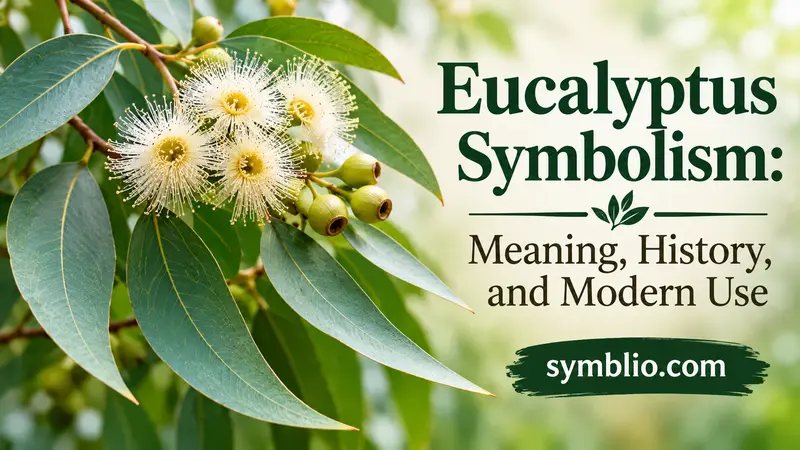
Eucalyptus symbolism centers on healing, renewal, protection, adaptability, and the ability to recover after difficult experiences. Recognized for its aromatic leaves, smooth or peeling bark, and distinctive silvery-green foliage, eucalyptus has become a familiar presence in American floral arrangements, home decor, wellness products, and gardens. Its clean appearance and refreshing scent often suggest a peaceful, restorative environment.
Native primarily to Australia, eucalyptus includes hundreds of species with different shapes, growth habits, and relationships to fire and wildlife. Although people often treat the plant as a single symbol, its meaning depends on the setting. A eucalyptus branch in a wedding bouquet can suggest fresh beginnings, while a dried arrangement in a living room may communicate simplicity, calm, and a connection to nature.
The plant also carries practical associations with traditional medicine, fragrant oils, and the distinctive landscapes of Australia. These connections help explain why eucalyptus can represent both physical restoration and the ability to adapt to changing circumstances. Understanding its symbolism requires separating documented cultural traditions from modern interpretations that have developed through design, wellness culture, and personal experience.
Quick Answer
Eucalyptus symbolism most commonly represents healing, renewal, protection, and resilience in modern American culture, especially in wellness products, floral arrangements, and nature-inspired decor. Its historical associations with traditional plant remedies and its origins in Australia also connect it with restoration, adaptability, and the enduring relationship between people and the natural world.
TL;DR
- Healing: Its aromatic leaves connect eucalyptus with restoration and traditional plant remedies.
- Renewal: Fresh foliage suggests new beginnings, growth, and a clean start.
- Protection: Its association with cleansing inspires modern symbolic interpretations of safety and care.
- Resilience: Many eucalyptus species demonstrate adaptation to challenging environmental conditions.
- Calm: Silvery-green leaves and a fresh scent evoke peaceful, natural surroundings.
- Modern use: Americans incorporate eucalyptus into bouquets, interior design, tattoos, and wellness rituals.
What Eucalyptus Looks Like and Why It Matters Symbolically
Eucalyptus is a genus of evergreen trees and shrubs known for aromatic leaves, varied bark textures, and distinctive foliage. Depending on the species, its leaves may be rounded and silvery when young or long, narrow, and dark green as the plant matures. Some trees develop smooth trunks that shed patches of bark, while others have rough, deeply textured surfaces.
These features give eucalyptus several visual associations. Its persistent foliage suggests continuity, while new leaves and changing bark can suggest growth and renewal. The plant’s fresh scent also connects it with cleanliness and restoration in contemporary American design.
Eucalyptus appears in grocery-store bouquets, wedding arrangements, botanical illustrations, essential-oil packaging, and home accessories. The familiar silver-dollar eucalyptus, with its rounded blue-green leaves, has become especially popular in floral design because it adds texture without overwhelming other flowers.
Its appearance helps explain its modern symbolism. Eucalyptus looks understated rather than extravagant, making it a natural choice for people who associate beauty with simplicity, balance, and an appreciation of the outdoors.
The Core Symbolic Meanings of Eucalyptus
Eucalyptus does not have one universally established symbolic meaning. Its associations arise from its physical characteristics, traditional uses, natural environment, and contemporary presentation.
Healing and restoration are among its most recognizable associations. The leaves of certain eucalyptus species have long been used in traditional remedies, and eucalyptus-derived ingredients appear in some modern products. These practical connections have helped make the plant an emblem of care and recovery.
Renewal comes partly from the tree’s evergreen appearance and the way many species produce new growth. Peeling bark can also suggest the gradual release of an old layer, although this is a modern metaphor rather than a universal traditional belief.
Protection is another common contemporary interpretation. People may associate eucalyptus with creating a clean, comfortable environment or caring for a home. This meaning should not be confused with a historically universal belief that the plant provides supernatural protection.
Resilience reflects the adaptability of many eucalyptus species. Some grow in challenging environments, and certain species have traits associated with recovery after fire. Their responses vary, however, so eucalyptus should not be treated as a single model of survival.
Finally, eucalyptus can symbolize calm and simplicity. Its muted colors, natural texture, and refreshing aroma suit contemporary preferences for uncluttered spaces and nature-inspired design.
Ancient Roots and Indigenous Australian Knowledge
Eucalyptus has its deepest cultural roots in Australia, where eucalypt-dominated landscapes have supported Aboriginal communities for thousands of years. The relationship between people and these trees extends well beyond the abstract meanings often presented in modern symbolism articles.
Different Aboriginal peoples developed detailed knowledge of local plants and their uses. Depending on the species and community, eucalyptus trees supplied materials for containers, canoes, tools, shelters, and other practical objects. Leaves, bark, gum, and other parts also had particular uses in traditional medicine and everyday life.
This knowledge was specific to place, species, and cultural practice. Eucalyptus should not be described as having one shared spiritual meaning across all Aboriginal Australian communities. Indigenous traditions are diverse, and the significance of a particular tree may depend on local knowledge, relationships to Country, and cultural responsibilities.
For example, historical records from southeastern Queensland describe how flowering and bark shedding helped people recognize seasonal changes. Such observations connect eucalypts with environmental knowledge, the timing of natural events, and the resources available in a particular landscape.
These connections offer a more grounded way to understand eucalyptus symbolism. Rather than assuming that every eucalyptus tree represents healing or protection, it is more accurate to recognize how its significance developed through practical experience, cultural relationships, and close observation of the natural world.
How Traditional Healing Shaped Its Symbolism
The association between eucalyptus and healing has a practical foundation. Various Australian communities used particular eucalypt species in traditional remedies, although methods and purposes differed by region. European settlers later adopted some eucalyptus preparations, contributing to the plant’s spread into commercial medicine and household products.
The leaves of certain species contain aromatic compounds, including eucalyptol, also known as 1,8-cineole. This compound contributes to eucalyptus’s characteristic scent and appears in some products designed for specific medicinal uses.
Over time, the plant’s reputation for practical applications became linked with a broader symbolic idea: restoration. A sprig of eucalyptus in a bathroom, a wellness-themed gift, or a relaxation space can communicate a wish for comfort and recovery without making a direct medical claim.
It is important to distinguish symbolism from evidence. A eucalyptus arrangement may remind someone of healing, but a decorative branch does not itself treat an illness. Concentrated eucalyptus oil can also be harmful if swallowed and may irritate the skin or eyes when used improperly.
The symbolic connection remains understandable because people often associate plants with the ways they have historically served human needs. In eucalyptus’s case, the relationship between traditional plant knowledge and modern products has made healing one of its most recognizable interpretations.
What Eucalyptus Symbolizes in the United States
In modern American culture, eucalyptus is especially visible in floral design, interior decoration, personal-care products, and nature-inspired lifestyles. Its symbolism tends to be practical and understated rather than tied to one religious or national tradition.
In homes, eucalyptus may suggest a peaceful atmosphere, a preference for natural materials, or a desire to make an ordinary room feel more inviting. Designers often combine its foliage with wood, linen, ceramic vases, and neutral colors. The resulting visual effect encourages associations with simplicity and balance.
In weddings, eucalyptus commonly appears in bouquets, table arrangements, ceremony decorations, and greenery garlands. Its flexible branches complement roses, lilies, and other flowers, while its subdued color works with many palettes. Within this setting, eucalyptus can suggest a fresh beginning, enduring affection, or a shared life connected to nature. These are contemporary interpretations, not fixed meanings that every couple must accept.
The plant also appears in American wellness culture. Its scent and association with certain personal-care products make it recognizable in soaps, bath products, and relaxation-themed gifts. Here, the emphasis is usually on freshness and self-care.
Unlike flowers such as roses, eucalyptus does not have one dominant romantic meaning in the United States. Its appeal lies in versatility: it can support a message of sympathy, celebration, renewal, or everyday comfort depending on how people use it.
Eucalyptus, Resilience, and the Natural World
Eucalyptus symbolism often includes resilience because many species have adapted to demanding environmental conditions. Some tolerate seasonal drought, while certain species can recover after fire through protected buds, underground structures, or seed regeneration. These traits vary considerably across the genus.
This variability matters. Eucalyptus forests do not all respond to fire in the same way, and some species face serious risks when conditions change. The plant’s reputation for toughness should not obscure the complexity of its ecology.
As a symbol, resilience does not have to mean surviving every hardship without consequences. Eucalyptus can instead represent the capacity to adjust, grow again, and respond to changing conditions. This interpretation suits people who want a botanical image that reflects persistence without suggesting that struggle is always easy.
The meaning may be particularly relevant during periods of transition, such as moving to a new home, beginning a different stage of education, or recovering confidence after a difficult experience. A eucalyptus branch on a desk or a botanical illustration in a room can serve as a quiet reminder that growth often happens gradually.
The tree’s natural characteristics provide the starting point for this interpretation. Personal experience gives it an individual meaning.
The Emotional and Psychological Meaning of Eucalyptus
Plants can influence how people experience a space through color, texture, scent, and personal associations. Eucalyptus brings these elements together in a distinctive way.
Its blue-green and silvery foliage fits comfortably into restrained color schemes. Green is often associated with nature and growth, while pale gray-green shades can appear subdued and gentle. These responses are not universal psychological laws; personal memories, cultural background, and the surrounding environment all affect interpretation.
The aroma of eucalyptus may also remind people of soaps, household products, outdoor environments, or particular experiences of care. Someone who associates the scent with a family member or a comforting routine may find it reassuring. Another person may simply enjoy its fresh smell without attaching a symbolic meaning to it.
This personal dimension explains why eucalyptus works well as a thoughtful gift. It can express concern for someone going through a difficult period, appreciation for a host, or a wish to create a calmer living environment. The message comes from the context and the giver’s intention rather than from a universal code.
Eucalyptus can also suggest emotional boundaries and simplicity in contemporary design. Its restrained appearance may appeal to people who prefer a less crowded environment. In that setting, it represents an aesthetic choice as much as an emotional one.
Eucalyptus in Weddings, Gifts, and Important Life Events
Eucalyptus is frequently chosen for events where people want natural decoration without an overly formal appearance. Its leaves add structure to bouquets, centerpieces, and decorative garlands while allowing brighter flowers to remain the focus.
At weddings, eucalyptus may communicate freshness, continuity, and a connection to the natural world. Couples often use it because it complements both rustic outdoor celebrations and modern indoor venues. Its meaning develops through the wider arrangement, including the flowers, colors, and personal traditions involved.
For sympathy gifts, eucalyptus can offer a quiet expression of care. Its understated appearance may feel appropriate when a dramatic or brightly colored arrangement seems unsuitable. A recipient might interpret it as a gesture of comfort, remembrance, or support, though the plant does not carry a universally recognized mourning meaning.
As a housewarming gift, eucalyptus can represent a welcoming home and the hope that a new space will become comfortable and restorative. In a thank-you arrangement, it can contribute to a message of appreciation without making the gesture seem excessively formal.
| Context | Common American interpretation | Why it fits |
|---|---|---|
| Weddings | Fresh beginnings and continuity | Evergreen foliage complements celebratory flowers |
| Sympathy gifts | Comfort and quiet remembrance | Muted colors create a restrained arrangement |
| Home decor | Calm and simplicity | Natural shapes suit uncluttered interiors |
| Wellness gifts | Care and restoration | Aromatic leaves connect with personal-care products |
| Personal milestones | Adaptability and renewal | New growth offers a metaphor for change |
These interpretations are flexible. A eucalyptus arrangement does not automatically communicate a particular message; the occasion and the relationship between giver and recipient help determine its meaning.
Eucalyptus in Tattoos, Jewelry, and Personal Style
Eucalyptus also appears in botanical tattoos, illustrations, and occasional jewelry designs. Its slender stems and rounded leaves lend themselves to minimalist artwork, fine-line tattoos, and small decorative motifs.
A eucalyptus tattoo may represent personal recovery, a new chapter, perseverance, or a preference for nature-inspired imagery. Someone might choose it after completing a challenging period or to commemorate a meaningful change. Another person may choose the plant simply because they like its shape and color.
The plant’s association with healing can make it suitable for a personal reminder of growth. However, eucalyptus is not a standardized symbol with a single recognized tattoo meaning. Its interpretation depends on the individual and any other elements included in the design.
In jewelry, eucalyptus may appear as a leaf motif, engraved pendant, or botanical pattern. Such designs can communicate an appreciation for the outdoors, understated elegance, or a personal connection to a particular landscape.
Eucalyptus imagery also fits a broader American interest in botanical design. It can appear on stationery, clothing prints, wall art, and digital illustrations. Unlike a symbol with a specific religious or political history, eucalyptus usually leaves room for individual interpretation.
Eucalyptus in Other Cultural Traditions
The most important cultural context for eucalyptus remains Australia, where different communities have long-standing relationships with local eucalypt species. Beyond Australia, the plant’s meaning has spread largely through cultivation, horticulture, commercial products, and decorative use.
As eucalyptus became established in other parts of the world, its practical uses helped shape its public image. In some regions, the trees were planted for timber, shade, drainage projects, or other land-management purposes. Elsewhere, eucalyptus oil and aromatic products made the plant familiar even to people who had never seen a mature tree.
These different experiences can produce different associations. A person who encounters eucalyptus mainly in a garden may connect it with landscape and growth. Someone who knows it through personal-care products may associate it with freshness. Someone familiar with Australian landscapes may connect it with the country’s distinctive vegetation.
It would be misleading to assign eucalyptus one universal spiritual meaning across cultures. Unlike a symbol with a well-established place in a particular religious tradition, eucalyptus does not have one widely shared religious interpretation recognized across the world’s major faiths.
Respectful interpretation starts with the specific culture and context involved. It also recognizes that Aboriginal Australian knowledge is not interchangeable with modern wellness trends or generalized ideas about nature.
Spiritual Interpretations and Modern Rituals
In contemporary spiritual and wellness settings, people sometimes use eucalyptus as a reminder of renewal, intention, or protection. A person might place a branch in a meditation space, include botanical imagery in a journal, or use the plant as a visual marker of a new routine.
These practices generally reflect personal or contemporary spiritual interpretations rather than a single ancient tradition shared by everyone. The symbolism comes from the meaning a person assigns to the plant and the role it plays in a ritual.
For example, someone starting a new chapter might keep a eucalyptus illustration nearby as a reminder to approach change with patience. Another person might associate the plant with a period of recovery and use it to commemorate progress.
There is no need to assume that the plant has supernatural powers for such practices to matter. Objects and natural materials can help people focus their attention, express intentions, and remember commitments.
It is also worth distinguishing eucalyptus itself from other plants that are sometimes confused with it. Eucalyptus belongs to the myrtle family, while tea trees commonly associated with certain essential oils belong to the related genus Melaleuca. Their cultural histories and traditional uses should not be treated as interchangeable.
Common Misunderstandings About Eucalyptus Symbolism
One common misunderstanding is that eucalyptus has a single ancient meaning of protection or purification. These associations appear in contemporary interpretations, but they should not automatically be presented as universal beliefs from ancient cultures.
Another misconception is that every eucalyptus species has the same healing properties. The genus contains hundreds of species, and their chemical composition and traditional uses differ. Symbolic associations with healing do not establish that every plant or product is medically effective.
People may also assume that eucalyptus is native to every region where it grows today. Its principal native range is Australia, with some species extending into nearby regions. Its widespread cultivation in other parts of the world reflects human movement and horticultural choices rather than a universal natural distribution.
The plant’s relationship with fire is another area where oversimplification can cause confusion. Some eucalypts possess traits that support regeneration after certain fires, but eucalyptus forests can also experience severe fire hazards under dry, windy conditions. Resilience does not mean immunity to damage.
Finally, eucalyptus is sometimes presented as inherently cleansing in a spiritual or medical sense. While its aroma and traditional uses explain this association, a pleasant scent does not prove that a plant purifies a room, prevents illness, or offers spiritual protection.
Understanding these distinctions allows eucalyptus to remain meaningful without overstating its history or properties.
How Eucalyptus Symbolism Has Evolved
Eucalyptus’s symbolic development reflects changing relationships between people, plants, and everyday life. In Australia, the trees have long been valued for practical resources and their place in local environments. Aboriginal knowledge includes detailed relationships with particular species, while later European settlers developed additional uses and commercial interests.
As eucalyptus products spread internationally, the plant became associated with aromatic oils, household preparations, and medicinal applications. These uses strengthened its connection with care and restoration.
In contemporary American culture, the plant has gained a distinct decorative identity. Florists use it for texture, interior designers appreciate its muted color, and consumers encounter it in wellness-oriented products. These everyday experiences have encouraged newer meanings involving calm, simplicity, renewal, and self-care.
Social media and modern lifestyle imagery have helped make eucalyptus recognizable as part of minimalist and nature-inspired design. However, popularity does not establish an ancient tradition. Some current interpretations are recent cultural associations rather than inherited beliefs.
The plant’s symbolism continues to change as people use it in new settings. Its most consistent meanings arise from the combination of its appearance, practical history, and the personal significance people attach to natural materials.
FAQs
In modern spiritual settings, eucalyptus is often associated with renewal, protection, clarity, and restoration. These meanings generally reflect contemporary personal practices rather than one universal religious doctrine.
Yes, healing is one of its most common modern associations. This connection draws partly from the traditional use of certain eucalyptus species and their role in contemporary aromatic and personal-care products.
Eucalyptus can represent fresh beginnings, continuity, and a connection to nature. Couples may also choose it for its muted color and ability to complement many different flowers.
Some modern interpretations connect eucalyptus with protection and a sense of safety. However, it does not have one universally established protective meaning across cultures, and decorative use does not provide supernatural protection.
A eucalyptus tattoo may express resilience, personal growth, recovery, or an appreciation for nature. Its meaning depends on the wearer’s experience and the design rather than a fixed symbolic rule.
Eucalyptus does not have one broadly recognized meaning shared by all major religions. Its cultural significance is especially connected to Australian Indigenous knowledge and to the different practical and decorative uses that developed elsewhere.
Eucalyptus is generally interpreted positively in contemporary floral design and home decor because of its associations with renewal, calm, and care. Its meaning can vary, however, according to personal experience and cultural context.
Conclusion
Eucalyptus symbolism brings together healing, renewal, protection, resilience, and calm. Its associations with traditional plant knowledge help explain the connection to restoration, while its evergreen foliage, aromatic leaves, and distinctive appearance support modern interpretations involving growth and a closer relationship with nature.
In the United States, eucalyptus has become a versatile botanical symbol used in weddings, gifts, interior design, tattoos, and wellness-inspired spaces. Its meaning is not fixed, and it should not be confused with a universal religious tradition or a guarantee of medical or spiritual benefits.
Ultimately, eucalyptus offers a grounded way to express care, change, and an appreciation for the natural world. Its significance comes from both the plant’s real history and the meaning people choose to give it.