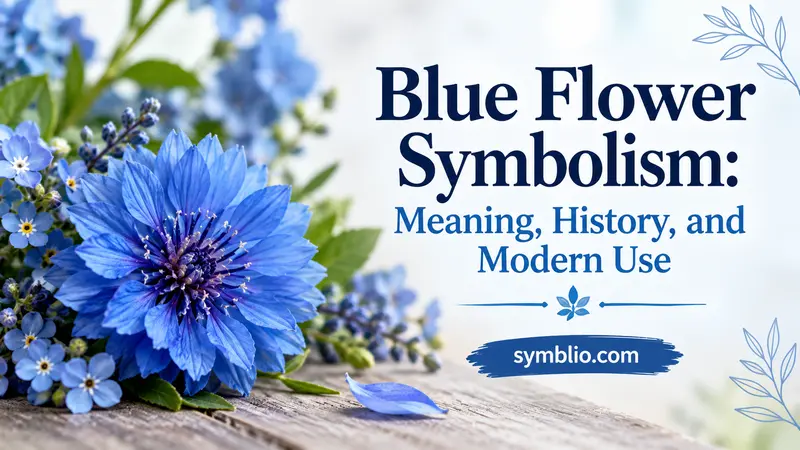
Blue flower symbolism connects the natural beauty of blue blossoms with ideas of peace, hope, devotion, mystery, and the search for something meaningful. From pale blue forget-me-nots to deep blue irises and vivid cornflowers, these flowers carry different associations depending on their species, cultural setting, and the reason someone gives or displays them.
In the United States, blue flowers often appear in gardens, wedding arrangements, sympathy bouquets, artwork, and personal gifts. Their cool colors can suggest calmness and sincerity, while their relative rarity in nature makes them especially noticeable in floral designs.
Unlike a rose, which has widely recognized associations with romantic love, a blue flower does not have one universal meaning. A forget-me-not may represent remembrance, an iris can suggest wisdom or hope, and a cornflower may evoke simplicity, affection, or cultural heritage. Understanding these differences makes the symbolism more useful and less dependent on general color associations.
Quick Answer
Blue flower symbolism most commonly represents peace, hope, trust, devotion, and the desire for something meaningful in modern American culture. Historically, blue blossoms have also been associated with remembrance, spiritual aspiration, romantic longing, and the pursuit of ideals that seem difficult to reach.
TL;DR
- Blue flowers commonly symbolize peace, trust, hope, and devotion.
- Forget-me-nots are closely associated with remembrance and enduring affection.
- Romantic literature connected blue flowers with longing and the search for ideals.
- American weddings and gardens use blue blooms to suggest calmness and sincerity.
- Flower species, cultural traditions, and personal experiences shape individual meanings.
- Blue flower tattoos can express loyalty, memory, individuality, or personal growth.
What Makes a Blue Flower Symbolic?
A blue flower can be a natural blossom, an artistic image, or a flower represented in literature. Its symbolism depends on both its appearance and the associations people attach to it.
Blue flowers range from the nearly white-blue of some forget-me-nots to the saturated indigo of certain irises and the violet-blue of delphiniums. Some have yellow centers, while others display several shades across their petals. Their shapes and growing environments also influence how people interpret them.
Blue is less common among naturally occurring flower colors than white, yellow, or many shades of pink and red. As a result, a blue blossom can feel distinctive without appearing showy. Its visual restraint often suits messages of sincerity, reflection, and quiet affection.
The flower itself matters, too. A blue rose in a painting may represent an impossible dream, while a real forget-me-not has an established association with memory. Treating every blue flower as interchangeable overlooks the botanical and cultural details that give each one its character.
The Main Meanings of Blue Flowers
Blue flowers can communicate several related ideas, but no single interpretation applies in every situation.
Peace and calmness are among the most intuitive associations. Blue skies, distant horizons, and still water influence how many people respond to the color. A blue floral arrangement can therefore create a relaxed atmosphere in a home, garden, or event space.
Trust and loyalty are also common interpretations. Blue often appears in settings associated with dependability and stability, so blue blossoms can make suitable gifts for close friends, relatives, or partners. This meaning is an interpretive convention rather than a universal rule.
Hope and possibility become especially relevant when a blue flower represents a goal or dream. A rare-looking blossom can suggest something worth pursuing, even when it seems difficult to attain.
Remembrance and enduring affection are particularly associated with forget-me-nots. Their small size and familiar name make them appropriate for representing relationships that continue to matter despite distance, separation, or loss.
Longing and imagination arise most clearly in literature and art. The blue flower became a major Romantic literary image for the pursuit of beauty, personal fulfillment, and ideals beyond ordinary experience.
These meanings overlap, but context determines which one becomes most prominent. A bouquet given to a friend may express loyalty, while a blue flower painted beside an open road may suggest hope or an unfinished journey.
Ancient Roots and Early Flower Symbolism
People have associated plants with religious beliefs, seasonal change, healing stories, and human relationships for thousands of years. However, the history of blue flower symbolism does not begin with one ancient civilization or a single established code.
In ancient Mediterranean traditions, flowers appeared in myths, rituals, decorative arts, and accounts of the natural world. Their meanings often depended on the particular plant. Greek mythology, for example, connected certain flowers with stories about gods, heroes, transformation, and mortality.
Blue blossoms also entered European religious and artistic traditions. The cornflower, a vivid blue field flower, appeared in European botanical imagery and religious art. Later interpretations connected it with tenderness, fidelity, and other qualities, although meanings varied across places and periods.
It is important not to project modern color psychology backward onto every historical object. An artist might choose a blue flower because the species was recognizable, because it fitted the composition, or because a particular religious or literary association mattered. The color alone does not prove a fixed symbolic intention.
The more reliable approach is to examine the plant, the artwork, and the historical setting together. That method helps distinguish documented traditions from later explanations that make a flower’s past sound more uniform than it really was.
The Blue Flower in Romantic Literature
One of the most influential literary uses of the blue flower appeared in the unfinished novel Heinrich von Ofterdingen, written by German Romantic author Novalis in the late 1790s and published posthumously in 1802.
In the story, the young protagonist dreams of an extraordinary blue flower. His attraction to it begins a search that extends beyond the desire to see a beautiful plant. The flower becomes associated with poetry, love, imagination, and the pursuit of something that ordinary life cannot fully provide.
This image helped establish the blue flower as a symbol of Romantic longing. Romantic writers often valued imagination, emotional experience, nature, and the individual search for meaning. The blue flower brought these concerns together in one memorable image.
Its significance was not simply that blue represented sadness or peace. The flower suggested a goal that remained compelling even when the seeker could not fully explain or attain it. It could stand for artistic inspiration, an ideal love, spiritual searching, or the desire to understand life more completely.
The image spread beyond the original novel and became a recognizable motif in European Romantic thought. Today, writers and artists may use a blue flower to suggest an elusive dream, a personal quest, or beauty that resists easy explanation.
This literary tradition is one reason the blue flower can carry a more reflective meaning than a straightforward color association would suggest.
Blue Flowers in American Culture
In the United States, blue flowers fit comfortably into a culture where floral gifts communicate affection, sympathy, celebration, and appreciation. Their meaning usually comes from a combination of color, flower type, occasion, and the relationship between the giver and recipient.
A blue bouquet can feel appropriate for a graduation, a birthday, a thank-you gift, or a personal milestone. It may communicate encouragement without the romantic emphasis often associated with red roses. For a friend beginning a new chapter, blue flowers can suggest confidence, optimism, and support.
Blue blossoms also work well in American home and garden design. They complement white flowers, soften bright yellow plantings, and create contrast against green foliage. Gardeners may choose them for a peaceful outdoor space, while florists use them to establish a cool-toned palette for formal events.
Some meanings have more specific American connections. The forget-me-not, for example, is the state flower of Alaska. Its familiar association with remembrance gives it a regional identity as well as a personal one.
These uses are not governed by a single national tradition. American floral customs draw on European flower dictionaries, religious imagery, immigrant traditions, popular culture, and individual preferences. That variety explains why two people might interpret the same blue bouquet differently.
Forget-Me-Nots and the Meaning of Remembrance
Forget-me-nots are among the clearest examples of a blue flower with an established symbolic meaning. Their small blue petals, often surrounding a yellow center, form delicate clusters that look modest beside larger garden flowers. Their common name expresses the message directly: remember me.
The association between forget-me-nots and remembrance dates back to medieval Europe. The flowers appeared in portraits, decorative objects, and expressions of romantic devotion. Their use in European love poetry helped establish them as emblems of fidelity and lasting affection.
A familiar legend tells of a knight who picked the flowers for his beloved but fell into water and called out for her to remember him. The story has circulated widely, but it should be treated as folklore rather than verified history. The flower’s documented cultural use does not depend on whether the legend actually happened.
In modern America, forget-me-nots can represent a loved one who has died, a friendship maintained across distance, or a relationship that remains important after a major change. Their small size also makes them suitable for jewelry, memorial artwork, and understated floral arrangements.
The flower can express both comfort and sadness. Remembering someone may bring happiness, grief, gratitude, or a mixture of feelings. That emotional range is part of what makes the forget-me-not a lasting symbol rather than simply a sign of sorrow.
Cornflowers, Fidelity, and Simplicity
The cornflower, also known as Centaurea cyanus, is a vivid blue flower historically associated with European fields and agricultural landscapes. Its narrow, fringed petals give it a more informal appearance than many cultivated garden flowers.
In European traditions, cornflowers have acquired associations with tenderness, fidelity, and reliability. Their presence among crops and wild plants also connects them with rural life and the seasonal renewal of vegetation. Such associations developed in different settings and should not be treated as one universal interpretation.
For an American audience, a cornflower can suggest natural beauty, simplicity, and an appreciation for wildflowers. It suits informal bouquets, cottage gardens, botanical illustrations, and designs inspired by meadows.
Cornflowers also demonstrate how symbolism can grow from a flower’s physical setting. A bloom encountered among grasses and grain may evoke open land and the rhythms of agriculture, while the same flower arranged in a formal vase may communicate elegance through its color.
Its message is usually gentler than the more specific remembrance symbolism of a forget-me-not. A cornflower can represent affection or dependability, but the intended meaning becomes clearer when the giver explains why the flower was chosen.
Blue Irises, Hope, and Wisdom
Blue irises have a distinctive structure, with upright petals and broad outer segments that create a balanced, almost architectural form. Their appearance makes them popular in gardens, floral arrangements, and decorative art.
The iris has a varied symbolic history. Its name comes from the Greek word associated with the rainbow, and the flower has appeared in European art and heraldic traditions. The fleur-de-lis, a stylized emblem resembling an iris or lily, is particularly associated with French royal imagery, although its exact botanical origin remains debated.
Blue irises can suggest wisdom, hope, faith, and dignity in modern floral interpretation. These associations are not exclusive to blue varieties, nor are they fixed rules. The iris’s historical associations and elegant form often matter as much as its color.
In a bouquet, blue irises can suit a graduation, a professional achievement, or a message of encouragement. They may communicate respect without the strong romantic implications of certain rose colors.
Their upright shape can also make them useful in arrangements intended to convey structure and confidence. The symbolism works best when it supports the occasion rather than replacing a personal message.
Blue Flowers in Religious and Spiritual Traditions
Blue blossoms appear in religious art and spiritual imagery, but their meanings vary significantly by tradition. It is important to distinguish the general symbolism of blue flowers from the specific meaning of a particular sacred plant.
In some Christian art, blue is associated with heaven and the Virgin Mary. Flowers in religious paintings may carry meanings connected with purity, devotion, compassion, or the divine, depending on the plant and the composition. A blue flower does not automatically represent one Christian doctrine or belief.
The blue lotus has a particularly notable history in ancient Egypt, where the blue water lily was associated with the sun, regeneration, and the renewal of life. Its daily opening and closing helped connect the plant with recurring cycles of light and creation.
In Buddhist art, blue lotus imagery can be associated with wisdom and knowledge. The symbolism belongs to a specific religious and artistic context; it should not be transferred indiscriminately to every blue flower or treated as identical to Egyptian lotus symbolism.
For Americans encountering blue flowers in a spiritual setting, the best interpretation depends on the artwork, community, and religious tradition involved. A flower used in a sacred image may communicate something more specific than the peaceful or hopeful meaning it carries in an ordinary bouquet.
What Blue Flowers Mean in Weddings and Celebrations
Blue flowers offer an alternative to the more familiar white, blush, and red floral palettes used in American weddings. Depending on the shade and flower type, they can make an arrangement feel relaxed, formal, romantic, or contemporary.
Pale blue blossoms often pair well with white roses, greenery, and soft neutral fabrics. Deeper blue flowers can create contrast in a bouquet or centerpiece, particularly when combined with white or cream-colored blooms.
Their symbolism may support several wedding themes:
- Trust and commitment: Blue can suggest dependability and faithfulness.
- Peace and harmony: Soft blue arrangements can create a calm atmosphere.
- Hope for the future: Blue blossoms can represent optimism about a shared life.
- Personal remembrance: Forget-me-nots may honor an absent or deceased loved one.
These interpretations are choices, not wedding rules. Blue flowers do not have a universally recognized meaning in American marriage ceremonies, and couples need not follow traditional color associations.
They can also suit baby showers, graduations, retirement celebrations, and milestone birthdays. In these settings, blue flowers often communicate encouragement, appreciation, and good wishes rather than romance.
The most meaningful arrangement is one that reflects the people and occasion. A flower chosen because it reminds someone of a family garden may carry more personal significance than any published list of symbolic meanings.
Blue Flowers in Mourning and Memorial Traditions
Blue flowers can offer a gentle way to express sympathy when words feel difficult to find. Their associations with peace, remembrance, and enduring connection make them suitable for memorial arrangements, cemetery plantings, and flowers sent to someone experiencing a loss.
In American floral customs, blue may evoke heaven or peaceful rest, while forget-me-nots provide a more direct reference to memory. These meanings can work together, but the specific flower and the family’s preferences should guide the choice.
A small arrangement of forget-me-nots may feel personal when honoring someone who loved gardening. Blue irises may suit a larger memorial arrangement where dignity and reflection are central. Blue hydrangeas can create a fuller display, although their symbolism is less standardized than that of forget-me-nots.
Flowers are also used to remember people whose lives continue to shape a family or community. In that setting, blue blossoms can represent an ongoing bond rather than an attempt to explain grief.
There is no universal color code for mourning in the United States. Families may follow religious customs, regional practices, or personal preferences, and some may favor a deceased person’s favorite flowers over traditional choices. A brief note explaining the selection can make a floral tribute more personal and avoid relying on assumptions about color.
The Emotional and Psychological Associations of Blue
Blue often brings to mind open skies, distant mountains, and bodies of water. These visual associations help explain why blue flowers can feel calming or reflective to many people.
In floral design, lighter blues can create a sense of openness, while darker shades may appear more formal or contemplative. A vivid blue blossom can attract attention without relying on the warmth and intensity commonly associated with red or orange flowers.
Color associations are not identical for everyone. A person who associates blue with a childhood garden may experience comfort, while another may connect it with loneliness or a difficult period in life. Cultural experience, memories, and the setting all influence emotional responses.
The shape and condition of a flower also affect its impression. A small wildflower may suggest modesty and familiarity, while a large, carefully arranged blue iris can feel ceremonial. The same color can therefore communicate different emotions through different plants.
It is useful to understand flower symbolism as a language of possibilities rather than a psychological test. A blue bouquet cannot reliably reveal someone’s personality, emotional state, or intentions. It can, however, provide a starting point for expressing a feeling or opening a conversation.
Blue Flowers in Tattoos, Jewelry, and Personal Style
Blue flowers appear in tattoos and personal accessories because they combine recognizable natural forms with a wide range of possible meanings. A person can select a specific flower to connect a design with a memory, relationship, or personal goal.
Forget-me-not tattoos commonly suggest remembrance, enduring affection, or a bond with someone important. Some people choose them to honor family members or friends, while others use them to mark a meaningful period in their lives.
Blue iris tattoos can communicate hope, wisdom, dignity, or personal development. A cornflower design may suit someone drawn to wildflowers, rural landscapes, or European cultural heritage. A stylized blue rose, meanwhile, may represent an unusual dream or an ideal that feels difficult to attain.
Jewelry uses similar ideas on a smaller scale. A blue flower pendant, embroidered blossom, or floral motif on a ring can act as a private reminder of a person or event. The meaning may be obvious to the wearer without being recognizable to everyone else.
In fashion, blue floral prints can convey freshness, elegance, or a connection with nature. Social media illustrations and digital artwork often use blue flowers to establish a reflective, dreamlike mood.
None of these designs has a universal interpretation. The flower species, accompanying imagery, and wearer’s explanation are more informative than color alone.
Common Misunderstandings About Blue Flower Symbolism
Blue flowers are sometimes presented as if they share one fixed meaning across every culture and historical period. That interpretation oversimplifies a tradition shaped by many plants, stories, and artistic choices.
Several distinctions help prevent confusion.
Blue does not always mean sadness. Blue can suggest melancholy in some artistic settings, but it also represents trust, calmness, hope, and devotion. A blue flower may communicate comfort rather than sorrow.
Every blue flower is not a forget-me-not. Remembrance is strongly associated with that particular plant. Other blue blossoms have different histories, and some have no widely established symbolic meaning beyond their appearance.
The blue flower in literature is not simply a symbol of peace. In Romantic writing, especially in Novalis’s work, it represents longing, imagination, and the pursuit of ideals. That literary meaning differs from the everyday associations of a blue bouquet.
Spiritual meanings depend on context. The blue lotus in ancient Egyptian imagery and the blue lotus in Buddhist art belong to distinct traditions. Their meanings should not be blended into a single universal belief.
Modern interpretations are not ancient facts. A flower’s current popularity in tattoos or social media does not prove that people in earlier centuries used it in the same way.
These distinctions do not diminish the value of symbolism. They make it more meaningful by connecting each interpretation to its actual context.
How Blue Flower Meanings Have Changed Over Time
Blue flower symbolism has developed through a combination of folklore, literature, religious art, gardening, and changing social customs. Some associations have persisted, while others have shifted with the way people communicate.
Medieval European use of forget-me-nots connected the flower with love and remembrance. Later, portraits and decorative objects helped carry that association into new settings. By the nineteenth century, the popularity of flower dictionaries in Europe and America encouraged people to interpret bouquets as messages.
Romantic literature added another dimension. Novalis’s blue flower turned an ordinary botanical image into a symbol of artistic longing and the search for an ideal. That literary association remains relevant in modern writing and visual art.
During the Victorian era, floral arrangements could convey feelings that social conventions made difficult to express directly. Yet the meanings in flower dictionaries were not entirely consistent. Different publications sometimes assigned different messages to the same plant, and interpretations changed with fashion.
Modern American flower giving is generally less dependent on formal floral codes. People choose flowers because of color, availability, personal preference, cultural tradition, and the message they want to convey. Symbolism still matters, but it often operates alongside these practical considerations.
The result is a flexible tradition. A blue flower can retain an old association with fidelity while also becoming a contemporary emblem of hope, individuality, or personal remembrance.
Blue Flower Symbolism at a Glance
The following table compares several familiar blue flowers and the meanings commonly associated with them. These are interpretive conventions, not universal definitions.
| Flower or context | Common symbolic meaning | Typical use |
|---|---|---|
| Forget-me-not | Remembrance and enduring affection | Memorials, friendship gifts |
| Cornflower | Tenderness and fidelity | Wildflower bouquets, garden designs |
| Blue iris | Hope, wisdom, and dignity | Celebrations, formal arrangements |
| Blue lotus | Regeneration in ancient Egyptian art; wisdom in some Buddhist imagery | Religious and historical artwork |
| Blue floral arrangement | Peace, trust, or encouragement | Weddings, sympathy gifts, milestones |
When choosing a flower, consider the message you want to communicate, the recipient’s preferences, and the flower’s particular history. That approach is more reliable than assigning the same meaning to every blue blossom.
FAQs
Blue flowers may represent peace, wisdom, hope, devotion, or spiritual aspiration, depending on the flower and religious tradition. The blue lotus, for example, has specific associations with regeneration in ancient Egyptian imagery and wisdom in some Buddhist traditions.
A blue flower can express trust, loyalty, sincerity, or lasting affection. Forget-me-nots are particularly appropriate for representing a relationship that remains important despite distance or separation.
A blue flower tattoo may represent remembrance, hope, individuality, or a personal aspiration. The exact meaning depends on the flower selected and the experience the wearer wants to commemorate.
They can suggest sadness or longing in some artistic and literary contexts, but sadness is not their only meaning. Blue flowers also commonly communicate peace, encouragement, trust, and hope.
Some people interpret a blue flower in a dream as a symbol of hope, emotional calm, longing, or a personal goal. However, dream meanings are subjective, and there is no reliable universal system that assigns a fixed interpretation to a particular flower.
The forget-me-not is the best-known flower associated with remembrance and enduring affection. Its symbolism has roots in medieval European culture and continues in modern memorials, jewelry, and personal gifts.
Yes. Blue flowers can communicate peace, sympathy, and remembrance in funeral and memorial arrangements. Forget-me-nots are particularly suitable when the intention is to honor a lasting connection, although the family’s wishes and cultural traditions should take priority.
Conclusion
Blue flowers combine the natural beauty of their blossoms with meanings shaped by literature, cultural traditions, personal memories, and modern floral customs. They commonly suggest peace, hope, trust, devotion, and longing, while individual flowers contribute more specific associations. Forget-me-nots represent remembrance, irises can communicate hope and wisdom, and the blue flower of Romantic literature expresses the pursuit of an ideal.
Understanding blue flower symbolism means looking beyond color alone. The species, occasion, cultural setting, and personal story all influence what a blossom communicates. Whether used in a bouquet, a garden, a memorial, or a work of art, a blue flower can express a meaningful sentiment without requiring an elaborate explanation.