Ant symbolism centers on hard work, cooperation, patience, organization, and persistence. Ants are small insects, yet their ability to build colonies, gather food, and work together makes them familiar examples of collective effort. In American culture, people often associate ants with diligence, preparation, and the idea that small, consistent actions can produce meaningful results.
Ants appear in gardens, forests, kitchens, children’s stories, educational materials, and popular expressions about work. Their behavior provides an easy way to discuss responsibility, teamwork, and the relationship between individual effort and shared goals. At the same time, ants can represent unwanted persistence, invasion, or the frustration of dealing with a problem that seems minor but keeps returning.
The meaning depends on context. An ant in a children’s book might represent discipline, while an ant tattoo may express independence, resilience, or loyalty to a community. Understanding these different interpretations reveals why such a small creature has become a recognizable symbol of everyday human behavior.
Quick Answer
Ant symbolism commonly represents hard work, teamwork, patience, and persistence in modern American culture. Historically, ants have also represented foresight, disciplined labor, social organization, and the value of preparing for future needs.
TL;DR
- Ants symbolize diligence, cooperation, patience, and steady progress.
- Fables helped establish ants as examples of preparation and responsible work.
- American culture often connects ants with productivity and teamwork.
- Ant colonies illustrate how individuals contribute to a shared purpose.
- Ant tattoos can represent resilience, discipline, and community loyalty.
- Negative interpretations include invasion, conformity, and relentless pressure.
The Physical Traits That Shape Ant Symbolism
Ants are recognizable by their small bodies, six legs, elbowed antennae, and narrow waists. Many species travel along established trails, carry food, and gather around a shared nest. These visible behaviors influence the qualities people associate with them.
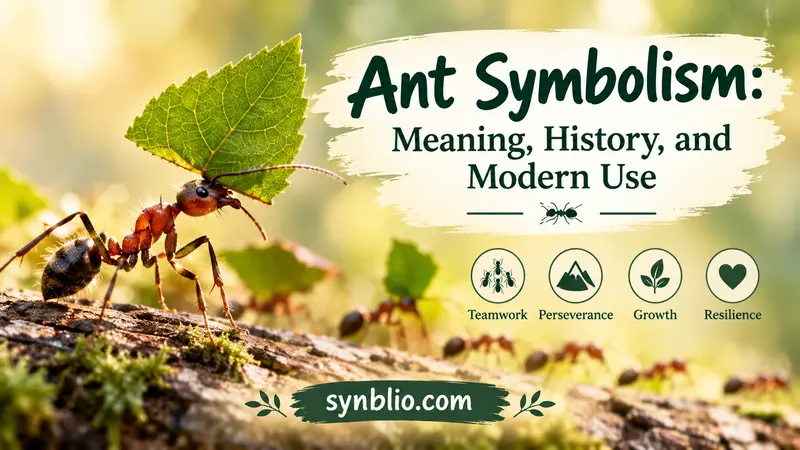
An ant carrying a crumb much larger than its body suggests determination and resourcefulness. A line of ants moving toward a food source illustrates coordination, while a colony repairing its nest can suggest persistence after disruption.
Their size also matters. Ants rarely appear physically impressive when viewed individually, yet their collective activity can change their surroundings. This contrast makes them useful symbols of how modest contributions can produce substantial results.
Ant behavior varies by species, and not every ant gathers food in the same way. The symbolism comes from recognizable patterns rather than a claim that every species follows one universal model.
Hard Work and Consistent Effort
Hard work is one of the most familiar meanings associated with ants. Their constant movement and repeated tasks make them natural examples of diligence, particularly in stories that teach children about responsibility.
In the United States, an ant can represent the person who keeps working toward a goal without expecting immediate recognition. A student studying regularly, a gardener tending plants, or a team member completing small tasks may be described as ant-like in their industry.
This interpretation emphasizes consistency over dramatic achievement. Ants do not build a functioning colony through one extraordinary effort. Their collective activity depends on many repeated actions, making them a useful reminder that progress often develops gradually.
However, hard work is not the same as working without rest. The ant’s symbolic value lies in purposeful effort, not the idea that people must remain productive every moment of the day.
Teamwork, Cooperation, and Community
Ants also symbolize cooperation because many species live in colonies with different roles. Workers gather food, care for young, maintain nests, and respond to changing conditions. Queens generally specialize in reproduction, while other colony members perform different tasks depending on the species.
These colonies offer a familiar example of individuals contributing to a shared goal. In American schools, workplaces, sports teams, and community organizations, ant imagery can communicate the importance of coordination and mutual responsibility.
A group of ants carrying food together may represent a family managing responsibilities, coworkers completing a project, or volunteers helping their neighborhood. The message is that useful contributions do not have to be identical to matter.
Yet this interpretation has a limitation. Human communities depend on individual rights, personal choice, and differences of opinion. Ant colonies cannot serve as perfect models for human society, so their symbolism works best as a lesson in cooperation rather than unquestioning obedience.
Patience, Persistence, and Resilience
Ants rarely accomplish large tasks in a single movement. They travel, gather materials, respond to obstacles, and continue working when conditions change. Their behavior makes them symbols of patience and persistence.
For someone facing a long-term goal, an ant may represent the willingness to continue despite slow progress. It can be a fitting emblem for learning a difficult skill, rebuilding confidence after disappointment, or maintaining a personal commitment.
Persistence does not mean refusing to change direction. Ants adjust their movement when trails become blocked, and people can likewise remain committed to a goal while changing their approach.
The ant’s small size adds another layer to this interpretation. It suggests that resilience does not require appearing powerful. A person can demonstrate determination through ordinary decisions and repeated effort, even when others do not immediately notice.
Preparation, Foresight, and Resourcefulness
Preparation is another major theme in ant symbolism. Ants searching for food and maintaining resources have long provided examples of planning for future needs.
This meaning appears prominently in traditional moral stories, where an ant prepares during favorable conditions rather than assuming that circumstances will always remain easy. The lesson concerns foresight: use available opportunities wisely and consider what may be needed later.
In contemporary American life, this symbolism can apply to saving money, preparing for an examination, organizing supplies before a trip, or developing skills before taking on a difficult responsibility.
Preparation, however, should not be confused with constant worry. The ant represents practical attention to future needs, not the belief that every possible problem must be predicted or controlled.
The symbol can also encourage resourcefulness. Ants make use of available materials and food sources, suggesting that people can often accomplish more by working thoughtfully with what they have.
Ancient Roots of Ant Symbolism
Ant symbolism developed through observation, storytelling, and moral teaching rather than a single historical origin. Different societies noticed the insects’ social behavior, food-gathering habits, and ability to construct complex nests, then interpreted those traits according to their own values.
In ancient Greek tradition, ants became associated with industry and collective effort. The mythological Myrmidons, a people connected with the hero Achilles, were linked by legend to ants. Ancient stories about their origins helped connect the insects with organized groups and disciplined action.
Ants also appeared in ancient Mediterranean discussions of animal behavior and natural order. Writers used them to consider how small creatures could display organization, persistence, and apparent foresight.
These traditions were not identical, and surviving accounts do not establish one universal ancient meaning. Rather, they show that people repeatedly found the ant useful for thinking about work, social organization, and the relationship between individual effort and collective achievement.
The Ant in Biblical and Religious Traditions
One of the best-known historical foundations for positive ant symbolism appears in the Book of Proverbs in the Hebrew Bible. Proverbs 6:6–8 directs readers to observe the ant as an example of diligence and preparation, particularly its gathering of food during the appropriate season.
A related passage in Proverbs 30:24–25 identifies ants among small creatures that display practical wisdom. Their modest size contrasts with their ability to prepare for future needs.
These passages helped establish the ant as a moral example in Jewish and Christian teaching. The insect became associated with responsibility, foresight, and the wisdom of learning from the natural world.
Ants also appear in Islamic tradition. In the Quran, Surah An-Naml, or the chapter known as “The Ant,” includes an episode involving an ant warning its community as Solomon’s forces approach. The passage places the ant within a story about Solomon, his extraordinary understanding, and the wider community of living creatures.
These religious contexts should be understood on their own terms. Biblical moral instruction and the Quranic narrative do not simply assign identical meanings to the insect, even though both show that ants can carry lessons about wisdom and communal life.
The Ant and the Grasshopper in Fables
The familiar story of the ant and the grasshopper helped spread ant symbolism through European storytelling and, eventually, American children’s education.
In the traditional fable, the ant gathers and stores food while the grasshopper spends the favorable season singing. When difficult weather arrives, the grasshopper discovers the consequences of failing to prepare. Versions differ in their details and endings, but the contrast between foresight and carelessness remains central.
The story became a convenient way to teach children about planning, responsibility, and the relationship between present choices and future consequences. In American classrooms and family reading, the ant often serves as the dependable character whose actions demonstrate practical wisdom.
The fable also invites a more complicated interpretation. Work and preparation matter, but rest, play, art, and music have value too. Some modern readers question whether the story places too much blame on the unprepared individual without considering hardship or unequal circumstances.
This tension makes the ant more than a simple emblem of industriousness. It also raises questions about how societies define responsibility and judge people whose circumstances differ.
What Ants Commonly Mean in the United States
In modern American culture, ant imagery most often communicates productivity, teamwork, persistence, and preparation. These associations appear in everyday speech, children’s literature, educational materials, advertising, and illustrations about community effort.
The phrase “busy as an ant” reflects the familiar connection between ants and constant activity. Ants can also represent a reliable worker who completes necessary tasks without seeking attention.
In schools, an ant character may encourage children to cooperate or finish assignments. In workplace illustrations, a colony can stand for employees coordinating different responsibilities. In environmental education, ants may represent the intricate relationships that connect organisms within an ecosystem.
American interpretations also reflect broader cultural discussions about ambition and work. The ant can be praised as an example of discipline, but its endless activity can also resemble the pressure to remain productive.
That contrast is important. An ant may symbolize a dependable team member in one setting and an impersonal workplace culture in another. The surrounding message determines whether its industry feels admirable or exhausting.
Emotional and Psychological Meanings
The ant can represent several emotional qualities because people interpret its behavior through familiar human experiences.
- Confidence through action: An ant suggests that meaningful progress can begin with small, manageable steps.
- Security through preparation: Food gathering and nest maintenance evoke the comfort of being ready for future responsibilities.
- Belonging through cooperation: Colony life can represent a family, team, or community that shares a purpose.
- Determination during difficulty: An ant continuing along a route can suggest patience when a goal takes longer than expected.
- Frustration with constant demands: A stream of ants entering a home may evoke a problem that keeps returning despite repeated efforts to address it.
These meanings are interpretations, not fixed psychological rules. Someone who admires ants may associate them with discipline, while another person may dislike them because of an unpleasant encounter at home.
Personal experience also matters. A person who grew up observing ants in a garden may associate them with summer and curiosity, whereas someone who has struggled with recurring household infestations may connect them with irritation.
The insect itself does not dictate the emotional response. Meaning develops through memory, cultural learning, and the circumstances in which the ant appears.
Ant Symbolism Across Different Cultures
Ant symbolism varies across cultures, although diligence and organized activity recur in many traditions.
In ancient Greek stories, ants could represent industriousness and collective identity. The legendary Myrmidons provide one example of how ant imagery became connected with a group of people.
In Jewish tradition, the ant’s preparation and work appear in biblical wisdom literature and later interpretation. These teachings emphasize practical conduct rather than simply admiring the insect’s physical abilities.
In Islamic tradition, the Quranic account involving an ant and Solomon highlights communication, awareness of danger, and the protection of a community. Its meaning comes from the narrative’s religious context rather than from a general rule that all ants symbolize the same qualities.
Persian literary traditions have also used the ant to express humility, careful movement, and persistence. In some literary settings, the small insect becomes a reminder that a seemingly insignificant creature still deserves consideration.
These examples demonstrate both overlap and difference. Diligence appears in several traditions, but other meanings emerge from specific stories, religious teachings, and literary conventions. It is more accurate to discuss particular traditions than to claim that ants have one universal spiritual meaning.
Positive and Negative Ant Symbolism
Ants are often viewed positively, but their symbolic meaning can change when people focus on different aspects of their behavior.
| Context | Symbolic meaning | Common association |
|---|---|---|
| A line of ants carrying food | Cooperation and effort | Teamwork |
| An ant collecting supplies | Foresight and preparation | Responsibility |
| An ant crossing an obstacle | Persistence and adaptability | Resilience |
| Ants spreading through a home | Intrusion and disruption | Frustration |
| A large colony of identical workers | Conformity or anonymity | Loss of individuality |
Positive interpretations focus on what ants accomplish together. Negative interpretations often focus on what their numbers or persistence can feel like from a human perspective.
A colony may be impressive in a nature documentary but unwelcome in a kitchen. Likewise, a workplace described as an ant colony might be praised for efficiency or criticized for treating employees as interchangeable parts.
Neither interpretation is automatically correct in every situation. Context determines whether the ant represents a healthy form of cooperation or an uncomfortable loss of personal space and identity.
Ant Tattoos, Jewelry, and Personal Style
Ant imagery can make a personal statement about persistence, independence, discipline, or commitment to a group. Because ants are small and recognizable, they also work well in minimalist illustrations and understated designs.
Someone might choose an ant tattoo to commemorate a period of steady effort, represent a family that supports one another, or express pride in working toward a difficult goal. A trail of ants may emphasize a journey, while several ants together may communicate shared responsibility.
Other designs may focus on the insect’s anatomy rather than its traditional symbolism. A detailed ant illustration can reflect an interest in entomology, nature, or scientific observation without making a statement about personality.
Ant jewelry and clothing are less common than designs featuring butterflies, birds, or bees, but the insect can still appear as a playful or unconventional motif. Its meaning may be personal rather than widely recognized.
There is no established universal meaning for an ant tattoo. Before interpreting someone else’s design, it is best to consider the person’s own explanation instead of assuming that the image represents hard work or loyalty.
Ants in Nature, Education, and Popular Culture
Ants are familiar in American environmental education because their colonies provide accessible examples of cooperation, communication, and ecological relationships. Observing ants can introduce children to questions about how organisms obtain food, respond to obstacles, and interact with their surroundings.
Their appearance in cartoons and children’s books also makes them useful characters. An ant may be portrayed as a determined worker, a clever problem-solver, or a small hero whose persistence helps overcome a challenge.
In advertising, ant imagery can communicate efficiency and coordination. A company may use a colony to suggest that many employees contribute to a common goal, although the same imagery can seem impersonal if the message emphasizes output above individual well-being.
Online, illustrations of ants may accompany motivational messages about consistency or teamwork. These uses generally draw on established associations rather than a newly developed symbolic tradition.
Real ants also have ecological roles. Many species influence soil, disperse seeds, consume other organisms, or help break down organic material. Awareness of these functions can shift the ant’s meaning from a moral example of work toward a broader reminder that small organisms can contribute to larger environmental systems.
Common Misunderstandings About Ant Symbolism
One common misunderstanding is that seeing an ant automatically signals good luck, financial success, or an approaching life change. These interpretations appear in some contemporary spiritual discussions, but they are not universal beliefs supported across cultures.
Another misconception is that every ant represents teamwork. Although many ants live in colonies, species differ in their behavior, and an isolated ant may carry a different personal meaning from a large group.
Ants are also sometimes described as symbols of blind obedience. Their colony organization can invite comparisons with strict hierarchies, but applying human moral judgments directly to insect behavior can oversimplify both ants and human societies.
Finally, the presence of ants in a house does not establish a spiritual message. In ordinary circumstances, ants enter buildings while searching for food, water, or shelter. A person may choose to interpret the encounter symbolically, but that interpretation remains personal rather than a demonstrated prediction.
Separating natural behavior from cultural interpretation allows the symbol to remain meaningful without treating every encounter as an omen.
How Ant Symbolism Has Changed Over Time
Ant symbolism has shifted as people have used the insect for different purposes. Early moral and literary traditions often emphasized diligence, foresight, and the value of preparing for difficult seasons.
Religious texts reinforced some of these associations by presenting ants as examples from the natural world. Fables then made the lessons accessible to children through memorable characters and contrasting choices.
In modern America, these older meanings remain familiar, but the ant now appears in discussions about teamwork, productivity, ecology, and social organization. Its image can illustrate the value of cooperation while also raising questions about pressure to work constantly or conform to group expectations.
Personal expression has added further possibilities. In tattoos and artwork, an ant can represent a specific experience or commitment rather than a shared cultural rule.
The central idea has not disappeared: a small creature can accomplish something significant through repeated effort and interaction with others. What has changed is how people evaluate that lesson. Contemporary interpretations increasingly leave room for balance, individual identity, and the limits of constant productivity.
FAQs
Ants are often interpreted as symbols of diligence, patience, preparation, humility, and cooperation. Spiritual interpretations differ by tradition, so an ant does not have one universally accepted religious meaning.
Ant symbolism is usually positive when it emphasizes teamwork, persistence, and foresight. It can become negative when ants represent intrusion, conformity, or the pressure to remain constantly busy.
An ant tattoo may represent hard work, resilience, independence, loyalty, or belonging to a community. Its intended meaning depends on the design and the person who chooses it.
In Proverbs, ants serve as examples of diligence and preparation. Their habit of gathering food illustrates practical wisdom and the importance of considering future needs.
A group of ants commonly represents cooperation, shared responsibility, and collective effort. Depending on the context, it may also suggest conformity or the loss of individual recognition.
Some contemporary spiritual interpretations associate ants with prosperity, progress, or favorable outcomes, but this is not a universal cultural belief. Traditional ant symbolism more consistently emphasizes work, preparation, and persistence.
Ants perform repeated tasks and often navigate obstacles while searching for resources or maintaining their nests. People interpret these behaviors as examples of steady effort rather than immediate results.
Conclusion
Ant symbolism connects a small, familiar insect with some of the most recognizable features of human life: hard work, cooperation, preparation, patience, and resilience. Its place in biblical teaching, classical stories, children’s fables, and modern American culture shows how observations of nature can become lessons about responsibility and community.
The symbol also has limits. Ants can represent unwanted intrusion, excessive productivity, or conformity, depending on the circumstances. In the end, ant symbolism offers a practical reminder that small actions matter, cooperation has value, and persistence works best when guided by purpose and balance.