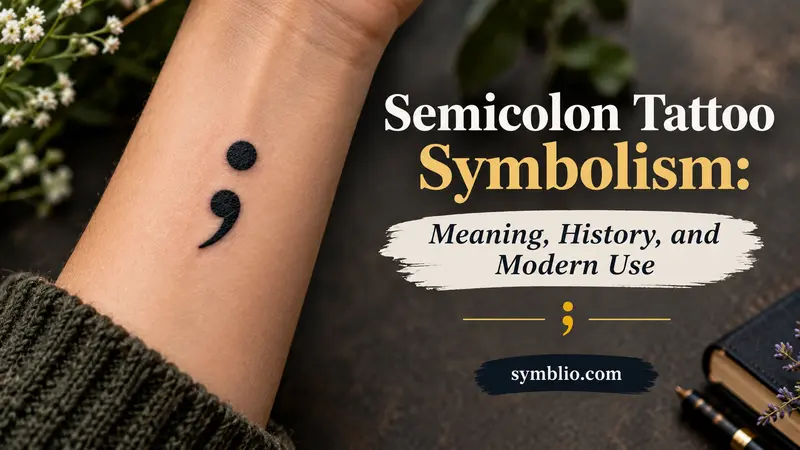
A semicolon tattoo is a small punctuation mark with a meaning that can extend far beyond grammar. In modern American culture, semicolon tattoo symbolism is closely associated with hope, mental health awareness, perseverance, and the decision to keep moving forward through difficult periods of life. For many people, the mark represents a personal story that they may not feel comfortable explaining in detail.
In writing, a semicolon connects two closely related independent clauses when a writer could have ended the first sentence instead. The sentence continues, even though a full stop was possible. This grammatical function inspired a metaphor that became widely recognized in mental health awareness movements: a person’s story is not over simply because life has become difficult.
Today, people choose semicolon tattoos for different reasons. Some want to recognize their own progress, while others use the mark to honor someone they care about or remember a person they have lost. Its meaning is personal rather than universal, and not everyone with this tattoo has the same experience or intention.
Understanding the symbol requires looking at its grammatical origins, its development within mental health advocacy, and the ways people interpret it in contemporary American life.
Quick Answer
A semicolon tattoo commonly symbolizes hope, perseverance, and continuing one’s life story through difficult times, particularly in modern American mental health awareness culture. Its meaning comes from the punctuation mark’s role in connecting clauses rather than ending a sentence, while its broader significance developed through personal storytelling and suicide-prevention advocacy.
TL;DR
- Hope: Represents the possibility of continuing after difficult experiences.
- Perseverance: Reminds the wearer that setbacks do not define an entire life.
- Mental health awareness: Often expresses support for people facing emotional challenges.
- Remembrance: Can honor someone who experienced mental health struggles or died by suicide.
- Personal growth: Marks a meaningful transition, recovery, or renewed commitment to the future.
- Individual meaning: The tattoo’s significance depends on the wearer’s experiences and intentions.
How the Semicolon Became a Symbol of Hope
The semicolon existed as a punctuation mark long before it became associated with mental health. Its modern tattoo meaning, however, has a specific origin in the United States rather than an ancient spiritual or traditional tattoo practice.
In 2013, American mental health advocate Amy Bleuel established Project Semicolon in memory of her father, who had died by suicide. The initiative encouraged people to use the semicolon as a sign that their lives and personal stories could continue despite painful experiences. The message spread through social media, where people shared drawings and tattoos of the punctuation mark.
The idea was easy to understand without a lengthy explanation. In a sentence, a semicolon allows one thought to continue into another. Applied to a person’s life, it suggests that a difficult chapter does not have to define the whole story.
This association gave the mark a recognizable place in mental health awareness. People who had experienced depression, grief, addiction, or other personal difficulties found a way to express solidarity without sharing private details publicly.
The movement grew beyond its original setting, and the semicolon became recognizable internationally. Its spread illustrates how an ordinary punctuation mark can acquire a new cultural meaning when people collectively adopt it to express an experience.
What the Semicolon Represents in Modern American Culture
In the United States, a semicolon tattoo most commonly communicates hope and continued living. It can also represent the importance of mental health conversations, compassion for others, and respect for the complexity of personal experiences.
Its meanings often overlap, but the emphasis varies from one wearer to another.
- Hope: The future remains open, even when the present feels difficult.
- Resilience: A person can experience setbacks without being defined by them.
- Awareness: Mental health deserves honest discussion rather than shame or silence.
- Solidarity: People experiencing emotional difficulties should not have to feel isolated.
- Remembrance: The mark can honor someone whose life was affected by mental health struggles.
- Personal agency: A person can recognize their own role in shaping what comes next.
The symbol is particularly suited to American tattoo culture because it communicates an idea with very little imagery. A small mark can carry a personal story while leaving the wearer in control of how much they reveal.
Its popularity also reflects broader efforts to make conversations about mental health more open. A tattoo may prompt a supportive conversation between friends or help someone explain why the subject matters to them.
Nevertheless, the mark does not communicate one fixed biography. Some wearers have personal experience with mental health challenges; others choose it to support a friend, recognize a loved one, or express a general commitment to compassion.
The Grammar Behind the Symbol
Understanding the tattoo begins with the punctuation itself.
A semicolon joins two independent clauses that are closely related in meaning. For example:
The road was difficult; the journey continued.
Both parts can stand as complete sentences, but the semicolon connects them into one grammatical unit. It signals a relationship between the ideas rather than ending the first thought with a period.
That function provides the foundation for the tattoo’s modern metaphor. The first clause represents a difficult chapter, while the second suggests that another part of the story remains possible.
The distinction matters because the symbol is not simply about pausing. A semicolon connects what came before with what follows. Its meaning includes continuity, not just a moment of rest.
For many wearers, the punctuation also suggests that a person’s life cannot be reduced to one event, diagnosis, mistake, or period of suffering. Experiences belong to a larger narrative, and future chapters may bring new relationships, opportunities, and understanding.
This interpretation makes the semicolon meaningful even to people who have never studied grammar closely. Its shape is familiar, and its literary function offers a straightforward visual metaphor.
Semicolon Tattoos and Mental Health Awareness
Mental health awareness is the most widely recognized context for the semicolon tattoo in contemporary American culture. The design can communicate that emotional well-being matters and that people experiencing mental health difficulties deserve understanding and support.
It also challenges the assumption that someone must explain their private experiences before others take their feelings seriously. A small tattoo can express an affiliation with mental health awareness without revealing a diagnosis or personal history.
Some people choose the mark to acknowledge progress in therapy or recovery. Others use it to show support for family members, friends, or wider communities affected by mental health challenges. In these cases, the tattoo can act as a reminder of empathy and the importance of asking for help when needed.
The design should not, however, be treated as a clinical indicator. Seeing a semicolon tattoo does not establish that someone has a particular diagnosis, has experienced a crisis, or currently needs intervention. Its meaning depends on the individual.
The broader lesson is that visible symbols can open conversations, but they cannot replace listening, professional care, or meaningful support. The tattoo is a reminder of a message, not proof of someone’s circumstances.
The Emotional and Psychological Meaning of the Tattoo
Symbols can help people organize experiences that are difficult to explain in ordinary conversation. A semicolon tattoo may serve as a physical reminder of a personal commitment, an important turning point, or the support someone received during a challenging period.
Its value does not come from the ink itself. Rather, the wearer assigns meaning to the mark and connects it with memories, relationships, or intentions.
For one person, the tattoo might recall the encouragement of a trusted friend. For another, it may represent the decision to approach the future with patience instead of judging life by a difficult season. Someone else may wear it as a reminder to treat other people’s struggles with kindness.
The symbol can also offer a sense of belonging. Recognizing the same mark on another person may create an opportunity for understanding, although neither person is obligated to discuss personal matters.
There is an important distinction between a reminder and a guarantee. A tattoo cannot resolve mental health difficulties by itself, and wearing one does not mean that someone will never struggle again. Its significance lies in what the person chooses to remember and how that meaning fits into their life.
Common Semicolon Tattoo Designs and Their Meanings
Although the punctuation mark is simple, tattoo artists and wearers interpret it in several visual styles. Additional elements can make a design more personal, though they do not have universal meanings.
Common designs and their usual associations
| Design | Common association | What to keep in mind |
|---|---|---|
| Plain semicolon | Hope, continuity, perseverance | The simplest version is also the most recognizable. |
| Semicolon with a butterfly | Change, growth, renewal | The butterfly adds a separate symbol of transformation. |
| Semicolon with a flower | Growth, care, remembrance | The flower’s meaning depends on its type and color. |
| Semicolon with a heart | Love, compassion, solidarity | Often emphasizes relationships and emotional support. |
| Semicolon with a short phrase | Personal commitment or encouragement | The words give the design a more individual message. |
A plain semicolon often appeals to people who prefer understated designs. Its recognizable shape carries the central meaning without needing extra decoration.
A butterfly can introduce the idea of transformation, while flowers may suggest growth or remembrance. A heart often emphasizes care for oneself or others. When paired with a short phrase, the semicolon becomes part of a larger statement.
These combinations are personal interpretations rather than an official visual language. There is no single design that makes a tattoo more authentic or gives it greater significance.
Why the Wrist Is a Popular Placement
The wrist became closely associated with semicolon tattoos during the movement’s early growth on social media. A small design in this location is easy to notice, making it suitable for people who want a visible reminder or hope to encourage conversations about mental health.
Other people prefer a placement that remains covered by everyday clothing. A tattoo on the upper arm, shoulder, ankle, or another less visible area can hold the same personal significance without inviting frequent questions.
Placement can influence how the tattoo functions in daily life. A visible mark may serve as a conversation starter, while a more private one may feel like a personal keepsake.
There is no official or required location for the design. The wrist is not a measure of commitment to mental health awareness, and a tattoo in another location is no less meaningful. The choice depends on comfort, personal preference, and the wearer’s reasons for choosing the symbol.
It is also worth remembering that people who notice the tattoo may recognize its public meaning but know nothing about the individual wearing it. The location should never be treated as evidence of a person’s past experiences.
The Role of Social Media and Popular Culture
Social media helped turn the semicolon from a punctuation mark into a widely recognized emblem of mental health awareness. People could share photographs, personal reflections, and messages of support with audiences far beyond their immediate communities.
The mark also reached mainstream entertainment. Its appearance in connection with the television series 13 Reasons Why helped introduce the symbol to additional viewers and contributed to public discussion of youth mental health.
Online sharing changed how people encounter symbolic tattoos. A viewer might learn the meaning through a post, recognize it in a photograph, or see someone discuss it in a video. Repeated exposure helped establish a common association between the punctuation mark and the idea of continuing one’s story.
Digital culture also allows the symbol to appear without a permanent tattoo. People can draw a semicolon on paper, include it in a profile image, or use it in artwork supporting mental health awareness.
However, social media can simplify complex personal experiences into short captions and recognizable images. A semicolon may encourage a conversation, but it cannot explain every person’s circumstances. The most respectful interpretation leaves room for individual differences instead of assuming that all wearers share one story.
Semicolon Tattoos as Remembrance
Not every semicolon tattoo focuses on the wearer’s own experiences. Some people choose it in memory of a family member, friend, or other person whose life was affected by mental health challenges.
For someone who has experienced bereavement, the mark can provide a small, enduring connection to a loved one. It may be combined with initials, a meaningful date, a flower, or another personal detail. In other cases, the punctuation stands alone because its public meaning already communicates enough.
Remembrance tattoos often allow people to maintain a connection with someone while recognizing that grief is personal. The design does not need to tell a complete story for it to matter to the person wearing it.
A semicolon may also represent solidarity with people who are still facing challenges. In that context, the mark is less about looking backward and more about expressing care in the present.
These meanings can coexist. Someone may wear the tattoo to remember a loved one, recognize their own progress, and encourage more open discussion about mental health.
The important point is that remembrance does not require a particular design or public explanation. The meaning belongs first to the person who chooses it.
Religious and Cross-Cultural Interpretations
The semicolon tattoo is not an ancient religious emblem with one established meaning across cultures. Its modern association with mental health awareness developed in the twenty-first century through a contemporary American movement.
People from different religious and cultural backgrounds may nevertheless incorporate the mark into their own understanding of hope, perseverance, or the continuation of life. Someone with a Christian background, for example, might connect it personally with faith and the possibility of renewal. Another person may understand it through a secular perspective centered on resilience and human connection.
These interpretations should not be confused with a universal religious teaching about the punctuation mark. The semicolon does not have a standard role in Christianity, Islam, Judaism, Buddhism, Hinduism, or other major religious traditions comparable to a traditional sacred symbol.
Its meaning is better understood as a modern cultural metaphor that people can incorporate into their existing beliefs.
The same principle applies across national boundaries. The tattoo has spread internationally, but its public association with mental health advocacy developed through a particular American initiative. People elsewhere may adopt that meaning or attach additional significance based on their own experiences.
What the Semicolon Means in Relationships and Community
Beyond individual identity, the semicolon can communicate support within families, friendships, and communities. Two friends might choose matching designs to acknowledge a period when they supported one another. A family member might wear the mark as a reminder to approach mental health conversations with patience and care.
Matching tattoos do not have to suggest identical experiences. They may represent a shared commitment to remain supportive, respect personal boundaries, or make space for honest conversations.
The symbol can also function as a quiet sign of solidarity in public settings. Someone who recognizes it may understand that the wearer values mental health awareness, even without knowing the details of their life.
Still, a shared symbol should not create an expectation that people disclose private experiences. Wearing the same tattoo does not automatically establish a close relationship, and recognizing the design does not give anyone permission to ask intrusive questions.
In its community role, the semicolon is most useful when it encourages respect rather than assumptions. It can help people find common ground while allowing each individual to decide what they wish to share.
Misunderstandings About Semicolon Tattoo Symbolism
Because the semicolon has a recognizable public meaning, people sometimes assume too much about those who wear it. Understanding the difference between the symbol and the individual is essential.
Misunderstanding: Everyone with a semicolon tattoo has experienced a mental health crisis.
The design is associated with mental health awareness, but people choose it for different reasons. Some have personal experiences they want to acknowledge; others wear it to honor or support someone else.
Misunderstanding: The tattoo guarantees that someone has recovered.
A tattoo can mark an important moment or intention, but it cannot establish someone’s current emotional well-being. Personal growth is not always straightforward, and the symbol does not tell the whole story.
Misunderstanding: The semicolon has an ancient spiritual origin.
The punctuation mark has a longer history in writing, but its modern tattoo association with mental health awareness is a contemporary development that gained recognition in 2013.
Misunderstanding: A person must explain the tattoo when asked.
The meaning may be private, and no one owes strangers a personal account of their experiences. A respectful response accepts that boundary.
Misunderstanding: There is only one acceptable design.
A plain semicolon, a decorated version, and a semicolon incorporated into a larger piece can all communicate the same general idea. Individual choices determine the details.
Separating assumptions from established meaning helps preserve the symbol’s purpose. The tattoo can encourage empathy, but it should never become a label used to judge someone else’s life.
How the Symbol’s Meaning Has Evolved
The semicolon’s development illustrates how cultural symbols can change when communities adopt them for new purposes.
Originally, its role was grammatical: it connected related clauses within a sentence. In 2013, Project Semicolon gave the mark a modern public association with mental health awareness, personal perseverance, and continuing one’s life story. Social media then helped carry the idea into tattoo culture and mainstream entertainment.
As the design spread, its use expanded beyond people sharing their own experiences. It became a way to remember loved ones, express solidarity, and make mental health awareness visible in everyday life.
The symbol also entered digital culture, where people could share it without committing to a permanent tattoo. Its simple shape made it easy to reproduce in drawings, graphics, and personal artwork.
By 2026, the semicolon remains recognizable as a mental health awareness symbol, although its significance is not identical for every person. Some wearers emphasize personal resilience, others focus on remembrance, and some simply want to support a cause that matters to them.
Its evolution demonstrates that a symbol can maintain a shared public meaning while leaving room for individual interpretation. The basic punctuation mark remains unchanged, but the stories people associate with it continue to vary.
Choosing a Semicolon Tattoo for Personal Reasons
Anyone considering a semicolon tattoo can begin by thinking about what the mark means to them. The design may represent a personal milestone, support for someone they care about, or a general belief in compassion and continued growth.
Some people prefer the traditional punctuation mark because its meaning is widely recognized. Others add a flower, butterfly, heart, or short phrase to connect it with a particular memory or value.
It can also help to consider whether the tattoo should be visible or private. A visible design may invite questions, while a less noticeable placement can preserve its personal nature. Neither approach is more meaningful than the other.
The decision should be based on personal significance rather than pressure to follow a trend. A tattoo does not need to prove resilience, explain a difficult experience, or communicate a message to everyone who sees it.
For younger people in particular, a permanent tattoo is a decision worth taking time over and discussing with a trusted adult. The underlying message can be meaningful without requiring an immediate permanent commitment.
Ultimately, the value of the design comes from the intention behind it. Its simplicity allows the wearer to carry a reminder without having to tell the world everything that reminder represents.
FAQs
A semicolon tattoo has no single established spiritual meaning. Some people connect it with faith, renewal, or a belief in new beginnings, while others interpret it through personal growth and mental health awareness.
No. Although mental health awareness is its best-known modern association, the tattoo can also represent support for a loved one, remembrance, perseverance, or a personal commitment to keep growing.
The wrist offers a visible location for a small design that the wearer can easily notice throughout the day. Some choose it as a reminder or conversation starter, but there is no required placement.
This combination often brings together the semicolon’s association with continuing one’s story and the butterfly’s common associations with change and transformation. The exact meaning depends on the wearer’s intentions.
Yes. Its modern association with mental health awareness grew through Project Semicolon, founded by Amy Bleuel in 2013 in memory of her father. The organization helped popularize the mark as a symbol of hope and continued living.
Yes. Some people use it to remember a loved one whose life was affected by mental health struggles or to express ongoing care for their memory. Additional details, such as initials or a flower, may make the tribute more personal.
It is generally associated with hope, perseverance, compassion, and mental health awareness. However, its meaning depends on context, and it should not be used to make assumptions about the emotional state or personal history of the person wearing it.
Conclusion
Semicolon tattoo symbolism centers on hope, perseverance, mental health awareness, and the idea that a difficult chapter does not have to define an entire life. Its modern meaning developed through Project Semicolon in 2013 and spread as people adopted the punctuation mark to express personal experiences, remember loved ones, and show solidarity.
The tattoo’s appeal lies in its simplicity. A small mark can communicate a recognizable message while allowing each wearer to decide how much of their personal story they wish to share.
Ultimately, the semicolon is a reminder that a person’s life cannot be understood from a single symbol or moment. Its most meaningful message is the space it leaves for what comes next.