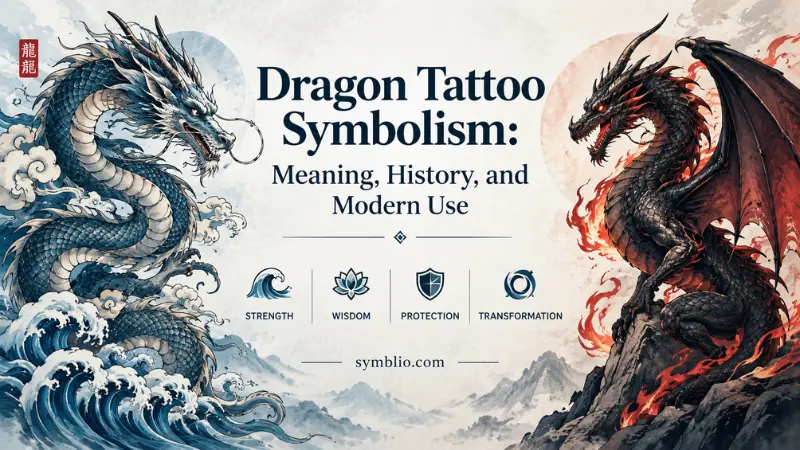
Dragons are among the most recognizable creatures in mythology, appearing in art, stories, architecture, and body art across many cultures. Dragon tattoo symbolism can represent strength, protection, independence, transformation, wisdom, or personal identity, depending on the dragon’s design and cultural tradition.
For many Americans, a dragon tattoo is less about following one fixed legend and more about choosing an image that expresses a personal quality or life experience. The style, pose, color, and cultural inspiration can significantly change what the tattoo communicates.
Quick Answer
Dragon tattoo symbolism commonly represents strength, protection, independence, and personal transformation in modern American tattoo culture. Historically, dragons have carried very different meanings across cultures, ranging from guardianship and good fortune to danger, chaos, and the defeat of evil.
TL;DR
- Dragons often symbolize strength, protection, independence, and transformation.
- Chinese dragons traditionally differ from European dragons in appearance and symbolism.
- Dragon tattoos can express identity, resilience, ambition, or personal change.
- Color and posture can significantly alter a dragon tattoo’s meaning.
- Modern American designs often combine multiple cultural and artistic influences.
- Some dragon imagery carries cultural associations that deserve respectful treatment.
What a Dragon Tattoo Represents
A dragon tattoo can communicate several ideas at once. Strength is one of the most common interpretations because dragons are traditionally portrayed as formidable creatures capable of overcoming powerful opponents.
Protection is another frequent meaning. A dragon may be depicted guarding treasure, sacred places, people, or important objects. When used in a tattoo, that protective role can become personal, representing family, personal boundaries, or something the wearer considers worth defending.
Other common interpretations include:
- Courage
- Independence
- Leadership
- Wisdom
- Resilience
- Transformation
- Ambition
- Freedom
- Mystery
- Personal power
The meaning is rarely determined by the dragon alone. A snarling dragon surrounded by flames sends a different message from a calm, cloud-covered dragon holding a pearl.
Ancient Roots and Early Dragon Symbolism
Dragon traditions developed independently in different parts of the world, so there is no single historical meaning for the creature.
In East Asian traditions, dragons were often associated with water, rain, weather, authority, and auspicious forces. Chinese dragons in particular became closely connected with imperial symbolism and ideas of legitimate authority. Their appearance also differs from the winged, fire-breathing creature familiar from many Western stories.
European dragon traditions developed differently. Medieval stories often portrayed dragons as dangerous creatures that heroes confronted or defeated. Christian-era European art sometimes used dragons as representations of evil, temptation, or forces opposed to righteousness.
Ancient and medieval dragon imagery therefore included both positive and negative associations. Modern tattoos often draw selectively from these traditions rather than reproducing one historical interpretation exactly.
Dragon Symbolism in the United States
In the United States, dragon imagery has become part of a broad visual vocabulary influenced by mythology, fantasy literature, movies, gaming, martial arts, Asian-inspired art, and tattoo traditions.
American tattoo culture frequently treats dragons as symbols of individuality. Someone may choose one because the creature represents determination, independence, or the ability to overcome difficult circumstances.
Dragons also fit American tattoo aesthetics because their bodies naturally create dynamic compositions. Long serpentine forms can wrap around an arm or leg, while wings, claws, horns, flames, clouds, and scales give tattoo artists numerous ways to build a large design.
There is no universally recognized American interpretation. Personal experience often matters more than a dictionary-style definition.
Chinese Dragon vs. European Dragon Tattoos
One of the most important distinctions is between Chinese and European dragon imagery.
| Dragon Style | Common Associations in the USA | Traditional Influences | Visual Features |
|---|---|---|---|
| Chinese-inspired | Fortune, authority, protection, wisdom | Chinese mythology and art | Serpentine body, clouds, water, pearl |
| Japanese-inspired | Strength, protection, balance, spiritual symbolism | Japanese mythology and tattoo tradition | Long body, claws, waves, clouds |
| European-inspired | Courage, conquest, danger, fantasy | Medieval European folklore | Wings, horns, heavy scales, fire |
| Celtic-inspired | Heritage, mythology, continuity | Celtic art and knotwork | Interwoven bodies, knot patterns |
| Fantasy dragon | Adventure, independence, imagination | Modern literature, games, film | Highly varied anatomy and colors |
These categories should not be treated as interchangeable. A tattoo inspired by Chinese imperial imagery carries a different cultural background from a medieval European dragon.
What Different Dragon Colors Can Suggest
Color can influence how a dragon tattoo is interpreted, although color symbolism is not universal.
A red dragon may suggest passion, courage, vitality, or aggression. In some designs, red also emphasizes fire and combat.
A black dragon can communicate mystery, authority, strength, or a darker aesthetic. Its meaning depends heavily on the surrounding imagery.
A green dragon may evoke nature, growth, renewal, or traditional East Asian visual associations.
A blue dragon can suggest water, calmness, wisdom, or control. Ocean waves and clouds can strengthen these associations.
A golden dragon may be associated with prosperity, status, achievement, or authority.
White dragons can suggest purity, spirituality, or a supernatural quality in some artistic traditions.
These interpretations should be understood as design conventions rather than universal rules.
Dragon Tattoos and Personal Transformation
Transformation is one of the most common modern interpretations of dragon tattoos.
A person may choose a dragon after completing an important stage of life, overcoming a difficult period, gaining independence, or adopting a new sense of identity. The dragon becomes a visual marker of change rather than simply a representation of physical strength.
This meaning can also come from the dragon’s mythical ability to cross boundaries between ordinary and supernatural worlds. In modern tattoo culture, that idea can translate into personal growth, reinvention, or becoming more confident.
A dragon emerging from flames, breaking through clouds, or rising above water can make this interpretation especially clear.
Protection, Guardianship, and Strength
Dragon imagery has long been connected with guarding valuable or significant things.
That idea works naturally in tattoo design. A dragon wrapped around another object can visually suggest guardianship. A dragon surrounding a family symbol, flower, name, or meaningful date can create a personalized protective composition.
For some people, the tattoo may represent protecting loved ones. For others, it can represent protecting their independence, values, boundaries, or accomplishments.
The protective interpretation is particularly effective when the dragon is positioned around rather than attacking an object.
Dragons as Symbols of Independence
Dragons are often portrayed as creatures that do not belong to ordinary society. They live in remote landscapes, caves, mountains, forests, or supernatural realms.
Modern tattoo wearers can adapt this imagery into a symbol of independence.
A solitary dragon flying through an open sky may emphasize freedom. A dragon standing alone may suggest self-reliance. A design without a human rider can reinforce the idea that the dragon itself represents autonomy rather than serving another character.
This interpretation fits contemporary tattoo culture, where body art often communicates individuality rather than membership in a single tradition.
Dragon Tattoos in Japanese and East Asian-Inspired Tattooing
Japanese dragon tattoos have become particularly recognizable within contemporary tattoo culture.
Traditional Japanese tattoo imagery often places dragons among waves, clouds, wind, flowers, and other elements. These surrounding motifs help establish a visual story rather than treating the dragon as an isolated creature.
Japanese dragons are generally depicted with serpentine bodies rather than the winged anatomy associated with many European dragons. Their imagery can carry associations with water, protection, strength, wisdom, and supernatural authority.
Anyone choosing an East Asian-inspired dragon design should recognize that these images come from specific artistic and cultural traditions rather than from a generic category called “Asian symbolism.”
Dragons in Mythology, Religion, and Folklore
Dragon stories appear across numerous mythological and folkloric traditions, but they do not all describe the same creature.
In parts of Europe, dragons frequently appear as adversaries defeated by heroes or saints. Stories such as Saint George and the dragon helped establish the creature as an opponent representing danger or evil.
Chinese mythology presents a markedly different tradition, where dragons could be associated with rain, water, celestial forces, and imperial authority.
Other cultures have their own serpent-like or dragon-like creatures with distinct histories. These differences matter because combining symbols from separate traditions can change the original context.
A modern tattoo can certainly blend influences, but calling every dragon “Chinese,” “Japanese,” or “Celtic” simply because it has scales would be historically inaccurate.
The Emotional and Psychological Meaning of Dragon Tattoos
A dragon tattoo can function as a visual reminder of a personal quality.
Someone might associate the image with courage before a difficult challenge. Another person may use it as a reminder of resilience after a major life change. Someone else may simply appreciate the creature’s dramatic appearance and connection to fantasy.
The psychological meaning therefore comes partly from the wearer’s own story.
This is one reason tattoo symbolism cannot always be interpreted from appearance alone. Two people can have nearly identical dragons while attaching completely different memories and values to them.
Why Dragons Work So Well as Tattoo Designs
Dragon anatomy gives tattoo artists considerable freedom.
The long body can follow the natural shape of a shoulder, arm, ribcage, thigh, or back. Wings can create a wide composition, while claws and horns provide sharp visual details.
Dragons also combine well with other imagery, including:
- Peonies
- Cherry blossoms
- Waves
- Clouds
- Flames
- Swords
- Skulls
- Mountains
- Pearls
- Geometric patterns
- Names and dates
The surrounding elements can shift the emotional tone. Flowers can make a design feel more balanced and ornamental, while flames and weapons can create a more aggressive appearance.
Dragon Tattoos in Modern Fashion and Pop Culture
Dragons remain prominent in fantasy entertainment, video games, comics, animation, novels, and movies. These modern portrayals have influenced how Americans visualize dragons.
Fantasy culture has also broadened the range of dragon designs. Some modern dragons look frightening and realistic, while others are playful, elegant, mechanical, or highly stylized.
Because of this influence, a dragon tattoo does not automatically communicate an ancient cultural meaning. It may instead represent a favorite fictional world, a gaming experience, a childhood interest, or an appreciation for fantasy art.
Modern dragon tattoos therefore exist at the intersection of mythology, popular culture, and personal identity.
Common Misunderstandings About Dragon Tattoo Symbolism
One common misconception is that every dragon represents evil. That interpretation comes primarily from particular Western religious and folkloric traditions and does not apply universally.
Another mistake is assuming that all dragons symbolize the same form of strength. Some traditions emphasize water, rain, prosperity, wisdom, or protection rather than aggression.
It is also misleading to describe a dragon tattoo as automatically representing one specific personality trait. A tattoo’s meaning depends on its cultural inspiration, design, placement, surrounding imagery, and the person who chose it.
Finally, using culturally specific imagery without understanding its background can lead to inaccurate descriptions. A respectful approach recognizes the differences between Chinese, Japanese, European, Celtic, and contemporary fantasy traditions.
How Dragon Tattoo Meanings Have Changed
Dragon symbolism has changed substantially as the creature moved between cultures and artistic traditions.
Medieval European stories often positioned dragons as threats that heroes needed to defeat. East Asian traditions developed very different relationships with dragon imagery, including associations with natural forces and authority.
During the modern era, literature and entertainment transformed dragons again. Fantasy novels, games, movies, and television helped turn dragons into symbols of adventure, imagination, independence, and extraordinary ability.
Tattoo culture added another layer by making the dragon a personal statement. Today, the same basic creature can represent heritage, resilience, fantasy fandom, artistic taste, protection, or a major personal transition.
Choosing a Dragon Design With a Specific Meaning
If the symbolism matters to you, start with the idea you want the tattoo to communicate rather than choosing an image first.
For protection, consider a dragon positioned around another meaningful object.
For transformation, a rising, flying, or emerging dragon may communicate change.
For wisdom or balance, a calmer dragon surrounded by clouds, water, or traditional motifs may work better than an aggressive battle scene.
For independence, a solitary dragon can communicate self-reliance without needing additional symbols.
For cultural heritage, research the specific dragon tradition before selecting the design. Details such as anatomy, clothing, objects, background patterns, and accompanying imagery can have cultural significance.
The most meaningful design is usually the one whose visual language matches the story you actually want to tell.
FAQs
A dragon tattoo commonly symbolizes strength, protection, independence, courage, transformation, or wisdom. The specific meaning depends on the cultural tradition and the tattoo’s design.
It can be either. Some traditions portray dragons as dangerous or destructive, while others associate them with protection, prosperity, authority, wisdom, or natural forces.
Chinese dragon imagery can be associated with rain, water, authority, good fortune, and auspicious forces. Its traditional symbolism differs substantially from the European image of a winged, fire-breathing dragon.
In the United States, dragon tattoos are often interpreted as expressions of strength, independence, resilience, individuality, or transformation. Popular culture and fantasy have also made dragons symbols of adventure and imagination.
Colors can influence interpretation, but there is no universal color code. Red may emphasize passion or fire, blue can suggest water or calmness, and gold may suggest prosperity or status, depending on the design.
Dragon imagery appears in several religious and mythological traditions, but its role differs greatly. In some European Christian traditions, dragons became associated with evil, while East Asian traditions often gave dragons more favorable or complex roles.
Their long bodies, wings, scales, claws, and dramatic poses give tattoo artists many compositional possibilities. Dragons also connect modern personal expression with mythology, fantasy, cultural traditions, and popular entertainment.
Conclusion
Dragon tattoo symbolism has no single universal definition. In contemporary American tattoo culture, dragons commonly represent strength, independence, protection, resilience, transformation, or personal identity, while historical meanings vary considerably between cultural traditions.
The design itself helps determine the message. A Chinese-inspired dragon, a medieval European dragon, a Japanese-style tattoo, and a modern fantasy creature may all look related while carrying very different cultural associations.
Ultimately, a dragon tattoo becomes most meaningful when its visual style, cultural inspiration, and personal story work together.