A carousel tattoo can represent childhood memories, nostalgia, change, joy, repetition, freedom, or the passage of time, depending on the design and the person wearing it. The familiar carousel horse, circular motion, ornate decorations, and fairground imagery give the tattoo several layers of meaning without requiring one fixed interpretation.
For many Americans, carousel imagery immediately recalls county fairs, amusement parks, family outings, and childhood rides. At the same time, the circular motion of a carousel can suggest life’s repeating patterns, while a single horse can represent movement, independence, or a treasured memory.
Understanding the history behind the carousel helps explain why the image works so well as a tattoo. What began as an equestrian training tradition eventually became a major form of American amusement and folk art.
Quick Answer
Carousel tattoo symbolism commonly represents nostalgia, childhood memories, joy, and the passage of time in modern American culture, especially when the design recalls fairs, amusement parks, or a meaningful period of life. The imagery can also symbolize life’s cycles, personal change, movement, freedom, and the contrast between youthful happiness and adult experience.
TL;DR
- Carousels often symbolize childhood, nostalgia, joy, and treasured memories.
- Circular movement can represent life’s repeating cycles and changing circumstances.
- Carousel horses may suggest freedom, movement, strength, or personal identity.
- American carousel culture grew alongside fairs and amusement parks.
- Tattoo details can shift the meaning from playful to reflective.
- Modern designs often personalize a specific memory or life chapter.
What a Carousel Tattoo Looks Like
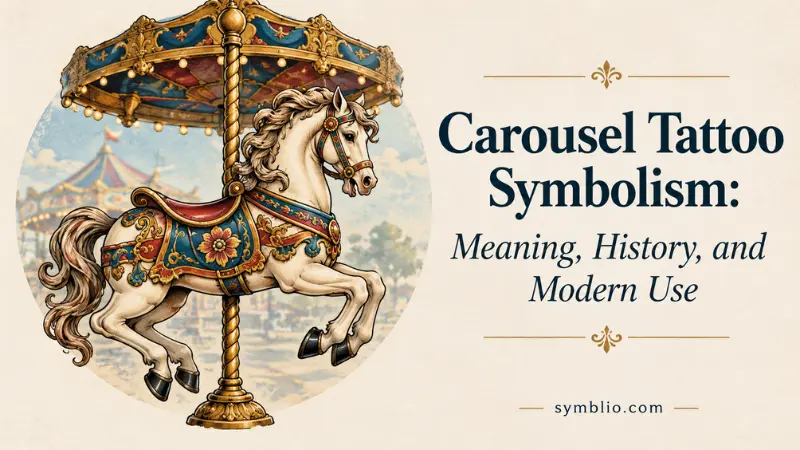
The classic carousel tattoo features a carved horse suspended beneath an ornate canopy. However, modern tattoo designs can depict much more than the traditional horse.
A tattoo might show an entire merry-go-round, a single carousel horse, a rotating platform, decorative poles, carnival lights, mirrors, ribbons, stars, or an old-fashioned fairground setting. Some designs emphasize realistic wood carving, while others use traditional tattoo lines, illustrative shading, watercolor effects, or darker gothic imagery.
The horse itself is often the visual centerpiece. Its raised legs can create a sense of motion, while carved decorations and flowing mane details make the animal appear energetic even though it is permanently attached to a circular ride.
That combination of movement and stillness gives carousel imagery an unusual quality: a tattoo can depict something that is constantly moving while remaining physically fixed in place.
What Does a Carousel Symbolize?
There is no universal symbolic dictionary for carousel imagery. Its meaning depends heavily on the wearer’s memories, the accompanying objects, and the artistic style.
The most common interpretations include:
- Childhood: A reminder of early experiences and youthful imagination.
- Nostalgia: Connection to a particular place, person, or period in life.
- Joy: Association with amusement parks, celebrations, music, and play.
- Life’s cycles: The circular ride can represent repetition and recurring experiences.
- Change: The rider continually moves even though the carousel returns to the same point.
- Movement: A representation of travel, progress, or continuing forward.
- Memory: A permanent image of something that might otherwise fade with time.
- Individuality: A particular horse or custom design can represent personal identity.
These meanings do not all apply to every tattoo. Someone may choose a carousel simply because it reminds them of a favorite childhood amusement park, while another person may intentionally use the circular motion as a metaphor for recurring stages of life.
Why Carousels Became Important in American Culture
Although carousel-like rotating devices existed in several parts of the world before the modern amusement-park ride, the form Americans recognize today developed through European traditions and later became closely associated with American fairs and amusement parks. The Smithsonian notes that rotating devices were used across several regions centuries ago, while European carousel makers eventually developed mechanisms and carved figures resembling modern merry-go-rounds.
The tradition reached the United States in the 19th century. German carousel maker Gustav A. Dentzel is credited with importing the first known carousel to the United States after arriving in America in 1864. Carousels subsequently became common attractions at American fairs and amusement parks.
This history matters to tattoo symbolism because the carousel eventually became more than a mechanical ride. Its carved animals, decorative panels, paintings, and elaborate architecture became recognizable forms of American folk and amusement art.
By the late 19th and early 20th centuries, the carousel had become an established part of American leisure culture. The Smithsonian American Art Museum notes that mechanical merry-go-rounds became especially popular from the late 1800s into the early 20th century.
The Carousel Horse as a Symbol of Freedom and Movement
The horse is one of the strongest individual elements in a carousel tattoo.
Horses already carry established associations with speed, travel, strength, independence, and movement. Putting a horse on a carousel changes those associations. Instead of traveling across an open landscape, the animal repeatedly follows the same circular path.
That contrast can make the design particularly meaningful.
A carousel horse may symbolize the desire to move forward while recognizing that life sometimes returns people to familiar situations. It can also represent the tension between freedom and structure: the horse appears to gallop freely, but its movement is controlled by the ride.
For some tattoo wearers, that contradiction is precisely the appeal.
A jumping horse can emphasize energy and optimism. A stationary horse may create a quieter, more nostalgic feeling. A weathered or damaged-looking horse can suggest age, memory, or the passage of time without necessarily carrying a negative message.
Circular Motion and the Cycles of Life
The carousel’s circular movement gives it a natural connection to cycles.
People often experience life through recurring patterns: childhood, adulthood, relationships, work, family responsibilities, celebrations, and periods of change. A carousel can represent the idea that certain experiences return in different forms.
However, the symbol does not have to mean that someone is trapped.
The carousel completes one rotation and begins another, but the rider’s experience can still change. A person may return to a familiar place with a completely different perspective.
That makes the carousel useful as a symbol of growth within repetition.
A tattoo featuring multiple horses moving around a circle can emphasize this idea. A single horse moving upward can instead place greater emphasis on momentum, aspiration, or personal progress.
Nostalgia, Childhood, and Personal Memory
For many people, this is the most straightforward interpretation.
A carousel can immediately bring back memories of childhood rides, amusement parks, family vacations, local fairs, or a particular person who shared those experiences.
That makes carousel tattoos particularly suitable as memory-based designs.
Someone might choose a carousel horse because it reminds them of a grandparent who took them to an amusement park. Another person may associate the image with a hometown fair or a childhood tradition that no longer exists.
In these cases, the tattoo does not need a complicated symbolic explanation. It can function as a visual memory.
The Smithsonian’s discussion of carousel animals similarly emphasizes the strong connection between carousels and childhood memories, while also documenting how these objects became part of American museum and folk-art collections.
What Carousel Tattoos Can Mean in the United States
In the United States, carousel imagery has a particularly strong connection with amusement parks, county fairs, boardwalks, family entertainment, and nostalgic Americana.
| Context | Common U.S. Meaning | Common Associations | Notes |
|---|---|---|---|
| Childhood memory | Innocence and happy memories | Family, fairs, amusement parks | Often highly personal |
| Carousel horse | Movement and individuality | Freedom, strength, travel | Horse design changes the emphasis |
| Full merry-go-round | Life’s cycles | Time, repetition, change | Circular structure is important |
| Vintage carousel | Nostalgia and history | Americana, old fairs, craftsmanship | Often paired with aged details |
| Dark carousel | Complexity or lost innocence | Change, memory, melancholy | Meaning depends strongly on artwork |
American carousel history also includes stories that go beyond childhood entertainment. For example, the Smithsonian documents the history of the carousel that operates on the National Mall and notes that the ride came from Baltimore’s Gwynn Oak Amusement Park, a formerly segregated park that became integrated in 1963.
That history illustrates why carousel imagery can carry broader cultural associations. A seemingly simple amusement ride can also be connected to American community life, social history, craftsmanship, and changing ideas about public recreation.
Vintage Carousel Tattoos and the Passage of Time
An antique-looking carousel tattoo can place more emphasis on time than a bright modern design.
Weathered paint, cracked wood, faded lettering, old-fashioned lights, and ornamental carving can suggest memories from another era. These elements may communicate affection for the past without suggesting that the wearer literally wants to return to it.
This distinction is important.
Nostalgia is not necessarily rejection of the present. A person can value a childhood memory while fully recognizing that life has changed.
A vintage carousel can therefore symbolize remembering without returning.
That interpretation works particularly well when the tattoo is associated with a childhood home, a family tradition, or an important period that has ended.
Color Choices and Their Symbolic Effect
Color can substantially change the emotional tone of a carousel tattoo.
Bright reds, blues, yellows, pinks, and other saturated colors can make the design feel playful and connected to traditional amusement-park aesthetics. These colors often reinforce childhood, celebration, energy, and fun.
Muted colors can create a more sentimental appearance. Sepia, faded reds, soft browns, and restrained shading can make the carousel resemble an old photograph or antique object.
Black-and-gray designs tend to emphasize structure, carving, shadows, and form. They can appear more mature or reflective without automatically carrying a darker meaning.
The important point is that color does not have one universal symbolic code. The combination of color, composition, subject, and personal story determines the overall impression.
Carousel Tattoos and Emotional Memory
Carousel imagery can communicate several emotions at once.
Joy comes naturally from its connection with rides, music, celebrations, and childhood.
Nostalgia emerges when the carousel represents something remembered rather than something currently experienced.
Melancholy can appear when the design emphasizes time passing, an empty amusement park, an aging horse, or a fading color palette.
Hope can come from upward movement, bright colors, or a horse depicted as if it is continually beginning another ride.
Resilience can be suggested by an old or weathered carousel that continues to stand despite age.
These interpretations are not clinical psychological meanings. They are visual and cultural associations that people may attach to the imagery.
Why People Choose Carousel Tattoos for Personal Milestones
A carousel can work particularly well as a marker of transition.
Graduation, moving away from home, entering adulthood, completing a major chapter, or remembering a loved one can all inspire symbolic tattoo designs. The carousel’s relationship with movement and repetition gives it a useful visual language for these moments.
For example, a person might use a carousel horse to represent leaving childhood behind while keeping the memories associated with it.
Another design might incorporate a date, initials, flowers, stars, or a meaningful location. In such cases, the carousel becomes the framework for a more personal story rather than the entire message.
This is one reason there is no single “correct” meaning for the tattoo.
Carousel Imagery in Folk Art and American Design
Carousel animals are also important examples of decorative craftsmanship.
American carousel makers produced elaborate horses and other animals, often decorated with detailed carving, paint, jewels, mirrors, and ornamental elements. Some carousels included animals beyond horses, including elephants, birds, sea creatures, and other figures.
The variety matters for tattoo design.
A carousel tattoo does not have to feature a horse. A sea creature, bird, elephant, or other carousel animal can preserve the basic carousel association while giving the tattoo a more individualized identity.
Some American carousels also incorporated regional themes. The Smithsonian’s Empire State Carousel, for example, uses animals and decorative imagery connected with New York State’s history and culture.
This tradition of customization translates naturally into tattoo art.
Religious and Cross-Cultural Interpretations
Carousel tattoos do not have one established religious meaning.
The basic carousel developed from older riding and training traditions associated with Europe and the Middle East, but its modern decorative form became especially connected with entertainment culture rather than a single religion.
The circular form may remind some people of broader cultural ideas involving cycles, seasons, renewal, or repetition, but those associations should not automatically be presented as ancient religious meanings of the carousel itself.
That distinction is important. A modern tattoo can borrow an idea such as life’s cycles without claiming that the carousel historically represented that concept in a specific religious tradition.
Common Carousel Tattoo Designs and Their Meanings
Different compositions can communicate noticeably different ideas.
Single carousel horse: Often works as a personal symbol of childhood, movement, freedom, or memory.
Full carousel: Places greater emphasis on cycles, community, celebration, and the passage of time.
Carousel with a child: Usually strengthens the connection with childhood and family memories.
Vintage carousel: Often emphasizes nostalgia, history, and changing times.
Dark or abandoned carousel: Can suggest lost innocence, memory, uncertainty, or the end of an era.
Carousel with flowers: Flowers can add themes of remembrance, growth, affection, or renewal to the design.
A carousel with a clock: This combination can emphasize time, aging, and the temporary nature of different life stages.
Adding a name or date to a carousel horse: Personal details can turn the tattoo into a meaningful memorial or milestone design.
The surrounding imagery is often more important than the carousel alone when determining the tattoo’s intended message.
Common Misunderstandings About Carousel Tattoos
One common mistake is assuming that every carousel tattoo means someone is stuck in a repetitive life.
The circular structure can suggest repetition, but it can just as easily represent continuity, tradition, returning to cherished memories, or moving through different stages of life.
Another misconception is that carousel tattoos are automatically childish.
The imagery has a childhood association, but tattoo artists can use realistic carving, architectural detail, black-and-gray shading, or sophisticated composition to create an adult and highly personal design.
A darker carousel is also not automatically a symbol of sadness. Dark colors and dramatic styling may simply reflect the wearer’s preferred tattoo aesthetic.
Finally, there is no universal rule that a carousel horse must represent freedom. Because the animal is physically attached to the ride, some designs intentionally explore the tension between movement and limitation.
How Carousel Tattoo Meaning Has Evolved
The carousel’s symbolic life has changed along with the object itself.
Early rotating rides were connected with horsemanship and training. Later developments turned them into forms of entertainment, particularly at fairs and amusement parks. By the late 19th and early 20th centuries, American carousel makers had developed an elaborate decorative tradition that made individual animals recognizable works of folk art.
Today, the carousel exists simultaneously as a ride, a nostalgic object, an example of craftsmanship, and a visual shorthand for childhood.
That evolution gives tattoo artists considerable freedom.
A traditional design can emphasize Americana. A minimalist horse can focus on memory. A weathered carousel can explore time. A brightly colored design can celebrate childhood. A custom animal can represent individuality.
The symbol has become flexible because people now encounter it through personal memories as much as through the amusement-park experience itself.
FAQs
A carousel tattoo commonly represents childhood memories, nostalgia, joy, and the passage of time. Depending on the design, it can also symbolize life’s cycles, movement, change, or a meaningful personal memory.
A carousel horse can symbolize movement, independence, childhood, or a connection to a particular memory. Because the horse moves repeatedly along a fixed path, some people also use it to represent the relationship between freedom and life’s recurring patterns.
Often, yes, particularly in the United States where carousels are strongly associated with amusement parks, fairs, and family entertainment. However, the tattoo can represent more than childhood, including nostalgia, personal growth, or remembering an important period of life.
A dark carousel design may represent lost innocence, nostalgia, uncertainty, aging, or complicated memories. It does not automatically have a negative meaning; the surrounding imagery and the wearer’s personal story determine the interpretation.
Yes. The carousel’s circular movement naturally lends itself to ideas about repetition, aging, and recurring stages of life. Adding imagery such as a clock, dates, faded paint, or an older carousel can make the time-related theme more apparent.
There is no universally established religious meaning for carousel tattoos. Although carousel history includes older riding traditions from several regions, the modern carousel is primarily associated with entertainment, craftsmanship, childhood memories, and American amusement culture.
Carousels are strongly connected with childhood rides, family outings, fairs, and amusement parks, so they can trigger memories of earlier periods of life. A tattoo makes that memory permanent and can represent appreciation for the past without suggesting that the wearer wants to return to it.
Conclusion
A carousel can represent much more than a children’s amusement ride. Its horses, circular movement, elaborate craftsmanship, and connection with American fairs give it a visual vocabulary for childhood, nostalgia, movement, memory, change, and life’s recurring patterns.
The meaning ultimately depends on the story behind the design. A brightly colored horse may celebrate a happy childhood memory, while an antique carousel may reflect the passage of time or a connection to an earlier generation. A customized design can turn those broad associations into something specific to one person’s experience.
Carousel tattoo symbolism works because the image combines movement with permanence: the ride keeps going around, while the tattoo preserves one chosen moment. That balance allows a familiar piece of Americana to become a highly personal reminder of where someone has been and how far they have traveled.