
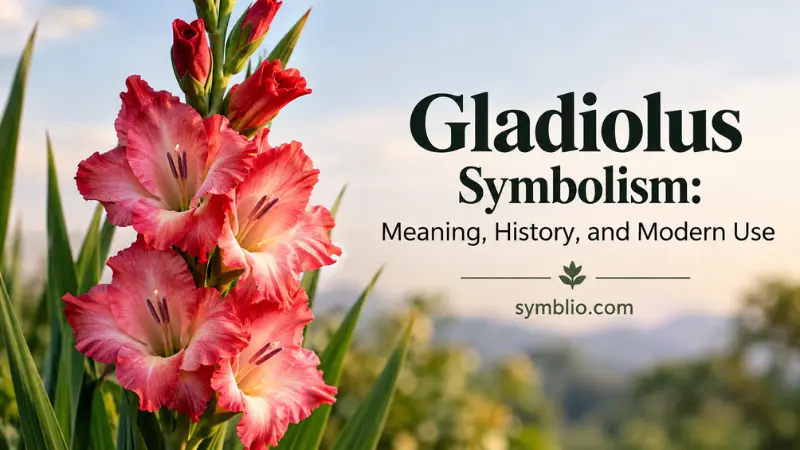
Gladiolus symbolism is closely associated with strength of character, integrity, remembrance, and sincere affection. The tall flower is easy to recognize because its blossoms rise along an upright stem, while its narrow leaves resemble blades. That physical form helped shape the flower’s name and several of its long-standing associations.
In the United States, gladiolus is especially familiar as an August birth flower, a garden plant, and a dramatic cut flower used in bouquets and arrangements. Its meanings can shift depending on the setting: a birthday bouquet may emphasize strength and admiration, while a memorial arrangement may emphasize remembrance and respect.
The flower also has an unusual history because its symbolism developed from more than one tradition. Its Latin name connects it to the image of a sword, while Victorian flower language added romantic meanings. Modern American flower culture has combined these older associations into a broader symbol of character, affection, honor, and memory.
Quick Answer
Gladiolus symbolism commonly represents strength of character, integrity, remembrance, and sincere affection in modern American culture, especially in birthday flowers, memorial arrangements, and meaningful gifts. Historically, its sword-like leaves inspired associations with strength and honor, while Victorian flower language connected the bloom with infatuation and love.
TL;DR
- Gladiolus commonly symbolizes strength, integrity, honor, and remembrance.
- Its Latin name refers to a small sword.
- The flower is strongly associated with August birthdays in the United States.
- Victorian flower language added meanings involving love and infatuation.
- Color can change the message of a gladiolus arrangement.
- Today, gladiolus appears in gardens, bouquets, weddings, and memorials.
What the Gladiolus Looks Like and Why Its Shape Matters
Gladiolus is a flowering plant in the Iridaceae family, which also includes iris, crocus, and freesia. It grows from a corm and produces an upright flower spike lined with blooms.
The leaves are long, narrow, and pointed. This shape explains the plant’s name: Gladiolus comes from the Latin gladius, meaning “sword.” The name can therefore be understood as referring to a little sword.
That physical resemblance matters because floral symbolism often develops from visible characteristics. A flower that rises vertically with blade-shaped foliage naturally lends itself to ideas such as determination, firmness, and strength.
The gladiolus is also commonly called the sword lily, although botanically it belongs to the iris family rather than the true lily family.
What Gladiolus Commonly Symbolizes Today
Several meanings consistently appear in modern flower traditions:
- Strength of character
- Integrity
- Sincerity
- Honor
- Remembrance
- Affection
- Perseverance
Strength of character is one of the most recognizable interpretations. Unlike symbolism based entirely on physical beauty, this meaning draws attention to personal qualities such as honesty, steadiness, and moral conviction.
Remembrance gives the flower another important role. Gladiolus can express respect for someone who has died or mark an occasion that deserves lasting memory.
The romantic meaning is somewhat different. In Victorian flower language, the pointed form inspired the idea that the flower could “pierce” the heart, producing associations with infatuation and strong romantic feeling.
These meanings do not need to compete. A bouquet can communicate admiration, affection, respect, or remembrance depending on why it is given.
The Sword Connection Behind Its Name
The sword association is one of the most firmly established parts of gladiolus history.
The Latin gladius means sword, and gladiolus is the diminutive form. The name refers to the plant’s sword-shaped leaves rather than proving that the flower originally carried every modern “warrior” meaning now associated with it.
The same Latin root is connected linguistically with gladiator, which has helped reinforce the flower’s martial imagery in later popular culture.
This distinction is useful because modern descriptions sometimes present every gladiator-related story as established ancient history. The botanical explanation for the name is much more secure: the plant was named for the appearance of its leaves.
Over time, the sword image became an effective metaphor for courage, firmness, and resilience.
Ancient Roots and the Roman Connection
Gladiolus species are native primarily to Africa and the Mediterranean region, with particularly strong botanical diversity in southern Africa. The modern garden gladiolus is the product of extensive horticultural development and hybridization.
Roman associations appear frequently in popular accounts of the flower. Some traditional stories describe gladiators and victorious fighters being connected with gladioli. However, such stories should be treated cautiously rather than presented as unquestioned historical fact.
What is clearer is the linguistic connection between gladiolus, gladius, and gladiator. Later writers and flower traditions built on that connection, helping the flower acquire an image of courage and victory.
The modern gladiolus seen in American gardens is also quite different from many of its wild ancestors. Nineteenth-century European horticulturists developed increasingly large and colorful hybrids from species brought primarily from southern Africa and other regions.
Gladiolus Symbolism in the Victorian Language of Flowers
The Victorian era added another layer to the flower’s story.
During the nineteenth century, floriography, commonly called the language of flowers, became a popular way of assigning messages to plants. Flower dictionaries did not always agree perfectly, so individual meanings should not be treated as a universal code.
Gladiolus was associated with qualities such as strength of character, sincerity, and moral integrity. Its sword-like form also encouraged a romantic interpretation: the flower could suggest that someone’s heart had been pierced by love.
That led to associations with:
- Infatuation
- Love at first sight
- Romantic attraction
- Faithfulness
- Sincere feeling
This combination makes gladiolus unusual. It can suggest firmness and emotional intensity at the same time.
What Gladiolus Means in the United States
In modern American culture, gladiolus is strongly connected with August, when it is commonly listed as one of the month’s birth flowers alongside the poppy.
As a birthday flower, gladiolus can communicate admiration for someone’s character rather than simply affection. Its tall form also makes it visually appropriate for celebratory arrangements where height and presence matter.
Americans may also encounter gladiolus in:
- Home gardens
- Florist arrangements
- Summer weddings
- Birthday bouquets
- Anniversary flowers
- Memorial arrangements
- Community and church decorations
- Seasonal floral displays
The flower’s meaning is therefore highly dependent on context. A colorful birthday bouquet and a subdued memorial arrangement can contain the same flower while communicating very different emotions.
Gladiolus in Mourning and Remembrance
Remembrance is one of the more serious meanings associated with gladiolus.
Its tall, upright form can create a visual impression of dignity, while its traditional associations with character and honor make it appropriate for occasions involving respect.
In American funeral and memorial settings, gladiolus may appear in larger arrangements because its long stems provide height and structure. The flower does not have one exclusive funeral meaning, however. Its presence can reflect personal preference, the deceased person’s favorite flowers, seasonal availability, or the family’s desired color scheme.
That makes it better understood as a flower that can express remembrance, rather than as a flower reserved specifically for mourning.
Color Changes the Message
Gladiolus comes in many colors, and modern flower traditions often assign different emotional associations to each.
| Gladiolus Color | Common American Association | Typical Context |
|---|---|---|
| Red | Love, passion, strong affection | Romantic gifts and anniversaries |
| Pink | Compassion, affection, caring | Birthdays, family gifts, supportive arrangements |
| White | Purity, innocence, respect | Weddings, formal events, remembrance |
| Yellow | Friendship, happiness, cheer | Friendly gifts and celebrations |
| Purple | Grace, admiration, beauty | Gifts, ceremonies, decorative arrangements |
These meanings are customary interpretations rather than universal rules. Color symbolism changes between cultures, generations, and individual flower traditions.
The occasion usually matters more than the color alone. For example, white gladiolus can communicate respect at a memorial but purity or elegance at a wedding.
Gladiolus as an August Birth Flower
Gladiolus is widely recognized in the United States as an August birth flower, alongside the poppy in many modern flower calendars.
The seasonal connection makes practical sense. Gladiolus generally flowers during the warmer months, with blooming periods varying according to climate, planting time, and variety.
As a birthday symbol, it offers a message that differs from flowers chosen purely for romantic reasons. It can represent strength, sincerity, admiration, and perseverance.
That makes gladiolus suitable for celebrating many kinds of relationships, including family members, friends, teachers, and partners.
It is also associated with the 40th wedding anniversary in modern anniversary-flower traditions, adding another connection with endurance and long-term commitment.
Gladiolus in Weddings and Celebrations
Gladiolus can create a strong vertical line in floral arrangements, making it useful when designers want height and structure.
At weddings, white or pastel gladiolus can contribute to an elegant arrangement without relying on the flower’s older martial associations. In other celebrations, brighter colors can create a more energetic appearance.
Its symbolic meanings can also complement major life events. Strength and integrity suit ceremonies focused on commitment, while affection and sincerity fit celebrations involving relationships.
Still, the symbolism does not dictate how a couple or family must use the flower. Modern floral design allows people to choose gladiolus simply because they like its shape and color.
Why Gladiolus Appeals as a Personal Symbol
The flower can work as a personal symbol because its meanings cover both character and emotion.
Someone may choose gladiolus to represent perseverance after a difficult period. Another person may associate it with a loved one who valued gardening. Someone born in August may use it simply because it represents their birth month.
This flexibility is important. Symbolism is rarely a fixed psychological rule. People often attach meaning to objects through memories, relationships, ceremonies, and personal experiences.
Gladiolus in Tattoos, Art, and Personal Style
Gladiolus can also appear in tattoos and other forms of personal artwork.
A gladiolus tattoo may represent:
- Strength after hardship
- Respect for a loved one
- An August birthday
- Family connection
- Remembrance
- Personal growth
- Romantic affection
The flower’s tall shape works well in vertical tattoo compositions, while individual colors can personalize the design.
A remembrance tattoo may use a gladiolus alongside a name, date, initials, or another meaningful image. An August-themed design may pair it with other birth-month imagery.
The symbolism ultimately comes from the person and the story behind the design rather than from a universal tattoo dictionary.
Cross-Cultural and Historical Interpretations
Gladiolus does not carry exactly the same meaning everywhere.
Its botanical history is particularly connected with southern Africa and the Mediterranean, while its modern ornamental forms developed extensively through European horticulture. Victorian Britain then contributed an influential system of flower meanings.
The sword association is especially easy to recognize across Western traditions because it comes directly from the Latin name. Other interpretations developed later and should not automatically be projected backward onto every ancient culture where gladiolus species grew.
This distinction helps avoid a common problem in symbolism writing: assuming that a modern floral meaning existed unchanged for thousands of years.
Common Misunderstandings About Gladiolus Symbolism
One frequent misunderstanding is that the gladiolus has a single universal meaning. In reality, its symbolism includes several strands developed at different times.
Another misconception is that every Roman gladiator story involving gladiolus is historically documented. The linguistic relationship between the flower’s name and the Latin word for sword is clear, but popular stories about gladiators and gladioli are often repeated more confidently than the surviving evidence allows.
It is also misleading to treat color meanings as strict rules. A red gladiolus does not automatically mean romance, and a white gladiolus does not automatically mean innocence. The setting and relationship between giver and recipient matter.
Finally, calling gladiolus exclusively a “warrior flower” leaves out its Victorian romantic meanings and its modern associations with birthdays, remembrance, friendship, and family.
How Gladiolus Symbolism Has Changed Over Time
The meaning of gladiolus has developed through several recognizable stages.
First came the physical image of the sword, reflected in the Latin name. Later traditions connected that image with strength, courage, and honor.
Nineteenth-century flower language introduced more personal and romantic interpretations, including infatuation and sincere affection.
Modern American culture has broadened the flower’s role further. It now functions as an August birth flower, a celebration flower, a memorial flower, an anniversary flower, and a decorative garden plant.
The result is not one replacement meaning but a layered tradition. Strength and remembrance can exist alongside love and admiration without contradiction.
Where Gladiolus Symbolism Fits in Modern Life
Today, gladiolus symbolism is most useful when it helps people express a specific relationship or occasion.
For an August birthday, the flower can highlight identity and celebration. For a memorial, it can communicate respect and remembrance. At an anniversary, it can suggest endurance and commitment. In a garden, its symbolism may be secondary to its visual appeal.
Social media and modern design have also made flower symbolism more personal. People frequently explain why they selected a particular bloom rather than relying on an established flower dictionary.
That shift gives gladiolus a contemporary role: its historical meanings provide a starting point, while individual experience determines what the flower ultimately represents.
FAQs
Gladiolus commonly represents strength of character, integrity, sincerity, honor, and remembrance. It can also carry romantic associations with infatuation and strong affection.
As an August birth flower, gladiolus is commonly connected with strength, sincerity, admiration, and perseverance. The poppy is also widely listed as an August birth flower.
The name gladiolus comes from the Latin gladius, meaning sword, because the plant has long, blade-like leaves. This physical resemblance helped create later associations with strength and honor.
A gladiolus tattoo can represent strength, remembrance, family, an August birthday, or personal perseverance. Its meaning depends largely on the person’s story and the other elements included in the design.
Traditional flower guides often associate red with love, pink with compassion, white with purity or respect, yellow with friendship, and purple with grace or beauty. These interpretations are cultural conventions rather than fixed rules.
Yes, remembrance is one of the meanings commonly associated with gladiolus. Its upright appearance and traditional connections with honor and character can make it appropriate for memorial arrangements.
Yes. Victorian flower traditions connected gladiolus with infatuation, love at first sight, and the idea of a heart being pierced by love. Modern arrangements can therefore use gladiolus for both romantic and non-romantic affection.
Conclusion
Gladiolus combines several meanings that developed from its distinctive appearance and changing cultural traditions. Its sword-shaped leaves inspired the name, while later flower language connected it with strength, integrity, sincerity, love, and remembrance.
In the United States, gladiolus symbolism is especially visible through August birthdays, anniversary traditions, gardens, bouquets, weddings, and memorial arrangements. Its message changes with color and occasion, allowing the same flower to express celebration in one setting and remembrance in another.
Rather than having one fixed definition, gladiolus works as a flexible symbol of character, affection, respect, and memory—meanings that continue to make sense in modern floral culture.


